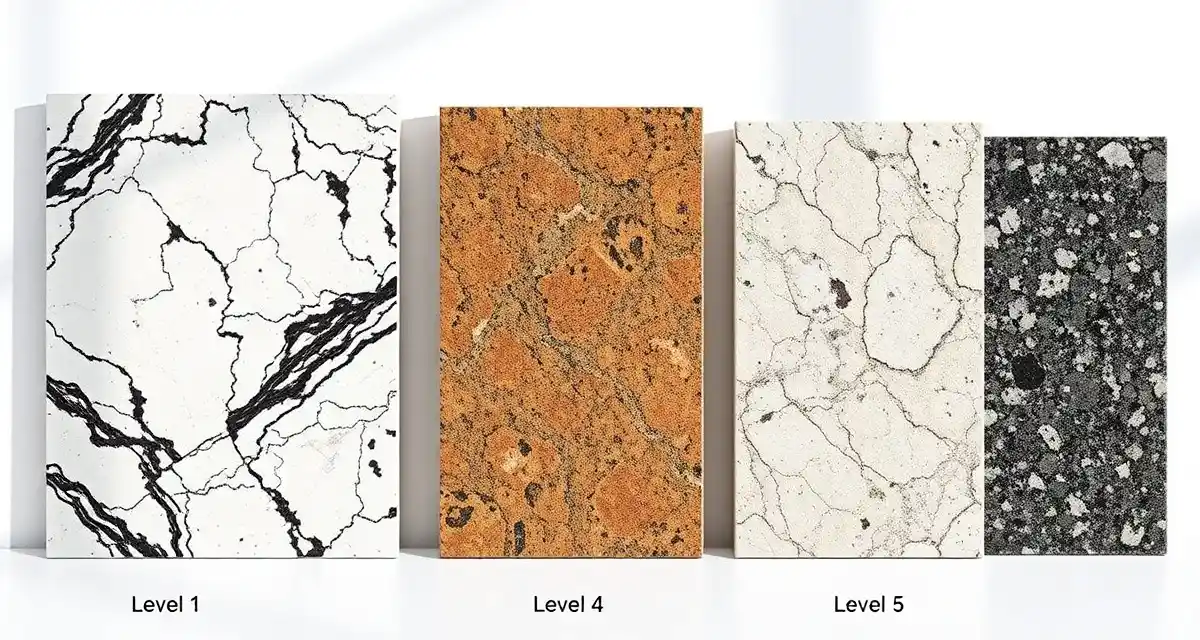
Understanding Granite Levels 1-5
Quick Definition
Granite levels (also called tiers or grades) are a pricing and quality classification system used by fabricators, distributors, and stone yards to categorize slabs. Level 1 is the most affordable ($40-$60/sq ft installed), while Level 5 is the most expensive ($100-$200+/sq ft installed). The level reflects rarity, origin, color complexity, and structural quality - not durability.
TL;DR
- Level 1 granite ($40-$60/sq ft installed) - common colors, mostly from China and India, uniform patterns
- Level 2 ($55-$75/sq ft) - more variation in pattern, slightly rarer colors, broader origin range
- Level 3 ($70-$100/sq ft) - unique veining, exotic colors, often from Brazil or Italy, fewer slabs available
- Level 4 ($90-$150/sq ft) - rare patterns, premium quarries, dramatic movement and color shifts
- Level 5 ($120-$200+/sq ft) - extremely rare, often one-of-a-kind slabs, exotic quartzites often grouped here
- All levels of granite are equally durable - a Level 1 slab lasts just as long as a Level 5 slab
- Leveling systems vary by supplier - one dealer's Level 3 might be another's Level 2
Why Granite Has Levels (And Why It's Confusing)
There's no industry-wide governing body that assigns granite levels. The Marble Institute of America (now the Natural Stone Institute) doesn't certify levels. Neither does any government agency. Granite levels are a trade convention - created by distributors and fabricators to organize inventory and simplify pricing.
Calculate your material waste savings
See exactly how much slab material and money you could save with optimized cutting layouts.
Try the free Waste CalculatorThis means the same slab sitting in two different yards might be classified differently. A Baltic Brown granite might be Level 2 at one distributor and Level 3 at another. The slab didn't change - the pricing structure did.
That said, the system isn't arbitrary. Certain factors consistently push a slab up or down the level scale:
- Rarity - how many slabs are available at any given time
- Origin - quarry location and extraction costs
- Color - unusual or in-demand colors cost more
- Pattern complexity - dramatic veining vs. uniform speckling
- Structural quality - fewer fissures, pits, and weak spots
- Slab size - larger usable area per slab = higher value
- Supply chain - transportation costs from remote quarries
Level-by-Level Breakdown
Level 1: Entry-Level Granite
| Attribute | Details |
|---|---|
| Price range | $40-$60/sq ft installed |
| Slab thickness | Usually 2cm (3/4") |
| Common origins | China, India |
| Pattern style | Uniform speckle, minimal movement |
| Colors | Blacks, tans, whites - basic palette |
| Availability | Very high - always in stock |
Popular Level 1 granites:
- Uba Tuba (dark green-black)
- Caledonia (gray with black flecks)
- Luna Pearl (gray-white speckle)
- New Venetian Gold (gold-tan)
- Santa Cecilia (gold-brown with burgundy)
Level 1 granite is the workhorse of the fabrication industry. These stones are quarried in massive volumes, cut into standard slab sizes, and shipped worldwide in container loads. The patterns tend to be consistent - what you see in one slab, you'll see in the next.
Who should buy Level 1: Homeowners on a budget, rental property owners, house flippers, anyone who wants real stone without the premium price. Level 1 granite is also the smart choice for secondary spaces like laundry rooms, basement bars, and bathroom vanities.
Level 2: Mid-Range Granite
| Attribute | Details |
|---|---|
| Price range | $55-$75/sq ft installed |
| Slab thickness | 2cm or 3cm |
| Common origins | India, Brazil, China |
| Pattern style | More movement, some veining |
| Colors | Broader palette - blues, greens, deeper reds |
| Availability | High - most colors in stock |
Popular Level 2 granites:
- Giallo Ornamental (cream with brown/gray movement)
- Steel Gray (uniform dark gray)
- Tan Brown (brown with black and gray)
- Kashmir White (white with red garnet specks)
- Black Pearl (black with silver/gold flecks)
Level 2 is where you start seeing character in the stone. The patterns have more variation slab to slab, and color depth increases. Brazilian granites begin appearing at this level, bringing more dramatic movement than the uniform Indian and Chinese stones in Level 1.
Who should buy Level 2: Homeowners doing a mid-range kitchen renovation ($15,000-$30,000 budget), anyone who wants some visual interest without paying exotic prices.
Level 3: Premium Granite
| Attribute | Details |
|---|---|
| Price range | $70-$100/sq ft installed |
| Slab thickness | Almost always 3cm |
| Common origins | Brazil, Italy, Norway, Finland |
| Pattern style | Dramatic veining, bold movement |
| Colors | Exotic blues, deep reds, complex multi-color |
| Availability | Moderate - specific slabs sell out |
Popular Level 3 granites:
- Blue Pearl (Norwegian blue-gray with iridescent flecks)
- Typhoon Bordeaux (cream/red/brown watercolor movement)
- Alaska White (white with gray veining)
- Colonial Gold (gold with dark brown movement)
- Volga Blue (dark blue from Ukraine - supply volatile)
Level 3 is where you start needing to pick your specific slab. Unlike Level 1 and 2, where any slab of the same name looks essentially identical, Level 3 granites vary slab to slab. Two pieces of Typhoon Bordeaux from the same quarry can look quite different.
Who should buy Level 3: Homeowners who view countertops as a design focal point, anyone willing to visit the slab yard and choose their specific stones, kitchen renovations in the $30,000-$50,000 range.
Level 4: Exotic Granite
| Attribute | Details |
|---|---|
| Price range | $90-$150/sq ft installed |
| Slab thickness | 3cm |
| Common origins | Brazil, Madagascar, Namibia, Norway |
| Pattern style | One-of-a-kind, dramatic, photogenic |
| Colors | Vivid blues, emerald greens, deep burgundy |
| Availability | Limited - when it's gone, it's gone |
Popular Level 4 granites:
- Marinace (river stone conglomerate - each slab looks like a cross-section of a riverbed)
- Cosmic Black (black with gold lightning-bolt veining)
- Juparana Bordeaux (complex red/cream/brown swirls)
- Azul Bahia (electric blue from Brazil)
- Van Gogh (multi-color swirl from Brazil)
Level 4 slabs are sold individually, not by color name. You're buying that specific slab. If you don't secure it with a deposit, someone else will. Many of these stones come from small quarries with limited output - once a pocket of stone is exhausted, that exact pattern may never be available again.
Who should buy Level 4: Homeowners building custom kitchens, design-driven renovations, anyone who wants their countertop to be the room's centerpiece. Budget: $50,000+ kitchen.
Level 5: Ultra-Exotic
| Attribute | Details |
|---|---|
| Price range | $120-$200+/sq ft installed |
| Slab thickness | 3cm (sometimes bookmatched pairs) |
| Common origins | Brazil, Italy, Madagascar |
| Pattern style | Museum-quality, one-of-a-kind |
| Colors | Any imaginable - some look like paintings |
| Availability | Extremely limited |
Popular Level 5 stones:
- Blue Bahia (vibrant blue - prices fluctuate wildly)
- Patagonia (quartzite with gold, cream, and burgundy)
- Taj Mahal (quartzite - soft gold with subtle veining)
- Calacatta Macchia Vecchia (marble, often grouped with granite at this tier)
- Sodalite Blue (deep blue with white veining)
Note: At Level 5, the lines between granite, quartzite, and exotic marble blur. Distributors often group all premium natural stones into this tier regardless of geological classification. A $180/sq ft "granite" might technically be a quartzite or dolomite.
Who should buy Level 5: Luxury homebuilders, high-end remodelers, commercial projects (hotel lobbies, restaurant bars) where the stone is the architecture.
Price Comparison Table
| Level | Material Cost/sq ft | Fabrication/sq ft | Installation/sq ft | Total Installed/sq ft |
|---|---|---|---|---|
| 1 | $15-$25 | $12-$18 | $10-$15 | $40-$60 |
| 2 | $25-$35 | $15-$20 | $12-$18 | $55-$75 |
| 3 | $35-$55 | $18-$25 | $15-$20 | $70-$100 |
| 4 | $50-$85 | $20-$30 | $18-$25 | $90-$150 |
| 5 | $70-$130+ | $25-$35 | $20-$30 | $120-$200+ |
Fabrication costs increase with level partly because exotic stones require more careful handling, cutting, and polishing. A $150/sq ft slab that cracks during fabrication is a $5,000+ loss - fabricators charge accordingly.
What Level Doesn't Tell You
Durability Is Not Tied to Level
A Level 1 Uba Tuba granite is just as hard, scratch-resistant, and heat-tolerant as a Level 5 Blue Bahia. Both score 6-7 on the Mohs hardness scale. Both resist heat up to 1,200°F. Both need periodic sealing (every 1-3 years).
The level system measures aesthetics and rarity, not performance. Don't let anyone tell you that Level 1 granite "won't last as long." That's a sales tactic, not a fact.
Thickness Matters More Than Level
A 3cm (1-1/4") slab of Level 1 granite is structurally stronger than a 2cm (3/4") slab of Level 4. Thickness affects:
- Overhang capacity (3cm can overhang 8-10" without brackets; 2cm needs support at 6")
- Undermount sink compatibility (3cm preferred)
- Overall feel and presence in the kitchen
Many Level 1 slabs come in 2cm only. If your project needs 3cm, you may be shopping at Level 2+ by default.
Color Popularity Shifts
Today's Level 3 color can become tomorrow's Level 2 if demand drops or a new quarry opens up. White granite was once exotic; now it's widely available at Level 1-2 prices. Market dynamics constantly reshuffle the tier system.
Tips for Shopping by Level
-
Always visit the slab yard for Level 3+ - photos don't capture the depth, movement, or mineral reflections in exotic granite. What looks brown on screen might shimmer gold in person.
-
Ask about remnants - fabricators often have Level 3-4 remnants (leftover pieces from large jobs) available at Level 1-2 prices. Perfect for bathroom vanities and small projects.
-
Compare pricing across 3+ suppliers - the same slab name can vary $15-$30/sq ft between distributors. Fabrication markup differs too.
-
Hold your slab with a deposit - Level 3+ slabs sell individually. If you need time between selection and fabrication, put down $200-$500 to reserve your specific slab.
-
Check slab size vs. your layout - a slightly smaller Level 4 slab might result in more seams than a larger Level 3 slab of similar appearance. Fewer seams usually looks better.
How Fabricators Price by Level
Most fabrication shops have tiered pricing lists that group granite by level. A typical shop might quote:
- Group A (Level 1): $42/sq ft installed
- Group B (Level 2): $58/sq ft installed
- Group C (Level 3): $78/sq ft installed
- Group D (Level 4-5): Call for pricing
The "call for pricing" note on exotic stones exists because slab cost fluctuates. A shop can lock in pricing for commodity granites (Level 1-2) but needs to check current slab prices for exotics before quoting.
For fabricators, accurate quoting across different granite levels is where pricing errors happen. A wrong level assignment on a quote can turn a profitable job into a loss. SlabWise's Quick Quote feature pulls from current slab pricing data, generating accurate quotes in about 3 minutes - helping shops avoid the $500-$2,000 quoting errors that come from manual pricing lookups.
FAQ
Is Level 1 granite bad quality?
No. Level 1 granite is just as durable and functional as any other level. It's common, uniformly patterned, and affordable - but structurally identical to premium granite. Many Level 1 stones (like Uba Tuba and Caledonia) are excellent choices.
What's the most popular granite level for kitchens?
Level 2 is the highest-volume category for residential kitchens. It offers enough pattern interest to look custom without the $80+/sq ft price tag of exotic stones. Level 1 dominates the rental and flip market.
Do granite levels affect resale value?
Somewhat. Real estate appraisers note "granite countertops" without distinguishing levels. However, buyers can visually tell the difference between a basic speckled granite and a dramatic veined one. For resale purposes, Level 2-3 offers the best return on investment.
Can you see the difference between levels?
Usually, yes. Level 1 tends to look uniform and speckled. Level 3+ shows dramatic veining, color shifts, and mineral crystal reflections. The difference is most obvious when you see slabs side by side in a stone yard.
Why do different suppliers classify the same granite at different levels?
Because there's no universal standard. Each distributor sets their own tier system based on their cost, demand, and inventory. Blue Pearl might be Level 2 at a supplier who stocks 50 slabs and Level 3 at one who stocks 5.
Is Level 3 granite worth the extra cost?
For a kitchen you'll use for 15+ years, the $20-$40/sq ft premium for Level 3 often amounts to $1,000-$2,000 extra on a typical job. Many homeowners who initially choose Level 2 upgrade after seeing Level 3 slabs in person.
Does granite level affect maintenance?
Not significantly. All granite levels need periodic sealing (every 1-3 years). Lighter colors (any level) show stains more readily than darker ones. Black granites (often Level 1-2) are the lowest maintenance.
What's the difference between Level 5 granite and quartzite?
At the Level 5 tier, the distinction often blurs. Many "Level 5 granites" are actually quartzites or other exotic natural stones. The level system is a pricing framework, not a geological classification. Ask your fabricator for the exact stone type.
How do I know what level granite I'm getting?
Ask the distributor or fabricator directly. Request the stone name, origin, and price tier. Then check 2-3 other suppliers for the same stone to verify the pricing. If one supplier calls it Level 3 and two others call it Level 2, you may be overpaying.
Are there Level 6 or 7 granites?
Some suppliers use more granular systems (6-8 levels), but most of the industry works with 3-5 tiers. More tiers just means smaller price jumps between levels. The top tier, whatever the number, covers the same ultra-exotic stones.
Price Your Granite Jobs Accurately
Granite level determines material cost, and material cost drives your quote. Getting the level wrong means quoting too high (losing the job) or too low (losing money). SlabWise's Quick Quote system ties directly to current slab pricing, so your estimates reflect actual material costs - not last month's price sheet.
Try SlabWise free for 14 days - accurate quotes mean better margins on every granite job.
Try These Free Tools
- Cost Calculator -- Get instant countertop cost estimates by material, edge profile, and square footage.
- Compare Materials -- Side-by-side material comparison with pricing, durability, and maintenance ratings.
- Edge Profile Selector -- Browse edge profiles with cost impact and visual previews.
Sources & Further Reading
-
Natural Stone Institute - Digital Tools and Technology in Stone Fabrication
-
International Surface Fabricators Association - Quoting Best Practices and Technology
-
National Kitchen & Bath Association - Technology Integration in Kitchen Design
-
Remodeling Magazine - Digital Transformation in Countertop Industry