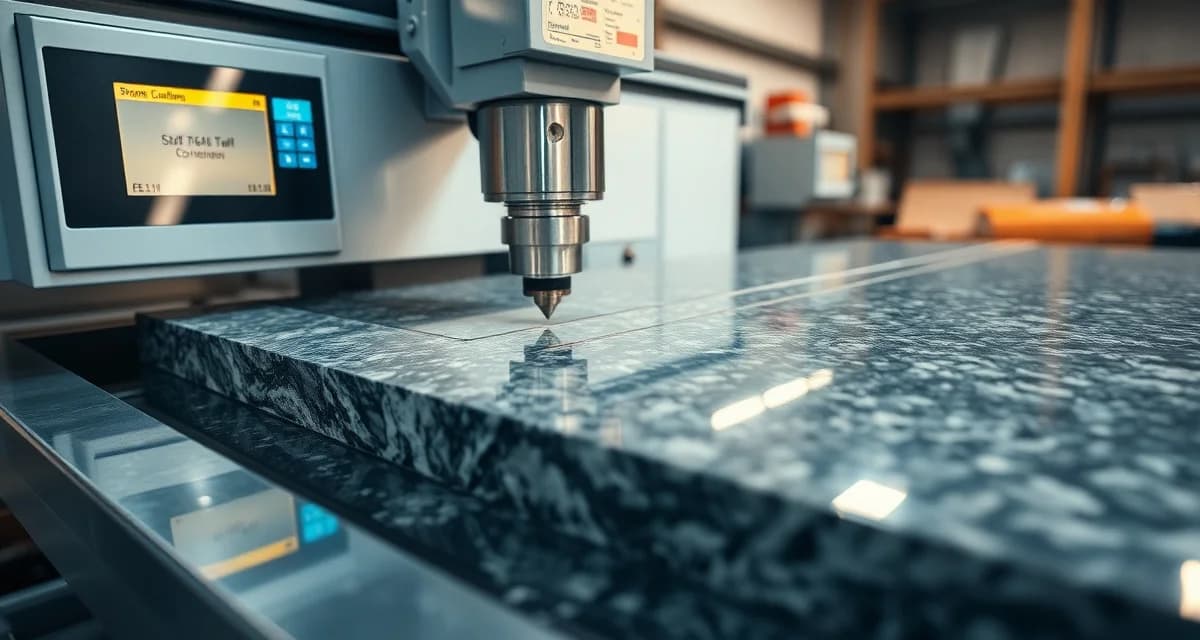
How Does CNC Stone Cutting Work? A Guide for Homeowners and Fabricators
Quick Definition
CNC (Computer Numerical Control) stone cutting uses computer-controlled machines to cut, shape, and polish natural and engineered stone countertops. A digital template file tells the machine exactly where to cut, what edge profiles to create, and where to place sink and cooktop cutouts. CNC cutting is accurate to within 1/32 inch, produces consistent results, and has largely replaced hand cutting in modern fabrication shops.
TL;DR
- CNC stands for Computer Numerical Control - a computer guides the cutting tool path
- Accuracy: 1/32 inch or better - far more precise than hand cutting
- Two main machine types: Bridge saws (straight cuts) and CNC routers (curves, cutouts, edges)
- Diamond tooling is used for all stone cutting - the diamonds do the actual grinding
- Water is essential - wet cutting controls crystalline silica dust (a serious health hazard)
- A typical kitchen set takes 2-4 hours of CNC time from slab to finished pieces
- Machine cost: $80,000-$500,000+ depending on capabilities and automation level
- CNC has reduced fabrication errors by 40-60% compared to hand cutting
The Basics: What CNC Means
CNC is a manufacturing method where pre-programmed computer software controls the movement of cutting tools. In stone fabrication, the computer controls:
Calculate your material waste savings
See exactly how much slab material and money you could save with optimized cutting layouts.
Try the free Waste Calculator- X-axis: Left-right position of the cutting head
- Y-axis: Front-back position of the cutting head
- Z-axis: Up-down depth of the cutting tool
- Spindle rotation: Speed of the cutting blade or profiling wheel
- Water flow: Coolant delivery to the cutting zone
The operator loads a digital file (DXF format, typically from a laser template), selects the tooling, and starts the program. The machine executes the cuts automatically while the operator monitors for problems.
Types of CNC Stone Cutting Machines
Bridge Saw
The most common machine in a fabrication shop. A bridge saw has a diamond blade mounted on a bridge that traverses the length of the slab.
What it does:
- Straight cuts (rip cuts, crosscuts)
- Miter cuts (45-degree angled cuts for mitered edges)
- Some basic curved cuts on advanced models
- Sink cutout roughing
Specifications:
- Blade diameter: 14-20 inches
- Cutting speed: 6-24 inches per minute (varies by material and blade)
- Accuracy: 1/32 inch
- Water usage: 3-5 gallons per minute during cutting
Cost: $40,000-$200,000 depending on automation level
CNC Router (Machining Center)
A more versatile machine that handles complex operations the bridge saw can't.
What it does:
- Sink and cooktop cutouts (precise curves)
- Edge profiling (bullnose, ogee, dupont, etc.)
- Surface texturing (leathered, brushed finishes)
- Drilling (faucet holes, soap dispenser holes)
- Engraving (custom details, logos on commercial work)
Specifications:
- Spindle speed: 1,000-24,000 RPM
- Tooling: Diamond router bits, profiling wheels, core drill bits
- Accuracy: 1/64 inch
- Water usage: 2-4 gallons per minute
Cost: $100,000-$500,000+ for a full 5-axis system
Waterjet Cutter
Used for specialty cuts that blades and routers can't handle efficiently.
What it does:
- Intricate inlay patterns
- Tight inside radius cuts
- Artistic and decorative cuts
- Cutting without heat generation (no risk of thermal damage)
Specifications:
- Cuts with a high-pressure water stream (50,000-90,000 PSI) mixed with abrasive garnet
- Accuracy: 0.003-0.005 inches
- Cutting speed: 1-12 inches per minute depending on thickness and material
Cost: $100,000-$300,000
The CNC Fabrication Process: Step by Step
Step 1: Digital Template Import
The laser template file (DXF/DWG format) is imported into the CNC software. The operator verifies:
- Overall dimensions match the work order
- Cutout positions are correct
- Edge profile specifications are assigned
- Seam locations are marked
Step 2: Slab Layout (Nesting)
The operator positions the template shapes on a digital image of the actual slab to:
- Maximize material usage (minimize waste)
- Avoid natural flaws, cracks, or undesirable color zones
- Align veining patterns across seam joints
- Ensure grain direction matches the customer's preference
Good nesting recovers 60-75% of the slab area as usable countertop. The remaining 25-40% becomes waste, remnants, or scrap.
Step 3: Bridge Saw Cutting
The slab is loaded onto the bridge saw table (using an overhead crane - full slabs weigh 800-1,100 lbs). The saw makes primary cuts:
- Separation cuts between individual pieces
- Rough outline cuts for each countertop section
- Miter cuts for mitered edges (if specified)
Time: 30-90 minutes for a typical kitchen slab
Step 4: CNC Router Operations
Cut pieces move to the CNC router for detailed work:
- Sink cutouts: The router follows the template outline to cut the exact sink shape, typically starting with a plunge cut and following a programmed path
- Cooktop cutouts: Same process, larger opening
- Faucet holes: Core drill bits bore precise holes at template-specified locations
- Edge profiling: Profiling wheels grind the edge into the specified shape (bullnose, ogee, etc.) in multiple passes from rough to fine
- Edge polishing: Progressive diamond pads bring the edge to the specified finish (polished, honed, leathered)
Time: 1-3 hours for a typical kitchen set including all cutouts and edge profiling
Step 5: Quality Check
Before the pieces leave the CNC station, the operator checks:
- All dimensions against the original template
- Cutout positions and sizes
- Edge profile consistency
- Surface finish quality
- Any chips, cracks, or defects from machining
Step 6: Finishing
Final hand work may include:
- Blending CNC tool marks on inside corner radii
- Hand-polishing areas the CNC couldn't reach
- Applying edge polish in tight spots
- Final inspection under raking light to check for surface flaws
Why CNC Changed Stone Fabrication
Before CNC (Manual Fabrication)
- Templates were physical (sticks, cardboard)
- Cuts were made by hand with angle grinders and circular saws
- Edge profiles were shaped by hand with pneumatic or electric profilers
- Accuracy depended entirely on the individual fabricator's skill
- Consistency between pieces varied significantly
- A skilled manual fabricator could produce a kitchen set in 6-10 hours
After CNC
- Templates are digital and feed directly to machines
- Cuts are automated and repeatable
- Edge profiles are consistent to within thousandths of an inch
- Less dependence on individual skill for basic operations
- A kitchen set takes 2-4 hours of machine time
- Remake rates dropped 40-60% industry-wide
The Numbers
| Metric | Manual Fabrication | CNC Fabrication |
|---|---|---|
| Kitchen set time | 6-10 hours | 2-4 hours |
| Cut accuracy | 1/8-1/16 inch | 1/32-1/64 inch |
| Edge consistency | Variable | Uniform |
| Remake rate | 8-12% | 3-5% |
| Operator skill needed | Very high | Moderate (machine operation) |
| Equipment cost | $10,000-$30,000 | $100,000-$500,000+ |
Water and Dust Control
Why Wet Cutting Is Mandatory
Cutting, grinding, and polishing stone generates fine dust that contains crystalline silica. Inhaling this dust causes silicosis - a serious, progressive, and incurable lung disease. OSHA regulates silica dust exposure limits at 50 micrograms per cubic meter over an 8-hour shift.
Wet cutting suppresses 90-95% of airborne dust. Water sprays directly onto the cutting point, capturing silica particles before they become airborne.
Water usage: A busy fabrication shop uses 500-2,000 gallons of water per day. This water is recycled through a clarification system that settles out stone particles, allowing the water to be reused.
Dry Cutting Risks
Some small operations dry-cut engineered quartz, which has particularly high silica content (90-94% quartz). This practice has caused a wave of silicosis cases among young fabricators. Multiple countries (Australia, Israel, US states) have enacted stricter regulations specifically addressing engineered stone fabrication dust.
All CNC machines are designed for wet operation. Dry-cutting stone on a CNC machine damages the tooling, reduces accuracy, and creates unacceptable health risks.
FAQ
What does CNC stand for in stone cutting?
CNC stands for Computer Numerical Control. It refers to automated machines that follow pre-programmed instructions to cut, shape, and polish stone countertops with high precision.
How accurate is CNC stone cutting?
CNC bridge saws cut to within 1/32 inch. CNC routers achieve 1/64 inch accuracy. This is far more precise than hand cutting (1/8 to 1/16 inch) and produces better-fitting countertops with tighter seams.
How long does CNC fabrication take for a kitchen?
A typical kitchen countertop set (40 square feet, 2-3 pieces with sink cutout and standard edge) takes 2-4 hours of total CNC time across bridge saw and router operations. Larger or more complex kitchens may take 4-6 hours.
Can CNC machines cut any countertop material?
CNC machines with diamond tooling can cut granite, quartz, marble, quartzite, porcelain slabs, and most other stone and engineered materials. Different materials require different blade speeds, feed rates, and water volumes.
Do all fabricators use CNC machines?
No, but the majority of mid-to-large fabrication shops (processing 10+ kitchens per month) use CNC equipment. Smaller shops may still use manual methods supplemented with basic machinery. CNC adoption in the US countertop industry is estimated at 60-70% of total production volume.
What's the difference between a bridge saw and a CNC router?
A bridge saw makes straight cuts and separates slab pieces. A CNC router handles curves, cutouts, edge profiling, drilling, and detailed shaping. Most fabrication shops use both - the bridge saw for primary cuts and the CNC router for finishing operations.
How much does a CNC stone cutting machine cost?
Bridge saws range from $40,000-$200,000. CNC routers range from $100,000-$500,000+. A fully equipped mid-size fabrication shop has $200,000-$600,000 in CNC machinery.
Is CNC cutting better than hand cutting?
For consistency, accuracy, and speed - yes. CNC produces repeatable results regardless of operator skill level. Hand cutting still has a place for custom artistic work, small repairs, and situations where CNC access isn't available.
What happens to the stone waste from CNC cutting?
Stone waste (offcuts, dust, slurry) is collected and typically sent to landfills or recyclers. Slurry water is processed through settling systems to separate stone particles from reusable water. Some waste stone is crushed for aggregate or landscaping use.
Can CNC machines create any edge profile?
CNC routers with profile wheel libraries can create virtually any standard edge profile (eased, bullnose, ogee, dupont, etc.) and many custom profiles. The profile wheel is the physical tool that shapes the edge - each profile requires a specific wheel or set of wheels.
Feed Your CNC Better Data
Garbage in, garbage out applies to CNC fabrication. SlabWise's Template Verification checks every digital template through a 3-layer validation before it reaches your CNC machine - catching measurement errors, impossible geometries, and specification conflicts before they waste stone. That's $1,500-$4,000 saved per prevented remake.
[Start Your 14-Day Free Trial →]
Try These Free Tools
- Photo to Template -- Snap a photo of an existing countertop and get an AI-generated DXF template.
- Template Compare -- Upload two templates and see every dimension change highlighted instantly.
- AI Template Verification -- Cross-check your template against manufacturer specs before cutting.
Sources & Further Reading
- Natural Stone Institute - Countertop Support Guidelines
- International Surface Fabricators Association - Structural Support Requirements
- National Kitchen & Bath Association - Countertop Installation Standards
- ASTM International - C1526 Standard Specification for Serpentine Dimension Stone