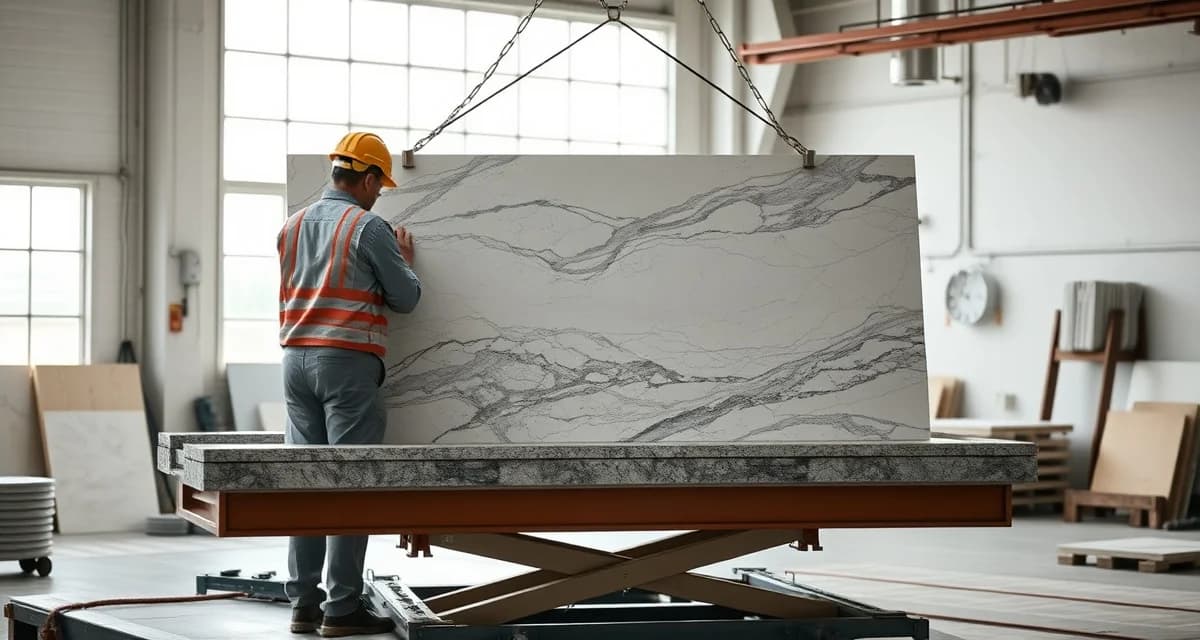
Can Countertops Be Moved?
Quick Answer
Yes, countertops can sometimes be moved and reused, but it depends on the material, how they were installed, and whether the new space has the same dimensions. Granite and quartz slabs have the best chance of surviving a move. Marble is riskier due to its fragility. Laminate and solid surface are rarely worth moving because the cost of removal and refitting often exceeds new material costs.
TL;DR
- Granite and quartz countertops can be removed and relocated if done carefully
- Success rate for moving stone countertops is roughly 50-70%
- Professional removal costs $300-$800; refabrication adds $500-$2,000+
- The biggest risks are cracking during removal and not fitting the new layout
- Seams are the weakest points - pieces often break at seam locations
- Undermount sinks make removal harder because they are epoxied to the stone
- Getting new countertops is often cheaper than moving old ones unless the material is rare or sentimental
When Moving Countertops Makes Sense
There are a few scenarios where reusing existing countertops is worth considering:
Calculate your material waste savings
See exactly how much slab material and money you could save with optimized cutting layouts.
Try the free Waste CalculatorHigh-Value or Rare Material
If you have a $15,000 slab of Calacatta marble or a discontinued quartzite that you love, the material value justifies the risk and expense of moving it. Replacing it with an equivalent could cost the same or more.
Same Kitchen, New Cabinets
If you are replacing cabinets but keeping the same kitchen layout, there is a good chance the existing countertops will fit back on the new bases - assuming the new cabinets are the same dimensions and in the same positions.
Short-Distance Moves
Moving countertops from one kitchen to another in the same house (during a renovation) is easier than transporting them across town. Less handling means less risk.
Rental or Temporary Situations
Some homeowners remove high-end countertops before selling a home and replace them with cheaper alternatives. They then install the saved countertops in their new home.
The Removal Process
Step 1: Disconnect Everything
Before the countertop comes off, you need to:
- Turn off water supply lines
- Disconnect plumbing under the sink
- Disconnect the garbage disposal
- Unhook cooktop gas or electric connections
- Remove the cooktop and sink (if undermount, this is part of the countertop)
Step 2: Break the Adhesive Bond
Countertops are typically adhered to cabinets with silicone caulk, construction adhesive, or both. Removal involves:
- Cutting through the caulk bead along the backsplash and wall
- Using putty knives and pry bars to gently separate the stone from the cabinet base
- Working slowly from one end to the other, applying even pressure
- Having at least 2-4 people for lifting (a 10-foot granite slab weighs 250-400 lbs)
Step 3: Transport
Stone countertops must be transported on edge, never flat. A flat piece resting on two sawhorses in a truck bed will crack from its own weight over bumps. Professional movers use A-frame carts and padded truck interiors.
| Material | Weight per Sq Ft (3 cm) | Risk Level for Moving |
|---|---|---|
| Granite | 18-20 lbs | Moderate |
| Quartz | 15-18 lbs | Moderate |
| Marble | 16-18 lbs | High |
| Quartzite | 18-22 lbs | High |
| Porcelain slab | 8-12 lbs | Very High (brittle) |
Step 4: Refabrication (If Needed)
If the new kitchen layout differs from the old one, the countertop pieces will need to be recut. This means:
- New measurements and templating of the new space
- CNC cutting to modify dimensions
- New edge polishing on any freshly cut sides
- New sink or cooktop cutouts if positions changed
- Re-seaming if pieces need to be joined differently
Refabrication costs $500-$2,000 depending on how much modification is needed.
What Can Go Wrong
Cracking During Removal
The number-one risk. Stone countertops are strong in compression (supporting weight from above) but relatively weak in tension (bending). The most common failure points:
- Seams: Existing seams are held together with colored epoxy. They are the weakest link in any countertop installation and the first place cracks develop during removal.
- Sink cutouts: The narrow strip of stone between the sink cutout and the front edge is a common fracture point.
- Cooktop cutouts: Same issue - large cutouts weaken the structural integrity of the slab.
- L-shaped corners: The inside corner of an L-shaped countertop is a stress concentration point.
Not Fitting the New Space
Kitchen dimensions are rarely identical. Even a half-inch difference in cabinet depth or a slightly different wall angle can mean the old countertop does not fit. Gaps, overhangs, and misalignment are common when trying to reuse countertops in a different kitchen.
Adhesive Damage
Some installers use aggressive construction adhesives that bond more permanently than silicone. Trying to pry up a countertop glued with Liquid Nails or PL Premium can rip chunks out of the cabinet tops or, worse, crack the stone.
Undermount Sink Complications
Undermount sinks are epoxied directly to the underside of the stone and held in place with clips. Removing the countertop means the sink comes with it (extra weight, awkward shape) or the sink has to be cut free, which can damage the stone around the cutout.
Cost Comparison: Move vs. Replace
| Cost Element | Moving Existing | Buying New |
|---|---|---|
| Professional removal | $300-$800 | $0 (included in new install) |
| Transport | $200-$500 | $0 |
| Storage (if needed) | $50-$150/month | $0 |
| Refabrication | $500-$2,000 | $0 |
| Reinstallation | $400-$800 | $400-$800 |
| New material | $0 | $1,500-$6,000+ |
| Total range | $1,450-$4,250 | $1,900-$6,800+ |
| Risk of total loss | 30-50% | ~0% |
The math only works in your favor if:
- The material is expensive ($60+ per square foot)
- The layouts are similar or identical
- The countertop is in good condition
- You hire experienced professionals for removal
Material-by-Material Breakdown
Granite
Granite is the most commonly moved countertop material. It is relatively hard and durable, which gives it the best survival rate during removal. Polished granite can be repolished if it gets scratched during the move.
Success rate: 60-70%
Quartz
Quartz (engineered stone) moves about as well as granite. The resin binder makes it slightly more flexible, which is actually helpful during removal. However, quartz cannot be refinished if the surface is damaged.
Success rate: 60-70%
Marble
Marble is softer and more prone to cracking than granite or quartz. It also chips and scratches more easily during handling. Moving marble is higher risk, and any damage is more visible on the lighter, more uniform surface.
Success rate: 40-55%
Quartzite
Natural quartzite is extremely hard - harder than granite - but it can be brittle. The hardness makes it resistant to surface damage during a move, but the brittleness means it can crack without warning if stressed.
Success rate: 50-65%
Laminate
Not worth moving. Laminate countertops are cheap ($10-$30 per square foot installed), and the particleboard substrate is easily damaged during removal. Just buy new ones.
Success rate: N/A - not economically justifiable
Solid Surface (Corian)
Solid surface can technically be moved and modified because it can be sanded, reshaped, and repaired. However, it is also one of the cheapest stone-alternative options, so the cost of moving often does not make sense.
Success rate: 70-80% (but rarely worth the effort)
Tips for a Successful Countertop Move
- Hire a fabricator, not a general mover: Stone fabrication shops have the equipment, A-frame carts, and experience. General movers do not.
- Get a pre-move assessment: Have the fabricator inspect the existing installation and assess risk before committing.
- Photograph everything: Document the countertops installed, including seam locations, overhangs, and support structure.
- Accept the risk: Even with professionals, there is a 30-50% chance something breaks. Be financially prepared to buy new countertops if it does not work out.
- Do not move pieces with large cutouts if possible: Pieces with full sink or cooktop cutouts are the most likely to crack.
- Transport on edge: Always. No exceptions.
How Fabricators Handle Reuse Projects
For fabrication shops, countertop reuse projects require careful handling and clear customer communication. These jobs carry higher liability risk because the shop is working with material they did not fabricate.
Shops using software like SlabWise can quickly quote reuse projects by inputting the existing piece dimensions and generating new layout plans that account for the modified space - helping determine whether the existing pieces will actually fit before any removal begins.
How much does it cost to remove and reinstall countertops?
Professional removal runs $300-$800. Reinstallation in the same or similar space costs another $400-$800. Total is typically $700-$1,600 before any refabrication.
Can I remove granite countertops myself?
It is possible but risky. Granite is heavy (18-20 lbs per square foot at 3 cm thickness), and a single crack makes the piece useless. You need at least 3-4 strong helpers and proper lifting technique.
Will my countertop crack if I move it?
There is always a risk. Estimates range from 30-50% chance of cracking during removal, depending on the material, seam locations, and installation method.
Can a cracked countertop piece be repaired?
Minor cracks can sometimes be filled with color-matched epoxy, but the repair is usually visible and the structural integrity is compromised. A clean break can occasionally be re-seamed, but it will never be invisible.
Should I move my countertops or buy new ones?
If the material costs less than $50 per square foot and the layouts are different, buy new. If the material is rare, expensive, or has sentimental value, and the layouts are similar, it is worth attempting the move.
How long can I store countertop pieces?
Indefinitely, as long as they are stored vertically on edge in a dry, indoor space. Do not stack pieces flat.
Can I reuse my countertop backsplash?
Backsplash pieces are thinner and more delicate. They crack easily during removal and rarely survive intact, especially if they were caulked and adhered to the wall.
Do fabricators offer warranties on moved countertops?
Most fabricators will not warranty countertop pieces they did not fabricate. They may warranty their reinstallation work but not the material itself.
Can I move a countertop with an undermount sink attached?
Yes, but the added weight and awkward shape increase the risk of cracking. Some fabricators prefer to cut the sink free first and install a new one.
How do I find a fabricator who does countertop removal?
Call local stone fabrication shops and ask about removal services. Not all offer it - look for shops that explicitly mention removal and reinstallation.
Planning a Countertop Project?
Whether you are moving existing countertops or starting fresh with new material, getting an accurate quote is the first step. Our calculator helps you estimate costs for both scenarios in minutes.
Try the SlabWise Quick Quote Calculator →
Try These Free Tools
- Cost Calculator -- Get instant countertop cost estimates by material and square footage.
- Kitchen Visualizer -- Upload a kitchen photo and preview different materials in place.
- Template Compare -- Upload two templates and see every dimension change highlighted.
Sources & Further Reading
-
Natural Stone Institute - Countertop Installation Best Practices Guide
-
National Kitchen & Bath Association - Kitchen Renovation Sequencing Guidelines
-
International Surface Fabricators Association - Professional Installation Standards
-
Remodeling Magazine - Kitchen Remodel Installation Order Best Practices