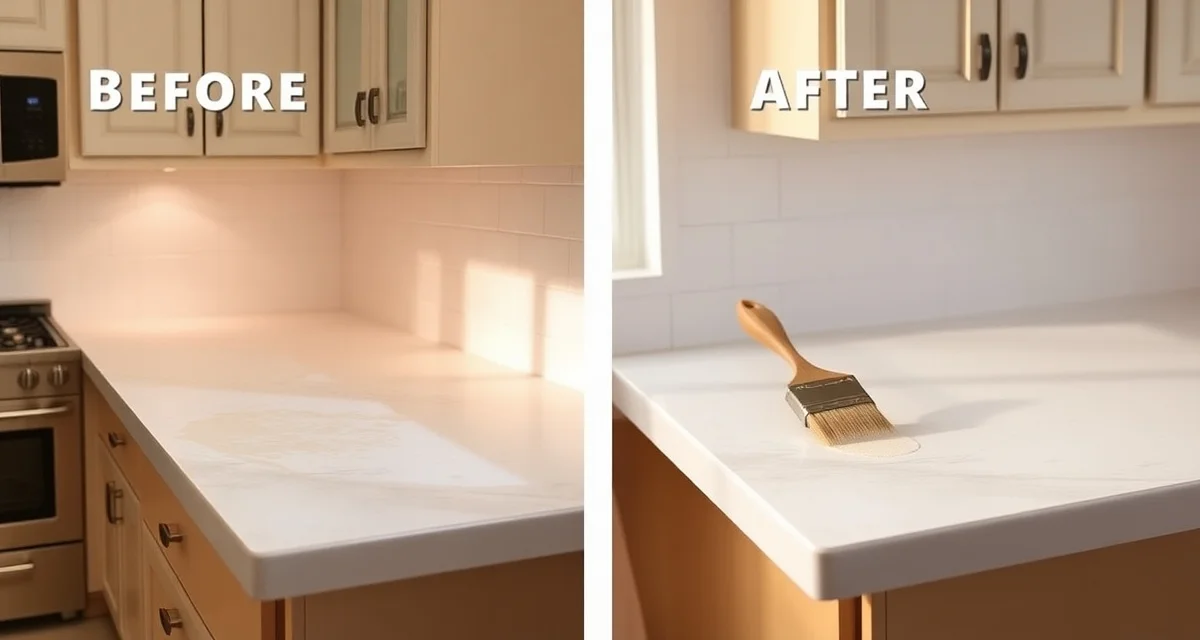
Can You Paint Countertops? What Actually Works (And What Doesn't)
Quick Definition
Yes, you can paint countertops - but results vary dramatically by material and paint system. Laminate countertops respond best to specialty countertop paint kits. Stone, quartz, and solid surface countertops can technically be painted, but shouldn't be - paint won't adhere well to their polished surfaces and you'll destroy resale value. Painted countertops typically last 1-3 years before showing significant wear.
TL;DR
- Laminate countertops are the best candidates for painting - specialty kits cost $50-$150 and last 2-5 years
- Never paint granite, quartz, or marble - paint adhesion is poor on polished stone and it kills resale value
- Epoxy countertop coatings last longer than standard paint (3-7 years) but cost $200-$400 in materials
- Prep is 80% of the job - skipping sanding and priming guarantees peeling within months
- Painted countertops can't handle hot pots, sharp knife cuts, or heavy scrubbing
- Budget $50-$400 for materials depending on the system; professional application adds $300-$600
- If your countertop budget is under $1,000, painting buys you time until a proper replacement
Which Countertops Can You Paint?
Good Candidates
| Material | Paintability | Expected Lifespan | Recommendation |
|---|---|---|---|
| Laminate | Good | 2-5 years | Best DIY candidate |
| Tile (with grout) | Good | 2-4 years | Works well, but grout lines remain visible |
| Butcher block | Moderate | 1-3 years | Works, but oil finishes are usually better |
| Concrete | Good | 3-5 years | Accepts stain and paint well |
Poor Candidates
| Material | Paintability | Why It Fails |
|---|---|---|
| Polished granite | Poor | Polished surface rejects adhesion |
| Quartz | Poor | Non-porous resin surface won't hold paint |
| Marble | Poor | Paint hides the stone's value; adhesion issues |
| Solid surface (Corian) | Moderate | Better to sand and refinish than paint |
| Soapstone | Poor | Oil-treated surface prevents adhesion |
Painting Laminate Countertops: The Full Process
Laminate is the one material where painting genuinely makes sense. Here's how to get results that last.
Calculate your material waste savings
See exactly how much slab material and money you could save with optimized cutting layouts.
Try the free Waste CalculatorMaterials You'll Need
- Countertop paint kit (Rust-Oleum, Giani, or similar) - $50-$150
- 120-grit and 220-grit sandpaper
- TSP (trisodium phosphate) cleaner or degreaser
- Painter's tape
- Foam rollers (4-inch and 6-inch)
- Polyurethane or epoxy topcoat
- Drop cloths
Step 1: Deep Clean (30 minutes)
Countertop surfaces accumulate grease, cooking oil residue, and soap film over years of use. Standard kitchen cleaners won't cut it. Use TSP solution mixed according to package directions - typically 1/4 cup per gallon of warm water. Scrub every inch, rinse thoroughly, and let dry completely.
Skipping this step is the #1 reason painted countertops peel. Grease under paint is a guaranteed failure.
Step 2: Sand the Surface (45 minutes)
Lightly sand the entire surface with 120-grit sandpaper. You're not trying to remove the laminate - just scuffing the glossy surface so primer can grip. Sand in circular motions until the shiny finish looks uniformly dull.
Wipe off all sanding dust with a tack cloth or damp microfiber towel. Let dry.
Step 3: Tape Off Edges (20 minutes)
Apply painter's tape along:
- The wall/backsplash joint
- Sink edges
- Cooktop or range edges
- Cabinet face frames below the counter edge
- Any fixtures you can't remove
Press tape edges firmly to prevent paint bleed.
Step 4: Apply Primer (1 hour + dry time)
Use a bonding primer designed for slick surfaces (Zinsser B-I-N or KILZ Adhesion are popular choices). Apply one thin, even coat with a foam roller. Let dry according to the can directions - typically 1-2 hours.
Step 5: Apply Countertop Paint (2-4 hours + dry time)
Most countertop paint kits use a two-part system:
Base coat: Apply 2-3 thin coats of the base color, allowing 2-4 hours of drying between coats. Thin coats prevent drips and brushstrokes.
Decorative layer (optional): Many kits include sponge-on techniques to create a stone-like appearance. This step adds the most visual improvement.
Topcoat: Apply 2-3 coats of protective topcoat (polyurethane or epoxy-based). This is what protects the paint from daily wear. Don't skip coats - each layer adds durability.
Step 6: Cure Time (3-7 days)
Paint feels dry to the touch in hours, but full cure takes 3-7 days. During this time:
- No placing objects on the surface
- No cleaning with anything other than a soft, dry cloth
- No hot pots, cutting, or heavy use
- Keep humidity low to help curing
Countertop Paint Kit Comparison
| Product | Price | Covers | System Type | Expected Life |
|---|---|---|---|---|
| Rust-Oleum Countertop Coating | $25-$35 | 35 sq ft | Single-component paint | 1-3 years |
| Giani Countertop Paint Kit | $70-$90 | 35 sq ft | Multi-step faux stone | 3-5 years |
| Rust-Oleum Transformations | $75-$100 | 50 sq ft | Multi-step with decorative chips | 3-5 years |
| SpreadStone Kit | $80-$120 | 40 sq ft | Textured stone finish | 3-5 years |
| Epoxy resin pour | $150-$400 | 40 sq ft | Two-part epoxy | 5-7 years |
Epoxy Countertop Coatings: The Step Up
For homeowners wanting something more durable than paint, epoxy coatings offer a middle ground between painting and replacement.
How Epoxy Countertop Coating Works
- Surface prep: Same as paint - clean, sand, prime
- Mix two-part epoxy according to manufacturer ratios (typically 1:1 or 2:1)
- Pour and spread the epoxy across the surface
- Add color effects - pigments, metallic powders, or veining techniques create custom looks
- Self-level: Epoxy naturally smooths itself into a flat, glossy surface
- Cure: 24-72 hours depending on product
Epoxy Pros and Cons
Pros:
- Harder surface than paint - resists scratches better
- Waterproof when fully cured
- Highly customizable appearance
- Fills small chips and imperfections in the original surface
- 5-7 year lifespan with proper care
Cons:
- Yellows over time with UV exposure (keep blinds closed on sunny counters)
- Can't handle temperatures over 150°F - trivets are mandatory
- Application is time-sensitive - epoxy begins curing in 20-40 minutes
- Mistakes are hard to fix once poured
- Glossy finish shows every fingerprint and water spot
Why You Shouldn't Paint Stone Countertops
This needs to be said plainly: painting granite, quartz, or marble countertops is almost always a bad idea.
Financial loss. Granite countertops add $3,000-$8,000 in home value. Painting them reduces that value to near zero. A buyer sees painted stone and wonders what damage is hiding underneath.
Adhesion failure. Polished stone is non-porous by design. Paint sits on the surface without proper mechanical or chemical bonding. Within months, you'll see peeling, especially around the sink and stove where moisture and heat cycle constantly.
Irreversibility. Removing paint from stone requires chemical strippers that can stain or etch the stone surface. The original finish may never be fully recoverable.
Better alternatives for stone you don't like:
- Professional re-polishing or honing ($15-$30/sq ft)
- Resurfacing the slab with a different finish (polished to leathered, for example)
- Selling the old countertop and applying the proceeds to new material
How Long Does Painted Countertop Last?
Real-world longevity depends heavily on usage:
| Usage Level | Standard Paint | Premium Kit | Epoxy Coating |
|---|---|---|---|
| Light (guest bath) | 3-5 years | 5-7 years | 7-10 years |
| Moderate (main bath) | 2-3 years | 3-5 years | 5-7 years |
| Heavy (active kitchen) | 1-2 years | 2-3 years | 3-5 years |
| Very heavy (rental) | 6-12 months | 1-2 years | 2-3 years |
The sink area always fails first. Constant water exposure, cleaning chemicals, and physical contact wear through paint faster than any other zone.
FAQ
How much does it cost to paint countertops?
DIY countertop painting costs $50-$150 for a standard kitchen using a specialty paint kit. Epoxy coatings run $150-$400 in materials. Professional application adds $300-$600 for labor. Compare this to $2,000-$6,000 for new countertop installation.
Can you paint over granite countertops?
Technically yes, but you shouldn't. Paint adheres poorly to polished granite, peels within months around wet areas, and destroys the stone's resale value. If you don't like your granite color, consider re-polishing, honing, or replacing it.
Do painted countertops look good?
Quality paint kits with faux stone techniques can look surprisingly convincing from a few feet away. Up close, the texture is clearly different from real stone. Solid-color paint jobs look obviously painted. Epoxy pours create a high-gloss look that's attractive but distinctly different from natural materials.
Is painting countertops worth it?
If you're on a tight budget (under $150) and have laminate countertops, painting is a reasonable short-term improvement. It's not worth it if you plan to sell your home within a year, if you have stone countertops, or if you expect the finish to last more than 3-5 years.
Can you put hot pots on painted countertops?
No. Painted and epoxy-coated countertops are heat-sensitive. Direct contact with pots over 150°F can cause discoloration, bubbling, or surface softening. Always use trivets or hot pads.
How long do you have to wait to use countertops after painting?
Light use (setting items down) can resume after 24-48 hours. Full use (cooking, cleaning, wet items) should wait 5-7 days for full cure. Placing heavy appliances back should wait 7-10 days.
Can you paint bathroom countertops?
Yes, and bathroom countertops are actually better candidates than kitchen ones. Lower heat exposure, less heavy cooking mess, and less aggressive cleaning means the finish lasts longer. Budget 3-5 years for a bathroom application.
What paint sheen is best for countertops?
Semi-gloss or high-gloss sheens work best because they're easier to clean and more moisture-resistant. Matte finishes look attractive initially but stain faster and are harder to wipe clean.
Can you repaint countertops that were already painted?
Yes. Sand the existing paint with 220-grit sandpaper, clean thoroughly, and recoat. If the existing paint is peeling, strip it completely before repainting. Each repaint adds thickness, which can affect fit around sinks and edges.
Do countertop paint kits come in different colors?
Yes. Most kits offer 8-15 color options ranging from white marble looks to dark granite patterns. Custom tinting is available for some base coat products. Epoxy coatings have virtually unlimited color options through pigment mixing.
When Paint Isn't Enough, Make the Upgrade Easy
Ready to move beyond paint to real stone or quartz? SlabWise helps fabrication shops deliver faster quotes - 3 minutes instead of 20 - so homeowners get accurate pricing without the usual week-long wait. Your new countertops could be templated, fabricated, and installed in as little as 5-10 business days.
[Start Your 14-Day Free Trial →]
Try These Free Tools
- Cost Calculator -- Get instant countertop cost estimates by material, edge profile, and square footage.
- Compare Materials -- Side-by-side material comparison with pricing, durability, and maintenance ratings.
- Edge Profile Selector -- Browse edge profiles with cost impact and visual previews.
Sources & Further Reading
- Natural Stone Institute - Stone Thickness Guidelines
- International Surface Fabricators Association - Countertop Specifications
- National Kitchen & Bath Association - Countertop Installation Standards
- ASTM International - Standard Test Methods for Stone Thickness