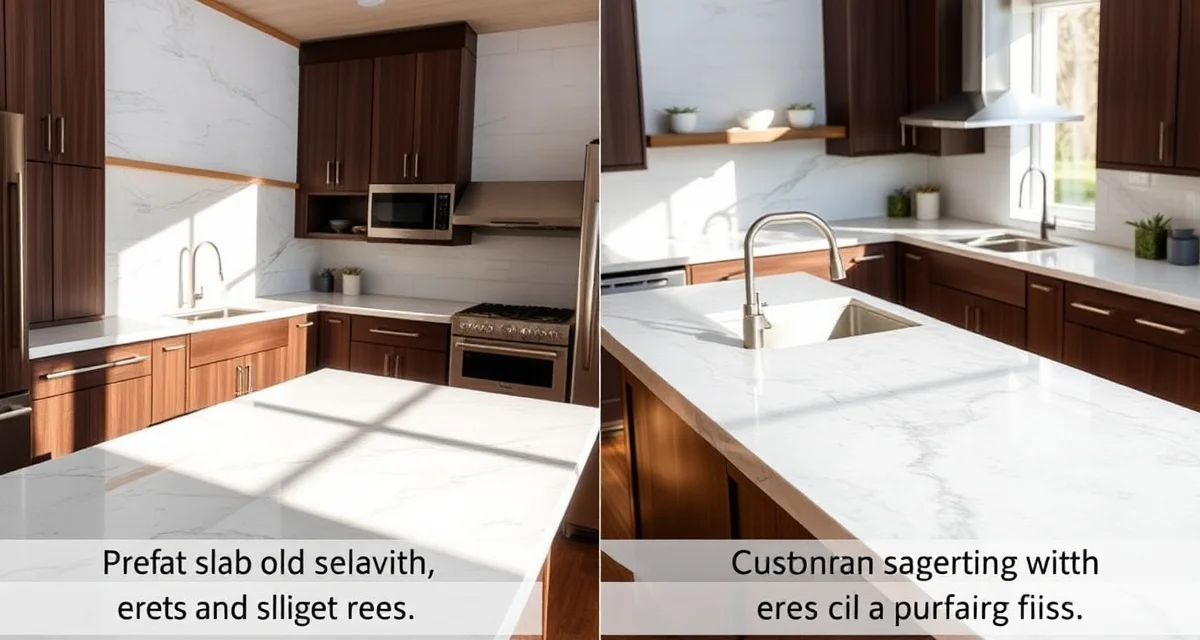
Prefab vs Custom Countertops
What Does "Prefab" and "Custom" Actually Mean?
Prefab countertops are pre-cut stone slabs manufactured to standard dimensions - typically 26" x 96" or 26" x 108" - with edges already polished and sometimes a backsplash already attached. Custom countertops, on the other hand, are fabricated from full-size slabs (usually around 55" x 120") and cut to match your exact kitchen measurements using digital templates.
TL;DR
- Prefab countertops cost $10-$35 per square foot installed; custom runs $40-$100+ per square foot
- Prefab works best for simple, straight-run layouts without complex cutouts
- Custom fabrication handles L-shapes, islands, unusual angles, and undermount sinks
- Prefab installation can happen in 1-3 days; custom takes 1-3 weeks from template to install
- Prefab limits you to 15-30 color options; custom opens the full slab inventory
- Seams are more common with prefab due to shorter slab lengths
- For most kitchens with any layout complexity, custom is the better long-term investment
Prefab Countertops: What You Get
Standard Sizes and Shapes
Prefab slabs come in fixed dimensions. The most common sizes you will find at home improvement stores and some stone yards:
Calculate your material waste savings
See exactly how much slab material and money you could save with optimized cutting layouts.
Try the free Waste Calculator| Prefab Size | Typical Use |
|---|---|
| 26" x 96" | Standard base cabinet runs |
| 26" x 108" | Longer wall sections |
| 36" x 72" | Island tops (limited) |
| 26" x 48" | Bathroom vanities |
Because these are pre-cut, the fabricator (or big box store) does minimal work on site. They may cut the slab to length and add a sink cutout, but that is about it.
Material Options
Prefab is most commonly available in:
- Granite: The most popular prefab material. You will find 15-30 color options at most retailers, mostly from India and China.
- Quartz: Some engineered quartz brands offer prefab sizing, though the selection is narrower than custom.
- Marble: Rarely available as prefab due to the material's sensitivity and the expectation of custom work.
Where to Buy Prefab
- Home Depot and Lowe's carry prefab granite and quartz
- Warehouse clubs like Costco occasionally stock them
- Some regional stone importers sell prefab at wholesale pricing
- IKEA offers prefab in laminate, butcher block, and quartz
Cost Breakdown
Expect to pay between $10 and $35 per square foot for prefab countertops, installed. That price usually includes:
- The slab itself
- Basic edge polishing (typically eased or bullnose)
- One straight sink cutout
- Basic installation
A typical 30-square-foot kitchen with prefab granite might run $800-$1,500 total. That same kitchen with custom granite fabrication could cost $2,400-$5,000+.
Custom Countertops: What You Get
Full-Size Slabs and Exact Fit
Custom countertops start with a full-size slab, typically 55" x 120" (about 130 cm x 300 cm). A fabricator will:
- Template your kitchen using digital laser measuring tools or physical templates
- Select and lay out the slab to minimize waste and align veining
- CNC-cut the pieces to exact dimensions
- Polish edges to your chosen profile
- Cut out for sinks, cooktops, and faucet holes
- Install with precise fitting and seaming
Edge Profile Options
Custom fabrication gives you access to 10+ edge profiles:
| Edge Profile | Description | Cost Impact |
|---|---|---|
| Eased | Simple rounded top edge | Included |
| Bullnose | Full half-round | +$5-10/LF |
| Ogee | S-curve decorative edge | +$10-20/LF |
| Dupont | Stepped profile | +$10-15/LF |
| Mitered | 90-degree thick appearance | +$30-60/LF |
| Waterfall | Slab continues down the side | +$40-80/LF |
Cost Breakdown
Custom countertop pricing per square foot, installed:
| Material | Low End | Mid Range | High End |
|---|---|---|---|
| Granite | $40 | $60 | $100 |
| Quartz | $45 | $70 | $120 |
| Marble | $50 | $80 | $150+ |
| Quartzite | $55 | $90 | $200+ |
| Porcelain | $50 | $75 | $130 |
Head-to-Head Comparison
| Factor | Prefab | Custom |
|---|---|---|
| Price per sq ft | $10-$35 | $40-$100+ |
| Lead time | 1-3 days | 1-3 weeks |
| Color selection | 15-30 options | Hundreds of slabs |
| Edge profiles | 1-3 basic | 10+ options |
| Sink options | Drop-in mostly | Undermount, farm sink, integrated |
| Layout flexibility | Straight runs only | Any shape or angle |
| Seam visibility | More seams (shorter slabs) | Fewer seams (larger slabs) |
| Resale value | Moderate | Higher |
| Thickness | Usually 2 cm | 2 cm or 3 cm |
| Warranty | Limited or none | Fabricator + material warranty |
When Prefab Makes Sense
Prefab countertops work well in specific situations:
- Rental properties: Where cost matters more than customization
- Straight galley kitchens: Simple layouts with no L-shapes or islands
- Bathroom vanities: Standard sizes with drop-in sinks
- Budget renovations: When the goal is to upgrade from laminate quickly and cheaply
- Laundry rooms and utility spaces: Where aesthetics are secondary
When Custom Is Worth the Money
Custom fabrication becomes necessary - or strongly advisable - when:
- Your kitchen has an L-shape, U-shape, or island: Prefab cannot handle corners well. Seams at corners look bad and can be structural weak points.
- You want an undermount sink: Prefab pieces usually do not support undermount sink cutouts because the edge is already finished.
- You care about veining and pattern matching: With custom, you pick the exact slab and the fabricator lays out pieces to align patterns across seams.
- You want a specific edge profile: Ogee, dupont, mitered - these require CNC equipment that prefab skips.
- Your walls are not straight: Most kitchen walls are not perfectly plumb. Custom templating accounts for this; prefab leaves gaps.
The Fabrication Process: What Happens Behind the Scenes
For custom countertops, the process involves serious equipment and skill:
- Digital templating: A technician uses a laser measurement device to capture every dimension, angle, and irregularity in your kitchen. This takes 30-60 minutes.
- Slab layout: The fabricator uses software to nest your countertop pieces on the slab, minimizing waste. Top shops achieve 85-90% material utilization.
- CNC cutting: A computer-controlled bridge saw or waterjet cuts the pieces with precision to 1/16 of an inch.
- Edge polishing: CNC routers or hand tools shape and polish the edge profile.
- Quality check: Good shops run a three-point verification to catch errors before the truck rolls.
- Installation: Pieces are dry-fit, leveled, seamed with color-matched epoxy, and secured.
For fabrication shops managing this workflow, software tools like SlabWise help optimize slab nesting to reduce waste by 10-15%, which can save thousands per month on material costs.
Common Mistakes to Avoid
With Prefab
- Assuming it fits without measuring: Even prefab needs accurate measurements. A 96-inch slab does not help if your counter run is 98 inches.
- Ignoring seam placement: Two prefab pieces joined in the middle of a visible run look cheap.
- Skipping the backsplash match: Prefab backsplash strips often do not match the slab pattern.
With Custom
- Choosing the cheapest fabricator: Recuts from measurement errors cost $1,500-$4,000. Cheap quotes often mean the shop is cutting corners on quality control.
- Not visiting the slab yard: Photos lie about color and veining. Go see your slab in person.
- Forgetting about plumbing timelines: Your plumber needs to disconnect and reconnect after install. Coordinate schedules ahead of time.
The Bottom Line for Homeowners
If your kitchen is simple, your budget is tight, and you are okay with limited material choices, prefab can save you 50-70% compared to custom. But for most full kitchen remodels - especially those with islands, undermount sinks, or L-shaped layouts - custom fabrication is the standard for good reason. The fit is better, the material selection is broader, and the finished result adds more value to your home.
Can you mix prefab and custom in the same kitchen?
Yes. Some homeowners use prefab for a straight back wall and custom for an island. Just be aware that matching colors between a prefab piece and a custom slab is difficult.
Is prefab granite lower quality than custom?
Not necessarily. The stone itself can be the same quality. The difference is in the cut, fit, and edge finishing - not the raw material.
Do prefab countertops have seams?
Often, yes. Because prefab pieces are shorter (96" or 108"), kitchens with long runs or corners will have visible seams.
Can I get an undermount sink with prefab?
It is very difficult. Most prefab countertops are 2 cm thick and come with pre-polished edges, making undermount sink installation impractical. Some fabricators will modify prefab for undermount, but it adds cost and risk.
How long do prefab countertops take to install?
Most prefab installations happen in 1-3 days from purchase, since the pieces are already cut and polished.
Is custom fabrication worth it for a small bathroom?
For a standard rectangular vanity with a drop-in sink, probably not. Prefab is fine for most bathroom applications.
Will prefab countertops hurt my home resale value?
Prefab granite still appraises better than laminate. However, buyers and agents can often spot prefab by the thinner profile (2 cm vs 3 cm) and visible seams.
Can I install prefab countertops myself?
Technically, yes. Prefab granite is lighter per piece than custom slabs and some homeowners do DIY installation. But any cracking or misalignment is your problem - and stone does not forgive mistakes.
What is the most popular material for prefab?
Granite dominates the prefab market, followed by quartz. Indian granite colors like Uba Tuba, Santa Cecilia, and New Venetian Gold are the most common prefab options.
How thick are prefab countertops versus custom?
Prefab is typically 2 cm (about 3/4 inch). Custom is available in both 2 cm and 3 cm (about 1-1/4 inch). The 3 cm thickness is preferred for most kitchen applications because it is stronger and does not require plywood substrate.
Get Accurate Countertop Pricing Fast
Whether you are leaning toward prefab or custom, knowing your exact square footage and layout needs is the first step. Use our quick countertop calculator to estimate costs for both options in under 3 minutes.
Try the SlabWise Quick Quote Calculator →
Try These Free Tools
- Cost Calculator -- Compare material costs instantly across different countertop options.
- Compare Materials -- Side-by-side material comparison with pricing, durability, and maintenance.
- Kitchen Visualizer -- Let customers preview countertop materials in their actual kitchen.
Sources & Further Reading
-
International Surface Fabricators Association - Countertop Fabrication Standards
-
National Kitchen & Bath Association - Countertop Selection and Installation Guidelines
-
ASTM International - Standard Specification for Natural Stone Dimension