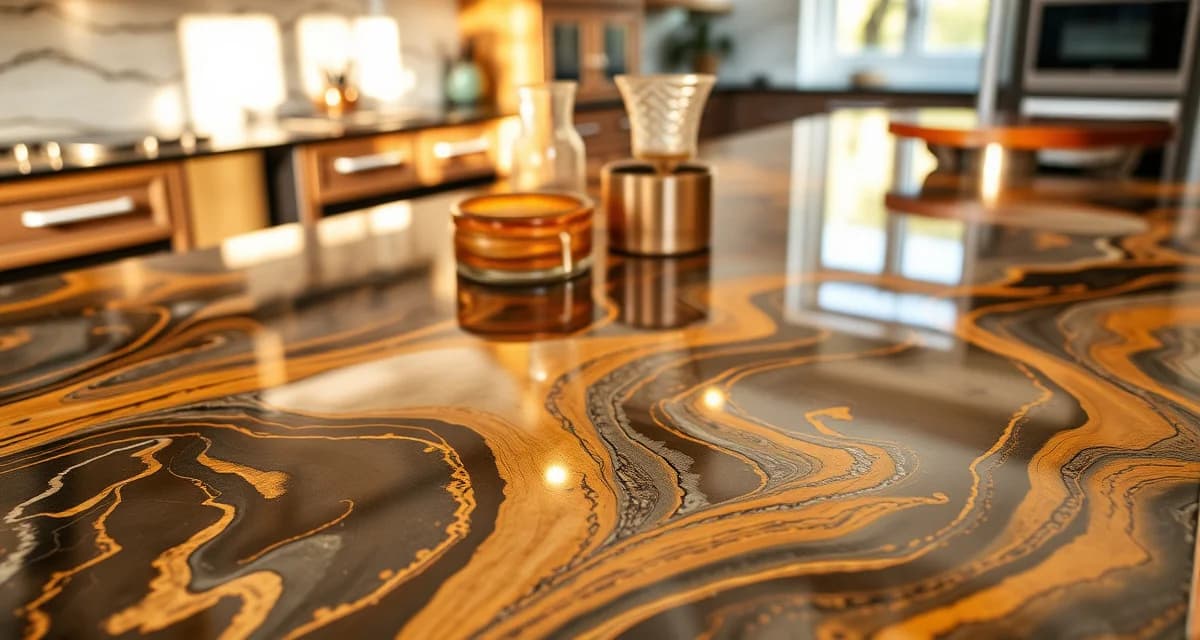
What Are Epoxy Countertops? Cost, Durability, and Honest Pros & Cons
Quick Definition
Epoxy countertops are surfaces created by pouring a two-part resin (epoxy resin + hardener) over an existing countertop or substrate. The liquid self-levels into a glossy, hard surface that can mimic marble, create metallic swirl effects, or produce solid colors. They cost $100-$400 in materials for DIY or $40-$100 per square foot professionally installed. Epoxy counters last 5-10 years but can't handle heat above 150°F.
TL;DR
- Epoxy is a coating, not a slab material - it's poured over existing laminate, wood, or concrete surfaces
- Material cost: $3-$10 per square foot for the epoxy itself; $100-$400 total for a typical kitchen
- Professional installation: $40-$100 per square foot including prep, pour, and finishing
- Heat limit: 150°F max - hot pots and pans will damage the surface permanently
- UV sensitivity - epoxy yellows over time near windows without UV-stabilized formulas
- Lifespan: 5-10 years with careful use; heavy kitchen use shortens this to 3-5 years
- DIY-friendly with practice, but mistakes are difficult to fix once the epoxy starts curing (20-40 minute working time)
How Epoxy Countertops Work
Epoxy is a thermosetting polymer. When you mix the resin component with the hardener component, a chemical reaction begins that transforms the liquid into a hard, clear solid over 24-72 hours.
Calculate your material waste savings
See exactly how much slab material and money you could save with optimized cutting layouts.
Try the free Waste CalculatorThe Basic Chemistry
The resin (bisphenol-A or BPA-free alternatives) reacts with the hardener (polyamine or polyamide) in an exothermic reaction - it actually generates heat as it cures. This reaction creates cross-linked polymer chains that give the finished surface its hardness, water resistance, and glossy finish.
What Goes On Top of What
Epoxy isn't a standalone countertop material. It needs a substrate:
| Substrate | Compatibility | Notes |
|---|---|---|
| Laminate | Excellent | Most common DIY application |
| Plywood | Good | Needs sanding and sealing first |
| MDF | Good | Seal edges to prevent moisture damage |
| Concrete | Excellent | Fills pores and creates smooth finish |
| Butcher block | Good | Seal wood first to prevent outgassing bubbles |
| Existing tile | Moderate | Fills grout lines but may show ghost lines |
| Granite/quartz | Poor | Epoxy doesn't adhere well to polished stone |
Types of Epoxy Countertop Finishes
Solid Color
The simplest approach. Mix a single pigment into the epoxy and pour. Results in a uniform, glossy surface. Works well for modern kitchens wanting a specific color match.
Marble/Stone Effect
The most popular DIY epoxy technique. Multiple colors are poured and manipulated with heat guns, brushes, or sticks to create veining that mimics marble or granite. The results range from convincingly marble-like to obviously artificial, depending on the artist's skill.
Metallic
Metallic pigment powders (mica-based) create shimmering, three-dimensional effects. Colors shift as you view the surface from different angles. Popular in bars, entertainment areas, and modern kitchens.
River/Geode
Inspired by river tables, these designs use colored epoxy to create flowing patterns. Often combined with metallic pigments for depth. More common in custom furniture than kitchen countertops.
The Full DIY Process
Materials Needed
- Epoxy resin and hardener (countertop-grade, FDA-compliant for food contact) - $80-$200
- Pigments (liquid or powder) - $10-$40
- 120-grit and 220-grit sandpaper
- TSP cleaner or degreaser
- Mixing containers (graduated for accurate ratios)
- Stir sticks
- Foam roller or brush
- Heat gun or propane torch (for bubble removal)
- Plastic sheeting for floor protection
- Painter's tape
- Nitrile gloves and respirator mask
Step 1: Surface Preparation (1-2 hours)
Clean the existing countertop with TSP, removing all grease, soap residue, and contaminants. Sand with 120-grit to create mechanical adhesion points. Wipe down with a tack cloth. Apply painter's tape along all edges, walls, sinks, and fixtures.
Cover the floor with plastic sheeting - epoxy drips are nearly impossible to remove from flooring once cured.
Step 2: Seal Coat (30 minutes + overnight cure)
Mix a thin batch of clear epoxy and apply a seal coat to the entire surface. This fills micro-pores in the substrate and prevents air bubbles from rising through the topcoat. Let cure 12-24 hours.
Step 3: Flood Coat (20-40 minutes working time)
This is the main event, and timing is critical.
- Mix epoxy and hardener at the exact ratio specified by the manufacturer (typically 1:1 or 2:1 by volume). Inaccurate mixing causes soft spots that never fully cure.
- Add pigments and mix thoroughly - 2-3 minutes of stirring.
- Pour the epoxy in the center of the countertop and spread to edges with a foam roller or squeegee.
- Create patterns immediately - you have 20-40 minutes before the epoxy starts to gel.
- Remove bubbles by passing a heat gun 6-8 inches above the surface. Propane torches work faster but carry a fire risk with the volatile compounds in uncured epoxy.
Step 4: Curing (24-72 hours)
Leave the countertop completely undisturbed. No touching, no placing items, no cleaning. Keep the room temperature between 70-80°F. Cooler temperatures slow curing; warmer temperatures accelerate it (but can cause yellowing).
Cover the surface loosely with a tent of plastic sheeting to prevent dust settling on the tacky surface during curing.
Step 5: Finishing (1-2 hours, after full cure)
Once fully cured (72+ hours for most products):
- Sand any high spots or drip edges with 220-grit
- Apply a UV-resistant polyurethane topcoat for extra protection and UV resistance
- Allow topcoat to cure per manufacturer instructions
Cost Breakdown
DIY Epoxy Countertop
| Item | Cost |
|---|---|
| Epoxy resin + hardener (2 gallons) | $80-$150 |
| Pigments and metallics | $15-$40 |
| Sandpaper, rollers, supplies | $20-$40 |
| Painter's tape and plastic sheeting | $10-$20 |
| UV topcoat | $25-$50 |
| Total | $150-$300 |
Professional Epoxy Countertop
| Item | Cost per sq ft |
|---|---|
| Materials | $8-$15 |
| Labor | $25-$60 |
| Prep and cleanup | $7-$15 |
| Total | $40-$90/sq ft |
For a 40-square-foot kitchen: $1,600-$3,600 professionally installed.
Comparison to Other Materials
| Material | Cost per sq ft (installed) |
|---|---|
| Epoxy (DIY) | $4-$8 |
| Epoxy (professional) | $40-$90 |
| Laminate | $15-$40 |
| Granite | $50-$100 |
| Quartz | $55-$120 |
| Marble | $75-$150 |
Durability: The Honest Truth
Epoxy countertops are durable enough for moderate use, but they have real limitations compared to stone and quartz.
What Epoxy Handles Well
- Water resistance: Fully cured epoxy is waterproof. No sealing required.
- Stain resistance: Most food stains wipe off easily. Wine, coffee, and oil don't penetrate.
- Impact resistance: Moderate - handles normal kitchen impacts without cracking.
- Chemical resistance: Tolerates mild cleaners and most household chemicals.
What Damages Epoxy
- Heat above 150°F: Causes permanent white marks, softening, or warping. Every hot pot needs a trivet.
- UV light: Standard epoxy yellows within 1-2 years near windows. UV-stabilized formulas resist this but don't eliminate it.
- Sharp impacts: Knife cuts score the surface permanently. Always use cutting boards.
- Abrasive cleaners: Scrubbing pads and powdered cleaners dull the glossy finish.
- Heavy scratching: Accumulated micro-scratches dull the surface over 3-5 years of heavy use.
Epoxy vs. Real Stone: What Fabricators Should Tell Customers
When homeowners consider epoxy as an alternative to stone, fabricators have an opportunity to educate rather than dismiss.
Fair comparison points:
| Factor | Epoxy | Granite/Quartz |
|---|---|---|
| Upfront cost (DIY) | $150-$400 | N/A (must be professional) |
| Upfront cost (pro) | $1,600-$3,600 | $2,000-$5,000 |
| Lifespan | 5-10 years | 20-30+ years |
| Heat resistance | 150°F max | 350°F+ (granite), 300°F (quartz) |
| Resale value added | Minimal | $3,000-$8,000 |
| Repairability | Re-pour entire surface | Chip repair kits, spot fixing |
| Maintenance | Moderate - avoid heat, cuts, UV | Low - occasional sealing (granite) |
The bottom line for homeowners: epoxy is a budget-friendly short-term solution. Stone is a long-term investment. A fabricator who presents this honestly builds trust and often wins the stone sale.
Common Epoxy Countertop Mistakes
Inaccurate Mixing Ratios
Even a 5% deviation from the specified ratio can cause:
- Permanently tacky surfaces that never fully harden
- Soft spots that dent under normal use
- Cloudy or milky appearance instead of clear gloss
Always use graduated mixing containers and measure precisely.
Working Too Slowly
Once mixed, the clock starts. At 75°F, most countertop epoxies give you 25-35 minutes of working time. Trying to pour and create patterns on a large surface (over 20 sq ft) in that window requires planning - and usually a helper.
Skipping the Seal Coat
Without a seal coat, air trapped in the substrate (especially wood and concrete) rises through the flood coat as it cures. The result: hundreds of tiny bubbles frozen in the surface that can't be removed without sanding down and re-pouring.
Inadequate Floor Protection
Epoxy drips off countertop edges. On hardwood or tile floors, cured epoxy drips require aggressive scraping or chemical removal that can damage the floor finish. Plastic sheeting extended 3-4 feet beyond the counter edge prevents this.
FAQ
Are epoxy countertops food-safe?
Most countertop-grade epoxy resins are FDA-compliant for food contact once fully cured (72+ hours). Check the product label for FDA 21 CFR 175.300 compliance. Don't cut food directly on the surface - use cutting boards.
How long do epoxy countertops last?
With careful use (trivets, cutting boards, gentle cleaners), 5-10 years. In heavy-use kitchens, 3-5 years before the surface needs refinishing. The glossy finish degrades faster than the structural integrity.
Can you pour epoxy over existing granite?
You can, but shouldn't. Epoxy bonds poorly to polished stone surfaces. You'd need to sand the granite to a matte finish first, destroying the stone's value. If you dislike your granite color, consider replacing it rather than coating it.
Do epoxy countertops yellow?
Standard epoxy yellows when exposed to UV light over 6-18 months. UV-stabilized formulas resist yellowing for 3-5 years. For counters near windows, UV-stabilized epoxy is mandatory. A UV-resistant topcoat adds another layer of protection.
How thick should epoxy countertops be?
The seal coat should be 1/16 inch. The flood coat should be 1/8 inch minimum for adequate self-leveling and durability. Total epoxy thickness of 3/16 to 1/4 inch is standard. Thicker pours require multiple coats to avoid excess heat from the exothermic reaction.
Can you repair a damaged epoxy countertop?
Minor scratches can be buffed out with fine sandpaper (400+ grit) and a fresh topcoat of epoxy or polyurethane. Deep gouges, heat damage, or large chips require sanding the damaged area and re-pouring a new layer of epoxy.
Is epoxy better than laminate countertops?
Epoxy over laminate creates a more durable, moisture-resistant surface than bare laminate. However, it still can't match laminate's heat tolerance in some cases (high-pressure laminate handles heat better than epoxy). The main advantage of epoxy is the visual upgrade.
How much epoxy do I need for a kitchen countertop?
Calculate square footage and plan for 1/8-inch thickness: 1 gallon of mixed epoxy covers approximately 12 square feet at 1/8 inch. A 40-square-foot kitchen needs approximately 3.5 gallons of mixed epoxy, plus extra for the seal coat.
Can you use epoxy on outdoor countertops?
Not recommended. UV exposure causes rapid yellowing (within months), temperature swings stress the epoxy bond to the substrate, and the surface can soften in direct summer sun (surface temperatures exceeding 150°F). Marine-grade epoxy performs better outdoors but still has limitations.
What happens if epoxy gets too hot?
Temperatures above 150°F cause the epoxy to soften temporarily. If an object is sitting on the surface during softening, it can leave a permanent impression or white mark. Extreme heat (300°F+) can cause the epoxy to bubble, crack, or separate from the substrate.
When Your Customers Are Ready for Real Stone
Epoxy works for tight budgets, but when homeowners are ready to invest in granite or quartz, SlabWise helps your shop deliver faster. Quick Quote generates accurate estimates in 3 minutes - so budget-conscious customers can see that real stone might be closer to their price range than they thought.
[Start Your 14-Day Free Trial →]
Try These Free Tools
- Cost Calculator -- Get instant countertop cost estimates by material and square footage.
- Kitchen Visualizer -- Upload a kitchen photo and preview different materials in place.
- Template Compare -- Upload two templates and see every dimension change highlighted.
Sources & Further Reading
-
Natural Stone Institute - Countertop Installation Best Practices Guide
-
National Kitchen & Bath Association - Kitchen Renovation Sequencing Guidelines
-
International Surface Fabricators Association - Professional Installation Standards
-
Remodeling Magazine - Kitchen Remodel Installation Order Best Practices