Best Laser Templating Systems in 2026: Buyer's Guide
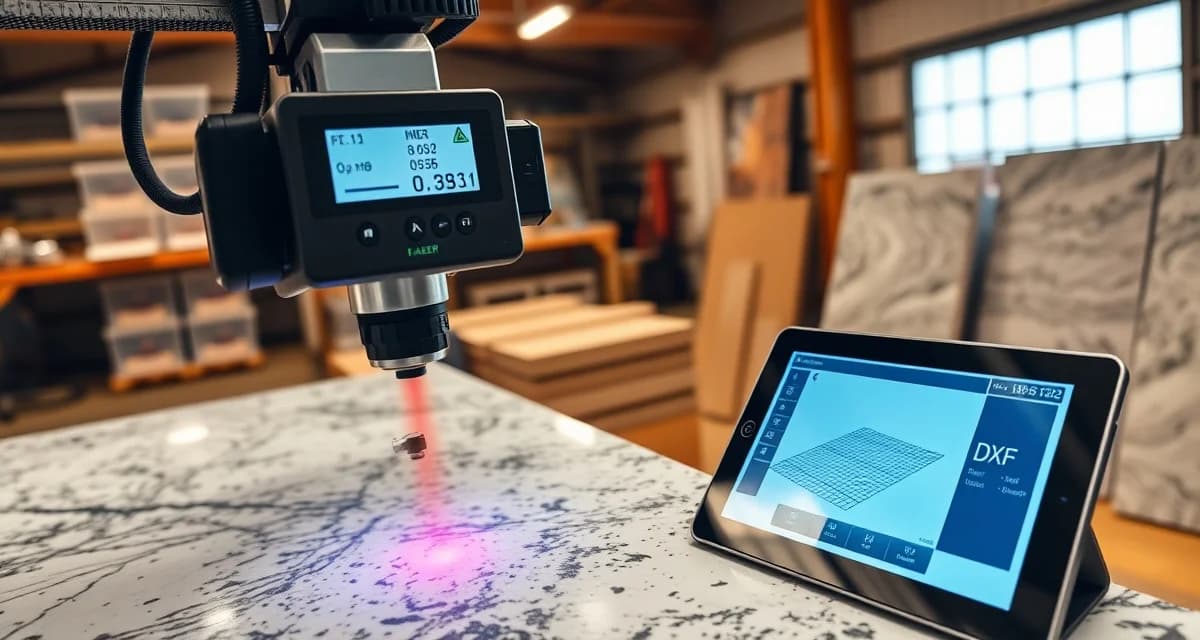
Laser templating systems capture kitchen and bathroom dimensions digitally, replacing physical wood or cardboard templates with precise DXF files that feed directly into CNC machines. The switch from physical to digital templating typically cuts template time by 50-70%, reduces measurement errors to under 1/16", and eliminates the truck space required to haul bulky physical templates back to the shop.
TL;DR: Best Laser Templating Systems
- Laser Products LT-2D3D -- industry standard for countertop fabricators, largest installed base ($15K-$25K)
- Prodim Proliner -- European precision with the widest range of models for different shop sizes ($20K-$45K)
- Flexijet 3D -- highest accuracy for complex 3D architectural work ($25K-$40K)
- Laser Products ScanTemplater -- camera-based system for faster capture of simple layouts ($10K-$18K)
- Leica 3D Disto -- compact, versatile option that doubles for other measurement tasks ($8K-$15K)
- Creaform HandySCAN -- portable 3D scanner for unusual or highly complex surfaces ($20K-$35K)
- Digital templating reduces callbacks by 60-80% compared to physical templates
How We Evaluated Templating Systems
| Criteria | Weight | What We Assessed |
|---|---|---|
| Accuracy | 25% | Measurement precision on countertop-typical jobs |
| Speed | 20% | Time to complete a standard kitchen template |
| Software and DXF output | 20% | Quality of DXF export, compatibility with CNC software |
| Ease of use | 15% | Learning curve for new operators, in-field usability |
| Durability and portability | 10% | Weight, battery life, ruggedness for jobsite conditions |
| Value for the money | 10% | Capability relative to purchase price |
1. Laser Products LT-2D3D -- Industry Standard for Countertop Templating
The LT-2D3D from Laser Products Industries is the most widely used digital templating system in the US countertop fabrication industry. Its combination of accuracy, speed, and direct DXF output has made it the default choice for shops transitioning from physical to digital templates.
Calculate your material waste savings
See exactly how much slab material and money you could save with optimized cutting layouts.
Try the free Waste CalculatorKey specifications:
- Measurement accuracy: +/- 1/32" (0.8mm) at distances up to 50 feet
- 2D and 3D measurement capability
- Direct DXF export compatible with all major CNC and nesting software
- Weight: approximately 16 lbs with tripod
- Battery life: 8+ hours
Why shops choose it:
- Largest installed base in the US countertop industry -- most fabricators know how to use it
- Excellent DXF output quality with minimal file cleanup needed
- Templaters can be hired or trained on this system easily due to widespread familiarity
- Laser Products provides strong training and support from their Minneapolis headquarters
- Integration with Slabsmith, SlabWise, and other layout software is well-established
Considerations:
- Higher learning curve than camera-based systems for brand-new templaters
- Requires line of sight to all measurement points
- Slower than 3D scanning systems on very complex layouts
- Tripod-based -- requires setup time at the jobsite
Typical workflow:
- Set up tripod in the kitchen
- Shoot laser points along walls, cabinet edges, and existing openings
- Mark sink location, faucet holes, and edge details
- Software generates 2D countertop outline as a DXF file
- DXF transfers to shop for nesting and CNC programming
| Spec | Detail |
|---|---|
| Price Range | $15,000-$25,000 |
| Accuracy | +/- 1/32" |
| Template Time | 30-60 min for average kitchen |
| DXF Quality | Excellent |
| Best For | Any countertop fab shop in the US |
For fabricators: The DXF file that comes out of an LT-2D3D is only as good as the points the operator captures. Missed points, wrong reference locations, and incomplete notes about overhangs and edge details cause problems downstream. SlabWise's Template Verification runs a 3-layer check on incoming DXF files, flagging geometry issues, missing dimensions, and inconsistencies before the file reaches your CNC machine.
2. Prodim Proliner -- Best Range of Model Options
Prodim is a Dutch company that produces the Proliner series of digital measuring systems. They offer more model variants than any other manufacturer, from compact models for small shops to large-format systems for architectural stone work. The Proliner is particularly popular in Europe and has a growing US presence.
Model range:
- Proliner 7 -- compact, entry-level for small fabrication jobs
- Proliner 8 -- mid-range, most popular for standard countertop work
- Proliner 10 -- large measuring range for big kitchens and commercial jobs
- Proliner IS -- industrial series for continuous high-volume use
Key specifications (Proliner 8):
- Measurement accuracy: +/- 0.5mm at 3 meters
- Flexible measuring arm with touch probe
- Direct DXF and other file format export
- Weight: approximately 15 lbs
- Battery life: 10+ hours
Why shops choose it:
- Touch probe methodology feels intuitive -- you physically touch the edge being measured
- Fast for backsplash and straight-edge measurements
- Multiple model options for different shop sizes and budgets
- Strong European market presence with growing US support
Considerations:
- Touch probe requires physical contact with surfaces -- can be slower than laser for complex layouts
- US service network is smaller than Laser Products
- Different workflow methodology than laser-based systems -- retraining needed if switching
| Spec | Detail |
|---|---|
| Price Range | $20,000-$45,000 (varies by model) |
| Accuracy | +/- 0.5mm |
| Template Time | 25-50 min for average kitchen |
| DXF Quality | Very good |
| Best For | Shops wanting a range of size/price options |
3. Flexijet 3D -- Best Accuracy for Complex Work
Flexijet is a German-made system that combines laser measurement with full 3D coordinate capture. While it is more expensive than the LT-2D3D, its accuracy and 3D capability make it the preferred choice for shops handling complex architectural stone, curved walls, and multi-level countertop installations.
Key specifications:
- Measurement accuracy: +/- 0.3mm at standard distances
- Full 3D coordinate measurement (not just 2D outlines)
- Automatic level compensation for uneven floors
- Integrated software with real-time 3D visualization
- Direct DXF and STEP file export
Why shops choose it:
- Highest accuracy of any countertop templating system
- True 3D measurement captures out-of-level walls and tilted surfaces
- Real-time 3D model shows the template as you measure, catching errors on-site
- Well-suited for curved countertops, reception desks, and architectural features
Considerations:
- Premium pricing -- the most expensive system on this list
- More capability than most standard kitchen countertop jobs require
- Steeper learning curve than simpler laser systems
- Heavier and more complex than compact alternatives
| Spec | Detail |
|---|---|
| Price Range | $25,000-$40,000 |
| Accuracy | +/- 0.3mm |
| Template Time | 30-60 min for average kitchen |
| DXF Quality | Excellent (also exports 3D formats) |
| Best For | Complex architectural work, curved surfaces, high-precision requirements |
4. Laser Products ScanTemplater -- Best for Fast Simple Layouts
The ScanTemplater is Laser Products' camera-based alternative to their laser systems. Instead of shooting individual points, the operator takes photographs of the countertop area, and the software uses photogrammetry to build the 2D outline. It is significantly faster than point-by-point laser measurement on simple, straight-edged layouts.
Key specifications:
- Camera-based photogrammetric measurement
- Accuracy: +/- 1/16" on standard kitchen layouts
- Template time: 10-20 minutes for a basic kitchen
- DXF output compatible with standard CNC software
- Lightweight -- no heavy tripod required
Why shops choose it:
- Fastest template capture on this list for simple kitchens
- Minimal setup time -- no tripod leveling required
- Lower price point than laser or touch-probe systems
- Easy to learn for new templaters
Considerations:
- Less accurate than laser systems on complex or large layouts
- Struggles with poor lighting conditions
- Cannot capture 3D information (walls out of plumb, uneven surfaces)
- Not suitable for complex architectural work
| Spec | Detail |
|---|---|
| Price Range | $10,000-$18,000 |
| Accuracy | +/- 1/16" |
| Template Time | 10-20 min for basic kitchen |
| DXF Quality | Good for standard work |
| Best For | High-volume shops doing mostly standard kitchen layouts |
5. Leica 3D Disto -- Best Versatile Compact Option
The Leica 3D Disto is a compact laser measurement device that captures 3D point data and exports DXF files. While not designed exclusively for countertop templating, it has been widely adopted by fabricators who also need a general-purpose measurement tool for other tasks (stairs, shower enclosures, flooring layouts).
Key specifications:
- Laser measurement accuracy: +/- 1mm at 10 meters
- 3D point capture with automatic compensation for setup position
- DXF, DWG, and CSV export
- Weight: approximately 4 lbs (device only)
- Operates on battery with 8-hour life
Why shops choose it:
- Compact and lightweight -- easy to carry to jobsites
- Multi-purpose -- useful for countertops, stairs, shower enclosures, and more
- Lower price than dedicated countertop templating systems
- Leica brand reputation for measurement quality
Considerations:
- Not specifically designed for countertop templating -- workflow is more manual
- Slower than purpose-built countertop systems for standard kitchen layouts
- DXF output may need more cleanup than dedicated countertop systems produce
- Software is functional but not as polished as LPI or Prodim offerings
| Spec | Detail |
|---|---|
| Price Range | $8,000-$15,000 |
| Accuracy | +/- 1mm |
| Template Time | 40-75 min for average kitchen |
| DXF Quality | Good (may need manual cleanup) |
| Best For | Small shops wanting a versatile measurement tool |
6. Creaform HandySCAN -- Best for Unusual Surfaces
The Creaform HandySCAN is a portable 3D scanner designed for capturing complex shapes. In the countertop world, it is used for jobs involving curved surfaces, organic shapes, heavily contoured existing countertops, or historic restoration work where standard point-by-point measurement would be impractical.
Key specifications:
- Full 3D surface scanning via structured light
- Accuracy: up to 0.025mm (for 3D surface capture)
- Scans curved, irregular, and complex surfaces in minutes
- Exports STL, OBJ, and DXF formats
- Portable -- hand-held operation
Why shops choose it:
- Captures surfaces that no point-based system can template efficiently
- Fast 3D surface capture for curved bars, reception desks, and artistic installations
- Works on any surface regardless of color, texture, or reflectivity
- Extremely high accuracy for surface matching
Considerations:
- Overkill for standard kitchen countertop work
- Highest learning curve on this list
- Generates very large files that need processing before CNC use
- Premium pricing for capability most shops rarely need
- Post-processing software required to convert scan data to usable DXF
| Spec | Detail |
|---|---|
| Price Range | $20,000-$35,000 |
| Accuracy | Up to 0.025mm (surface capture) |
| Template Time | Varies widely by surface complexity |
| Best For | Curved, organic, or highly complex surfaces |
Laser Templating System Comparison Table
| System | Price | Accuracy | Speed | DXF Quality | Best For |
|---|---|---|---|---|---|
| LPI LT-2D3D | $15K-$25K | +/- 1/32" | Moderate | Excellent | US standard |
| Prodim Proliner | $20K-$45K | +/- 0.5mm | Fast | Very Good | Various shop sizes |
| Flexijet 3D | $25K-$40K | +/- 0.3mm | Moderate | Excellent | Complex 3D work |
| LPI ScanTemplater | $10K-$18K | +/- 1/16" | Fast | Good | Simple high-volume |
| Leica 3D Disto | $8K-$15K | +/- 1mm | Slower | Good | Multi-purpose tool |
| Creaform HandySCAN | $20K-$35K | +/- 0.025mm | Varies | Specialized | Unusual surfaces |
Physical vs. Digital Templates: The Business Case
Many shops still use physical (wood strip or cardboard) templates. Here is why the switch to digital matters financially:
| Factor | Physical Templates | Digital Templates |
|---|---|---|
| Template time per kitchen | 90-180 minutes | 30-60 minutes |
| Accuracy | +/- 1/8" to 1/4" | +/- 1/32" to 1/16" |
| Remake rate due to template errors | 5-10% of jobs | 1-3% of jobs |
| Transport cost | Truck space for bulky templates | Laptop or USB drive |
| Storage | Warehouse space required | Digital file storage |
| Reusability | Single use | Referenceable forever |
At an average remake cost of $1,500-$4,000, reducing your remake rate from 8% to 2% on 100 annual jobs saves $9,000-$24,000 per year. A $15,000-$25,000 templating system pays for itself in 1-2 years from remake reduction alone.
Getting the Most from Your Digital Templates
A digital templating system only prevents remakes if the data is clean and verified. Common issues that slip through:
- Missing edge details -- The template captures the countertop outline but the operator forgets to note edge profile type and overhang dimensions
- Incorrect sink positioning -- Sink centerline measured to the wrong reference point
- Scale errors -- DXF file imported at wrong units (inches vs. millimeters)
- Open polylines -- Template software exports unclosed shapes that CNC software cannot process
- Missing backsplash dimensions -- Height and end conditions not captured
Template verification software catches these before cutting. SlabWise's 3-layer verification checks geometry integrity, dimensional consistency, and fabrication completeness -- flagging issues while there is still time to send the templater back to the jobsite instead of discovering the error during fabrication.
FAQ
How much does a digital templating system cost?
Entry-level systems start around $8,000 (Leica 3D Disto). The industry-standard Laser Products LT-2D3D runs $15,000-$25,000. Premium systems like the Flexijet 3D range from $25,000-$40,000.
How long does it take to learn digital templating?
Most operators become proficient with the LT-2D3D or Proliner within 2-4 weeks of daily use. Camera-based systems like the ScanTemplater are faster to learn -- typically 1-2 weeks. Complex systems like the Flexijet 3D may take 4-8 weeks to master.
Can digital templates replace physical templates entirely?
Yes, for the vast majority of countertop jobs. Some fabricators keep physical template capability for unusual situations (very tight spaces, areas with poor lighting, or jobs where digital equipment cannot access), but 95%+ of standard residential work can be handled digitally.
What file format do digital templating systems output?
DXF is the universal standard. Most systems also export DWG, PDF, and sometimes 3D formats like STEP. DXF is the format your CNC bridge saw and waterjet software will import.
How accurate are digital templates compared to physical templates?
Digital templates are typically accurate to +/- 1/32" to 1/16", while physical templates are +/- 1/8" to 1/4". This 4-8x improvement in accuracy is the primary reason digital templating reduces remakes.
Do I need a specific template system for my CNC machine?
No. All major CNC bridge saws and waterjets import standard DXF files. Any reputable digital templating system exports DXF. The template system and CNC machine are connected by the DXF file format, not by brand compatibility.
How do digital templates work with nesting software?
The DXF file from your templating system is imported into nesting software (like SlabWise or Slabsmith), which positions the countertop pieces optimally on the slab. The nested layout is then exported as a new DXF or machine-specific file for the CNC to cut.
What is the ROI on a digital templating system?
Most shops see payback in 12-24 months. The primary savings come from reduced remakes (each avoided remake saves $1,500-$4,000), faster template times (more jobs per day), and lower transportation costs (no hauling physical templates).
Can one templater use multiple templating systems?
Yes, though each system has a different workflow. Many shops standardize on one system to simplify training. Some larger multi-location shops use different systems at different locations based on the types of jobs each location handles.
How often do digital templating systems need calibration?
Most systems should be checked for calibration every 6-12 months. Laser-based systems can drift if they are dropped, exposed to extreme temperatures, or heavily used. Manufacturers typically offer calibration services.
Verify Every Template Before You Cut
A $20,000 templating system cannot prevent operator errors -- but verification software can catch them. SlabWise's 3-layer Template Verification checks every DXF file for geometry issues, missing dimensions, and fabrication problems before your CNC sees it. Stop finding template mistakes at the saw. Start your 14-day free trial at slabwise.com.
Try These Free Tools
- Nesting Optimizer -- AI-powered slab layout that maximizes yield considering vein direction and defects.
- Defect Mapping -- Upload a slab photo and AI maps every fissure, pit, and color issue.
- Value Engineering -- Find dollar-quantified suggestions to save material without cutting margin.
Sources & Further Reading
- Natural Stone Institute - Digital Tools for Stone Fabricators
- International Surface Fabricators Association - Technology Solutions for Countertop Businesses
- National Kitchen & Bath Association - Business Management Software Guide
- Remodeling Magazine - CRM Systems for Custom Fabricators