Templating Systems Compared: Digital vs Manual for Countertop Fabricators
The template determines everything. A bad template produces a bad countertop - no amount of CNC precision or skilled fabrication can compensate for measurements that are 1/4" off. This guide compares the three main templating approaches used in countertop fabrication: manual (sticks and strips), digital laser, and photogrammetry-based systems.
TL;DR
- Digital laser templating reduces measurement errors by 40-60% compared to manual methods
- Laser Products LT-2D3D: $18,000-$25,000; most widely used in US countertop shops
- Prodim Proliner: $22,000-$30,000; popular for complex commercial and curved work
- Manual templating: $200-$500 in materials; highest error rate but lowest entry cost
- Template errors cause 30-40% of all countertop remakes (costing $1,500-$4,000 each)
- ROI on digital templating: 6-12 months for shops doing 15+ jobs per month
- Template time: manual 60-120 min/job; digital 20-45 min/job
- Digital templates transfer directly to CNC, eliminating a manual data-entry step
The Three Templating Approaches
Manual Templating (Sticks, Strips, and Hot Glue)
Manual templating uses physical materials - typically thin wood strips, plastic strips, or foam core - glued together on-site to create a physical representation of the countertop shape. The assembled template is transported to the shop, placed on the slab, and the countertop is cut to match.
Calculate your material waste savings
See exactly how much slab material and money you could save with optimized cutting layouts.
Try the free Waste CalculatorProcess:
- Lay strips along the counter edges and walls
- Hot-glue strips together at corners and joints
- Mark sink locations, outlet positions, and reference points
- Transport the assembled template to the shop
- Place template on slab and trace cut lines
Accuracy: +/- 1/8" to 1/4" depending on operator skill
Cost: $200-$500 for supplies (strips, hot glue, markers) - essentially free after initial investment
Time: 60-120 minutes per average kitchen job
Digital Laser Templating
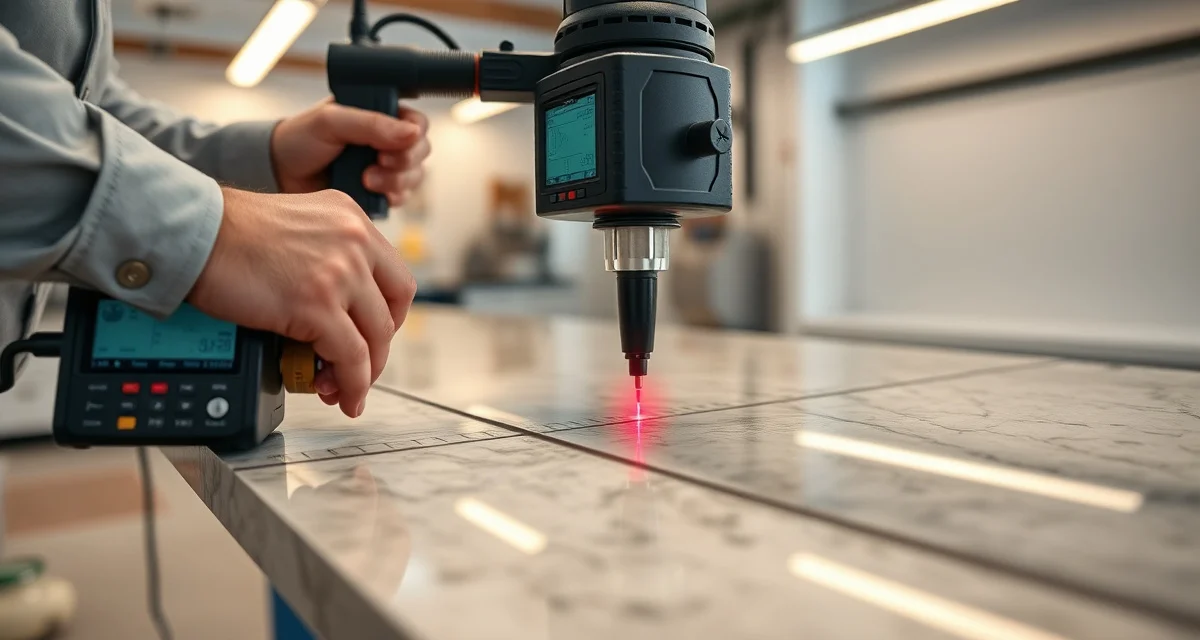
Digital laser systems use a laser distance measuring device mounted on a portable stand to capture precise measurements of the countertop area. The device records points in 3D space, building a digital template that is transferred to CNC software for cutting.
Process:
- Set up the laser device on its tripod/stand in the kitchen
- Aim the laser at key points: wall intersections, corners, edge transitions, sink locations
- Record 50-200+ measurement points per template
- Software generates a 2D or 3D digital template
- Transfer the file directly to CNC programming software
Accuracy: +/- 1/16" (0.0625")
Cost: $18,000-$30,000 for hardware and software
Time: 20-45 minutes per average kitchen job
Photogrammetry-Based Systems
Photogrammetry systems use photographs taken from multiple angles to create a 3D model of the countertop area. Software processes the images to generate dimensional data. This approach is newer to the countertop industry and less widely adopted than laser templating.
Accuracy: +/- 1/8" (improving with software updates)
Cost: $5,000-$15,000 (camera + software)
Time: 30-50 minutes per job (including photo capture and processing)
Head-to-Head Comparison
Laser Products LT-2D3D vs Prodim Proliner
These are the two dominant digital templating systems in US countertop fabrication:
| Feature | Laser Products LT-2D3D | Prodim Proliner |
|---|---|---|
| Price | $18,000-$25,000 | $22,000-$30,000 |
| Accuracy | +/- 1/16" | +/- 1/16" |
| Measurement method | Laser distance + angle | Laser distance + angle |
| Software | LT-2D3D software | Prodim Factory |
| CNC file export | DXF, most CNC formats | DXF, most CNC formats |
| Training included | 2-3 days | 2-3 days |
| Portability | 25-30 lbs with case | 20-25 lbs with case |
| Setup time on site | 3-5 minutes | 3-5 minutes |
| Battery life | 6-8 hours | 8-10 hours |
| Curved surface capability | Good | Excellent |
| US service/support | Excellent (US-based company) | Good (European HQ, US support) |
| Market share (US countertop) | ~60% | ~25% |
| Software updates | Included first year, then $1,500-$2,500/year | Included first year, then $2,000-$3,000/year |
All Methods Compared
| Criteria | Manual | Laser Products | Prodim | Photogrammetry |
|---|---|---|---|---|
| Accuracy | +/- 1/4" | +/- 1/16" | +/- 1/16" | +/- 1/8" |
| Speed (avg kitchen) | 60-120 min | 20-35 min | 20-40 min | 30-50 min |
| Upfront cost | $200-$500 | $18,000-$25,000 | $22,000-$30,000 | $5,000-$15,000 |
| Annual operating cost | $500-$1,000 | $1,500-$3,000 | $2,000-$3,500 | $500-$2,000 |
| Training time | 1-2 weeks | 2-3 days + practice | 2-3 days + practice | 1-2 days |
| CNC integration | None (manual transfer) | Direct file export | Direct file export | Direct file export |
| Error rate | 12-18% | 3-5% | 3-5% | 6-10% |
| Template transport | Physical pieces in truck | USB/cloud file | USB/cloud file | USB/cloud file |
| Operator skill required | High | Moderate | Moderate | Low-Moderate |
| Works in tight spaces | Yes | Limited by line-of-sight | Limited by line-of-sight | Yes |
ROI Analysis
The Cost of Template Errors
Template errors don't just waste material - they disrupt your entire production schedule:
| Error Consequence | Cost |
|---|---|
| Material waste (remade piece) | $200-$800 |
| Fabrication labor (redo) | $150-$400 |
| Second template visit | $75-$200 |
| Second installation visit | $150-$400 |
| Schedule delay (pushes other jobs) | $200-$500 (opportunity cost) |
| Customer dissatisfaction | Hard to quantify, easy to lose referrals |
| Total per remake | $775-$2,300 |
Shops using manual templates report template-related remake rates of 4-8%. Shops using digital templates report 1-3%. The difference: 3-5 fewer remakes per 100 jobs.
Payback Period Calculation
Assumptions: 20 jobs/month, $1,500 average remake cost, manual error rate 6%, digital error rate 2%
Monthly remakes avoided: 20 jobs x (6% - 2%) = 0.8 remakes/month Monthly savings from remakes avoided: 0.8 x $1,500 = $1,200 Monthly time savings: 20 jobs x 40 min saved x ($35/hour labor) = $467 Total monthly savings: $1,667
Laser Products LT-2D3D payback: $22,000 / $1,667 = 13 months Prodim Proliner payback: $26,000 / $1,667 = 16 months
For shops doing 30+ jobs per month, payback drops to 8-10 months.
Additional Benefits Not in the Math
- Faster scheduling (digital files ready immediately, no waiting for template transport)
- Cleaner CNC integration (no manual data entry from physical templates)
- Better customer presentations (show the digital layout on screen during selection)
- Easier quality audits (digital templates are stored and searchable)
- Reduced vehicle wear (template tech spends less time on-site)
Making the Choice
Buy Digital Templating If:
- You process 15+ jobs per month (ROI is strong)
- Your remake rate exceeds 3% (digital will reduce it)
- You have CNC equipment (direct file integration is a major benefit)
- You're doing commercial work (larger templates with more measurement points)
- Your template tech has an hour-plus drive to most job sites (time savings compound)
Stick with Manual Templating If:
- You process fewer than 10 jobs per month (ROI is slower)
- Your current remake rate is below 2% (your manual process works well)
- You don't have CNC equipment (the CNC integration benefit doesn't apply)
- Capital is tight and you can't justify $18,000-$30,000 right now
- You work in extremely tight spaces (small bathrooms, closets) where laser line-of-sight is limited
Choose Laser Products LT-2D3D If:
- You want the widest US support network and largest user community
- Your work is primarily residential kitchens and bathrooms (standard layouts)
- You value US-based customer service and training
- Budget is a factor (lower price point than Prodim)
Choose Prodim Proliner If:
- You do significant curved or complex work (commercial, hospitality)
- You need the most precise curved-surface measurement
- You work with multiple material types and complex geometries
- You already have experience with Prodim from another trade
Training and Adoption Tips
Common Mistakes During Digital Template Adoption
-
Not enough measurement points. New users take 30-40 points per kitchen when they should be taking 80-120. More points = more accurate template. The extra 10 minutes is worth it.
-
Skipping the verification step. Always re-measure 2-3 key dimensions manually (tape measure) and compare to the digital output. If they don't match within 1/8", something went wrong.
-
Forgetting to capture vertical data. Wall-to-cabinet heights, backsplash areas, and appliance clearances should be measured during the template visit - not on a separate trip.
-
Not photographing the job site. Digital templates capture geometry, not context. Photos of appliance locations, existing plumbing, wall conditions, and access points are still essential.
-
Overriding the software. When the software flags an impossible geometry (angles that don't close, dimensions that conflict), investigate rather than force the template. The software is usually right.
Training Timeline
| Week | Focus | Outcome |
|---|---|---|
| 1 | Manufacturer training (on-site or remote) | Basic device operation and software use |
| 2 | Practice templates in the shop | 5-10 practice templates on known dimensions |
| 3 | Supervised field templates | Template real jobs with an experienced person checking |
| 4 | Independent field templates with verification | Solo templates, verified against manual measurements |
| 5-8 | Full independence | Normal production templating |
Most operators are fully proficient within 4-8 weeks. The key: don't rush the verification stage. Running parallel templates (digital + manual for the same job) during weeks 3-4 builds confidence and catches errors.
Can digital templating work in homes with no power?
Yes. Both Laser Products and Prodim systems run on rechargeable batteries (6-10 hours per charge). They don't need house power.
Do I still need to visit the job site with digital templating?
Yes. Digital templating doesn't eliminate the site visit - it makes the visit faster and more accurate. You still need to verify conditions, check for level/plumb, and discuss details with the customer.
Can one template system serve multiple job types?
Yes. Both major systems handle residential kitchens, bathrooms, commercial bars, reception desks, and complex curved surfaces. The Prodim has an edge for highly curved work; the Laser Products is perfectly capable for standard residential and commercial.
What if the template device breaks on-site?
Carry a manual templating kit as backup. Devices rarely fail mid-template, but battery issues or software glitches can happen. Having strips and hot glue in the truck means you never leave a job site without a template.
How do I justify the cost to my team or partner?
Show the remake cost calculation. If you're remaking 2+ jobs per month due to template errors, a digital system pays for itself in under a year. Add the labor time savings and the math becomes even more compelling.
Can entry-level employees learn digital templating?
Yes. The learning curve for digital templating is actually shorter than manual templating - the device handles the precision, so the operator mainly needs to know what to measure and where to point the laser. Experienced carpenters and drafters pick it up in days.
Do digital templates eliminate the need for SlabWise template verification?
No. Digital templating improves measurement accuracy, but errors in sink specifications, edge profile selections, and customer change orders still slip through. SlabWise's 3-layer template verification checks the template data against the job specifications, catching discrepancies that the templating hardware alone can't identify.
How often do digital template devices need calibration?
Manufacturer-recommended calibration: annually. Some shops calibrate every 6 months for critical commercial work. Calibration can often be done by the operator using included calibration targets, or sent to the manufacturer ($200-$500 per calibration visit).
Verify Every Template Before You Cut
Whether you template manually or digitally, errors still happen - wrong sink models, changed edge profiles, and miscommunicated dimensions. SlabWise's Template Verification runs a 3-layer check on every template before it reaches your CNC, catching the errors that cause $1,500-$4,000 remakes.
Start Your 14-Day Free Trial →
Try These Free Tools
- Cost Calculator -- Compare material costs instantly across different countertop options.
- Compare Materials -- Side-by-side material comparison with pricing, durability, and maintenance.
- Kitchen Visualizer -- Let customers preview countertop materials in their actual kitchen.
Sources & Further Reading
- Natural Stone Institute - Stone Selection and Specification Guide
- National Kitchen & Bath Association - Countertop Material Selection Guidelines
- ASTM International - Standard Test Methods for Natural Building Stone
- International Surface Fabricators Association - Material Sampling Best Practices