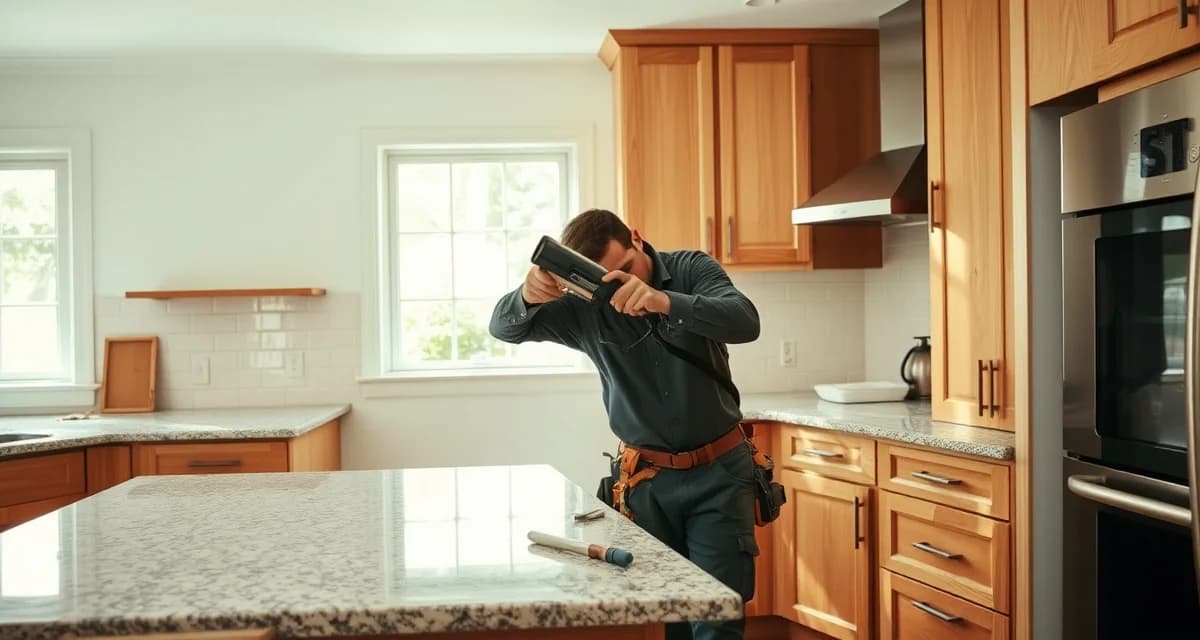
How to Remove Old Countertops: Step-by-Step for Every Material
Quick Definition
Removing old countertops involves disconnecting plumbing, detaching the countertop from cabinets (screws, adhesive, or clips), and carefully lifting the material away. Laminate removal is a straightforward DIY job. Stone removal requires professional help - a 40-square-foot granite counter weighs 700-800 lbs and can damage cabinets if mishandled. Most fabricators include old countertop removal in their installation quote at $150-$400.
TL;DR
- Laminate countertops: DIY-friendly, 1-3 hours, requires a pry bar, utility knife, and basic tools
- Stone countertops (granite, quartz, marble): Professional removal recommended due to weight (15-22 lbs/sq ft)
- Disconnect plumbing first - turn off water supply, disconnect supply lines and drain
- Typical removal cost: $150-$400 when bundled with new installation; $300-$600 standalone
- Save your cabinets: Careless removal damages cabinet tops, requiring $500-$1,500 in repairs
- Removal takes 2-4 hours for a typical kitchen depending on material and complexity
- Old stone countertops can be resold or repurposed - granite pieces sell for $50-$200 on local marketplaces
Before You Start: Preparation Checklist
Skipping preparation turns a 3-hour job into a full-day disaster. Run through this list first.
Calculate your material waste savings
See exactly how much slab material and money you could save with optimized cutting layouts.
Try the free Waste CalculatorClear Everything
- Remove all items from countertops and under sinks
- Take out any appliances sitting on the counter (microwave, coffee maker, mixer)
- Remove anything stored in the cabinet directly below where you'll be working
- Cover floors with drop cloths or cardboard - stone chips and adhesive residue are inevitable
Disconnect Services
| Service | Steps | Who Should Do It |
|---|---|---|
| Water supply | Turn off shutoff valves under sink, disconnect supply lines | DIY or plumber |
| Drain pipes | Loosen P-trap connections, have bucket ready | DIY or plumber |
| Gas line (if cooktop) | Turn off gas valve, disconnect flex line | Licensed plumber/gas fitter only |
| Electrical (if cooktop) | Turn off breaker, disconnect wiring | Licensed electrician only |
| Dishwasher | Disconnect drain hose and water supply from under sink | DIY or plumber |
| Garbage disposal | Disconnect from drain, disconnect electrical | DIY or electrician |
Critical safety note: Gas line disconnection is not a DIY task. An improperly disconnected gas line can cause an explosion. Always hire a licensed professional for gas work.
Gather Tools
For laminate removal:
- Utility knife
- Pry bar or putty knife
- Drill/driver (for removing screws)
- Work gloves
- Safety glasses
For stone removal (professional equipment):
- Suction cup lifters (rated for slab weight)
- A-frame cart or dolly
- Shims and wedges
- Reciprocating saw with carbide blade (for adhesive cutting)
- 3-4 person crew
Removing Laminate Countertops (DIY)
Laminate on particleboard or MDF is the easiest countertop to remove. A reasonably handy homeowner can handle this in 1-3 hours.
Step 1: Remove the Backsplash
If your laminate countertop has an attached backsplash (a 4-inch strip at the back), score the caulk line between the backsplash and wall with a utility knife. Then gently pry the backsplash away from the wall using a putty knife. Go slowly to avoid pulling drywall paper off with the backsplash.
Step 2: Locate and Remove Fasteners
Check underneath the countertop for screws driven up through the cabinet corner brackets into the countertop underside. There are typically 4-8 screws across a standard kitchen run. Remove them with a drill/driver.
Also check for any screws at the front rail of the cabinets and at corner joints where two countertop sections meet.
Step 3: Cut Caulk Lines
Run a utility knife along the joint where the countertop meets the wall. Also cut any caulk or adhesive around the sink cutout area.
Step 4: Lift and Remove
With fasteners removed, laminate countertops often lift straight up. If adhesive is holding them, work a pry bar underneath and gradually break the bond. Start at one end and work your way across.
Tip: Laminate countertops on particleboard are fragile. If you need to reuse them (for a garage workbench, for example), lift from underneath rather than prying up from one end.
Step 5: Clean Cabinet Tops
Scrape off any remaining adhesive, caulk, or shim material from the cabinet tops. Inspect for damage. The cabinet tops need to be clean and level before new countertop installation.
Removing Stone Countertops (Professional)
Stone countertop removal is a professional job. Here's why:
- A 10-foot section of 3cm granite weighs 380-400 lbs
- Stone doesn't flex - awkward lifting angles cause cracks
- A broken stone slab can't be repaired to like-new condition
- Dropping stone on cabinets causes $500-$1,500 in damage
How Professionals Remove Stone
Step 1: Disconnect all plumbing, appliances, and utilities.
Step 2: Cut adhesive bonds. Fabricators typically silicone stone countertops to the cabinet tops. A reciprocating saw with a long, thin blade slides between the stone and cabinet to cut through silicone. Some installers use piano wire for the same purpose.
Step 3: Break vacuum seal. Even after cutting adhesive, the stone may resist lifting due to a vacuum seal between the flat surfaces. Inserting thin shims at multiple points along the back edge breaks the seal.
Step 4: Lift with suction cups. Two or three workers position suction cup lifters on the stone surface and lift simultaneously. The stone comes up vertically, then tips onto a padded A-frame cart.
Step 5: Transport out of kitchen. Rolling the A-frame through doorways requires measuring clearances in advance. A 10-foot slab section doesn't fit through a standard 32-inch doorway - it goes out on its edge.
Step 6: Handle seam sections independently. Multi-piece countertop layouts (which account for 80%+ of kitchens) have seam joints held together with epoxy. Each section lifts independently. Don't try to lift two sections as one piece - the seam will break in an uncontrolled way.
Removing Other Countertop Materials
Tile Countertops
Tile countertops sit on a plywood and cement board substrate. Removal involves:
- Breaking tiles with a hammer (wear safety glasses and gloves)
- Prying up cement board from plywood
- Removing plywood from cabinets
- Cleaning up significant debris - expect a full garbage bag of tile shards
Time: 2-4 hours. Very messy. Dust masks recommended.
Solid Surface (Corian)
Solid surface countertops are adhered with construction adhesive and sometimes screwed from below. Removal is similar to laminate but the material is harder:
- Remove screws from below
- Cut adhesive with reciprocating saw or piano wire
- Pry gently - solid surface can crack if flexed too sharply
- Sections are much lighter than stone (4-6 lbs/sq ft)
Butcher Block
Wood countertops are usually screwed from below and sealed with adhesive. Remove screws, cut any adhesive, and lift. Butcher block weighs 8-12 lbs per square foot - manageable for two people.
Concrete
Concrete countertop removal is the hardest. Concrete counters are typically poured in place or installed as extremely heavy sections (18-25 lbs/sq ft). They're often attached with heavy-duty adhesive and may be anchored to the cabinets with rebar or wire.
Professional removal is mandatory. Cost: $400-$800 for a standard kitchen.
Costs for Countertop Removal
| Scenario | Typical Cost | Notes |
|---|---|---|
| Laminate removal (DIY) | $0 (your time) | 1-3 hours of work |
| Laminate removal (pro) | $100-$250 | Often included with new install |
| Stone removal (with new install) | $150-$400 | Bundled pricing |
| Stone removal (standalone) | $300-$600 | Higher because separate trip |
| Tile removal | $200-$400 | Debris disposal adds cost |
| Concrete removal | $400-$800 | Heavy equipment needed |
| Haul-away/disposal fee | $50-$150 | Extra for most contractors |
Most countertop fabricators bundle removal with new countertop installation. Ask about this when getting quotes - it's usually 30-50% cheaper than hiring a separate removal crew.
What to Do With Old Countertops
Resell
Granite countertops in good condition sell on Facebook Marketplace and Craigslist for $50-$200 per piece. Unusual colors or large island pieces can fetch more. The buyer handles pickup and transport.
Repurpose
Common repurposing ideas for old stone countertops:
- Outdoor kitchen or grill station
- Potting bench surface
- Workbench top
- Tabletop or desk surface
- Garden stepping stones (broken pieces)
Dispose
Most countertop materials can go to a construction debris recycler. Stone waste is inert and accepted at most landfills. Some communities have specific drop-off points for stone and concrete.
Laminate on particleboard: Standard landfill disposal. Not recyclable in most areas.
Tile: Concrete and masonry recyclers accept tile waste.
Protecting Cabinets During Removal
Cabinet damage during countertop removal is common and expensive. Scratched, dented, or cracked cabinet tops mean the new countertop won't sit properly.
Prevention strategies:
- Use thin pry bars and shims rather than large crowbars
- Lift stone vertically rather than sliding it across cabinet tops
- Place padding on cabinet edges before any lifting starts
- Check cabinet condition after removal - small damage is easier to fix now than after new installation
- Budget 15-30 minutes for cabinet cleanup and minor repairs post-removal
FAQ
How long does it take to remove kitchen countertops?
Laminate takes 1-3 hours for DIY removal. Stone countertops take 2-4 hours with a professional crew. Tile removal takes 2-4 hours. Add 30-60 minutes for plumbing disconnection and cleanup.
Can I remove granite countertops myself?
It's not recommended. A typical granite kitchen counter weighs 700-800 lbs total. The pieces are heavy, fragile under flex, and dangerous if they slip during lifting. Professional removal costs $150-$400 - cheap insurance against injury and cabinet damage.
Do I need to remove countertops before installing new ones?
Yes. The old countertop must come off before new material goes on. The exception: some contractors install over existing laminate by adding build-up strips, but this raises the counter height and isn't considered best practice.
Will removing the countertop damage my cabinets?
It can. Adhesive removal sometimes tears the cabinet surface, and prying tools can scratch or dent cabinet tops. Professional removal minimizes this risk. Budget $100-$300 for minor cabinet repairs if needed.
Should the countertop fabricator remove the old countertop?
Yes, this is the ideal approach. The same crew that installs the new countertop can remove the old one efficiently, and they know how to protect the cabinets for the new installation. Most fabricators charge $150-$400 for bundled removal.
Can I reuse my old granite countertop somewhere else?
Possibly. If the granite is in good condition and the pieces fit the new location, a fabricator can re-cut and re-polish them. However, re-fabrication costs ($20-$40/sq ft) sometimes make buying new material more economical.
What happens to my sink during countertop removal?
Undermount sinks are adhered to the underside of the countertop and usually come off with it. Drop-in sinks lift out separately. In both cases, the sink is disconnected from plumbing before countertop removal.
Do I need to remove the backsplash too?
If the backsplash is attached to the countertop (common with laminate and some stone installations), it comes off during removal. A separate tile backsplash on the wall stays in place, though the bottom row may need re-caulking after new countertop installation.
How much does it cost to remove and replace countertops?
Removal costs $150-$600 depending on material. New countertop installation ranges from $2,000-$6,000 for a standard kitchen. Total remove-and-replace budgets typically fall between $2,500 and $7,000.
Can I leave old countertops for the garbage collector?
Generally no. Most municipal garbage services don't take construction debris. Stone countertops are too heavy for standard trash pickup. You'll need a construction dumpster, a trip to the landfill, or a junk removal service ($100-$250).
Make New Installation Day Smooth From the Start
Old counter out, new counter in - the smoothest transitions start with accurate templates. SlabWise's Template Verification runs a 3-layer accuracy check so your fabrication fits perfectly the first time. No second visits, no remakes, no frustrated homeowners waiting an extra two weeks.
[Start Your 14-Day Free Trial →]
Try These Free Tools
- Photo to Template -- Snap a photo of an existing countertop and get an AI-generated DXF template.
- Template Compare -- Upload two templates and see every dimension change highlighted instantly.
- AI Template Verification -- Cross-check your template against manufacturer specs before cutting.
Sources & Further Reading
- Natural Stone Institute - Countertop Support Guidelines
- International Surface Fabricators Association - Structural Support Requirements
- National Kitchen & Bath Association - Countertop Installation Standards
- ASTM International - C1526 Standard Specification for Serpentine Dimension Stone