
TL;DR
- Stone fabrication workers need, at minimum: a NIOSH-approved respirator (N95 or better) for silica dust, safety glasses or goggles, hearing protection when noise passes 85 dB, cut-resistant gloves, safety-toe footwear, and wet-cutting controls.
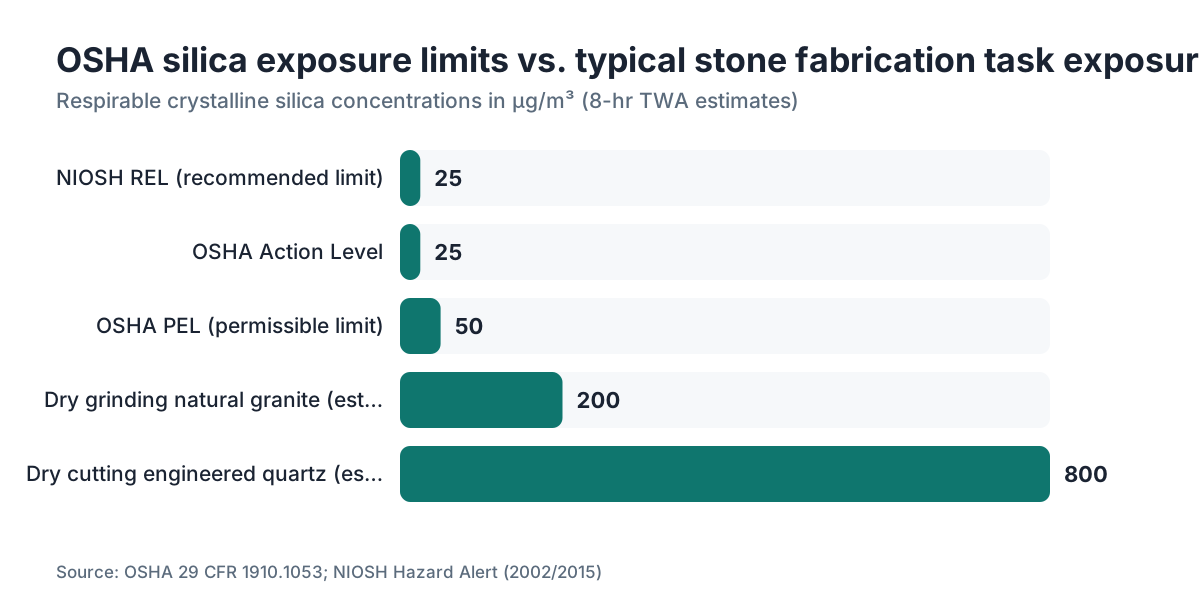
- OSHA's silica rule (29 CFR 1910.1053) caps exposure at 50 micrograms per cubic meter as an 8-hour average.
- PPE is the last defense, not the first.
Why PPE in stone fabrication is a life-or-death issue, not a compliance checkbox
Silicosis kills stone workers. That sentence is blunt on purpose.
Engineered stone (quartz composite) contains up to 93% crystalline silica by weight [1]. Cut, grind, or polish it dry and you make respirable dust thick enough to cause accelerated silicosis in months, not decades. The CDC and NIOSH put out a hazard alert in 2015 aimed squarely at engineered stone countertop fabrication, after documenting workers in their 30s with severe silicosis [2]. Some of them died.
Natural granite runs 25 to 30% silica, marble lower still. But every dry cut in a shop without controls pushes airborne particle counts well past the OSHA permissible exposure limit (PEL) of 50 micrograms per cubic meter (8-hour TWA) and past the tighter NIOSH recommended exposure limit (REL) of 25 micrograms per cubic meter [3].
PPE sits at the bottom of the hierarchy of controls, not the top. Engineering controls (wet cutting, local exhaust ventilation) come first. Even with good wet methods, though, workers still need respiratory protection for certain tasks, plus cut, impact, and noise protection layered on top. This article covers all of it.
What does OSHA actually require for stone fabrication workers?
OSHA's main rule for stone fab is 29 CFR 1910.1053 (general industry) and 29 CFR 1926.1153 (construction), both titled "Respirable Crystalline Silica" [3]. Full enforcement for general industry started in June 2018.
The core duties under 1910.1053:
- Assess exposures and control them to stay at or below the PEL of 50 micrograms per cubic meter as an 8-hour TWA
- Use engineering and work practice controls first, then add respiratory protection when those controls fall short
- Offer medical surveillance to anyone exposed at or above the action level (25 micrograms per cubic meter) for 30 or more days a year
- Train workers on silica hazards, the operations that expose them, and how to use controls
- Keep a written exposure control plan
Beyond silica, OSHA's general industry standards cover noise (29 CFR 1910.95), eye and face protection (29 CFR 1910.133), hand protection (29 CFR 1910.138), and foot protection (29 CFR 1910.136) [4]. Every shop is expected to run a hazard assessment and spell out the required PPE in writing.
Here's what shops get wrong. They assume wet cutting kills the respiratory hazard outright. It slashes it, but misting near a dry angle grinder, or kicking up dust from dried slurry, still counts as exposure. The written plan has to account for every task, not the obvious ones.
What respirator do stone fabrication workers need?
For most cutting and grinding, OSHA and NIOSH both point to a half-face elastomeric respirator with P100 filters (NIOSH-approved) or a powered air-purifying respirator (PAPR) [2][3]. A disposable N95 meets the minimum for lower-exposure tasks, but P100 filters catch 99.97% of particles versus the N95's 95%.
Here is what the filter labels mean on the shop floor:
| Designation | Oil resistance | Filtration efficiency | Typical use in stone fab |
|---|---|---|---|
| N95 | None | 95% | Low-exposure tasks, brief tool changes |
| N100 | None | 99.97% | Heavier grinding without wet suppression |
| P100 | Oil-proof | 99.97% | All silica-heavy tasks, preferred choice |
| PAPR (P100 hood) | Oil-proof | 99.97% | High-exposure shops, all-day wear |
Fit matters as much as filter rating. An N95 on a bearded face protects almost nothing. OSHA requires a fit test (qualitative or quantitative) before any worker uses a tight-fitting respirator [3]. Fit tests repeat every year, and again any time a worker's face changes enough to break the seal (dental work, big weight swing, facial injury).
NIOSH's hazard alert put it plainly: "Workers should use respiratory protection with at least an assigned protection factor of 10 (e.g., a half-face air-purifying respirator) when engineering and work practice controls are not sufficient to limit exposures to the NIOSH REL" [2]. That's the agency's language, word for word.
For engineered stone, many occupational health professionals now treat the P100 half-face as the practical floor and a PAPR as the answer for anyone doing long stretches of grinding on quartz. A P100 half-face runs about $25 to $45 for the facepiece plus $15 to $20 per filter pair. A disposable N95 runs $0.50 to $2.00 each. That gap matters to a shop budget. It vanishes next to the cost of one silicosis claim.
What eye and face protection is required?
Grinding and cutting stone throws fragments, slurry, and abrasive grit. Safety glasses with side shields meet OSHA 1910.133 for many tasks. For angle grinding and wet polishing, ANSI Z87.1-rated indirect-vent goggles add real coverage [4].
A face shield (rated to ANSI Z87.1) is required when you run a hand-held angle grinder without a guard, or when water and coolant create a splash hazard. A face shield alone is not eye protection. It goes over safety glasses or goggles, never instead of them.
CNC operators standing away from the cutting head, behind a water enclosure, can usually get by with safety glasses. The hazard assessment decides which task needs what, and that assessment has to be written down.
Anti-fog coating matters more than people expect. A worker who flips up fogged goggles has zero protection. Paying $8 more per unit for anti-fog lenses usually earns it back in actual compliance.
Do stone workers need hearing protection, and when?
Yes, and more often than shops think. OSHA's noise rule (29 CFR 1910.95) requires a hearing conservation program once workers hit 85 dB(A) as an 8-hour time-weighted average [4]. Dry grinding in a stone shop routinely runs 90 to 105 dB(A).
At 100 dB(A), OSHA's permissible exposure time without protection drops to 2 hours. That's one bridge saw run plus an hour of edge work.
Hearing protectors carry a Noise Reduction Rating (NRR). A foam earplug rated NRR 33 gives about 33 decibels of attenuation in a lab. OSHA derates real-world performance, cutting effective protection roughly in half. So NRR 33 plugs deliver about 16 to 17 dB in practice.
A shop averaging 100 dB needs muffs or plugs that drop effective exposure below 85 dB. High-NRR earmuffs (NRR 28 to 31) or foam plugs (NRR 29 to 33) are the usual picks. Some workers favor earmuffs because they're reusable and don't need clean hands to insert, which is a genuine problem in a wet shop. Double protection (plugs plus muffs) is required once noise passes 105 dB(A) [4].
Shops that skip noise monitoring and assume they're fine tend to find out during an inspection. A sound level meter costs $50 to $200 and tells you exactly what you're dealing with.
What hand protection do stone fabrication workers need?
Stone slabs have sharp edges. Full stop. Cut-resistant gloves rated ANSI/ISEA 105 Level A4 or higher are the practical minimum for manual slab handling [5]. Plenty of shops step up to Level A6 for edge work.
The ANSI/ISEA 105 scale runs A1 through A9. Level A4 means the glove withstands at least 1,000 grams of cutting load before a blade gets through. Level A6 means 2,000 grams. A standard leather work glove sits around A2 to A3.
Glove choice trades off with grip. Thin high-cut gloves give better dexterity for polishing. Heavier gloves suit raw slab handling. A nitrile coating helps when workers grab wet slabs.
One limit nobody should forget: cut-resistant gloves do not stop power tools. No glove in any commercial grade stops an angle grinder. Training has to hammer this home, because a high cut rating can breed the exact false confidence that gets a hand into a spinning blade.
What footwear is required in a stone fabrication shop?
OSHA 1910.136 requires foot protection wherever heavy, falling, or rolling objects (or electrical hazards) put feet at risk [4]. Stone slabs qualify. A full slab weighs 500 to 700 pounds. Even a remnant can break a foot.
The footwear standard is ASTM F2413, which covers impact resistance (a 75 ft-lb toe cap rating is standard) and compression resistance [6]. Steel-toe and composite-toe boots both meet it. Composite is common in wet shops because it doesn't corrode and it's lighter.
Slip resistance counts too, especially around wet polishing stations. ASTM F2913 rates slip resistance. Look for boots with a coefficient of friction of 0.4 or higher on wet surfaces [6].
Metatarsal guards protect the top of the foot, more than the toes. They're worth a look for anyone hand-handling large slabs all day. OSHA doesn't require them across the board, but your hazard assessment might.
What about protective clothing and skin protection?
OSHA doesn't set a specific clothing standard for stone fab beyond the general duty to protect against identified hazards. In practice, shops should require long sleeves or a work shirt and long pants against abrasive fragments and wet slurry.
Skin contact with silica slurry is lower risk than breathing the dust, but granite and marble slurry can irritate skin with repeated exposure. Chemical-resistant aprons matter more for workers handling adhesives, resins, or sealers, some of which carry isocyanates or VOC-heavy solvents.
For resin filling and seam work with two-part adhesives or UV-cure resins, keep a separate set of nitrile gloves (not the cut-resistant slab-handling ones) to guard against dermal sensitization. Isocyanate sensitivity, once it develops, can be permanent and can end a career.
Sun protection matters for outdoor templating and installation. That's outside the shop, but it's the same workforce.
What engineering controls reduce the need for PPE?
OSHA's hierarchy of controls ranks engineering controls above PPE. For silica in stone fab, the main ones are:
Wet cutting and grinding: water suppresses dust at the point it's made. A bridge saw with continuous water flow can cut airborne silica by 90% or more against dry cutting [3].
Local exhaust ventilation (LEV): vacuum shrouds on angle grinders and routers catch dust at the source. OSHA's Table 1 for the construction silica standard lists specific tool and LEV combinations that let workers skip exposure monitoring under set conditions [7].
Enclosures: CNC routers in enclosed cabinets with water irrigation nearly eliminate exposure at the machine. The worker still needs protection during manual finishing.
General dilution ventilation: swapping shop air for outdoor air lowers ambient dust, but it's not enough on its own for silica.
The takeaway for owners: spending on wet methods and LEV shrinks your monitoring burden, lowers PPE program costs over time, and controls the hazard instead of protecting one worker at a time. Shops running countertop installation alongside fabrication face the same silica controls at the job site for any on-site cutting.
How much does a proper stone fabrication PPE program cost?
A compliant PPE program for a 5-worker shop runs roughly $800 to $1,800 a year in consumables, assuming wet cutting is already in place. Here's a realistic breakdown:
| PPE item | Unit cost | Annual cost per worker |
|---|---|---|
| P100 half-face respirator (facepiece) | $25-$45 (1x) | $30-$45 |
| P100 filter pairs (change monthly) | $15-$20/pair | $180-$240 |
| Fit testing (annual, third-party) | $30-$75/worker | $30-$75 |
| ANSI Z87.1 safety glasses | $10-$20 | $20-$40 |
| Anti-fog goggles | $15-$30 | $15-$30 |
| ANSI A4+ cut gloves (4 pairs/yr) | $15-$40/pair | $60-$160 |
| Hearing protection (foam or muffs) | $1-$30 | $12-$60 |
| Steel-toe boots (employer provided varies) | $80-$180 | $40-$90 |
| Total per worker per year | $387-$740 |
These are real market ranges as of 2025. Prices swing with supplier and volume. OSHA generally makes the employer pay for required PPE (29 CFR 1910.132(h)), except for safety-toe footwear when the employer only recommends it rather than requires it [4].
The real cost is a silicosis workers' comp or litigation claim. Treating advanced silicosis, including a lung transplant in the worst cases, runs into hundreds of thousands of dollars. The PPE math is easy.
Shops tracking PPE against materials and labor need software that captures job-level costs cleanly. SlabWise's fabrication cost tracking shows where overhead items like PPE land in your actual job margins, which is exactly the number spreadsheets tend to lose.
What training do workers need to use PPE correctly?
PPE that workers don't use right is the same as no PPE. OSHA's silica standard requires training on the health effects of silica, the specific tasks that generate exposure in your shop, the engineering controls in place, how to use and limit use of respirators, and the purpose and content of the medical surveillance program [3].
Training has to happen before exposure starts and repeat when tasks or controls change. It has to land in a language and at a reading level the worker actually understands. OSHA has cited shops for training only in English where most workers spoke Spanish.
Respirators carry a separate set of rules. OSHA 29 CFR 1910.134 requires a written respiratory protection program, a medical evaluation before first use (a physician or PLHCP must clear the worker), and annual fit testing [8]. Those sit apart from 1910.1053's silica training.
For granite countertops and other natural stone, silica content varies, so training should match the actual materials in your shop. Marble is lower-silica. Engineered quartz is the highest-risk material in a typical countertop shop.
Hands-on beats a video every time. Have workers don and doff respirators under supervision, check the seal, and spot a spent filter. That's an hour of shop time worth spending.
What medical surveillance does OSHA require for stone workers?
Under 29 CFR 1910.1053, workers exposed at or above the action level (25 micrograms per cubic meter) for 30 or more days a year must be offered medical exams every 3 years [3]. Workers exposed above the PEL (50 micrograms per cubic meter) for 30 or more days a year must be offered exams every year.
The exam has to include a medical and work history focused on respiratory conditions, a physical exam of the respiratory system, a chest X-ray or low-dose CT scan, pulmonary function testing (spirometry), and any tests the examining physician deems appropriate.
The employer pays for every required exam. The worker gets a full written medical opinion. The employer receives only a statement of the worker's fitness for duty with required PPE, plus any recommended limits. The rest of the health information stays private.
This is the piece shops skip most. They buy the respirators, wet-cut the slabs, and never stand up medical surveillance. That's a citation waiting to happen. Worse, it's how workers reach advanced silicosis with nobody catching it early.
What are the penalties for PPE violations in stone fabrication?
OSHA's penalty structure (as of January 2025) caps serious violations at $16,550 each and willful or repeat violations at $165,514 each [9]. Silica violations land as serious by default, because the health damage is severe and well-documented.
OSHA has run targeted enforcement on engineered stone fabrication since 2019. Inspectors hunt for silica exposure control plans, monitoring records, medical surveillance enrollment, respirator fit test records, and training documentation. A shop missing all of these is looking at a stack of serious citations.
State-plan states (California, Washington, Michigan, and about 22 others) run their own OSHA programs, which have to be at least as effective as federal OSHA. Several go further. California's Cal/OSHA has been especially aggressive on engineered stone [10].
For any shop that figures it's too small to get inspected: OSHA takes referrals from workers, hospitals, and other agencies. A single silicosis diagnosis triggers one. At that point the inspection isn't random, it's aimed at you.
Frequently asked questions
Is an N95 mask enough for cutting granite or quartz countertops?
An N95 meets OSHA's minimum for lower-exposure tasks but falls short for heavy grinding or cutting of engineered quartz, which can hold up to 93% crystalline silica. NIOSH points to a half-face elastomeric respirator with P100 filters (99.97% efficiency) as the more reliable choice. N95s also fail on bearded faces. For engineered stone, most occupational health professionals treat the P100 half-face as the practical floor.
What OSHA standard covers silica dust in stone countertop fabrication?
The main standard is 29 CFR 1910.1053, OSHA's respirable crystalline silica rule for general industry, in full effect since June 2018. It sets a PEL of 50 micrograms per cubic meter as an 8-hour TWA and an action level of 25 micrograms per cubic meter. Shops doing installation work at job sites fall under 29 CFR 1926.1153, the construction version of the same rule.
Do employers have to pay for PPE in a fabrication shop?
Yes, with limited exceptions. OSHA 29 CFR 1910.132(h) requires employers to pay for required PPE, including respirators, eye protection, gloves, and hearing protection. The main exception is safety-toe footwear when the employer only recommends it rather than mandating it. If your hazard assessment says steel-toe boots are required, you pay for them.
How often do respirator fit tests need to happen in a stone fab shop?
At least once a year, per OSHA 29 CFR 1910.134. A new fit test is also required whenever a worker changes respirator model or size, has significant facial changes (dental work, major weight swing, facial injury), or reports the seal doesn't feel right. Fit tests must happen before first use, run by a qualified tester using either qualitative or quantitative methods.
What cut-resistance level gloves should stone fabrication workers wear?
ANSI/ISEA 105 Level A4 is the practical minimum for slab handling and edge work, meaning the glove withstands at least 1,000 grams of cutting load. Many shops use A6 (2,000 grams) for raw edge handling. Cut-resistant gloves do not protect against power tools. No commercial glove stops an angle grinder. Workers handling wet slabs benefit from nitrile-coated grip surfaces.
Does wet cutting eliminate the need for a respirator?
No, but it slashes exposure. Continuous water flow on a bridge saw can cut airborne silica by 90% or more against dry cutting. Workers grinding with angle grinders near wet slurry, or kicking up dried slurry, still face real exposure. OSHA and NIOSH require respirators as a supplement to engineering controls, not a replacement, when exposures aren't fully controlled.
What is the OSHA permissible exposure limit for silica dust?
OSHA's PEL for respirable crystalline silica is 50 micrograms per cubic meter as an 8-hour time-weighted average, set in 29 CFR 1910.1053. The action level, which triggers monitoring and medical surveillance requirements, is 25 micrograms per cubic meter. NIOSH's recommended exposure limit is lower at 25 micrograms per cubic meter, reflecting stricter health-based guidance.
What hearing protection is required in a stone fabrication shop?
OSHA requires hearing protection once workers reach 85 dB(A) as an 8-hour TWA, under 29 CFR 1910.95. Dry grinding in stone shops typically runs 90 to 105 dB(A). Foam earplugs with NRR 29 to 33 or high-NRR earmuffs (NRR 28 to 31) are standard. Double protection is required above 105 dB(A). Shops must monitor noise and run a hearing conservation program once the action level is reached.
Are there specific PPE requirements for engineered quartz versus natural stone?
OSHA's silica standard covers both, but the risk gap is large. Engineered quartz can hit 93% crystalline silica versus roughly 25 to 30% for granite and much lower for marble. The same dry cutting task on quartz makes far more hazardous dust. Many occupational health professionals recommend moving up from N95 to P100 half-face respirators specifically for quartz fabrication.
What does OSHA require for medical surveillance of stone workers exposed to silica?
Workers exposed at or above the action level (25 micrograms per cubic meter) for 30 or more days a year must be offered exams every 3 years. Workers above the PEL (50 micrograms per cubic meter) for 30 or more days must be offered exams every year. Exams include medical and work history, a respiratory exam, chest X-ray or CT, and spirometry. Employers pay and receive only a fitness-for-duty opinion, not detailed health data.
What PPE is needed for countertop installation at a job site?
The same silica controls apply for any on-site cutting of stone. Workers cutting granite, quartz, or marble at a job site fall under OSHA 29 CFR 1926.1153. P100 respirators, eye protection, and hearing protection are required for any dry or insufficiently wet cutting. Most experienced fabricators do all cutting in the shop and only handle finished pieces on site to hold this exposure down.
What are the penalties for not providing proper PPE to stone workers?
As of January 2025, OSHA's maximum penalty for a serious violation is $16,550. Willful or repeat violations can reach $165,514 each. Silica violations count as serious by default. A shop with no written exposure control plan, no fit test records, and no medical surveillance enrollment is likely to face multiple citations in a targeted inspection. State-plan states like California can add their own penalties.
Can fabrication shop owners be held personally liable for silica injuries?
OSHA citations go to the employer entity, not individuals in most cases. Workers' compensation claims, civil suits, and in some states criminal charges can follow if an employer knowingly exposed workers to hazardous conditions. Several fabrication shops have faced large workers' comp settlements after silicosis diagnoses. Adequate PPE and documented compliance programs are the factual foundation of any legal defense.
How do I set up a written exposure control plan for a stone fab shop?
OSHA 1910.1053 requires a written plan describing each task that involves silica exposure, the engineering controls and work practices used for each, the respirator assigned to each, and the housekeeping measures in place. OSHA's Small Entity Compliance Guide gives a template structure. The plan has to be accessible to workers and updated when tasks or controls change. Your state plan agency may add requirements.
Sources
- NIOSH, "Silica, Crystalline (Respirable Size)" - Health Hazard Evaluations: Engineered stone countertop products can contain up to 93% crystalline silica by weight
- NIOSH Hazard Alert: Health Effects of Occupational Exposure to Respirable Crystalline Silica (2002, updated 2015 for engineered stone): NIOSH recommends workers use respiratory protection with at least an assigned protection factor of 10 when engineering and work practice controls are not sufficient to limit exposures to the NIOSH REL; cases of accelerated silicosis in young engineered stone workers documented
- OSHA, 29 CFR 1910.1053 Respirable Crystalline Silica - General Industry Standard: PEL is 50 µg/m³ as an 8-hour TWA; action level is 25 µg/m³; requires written exposure control plan, medical surveillance, and training
- OSHA, Personal Protective Equipment Standards (29 CFR 1910.132-.138, .95): OSHA requires employer-paid PPE including eye, face, hand, foot, and hearing protection based on documented hazard assessment; employers pay for required PPE per 1910.132(h)
- ISEA, ANSI/ISEA 105-2016 American National Standard for Hand Protection Classification: ANSI/ISEA 105 cut resistance levels A1-A9; Level A4 requires 1,000 grams cutting load resistance, A6 requires 2,000 grams
- ASTM International, ASTM F2413 Standard Specification for Performance Requirements for Protective (Safety) Toe Cap Footwear: ASTM F2413 sets impact resistance (75 ft-lb) and compression requirements for protective footwear; ASTM F2913 covers slip resistance with COF thresholds
- OSHA, 29 CFR 1926.1153 Table 1 - Specified Exposure Control Methods When Working with Materials Containing Crystalline Silica: OSHA Table 1 lists specific tool/LEV combinations for construction silica tasks that allow workers to forego exposure monitoring under specified conditions
- OSHA, 29 CFR 1910.134 Respiratory Protection Standard: Requires written respiratory protection program, medical evaluation before first respirator use, and annual fit testing for tight-fitting respirators
- OSHA, Penalty Adjustments (January 2025): Maximum penalty for serious violation is $16,550; maximum for willful or repeat violation is $165,514 as of January 2025
- California DIR/Cal OSHA, Engineered Stone Countertop Enforcement: Cal/OSHA has conducted targeted enforcement of engineered stone fabrication shops and may impose penalties beyond federal OSHA minimums
- OSHA, Small Entity Compliance Guide for the Respirable Crystalline Silica Standard for General Industry and Maritime: Provides template structure and guidance for written exposure control plans required under 1910.1053
Last updated 2026-07-11