
TL;DR
- Completed operations coverage is the part of a general liability policy that pays for bodily injury or property damage that happens after a job is finished.
- For countertop installers, that means a cracked slab that falls weeks later, a leak from a bad sink cutout, or a customer who slips on a new countertop.
- Without it, your policy stops protecting you the second you pack up the truck.
What exactly is completed operations coverage?
Completed operations coverage is the piece of a commercial general liability (CGL) policy that responds after your work is done. The Insurance Services Office (ISO), which writes the standard policy forms used across the industry, defines the "products-completed operations hazard" to include bodily injury and property damage that occur away from your premises and arise out of your work once that work is finished [1]. Plain version: the moment you leave the job site, the completed operations part of your policy takes over from the premises and ongoing-operations part.
Timing is the whole point. The injury or damage does not have to happen the same day. A countertop installed correctly can develop a stress crack from an unseen substrate problem six months later. A silicone bead around an undermount sink can look perfect at install and start leaking into a cabinet three weeks after the homeowner moves in. File a claim at that point and your ongoing-operations coverage does nothing. Completed operations is what answers the phone.
The ISO CGL form (CG 00 01) is the backbone of most contractors' liability policies in the United States. Many versions bundle two coverage limits: the products-completed operations aggregate and the general aggregate. Some keep them separate. Check your declarations page to see which structure you have. Once you burn through the products-completed operations aggregate, there is nothing left for after-the-fact claims even if your general aggregate still has money sitting in it [1].
Why do countertop installers specifically need this coverage?
Countertop work is almost a textbook match for the completed operations exposure. The material is heavy (granite runs 18 to 20 pounds per square foot [2]), it sits on top of other people's property, and failures tend to surface days or weeks after you leave, not while you're standing there.
Here are the loss scenarios that come up most in this trade:
- A stone slab falls during or after install and damages flooring, cabinetry, or injures someone in the kitchen.
- A sink cutout weakens the slab, and it cracks under normal use after you're gone.
- Water gets in around a cooktop cutout and grows mold inside the cabinet below.
- A bad seam lets the two slab pieces shift, cracking adjacent tile or a backsplash.
- A customer trips over a lip created by a new countertop height that doesn't match the old one.
Every one of those arrives after you've left. Ongoing-operations coverage, which protects you while you're physically on site and working, has already closed. No completed operations means you're self-insuring those losses out of your own pocket.
Countertop installers also carry a longer tail than, say, a painter. A bad paint job looks bad fast. A stone installation can look and perform perfectly for months before a defect shows itself. Some state statutes of repose run six to ten years for construction defects, so a claim can land years after the job [3]. Your completed operations coverage runs for whatever period you keep it in force, and a one-year occurrence policy with a coverage gap can leave you badly exposed.
How does completed operations coverage differ from ongoing operations coverage?
Easiest way to hold it in your head: ongoing operations is live while your crew is on site. Completed operations is live after they leave.
ISO's CGL form (CG 00 01) treats them as two phases of the same policy, but the trigger differs. Ongoing operations responds to damage that happens while the work is in progress. Completed operations responds to damage that happens once the work is done, abandoned, or your part of the contract is fulfilled [1].
For a shop that also templates, fabricates, and delivers, the line blurs. If your driver drops a slab during delivery and it smashes a client's front steps, that's likely an ongoing-operations claim, because your crew is still on site and the work isn't complete. If the slab was installed, the customer signed off, and it falls two weeks later, that's a completed-operations claim.
Some insurers sell "combined single limit" policies that don't cleanly separate the two phases in the aggregate. Others write policies where the products-completed operations aggregate is its own bucket. For a shop running multiple crews and dozens of installs a month, a separate and higher completed-operations aggregate is worth asking for. Burn through it on one bad claim and you still have your general aggregate intact for everything else.
Here's what completed operations does not touch: the cost to redo your own work. If the slab cracks because you made a bad cut, your CGL (completed operations included) pays for the damage to the customer's home, not the replacement slab. That's a contractor's errors and omissions (E&O) or a business property policy question. Know the difference before you assume you're covered for everything.
What does a completed operations claim actually look like in practice?
Your crew installs a quartzite countertop on a Monday. The homeowner is thrilled, pays the invoice, and you close the job. Three weeks later, they notice a hairline crack running from the sink cutout toward the edge. By week six the crack has widened, a piece of the front edge lets go, and it nicks the hardwood floor below.
The homeowner calls. They want the countertop replaced and the floor repaired. Damages: $4,200 for a new slab and installation, $800 for floor repair, $600 for the temporary rental sink they had to use. That's $5,600.
Your completed operations coverage pays for the property damage, meaning the floor and the temporary sink. It does not pay your cost to reinstall the countertop itself, because the policy covers third-party property damage, not your faulty product. In practice, most fabricators eat the material cost anyway to save the relationship and head off a bigger fight.
Now change one detail. The edge piece hits the homeowner's child instead of the floor. You're looking at a bodily injury claim that can clear $50,000 fast once you add medical bills and lost wages. That's where completed operations earns its premium many times over.
Same scenario, no completed operations, or a policy that excludes it. You pay that claim personally. For a small shop doing $500,000 a year in revenue, one serious bodily injury claim can close the doors.
How much does completed operations coverage cost for countertop shops?
You can't buy completed operations as a standalone policy. It comes bundled inside a CGL policy. What you actually control is the aggregate limit you buy and the overall CGL premium.
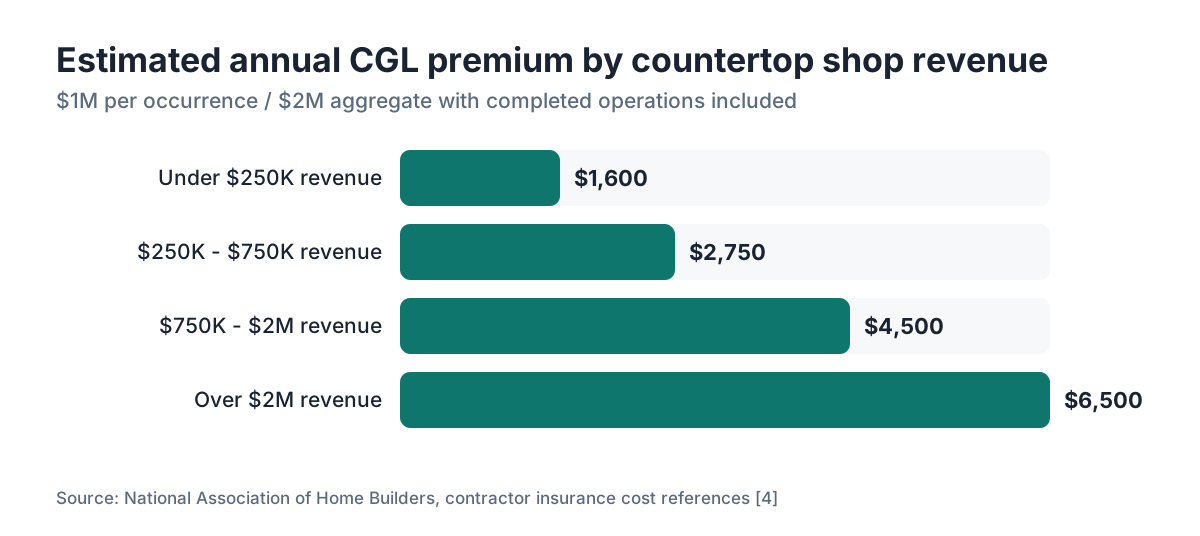
For a small countertop fabrication or installation shop, a CGL policy with $1 million per occurrence and $2 million aggregate typically runs $1,200 to $4,000 a year, based on industry surveys and broker data [4]. The products-completed operations aggregate on that policy is often the same $2 million. Shops with higher revenue, more employees, or a claims history pay more.
The table below shows roughly how limits and premiums scale. These are ballpark figures from contractor insurance surveys. Your real quote depends on your state, payroll, and loss history.
| Annual Revenue | Occurrence Limit | Completed Ops Aggregate | Estimated Annual Premium |
|---|---|---|---|
| Under $250K | $1M | $2M | $1,200 - $2,000 |
| $250K - $750K | $1M | $2M | $2,000 - $3,500 |
| $750K - $2M | $1M or $2M | $2M | $3,000 - $6,000 |
| Over $2M | $2M+ | $2M+ | $5,500+ |
Many general contractors require your certificate of insurance to show completed operations coverage for a set number of years after project completion, often two to five. If your policy renews annually and you switch insurers, confirm the new policy picks up the tail. The gap between policy years is exactly where installers get hurt.
Ask your broker one pointed thing: is the products-completed operations aggregate shared with the general aggregate, or separate? It is one of the most misread line items on a CGL declarations page.
What does completed operations coverage NOT cover?
Knowing the exclusions matters as much as knowing what's covered.
The CGL policy, completed operations included, excludes the cost of repairing or replacing your own faulty work. ISO's standard CGL form excludes damage to "your work" arising out of it or any part of it [1]. If your countertop cracks because you made a bad cut, the policy doesn't buy a new slab. It pays for the customer's damaged cabinet below, not your material.
Completed operations also does not cover:
- Intentional acts or fraud.
- Contractual liability beyond what the policy specifically extends to (though most standard CGL forms do cover liability you assume in an "insured contract," which usually includes construction contracts).
- Employee injuries. Those belong under workers' compensation, not CGL.
- Damage to property you own or that's in your care, custody, or control during the job.
- Professional errors in design or specification, which fall under professional liability or E&O policies.
- Auto liability from your vehicles.
For countertop shops, the care-custody-control exclusion is the one to watch. While the slab sits in your shop being fabricated, it's in your custody. Break it there and your commercial property policy responds, not your CGL. Once it's installed and the customer owns it, completed operations is the right coverage.
Some policies add exclusions for specific materials or methods. A policy written for a general contractor might exclude stone work outright, or exclude work over a set dollar amount per project. Read your exclusions page before you assume anything.
Do general contractors require completed operations coverage from subs?
Yes, and more of them every year. Most GC subcontracts include indemnification clauses and insurance requirements that spell out completed operations coverage, sometimes for a period stretching well past project completion.
The requirement usually lives in the subcontract's insurance exhibit. A typical clause reads something like: "Subcontractor shall maintain commercial general liability insurance with completed operations coverage for a period of not less than three years following final completion of the work." The GC gets named as an additional insured on that policy, often including the completed operations piece.
ISO has an endorsement built for this: CG 20 37 (Additional Insured, Owners, Lessees or Contractors, Completed Operations) [1]. When a GC asks to be added as an additional insured for completed operations, your insurer adds this endorsement. It doesn't cut your own limits. It extends those limits to cover the GC for claims arising from your completed work.
For countertop shops subbing to GCs on commercial jobs (restaurant buildouts, hotel renovations, office kitchenettes), failing to provide this endorsement gets you dropped from the bidding list. It's a standard requirement, not a special favor. Make sure your certificate of insurance reflects completed operations coverage and that your insurer can issue CG 20 37 when a GC asks.
Homeowners doing a kitchen remodel rarely think to ask for this, but a careful one reading the countertop installation contract might. Either way, the coverage protects you whether or not the client knew to require it.
How long does completed operations coverage last after a job is finished?
That depends on your policy structure, and it's one of the more confusing parts of contractor insurance.
If you have an occurrence-based policy (most CGL policies are), completed operations applies to incidents that occur during the policy period, no matter when the claim gets filed. Finish a job in March, and if your policy runs through December, any incident before December is covered even if the claim doesn't show up until the next year.
The trouble starts when you stop paying premiums or switch insurers. An occurrence policy covers incidents during the period you paid for. Let your policy lapse in December and someone files in January for an incident that happened in November, and you're covered, because the incident fell inside the policy period. But if the incident itself happens after your policy lapses, you have nothing.
For countertop shops, the practical rule is simple: keep your CGL in force continuously. Don't cancel at the end of a slow season, and don't switch insurers without confirming there's no gap. If you retire or close the shop, ask about a "tail" endorsement (an extended reporting period) that extends coverage for claims arising from completed work after you stop operating.
State statutes of repose set the outer limit on construction defect claims. California's runs ten years from substantial completion [3]. Other states range from four to twelve. Your coverage needs to outlast the statute of repose, or at least you need to understand exactly what you're risking during any gap years.
How do you verify your policy actually includes completed operations?
Pull your certificate of insurance (the ACORD 25 form) and your policy declarations page. Look for two specific things.
First, on the ACORD 25, find the line under commercial general liability that reads "Products-Comp/Op Agg" with a dollar amount. A limit in that field means you have completed operations coverage. Blank or "excluded" means you don't [5].
Second, open the actual policy and hunt for endorsements that change the completed operations coverage. The ones to watch:
- CG 21 34 (Exclusion, Designated Work): can carve specific types of work out of completed operations.
- CG 22 79 (Exclusion of Injury or Damage Arising from the Products-Completed Operations Hazard): removes completed operations entirely. See this endorsement and your policy does not cover post-completion claims. Full stop.
- CG 20 37 (Additional Insured, Completed Operations): a positive endorsement that extends coverage to a named additional insured.
Plenty of installers assume they're covered because they hold a "liability policy." Some policies sold to small contractors, especially the very cheap online-quoted ones, strip out products-completed operations by endorsement. The premium looks great precisely because a major exposure got quietly deleted.
Run shop management software like SlabWise to track jobs and close them out, and you have clean records of when each install finished. Those dates matter if a claim comes in and your insurer needs to confirm the job fell inside your coverage period.
If you're not sure what your policy says, call your broker and ask three questions: (1) Do I have products-completed operations coverage? (2) What is the aggregate limit? (3) Is it separate from or shared with my general aggregate? Those three answers tell you most of what you need to know.
What limits should a countertop installer carry?
The standard minimum for most subcontract work is $1 million per occurrence and $2 million aggregate, with the products-completed operations aggregate matching the general aggregate. That's the floor, not the recommendation.
For a shop doing real volume, think about how fast one bad claim eats a $2 million aggregate. A single serious bodily injury claim with hospital bills, lost wages, and pain-and-suffering damages can settle well north of $1 million. Get three installs that generate claims in the same policy year and $2 million disappears quicker than you'd guess.
Most brokers who specialize in contractor coverage tell countertop shops over $1 million in annual revenue to carry $2 million per occurrence and $4 million aggregate, plus a commercial umbrella adding $1 to $5 million of excess coverage. Umbrella policies are often cheaper than people expect, running $500 to $1,500 a year for $1 million in coverage on top of your primary CGL [4].
High-end residential and commercial work carries higher exposure. A boutique kitchen with $60,000 of quartzite is a far bigger completed operations risk than a rental getting laminate. The value of the surrounding property (custom cabinetry, hardwood floors, high-end appliances) sets how expensive a consequential damage claim can get. Scale your limits to the work you actually do.
Install granite countertops or marble countertops on high-end projects? Carry higher limits. The material value and the surrounding finishes both push the potential claim size up.
What records should you keep to protect yourself on completed operations claims?
Your ability to defend a completed operations claim rests almost entirely on documentation.
The core records to keep on every job:
- Signed customer acceptance or completion document with the date. This nails down when your work finished and starts the clock on your completed operations coverage period.
- Pre-installation photos of the substrate and the existing condition of cabinets, flooring, and appliances.
- Post-installation photos of the finished countertop, seams, cutouts, and edge profiles.
- Material traceability: slab lot number, supplier, fabrication date. If a defect traces back to a manufacturing issue in the stone, you may have a claim against the supplier instead of eating it yourself.
- Written notes on anything you warned the client about (unlevel cabinets, unusual stress points, a sink already slightly off-center).
- Your template measurements and cut files. Run CNC equipment or digital templating and those files survive to prove the dimensions matched the space.
Shops running digital job management, including software that tracks job status, close-out dates, and document uploads, have a real edge here. Organizing job records by close-out date means you can pull documentation fast when an insurer asks, sometimes two or three years after the install.
One thing installers skip too often: have the customer sign a document listing any pre-existing conditions you noted and the care instructions you gave them. If they later claim the countertop cracked because of your installation when the real cause was a cast iron skillet dropped from waist height, that signed document is your defense.
For commercial jobs on materials like Cambria countertops or engineered stone, the manufacturer's installation requirements matter too. Deviate from the spec sheet and you can void the manufacturer's warranty and pull a claim back onto yourself that you could have handed to them.
Frequently asked questions
Is completed operations coverage the same as general liability insurance?
No, but it's part of it. General liability (CGL) insurance has two main phases: ongoing operations (while you're on site) and completed operations (after you leave). Most standard CGL policies include both under the ISO CG 00 01 form. The confusion comes from policies that quietly exclude the completed operations portion through an endorsement, which leaves a big gap for contractors whose claims often arrive weeks or months after the job is done.
What if a homeowner claims damage a year after I installed their countertop?
Your completed operations coverage responds to claims for bodily injury or property damage that occurred after the job finished, as long as the incident happened while your policy was in force. A claim filed a year later is covered if the damage itself happened while your policy was active. That's why continuous coverage matters: a lapse means any incident during the gap is uninsured, even if the claim comes in while you're covered again.
Do I need completed operations coverage if I only do residential work?
Yes. Residential clients are more likely to sue over post-installation problems than commercial clients, not less. Homeowners live in the space and notice issues immediately. They also have more emotional stake in the outcome. A cracked countertop over a beautiful cabinet run, or water damage from a leaking cutout, can generate claims that exceed your annual revenue. The residential market doesn't demand certificates of insurance the way GCs do, but the exposure is just as real.
Can I add completed operations coverage if my current policy excludes it?
Sometimes. Ask your broker whether the exclusion can be removed by endorsement and what the added premium is. Some insurers exclude it because of your claims history or the type of work you do and won't add it back. In that case you may need to shop a different carrier. Specialty contractor insurance markets (many operate through wholesale brokers) often have more flexibility than standard admitted carriers for trades with higher completed operations exposure.
How is completed operations different from a warranty I offer customers?
A warranty is a contractual promise you make to your customer about the work. Completed operations is insurance that pays third parties for bodily injury or property damage. Different purposes. Your warranty might cover resealing a countertop or replacing a cracked slab at your expense. Your completed operations coverage pays if that cracked slab damages the customer's property or injures someone. You need both, and one does not substitute for the other.
What is the products-completed operations aggregate on my policy declarations page?
It's the maximum your insurer pays in a single policy year for all completed operations claims combined. Exhaust that amount and additional claims in the same year go uncovered under that policy. On many standard CGL policies this aggregate is $2 million, either shared with or separate from the general aggregate. Checking whether your policy keeps these aggregates separate matters: a separate completed ops aggregate gives you more total protection.
Does completed operations coverage pay to redo my own bad work?
No. The ISO CGL form specifically excludes damage to your own work that arises from the work itself. Make a bad cut and the slab cracks, and completed operations pays for your customer's damaged cabinet below the slab, not the replacement stone. The cost to redo your own work is a business loss you absorb directly or recover from your supplier if the material was defective. Some contractors add a separate errors and omissions policy to cover this gap.
How long do I need to maintain completed operations coverage after finishing a job?
At minimum, long enough to cover your state's statute of repose for construction defects. California's is ten years from substantial completion. Most other states run four to twelve years. Practically, keep your CGL in force continuously as long as you're in business. If you close the shop, ask about a tail endorsement to extend reporting coverage for claims arising from past work. GC subcontracts often specify two to five years of coverage post-completion as a contractual requirement.
What is an additional insured endorsement for completed operations, and when do I need one?
When a general contractor or property owner requires your completed operations coverage to also protect them, your insurer adds them as an additional insured, typically via ISO endorsement CG 20 37. It doesn't reduce your own coverage. It means that if a claim arises from your completed work and the GC gets sued alongside you, your insurer defends both up to your limits. This is standard on commercial subcontracts and increasingly common on larger residential remodels.
Is completed operations coverage required by law for countertop installers?
No federal law mandates it, and most states don't require it specifically. But many state contractor licensing rules mandate general liability coverage, and in practice those policies include completed operations. California's Contractors State License Board requires licensees to carry general liability, and standard CGL policies include completed operations unless excluded by endorsement. Licensing requirements vary by state; check your state licensing board's current minimums.
What happens to completed operations coverage if I switch insurance companies?
Only incidents that occur during your new policy's coverage period are covered by the new insurer. Your old insurer still handles claims for incidents that happened during their policy period, even after you switch. The risk is a gap: cancel coverage in December and don't start new coverage until February, and any incident in January is uninsured even if the actual claim arrives months later when you're covered again. Never let your CGL lapse between carriers.
Does completed operations coverage apply to subcontractors I hire?
Your CGL covers your own completed work. If you hire a sub who causes damage and your customer sues you, your policy may respond, but you'll want to recover from the sub's insurer. That's why requiring subs to carry their own CGL with completed operations coverage (and to name you as an additional insured) matters. Without it, you end up paying claims your sub caused, with little ability to recover if they have no assets or insurance.
Can a customer sue me for a countertop problem after the statute of limitations expires?
Generally no, but statutes of limitations and statutes of repose are different. The statute of limitations (often two to three years for property damage) starts when the customer knew or should have known about the damage. The statute of repose is a hard cutoff from the date of completion, regardless of discovery. California's construction defect statute of repose is ten years. Other states run four to twelve. Both clocks are running on every job you finish, so keep your records and coverage accordingly.
Sources
- Insurance Services Office (ISO), Commercial General Liability Coverage Form CG 00 01: ISO CG 00 01 defines the products-completed operations hazard, the 'your work' exclusion, and the framework for ongoing versus completed operations coverage phases; endorsements CG 20 37 and CG 21 34 modify completed operations coverage for additional insureds and designated work exclusions.
- Natural Stone Institute, Stone Weight and Specifications: Granite weighs approximately 18 to 20 pounds per square foot at standard countertop thickness.
- California Code of Civil Procedure Section 337.15 (Statute of Repose for Construction Defects): California's statute of repose for latent construction defects is ten years from substantial completion of the improvement.
- National Association of Home Builders, Cost of Construction Survey and Insurance Cost References: Small contractor CGL policies with $1M/$2M limits typically run $1,200 to $4,000 per year; commercial umbrella policies often cost $500 to $1,500 per year for $1M in additional coverage.
- ACORD Corporation, ACORD 25 Certificate of Liability Insurance Form: The ACORD 25 Certificate of Liability Insurance includes a Products-Comp/Op Agg field that shows whether completed operations coverage is in force and the aggregate limit available.
- California Contractors State License Board, Insurance and Bond Requirements: California requires licensed contractors to carry general liability insurance; standard CGL policies include completed operations coverage unless excluded by endorsement.
- Texas Department of Insurance, Commercial General Liability Insurance Guidance: Standard CGL policies in Texas and most states use ISO policy forms that include products-completed operations hazard coverage as a default component.
- Florida Division of Financial Services: Florida contractor licensing requirements include general liability coverage; policies must clearly state completed operations limits on the certificate of insurance.
- Occupational Safety and Health Administration (OSHA), Construction Industry Standards: OSHA construction standards establish worker safety requirements relevant to countertop installation sites, separate from insurance coverage requirements.
- U.S. Small Business Administration, Business Insurance Guide: SBA guidance recommends commercial general liability insurance for contractors, noting that policies should cover both ongoing and completed operations for full protection.
Last updated 2026-07-11