
TL;DR
- Cutting, grinding, or polishing engineered stone and natural stone releases respirable crystalline silica dust, which causes silicosis and lung cancer.
- OSHA's permissible exposure limit is 50 micrograms per cubic meter over an 8-hour shift.
- Wet cutting, local exhaust ventilation, and N95 or higher respirators are the core controls.
- Skipping them kills workers, sometimes within months of first exposure.
Why is stone fabrication so dangerous?
The most dangerous thing in a stone shop is the part you cannot see. Cut, grind, or polish granite, marble, quartzite, or engineered quartz and you throw fine airborne particles of crystalline silica into the air. They measure in microns. You cannot see most of them, they don't scratch your throat the way sawdust does, and by the time a worker feels short of breath the scarring in the lungs is already permanent.
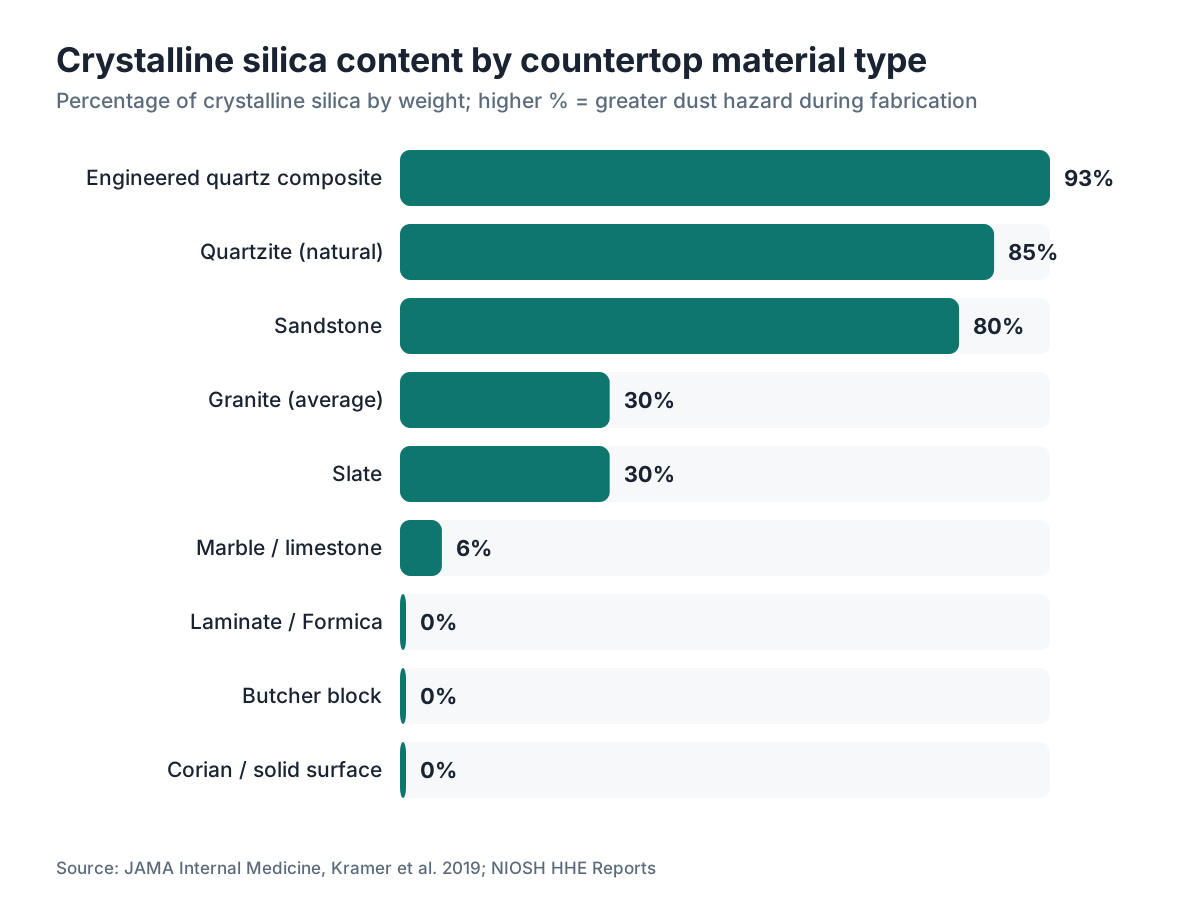
Engineered stone is the current crisis. A 2019 study in JAMA Internal Medicine, 'Silicosis Among Engineered Stone Countertop Fabrication Workers,' reported that engineered stone contains up to 93% crystalline silica by weight, against roughly 20-45% in natural granite [1]. Workers cutting it have developed accelerated silicosis, a fast-moving form of the disease, after only one to three years on the job. Some died before 40.
Natural stone is not the safe alternative. Granite averages 25-30% silica. Marble runs lower on silica but still throws fine particulate. Quartzite, natural as it is, can hit 80-90% silica. Material matters, but no dry-cutting operation on any of these is acceptable without engineering controls.
The physical hazards stack on top of the dust. Slabs weigh 400-700 pounds and get moved, tilted, and set by workers who a shifting slab can crush. Bridge saws, angle grinders, core drills, and CNC routers all cut people as readily as stone. Cutting noise routinely clears 90 dB, the level OSHA ties to a required hearing conservation program [2]. Coolant and slurry make floors slick. The list runs long. Silica dust is just the hazard that has produced federal enforcement sweeps and wrongful-death verdicts at scale.
What is OSHA's silica rule and what does it require?
OSHA's final rule on respirable crystalline silica sets a permissible exposure limit of 50 micrograms per cubic meter of air (µg/m³) as an 8-hour time-weighted average, with an action level of 25 µg/m³ that triggers monitoring and medical surveillance [3]. The rule took full effect for general industry in 2018. Stone fabrication falls under it.
The old PEL, in force before the 2016 rulemaking, was 100 µg/m³. The current limit is half that. OSHA's own regulatory impact analysis estimated the tighter rule would save roughly 600 lives per year and prevent about 900 new silicosis cases annually [3].
Countertop fabrication lives in the general industry category (29 CFR 1910.1053), not construction, because shops are fixed workplaces. The general industry standard tells employers to:
- Measure worker exposures when there's reason to think the action level may be exceeded (in a fabrication shop without controls, it almost always is).
- Use engineering and work-practice controls to hold exposures at or below the PEL before leaning on respirators.
- Offer medical surveillance, including periodic chest X-rays and spirometry, to anyone exposed at or above the action level 30 or more days a year.
- Train workers on silica hazards, symptoms, and controls.
- Keep exposure and medical records for 30 years [3].
OSHA launched a National Emphasis Program on silica in 2020, which means inspectors are actively hunting for stone fabrication shops [10]. Serious violations run up to $15,625 each, and willful or repeated ones up to $156,259, as of 2024 [4].
How much silica dust does stone cutting actually produce?
A staggering amount, fast. A 2015 NIOSH Health Hazard Evaluation at a countertop shop measured silica during dry grinding above 2,000 µg/m³, forty times the current OSHA PEL [5]. Even wet cutting without proper ventilation came back well over the action level.
Engineered stone cuts worse than natural stone. The high silica content plus the resin binder, which keeps particles suspended longer, means a worker dry-grinding an engineered quartz slab can take in a full day's allowed exposure in under 10 minutes at peak task intensity. Nobody has modeled every product-and-tool pairing, but NIOSH field studies keep showing this class of material is several times more hazardous than natural granite under matched cutting conditions [5].
Air behaves differently by shop. Hot, dry conditions keep particles aloft longer. A ventilation system laid out badly can shove a dust plume from one station straight into the next worker's breathing zone. So the exposure isn't limited to the person on the saw. Polishers, installers hauling slabs, office staff cutting through the shop, all pick up meaningful dose over time.
What engineering controls actually work for silica in a stone shop?
Engineering controls come first, always. Respirators are the backstop, not the plan.
Wet cutting is the single best control for saw work. A continuous water feed at the blade cuts airborne silica by 85-98% in most documented cases [5]. Every bridge saw in a working shop should have an integrated water delivery system, and the flow has to stay on through the whole cut, not get flicked on and off. That coolant water turns into contaminated slurry, which then has to be managed so nobody is kicking up dried silica off the floor.
Local exhaust ventilation (LEV) at grinding and polishing stations grabs dust before it reaches room air. NIOSH recommends capture velocity strong enough to pull particles into the hood before they travel more than a few inches from the source [5]. Off-the-shelf grinding shrouds that connect to a HEPA-filtered vacuum work well on angle grinders and edge polishers when they're maintained. The filter is the whole game here. A standard shop vac without HEPA filtration just blows fine silica back into the air.
Dilution ventilation, meaning open doors and a big fan, does not control silica on its own. It helps as a supplement. It will not reliably pull a busy shop below the PEL.
CNC routers with water mist or vacuum systems handle much of the cutting in modern shops and control dust better than a hand-held grinder does. That's exactly why grinding and detailing stations show the highest exposures in most air-sampling surveys.
Table: Effectiveness of common silica controls in stone fabrication
| Control method | Typical silica reduction | OSHA accepted as primary? |
|---|---|---|
| Wet cutting (bridge saw, continuous water) | 85-98% | Yes |
| LEV with HEPA vacuum at grinder | 70-90% | Yes |
| Water mist spray at grinder | 50-75% | Yes, with monitoring |
| General dilution ventilation alone | 20-40% | No |
| Dry cutting, no controls | 0% | Never acceptable |
| N95 respirator alone (no engineering controls) | Depends on fit | No (backup only) |
What respirator do stone fabrication workers need?
Once the engineering controls are running, a respirator covers the gap that's left. OSHA requires NIOSH-approved respirators selected by hazard level under 29 CFR 1910.134 [12]. A half-face air-purifying respirator with N95 or P100 filters is the floor for exposures at or a little above the PEL, and only with a real seal.
A P100 filter stops at least 99.97% of airborne particles. Most industrial hygienists pick it over N95 for silica because the protection factor is higher and oil-based coolant mist doesn't degrade P100 efficiency the way it can degrade an N95.
High-exposure tasks change the math. Dry grinding, or cutting engineered stone with weak controls, can outrun a half-face respirator. Powered air-purifying respirators (PAPRs) or supplied-air respirators carry far higher assigned protection factors: OSHA lists an APF of 25 for a half-face APR versus 1,000 for a supplied-air respirator in pressure-demand mode [12].
Fit testing is not optional. A respirator that doesn't seal gives far less protection than its rating implies, and OSHA requires annual fit testing for tight-fitting respirators [12]. Beards break the seal on any tight-fitting half-face or full-face mask. The fix for a bearded worker is a PAPR with a loose-fitting hood.
The disposable N95 from the hardware store, the kind people wore as a COVID face covering, is not a substitute for a fit-tested, NIOSH-approved respirator in a stone shop. It might help in a true emergency or a brief one-off exposure. It is not a program.
What are the physical and mechanical hazards in a stone shop?
Silica gets the headlines. The physical hazards send people to the ER.
Slab handling. A full 3cm slab of granite or quartz runs 400-700 pounds depending on size. Moving it by hand, even with a crew, invites crush and strain injuries. A-frame carts, suction cups rated for the load, and overhead cranes or gantries cut the risk hard. Watch the cup rating: a wet or dusty surface weakens the grip, and a slab that shifts mid-lift has killed people.
Bridge saws and CNC routers. Blade-contact injuries tend to be severe. Guards have to be in place and working. Lockout/tagout has to happen anytime a worker reaches into the machine, including clearing a jam or nudging a workpiece. OSHA's lockout/tagout standard (29 CFR 1910.147) applies straight to this work [9].
Angle grinders. The most abused tool in the shop. Running a grinder faster than the wheel's rating, using a cracked disc, or pulling the guard sets up disc disintegration and flying fragments. Check the disc's max RPM against the tool speed every time. Keep the guard on.
Noise. Bridge saw cutting on granite or engineered stone hits 95-105 dB at the operator's position. OSHA's permissible exposure is 4 hours a shift at 95 dB and 2 hours at 100 dB [2]. Most fabricators blow past those without protection. Foam plugs rated NRR 29-33, or muffs at a similar rating, are the minimum.
Slips and chemicals. Wet cutting lays down slurry all day. Non-slip footwear and floor drainage matter. Some sealers, resin fillers, and adhesives carry isocyanates or solvents that need ventilation and the right glove for that specific chemical, more than any glove.
What are the health effects of silica exposure and how long do they take?
Chronic silicosis, the classic form, shows up after 10 or more years of moderate exposure. Fibrous nodules build in the lungs and slowly choke off breathing capacity. There is no cure, and it keeps getting worse even after exposure ends [11].
Accelerated silicosis lands after 5-10 years at higher exposures. Acute silicosis, the worst form, can appear within months to five years of very high exposure [11]. Engineered stone workers have been diagnosed with the accelerated and acute forms after careers a prior generation would have called short. California and other states have documented clusters of young fabricators on home oxygen or waiting for lung transplants [1].
There's more than silicosis. The International Agency for Research on Cancer classifies crystalline silica as a Group 1 carcinogen, meaning the human evidence for lung cancer is sufficient without qualification. Silica-exposed workers also show elevated rates of kidney disease and autoimmune conditions like scleroderma and lupus, though those mechanisms are less well characterized than the lung effects.
Say it plainly because some owners still treat controls as paperwork: the disease is irreversible. Nothing reverses the scarring once it forms. Lung transplantation is the only route for end-stage silicosis, and organs are scarce. Workers who develop accelerated silicosis from engineered stone are often unable to work at all within a year of diagnosis.
Do homeowners face any silica risk during countertop installation?
For a homeowner watching an install, the risk is low but not zero. An installer doing final template cuts or grinding on site makes real dust, and a dry cut indoors can spike silica in the kitchen for a while.
Ask the crew whether they wet-cut and use vacuum shrouds for any on-site cutting. Most pros do their heavy cutting back at the shop and keep site work to minor trims and cutouts. If you see dry grinding in your kitchen with no dust capture, it's fair to ask them to stop and switch to wet methods or a vacuum shroud.
Kids and people with existing respiratory conditions are more vulnerable than healthy adults, and even short high-level exposures add to lifetime dose. Ventilate during and after the install, and let dust settle before you clean. Clean damp, not dry. Dry sweeping or a non-HEPA vacuum just puts settled silica back in the air.
For fabricators, site work is where controls slip. The shop has the bridge saw water system. The job site has an angle grinder and no hose. That's where OSHA's Table 1 for construction silica (29 CFR 1926.1153) comes in: it names controls for specific tasks, including hand-held angle grinders, and calls for water delivery or a vacuum shroud instead of dry work [8].
What do shop owners need to do to stay in legal compliance?
A compliant stone shop isn't complicated, but it costs money and takes steady attention. Here's a practical framework built on OSHA's general industry silica standard.
Start with exposure monitoring. You cannot manage what you have not measured. Have a competent person, usually a third-party industrial hygienist, run personal air sampling for each job classification. Below 25 µg/m³, you document it and reassess when operations change. Between 25 and 50, the monitoring and medical surveillance requirements kick in. Above 50, you act on engineering controls now.
Second, write an exposure control plan. OSHA requires one, and it has to list affected job classifications, the engineering controls in use, the respirator selection rationale, and the housekeeping procedures [3]. A plan that lives in a drawer is a liability, not an asset. Workers have to read it and sign for it.
Third, set up medical surveillance. Anyone at or above the action level 30 or more days a year gets a baseline exam (chest X-ray and spirometry) and follow-ups every three years, or every year for workers 45 and older or those with 10 or more years of silica work [3].
Fourth, train in a language workers actually understand. OSHA requires training "in a manner and language that the employee understands." An English-only binder does not satisfy that for a Spanish-speaking crew.
Software that tracks shop workflow, like the tools SlabWise builds for quoting and production, can also log which jobs used which materials and which workers ran them, which is the exposure history OSHA wants kept for 30 years. That's a side benefit, but a real one.
Fifth, run housekeeping that bans dry sweeping and dry blowdown of silica dust. Wet mopping, HEPA vacuums, or wet methods only. OSHA specifically prohibits compressed air for silica cleanup [3].
What protective equipment do stone workers need day to day?
PPE in a stone shop is a layered system, not one item.
Eyes and face. Cutting and grinding launch chips and fragments. Safety glasses with side shields are the floor. A full face shield is better for grinding. Splash goggles for chemicals or coolant.
Hands. Cut-resistant gloves rated ANSI/ISEA 105 level A4 or higher for slab handling and work near blades. A plain work glove is almost nothing against a thin granite edge. Nitrile or neoprene gloves for resin work and solvent adhesives.
Feet. Steel-toed boots with slip-resistant soles. A dropped slab corner carries more than enough energy to crush an unprotected foot.
Hearing. Plugs or muffs at NRR 25 or higher during any saw or grinder work over 85 dB, which is basically all of it. Workers who find plugs uncomfortable, or who don't seat them fully, get less than the rated protection. Banded plugs worn under the chin and flipped up when needed help compliance.
Skin. Some stone dusts, especially those with chromium compounds found in certain granites, carry a dermal hazard over long exposure. Long sleeves plus washing exposed skin before breaks and at shift end are sensible.
Respiratory protection, covered in full above, is the most important layer and the one most often skipped or done wrong.
Are there state-level rules stricter than federal OSHA on silica?
Yes. Several states run their own OSHA-approved plans that can go past the federal floor. California's Cal/OSHA has been the most aggressive on engineered stone. California moved to be the first state to ban the sale, distribution, and installation of engineered stone as of July 1, 2026, though the legislation went through revisions and you should verify the exact final form with Cal/OSHA directly [7].
Washington, Oregon, Michigan, Nevada, and roughly 20 more states run their own plans. Each has to be at least as protective as federal OSHA, and some tighten medical surveillance timing, training specifics, or exposure limits. If you operate in a state-plan state, check with the state agency and don't assume federal OSHA is the ceiling.
No state has banned natural stone. The focus sits almost entirely on engineered stone because of the acute silicosis clusters. The general silica PEL and the engineering control rules still apply to natural stone fabrication everywhere.
Australia, the UK, and Israel acted on engineered stone before the United States, and their experience is worth reading: the countries that banned it did so after documented clusters of young workers dying from accelerated silicosis despite nominal compliance with existing rules. CDC and NIOSH have cited these international clusters in their own guidance [5].
How does silica risk vary by countertop material?
It varies a lot, and that should drive which stations get the strictest controls and how you quote unusual materials.
Engineered quartz (Cambria, Silestone, Caesarstone) contains 85-93% crystalline silica. Cut these without wet methods or LEV and you produce the highest silica exposures in any countertop context [1]. If you want to understand how high the silica goes in products like Cambria countertops, the short version is: very high, and the safety controls are non-negotiable.
Granite averages 25-30% silica, higher in some quarries. Granite countertops still need full wet cutting and dust controls, just at a lower hazard magnitude than engineered stone.
Quartzite is natural stone but predominantly quartz by definition, running 80-90% silica. People confuse it with quartzsite (a different rock) or with quartz composite. Whatever the supplier calls it, high-silica stone gets the same controls as engineered quartz.
Marble and limestone carry lower crystalline silica but still throw fine respirable dust. Lower risk, not zero, and OSHA rules apply to all stone cutting regardless of silica percentage.
Laminate, butcher block, and solid surface like Corian carry no silica hazard. Laminate countertops make wood dust (its own carcinogen at high levels) plus some polymer fines; Corian countertops make polyester and acrylic dust. Still worth dust management, just a different hazard than crystalline silica.
Table: Silica content and fabrication hazard by countertop material type
| Material | Typical crystalline silica % | Primary fabrication hazard level |
|---|---|---|
| Engineered quartz (quartz composite) | 85-93% | Highest |
| Quartzite (natural) | 80-90% | Very high |
| Granite | 20-45% | High |
| Sandstone | 70-90% | High |
| Marble / limestone | 2-10% | Moderate (dust still hazardous) |
| Slate | 20-40% | High |
| Laminate / Formica | 0% silica | Low (wood/polymer dust) |
| Butcher block | 0% silica | Low (wood dust) |
| Corian / solid surface | 0% silica | Low (polymer dust) |
What should small fabrication shops do with limited budgets?
The claim that silica controls cost too much falls apart the moment you run the numbers. One willful OSHA penalty can top $150,000 [4]. A wrongful-death suit has no ceiling. A HEPA vacuum for a grinding station runs $400-$800. A respirator program for five workers costs maybe $200 a year in filters and fit-test fees.
For a shop with thin capital, order matters. Start with wet cutting at the bridge saw. It hits the highest-volume, highest-exposure task in most shops, and the plumbing is often already there or available as a bolt-on. Next, put vacuum shrouds and HEPA vacuums on the grinding stations. Then stand up the respirator program with fit testing. A one-time baseline air survey from a local industrial hygienist runs about $500-$2,000 depending on shop size and job classifications. OSHA's free On-Site Consultation Program, separate from enforcement, will visit your shop and flag hazards without issuing citations [4].
That free program is badly underused. Consultation is funded separately from enforcement, and a visit does not trigger enforcement for hazards found, as long as you fix them in good faith on an agreed schedule [4]. Small shops should call it.
Shop software that tracks job types, materials, and schedules, like what SlabWise builds for fabricators, can also log which workers handled which materials and for how long, which is exactly the exposure record medical surveillance calls for. The paperwork burden is real. Systematizing it saves time.
Here's the honest floor for a small owner: you cannot run a legal, ethical stone shop in 2024 on dry cutting and hardware-store dust masks. That era is over. The workers who paid for it with their lungs were real people.
Frequently asked questions
What is silicosis and can it be cured?
Silicosis is a fibrotic lung disease caused by inhaling crystalline silica dust. Scar tissue forms in the lungs and steadily reduces breathing capacity. There is no cure. The scarring keeps advancing even after exposure stops. The accelerated and acute forms, common among engineered stone workers, can turn fatal within months to a few years of diagnosis. Lung transplantation is the only option for end-stage cases, and organs are not always available.
Is dry cutting stone ever acceptable?
No, not in a professional fabrication setting. OSHA does not list dry cutting of stone as an acceptable engineering control when wet or vacuum methods are feasible, and they are always feasible in a shop. Outdoor dry cutting with wind dilution gets argued as a loophole, but the general industry standard applies regardless of location, and exposure monitoring in those cases routinely shows PEL exceedances.
How often do stone fabrication shops get OSHA inspections?
Under OSHA's National Emphasis Program on silica, fabrication shops are a targeted industry. OSHA can run programmed inspections without any complaint, referral, or accident to trigger them. Inspections typically cover air sampling, the written exposure control plan, medical surveillance records, and fit-test documentation. Shops missing basic documentation get cited even when measured exposures happen to fall below the PEL on inspection day.
What does an N95 respirator actually protect against compared to P100?
An N95 filters at least 95% of airborne particles 0.3 microns and larger but is not oil-resistant. A P100 filters at least 99.97% and is oil-resistant. In stone fabrication, where water and coolant mist are common, P100 holds its performance better. Both have to be NIOSH-approved and fit-tested to give real protection. Neither works as a standalone control without engineering controls in place first.
Do OSHA silica rules apply to a one-person stone shop?
Yes. OSHA's general industry silica standard (29 CFR 1910.1053) applies to all employers regardless of size, including a sole proprietor with even one employee. A truly self-employed sole proprietor with no employees is not covered by federal OSHA, but the moment there's a second worker, the full employer obligations kick in. Self-employed fabricators are still covered by Cal/OSHA in California and some other state plans that include the self-employed.
What is OSHA's free consultation program and how does a shop use it?
OSHA funds a separate On-Site Consultation Program through grants to state agencies. A consultant visits your shop, identifies hazards, and recommends fixes. The visit is confidential, free, and produces no citations or penalties for hazards found, provided you correct them on an agreed schedule. Shops that complete the program and show strong safety performance can apply for OSHA's SHARP recognition. Contact your state's consultation program through OSHA's website.
Can homeowners get silica exposure during countertop installation?
Exposure during a professional install is low but possible if the crew dry-cuts or grinds inside the home without dust capture. Ask whether they wet-cut and use vacuum shrouds for all on-site work. Ventilate during and after installation. Clean up with damp methods, not dry sweeping. Homeowners with asthma or other respiratory conditions should leave the area during any grinding or cutting.
What medical surveillance is required for stone workers under OSHA?
Workers exposed at or above the 25 µg/m³ action level for 30 or more days a year must get a medical exam including a chest X-ray (ILO classification format), a pulmonary function test, and a symptom questionnaire, administered or reviewed by a physician. Follow-ups run every three years, or annually for workers 45 and older or with 10 or more years of silica exposure. The employer pays for all of it and receives written opinions from the physician.
How do I safely handle and move stone slabs to prevent crushing injuries?
Always use rated mechanical assists: A-frame transport carts, suction lifters rated for the load (check the rating on wet or dusty surfaces), and overhead cranes or gantries for heavy slabs. Use a minimum two-person team for any slab over 150 pounds moved by hand. Agree on clear signals before a lift. Keep floors clear of slurry and debris. Never walk backward carrying a slab. Check suction cups for seal integrity before every lift.
Are engineered stone countertops banned in the United States?
As of mid-2025, there's no federal ban on engineered stone fabrication or installation. California passed legislation moving toward a ban effective July 1, 2026, making it the first U.S. state to do so. Several other countries, including Australia and the United Kingdom, enacted partial or full bans earlier. Federal OSHA has not proposed a ban but has intensified enforcement of silica standards in shops handling engineered stone.
What noise protection do stone fabrication workers need?
Any tool or process at 85 dB or higher requires a hearing conservation program under OSHA 29 CFR 1910.95. Bridge saws typically run 95-105 dB at the operator position. At 95 dB the permissible daily exposure without protection is 4 hours. Workers need plugs or muffs with a Noise Reduction Rating high enough to bring effective exposure under 85 dB. Foam plugs at NRR 29-33 or rated earmuffs meet that for most fabrication noise.
What housekeeping rules apply to silica in a stone shop?
OSHA prohibits dry sweeping, dry dusting, and compressed air for cleaning silica-contaminated surfaces. Permitted methods are wet mopping, HEPA-filtered vacuums, or other wet suppression. Slurry from wet cutting also has to be managed: let it settle, don't let it dry and re-suspend, and dispose of it per local solid waste rules. Documented daily housekeeping logs help demonstrate compliance during an inspection.
Do stone installers at job sites face the same silica risks as shop workers?
Yes, and site work is often harder to control. OSHA's construction silica standard (29 CFR 1926.1153) applies to installation. Table 1 of that standard names required controls for hand-held angle grinder use on stone, including a water delivery system or vacuum shroud. Installers who dry-grind on site without controls face the same exposure levels as shop workers, sometimes higher, because job-site ventilation is less predictable.
Sources
- JAMA Internal Medicine, Kramer et al. 2019, 'Silicosis Among Engineered Stone Countertop Fabrication Workers': Engineered stone contains up to 93% crystalline silica by weight; young workers have developed accelerated silicosis after 1-3 years of exposure
- OSHA, Occupational Noise Exposure Standard (29 CFR 1910.95): Permissible noise exposure at 95 dB is 4 hours per shift; hearing conservation program required at 85 dB action level
- OSHA, Respirable Crystalline Silica Standard for General Industry (29 CFR 1910.1053): PEL of 50 µg/m³ and action level of 25 µg/m³ as 8-hour TWA; medical surveillance, exposure monitoring, written exposure control plan, and worker training required; OSHA estimated rule would save roughly 600 lives per year
- OSHA, Penalty Adjustments and Federal Civil Penalties: Serious violations up to $15,625 per violation; willful or repeated violations up to $156,259 per violation as of 2024; free On-Site Consultation Program available separately from enforcement
- NIOSH, Health Hazard Evaluation Report: Crystalline Silica Exposure at Stone Countertop Fabrication Shops: Air sampling during dry grinding measured silica levels exceeding 2,000 µg/m³; wet cutting reduces airborne silica by 85-98%; engineered stone produces significantly higher exposures than natural granite under equivalent conditions
- California Division of Occupational Safety and Health (Cal/OSHA), Engineered Stone Resources: California legislation targeting engineered stone fabrication and installation with ban effective July 1, 2026; California was first U.S. state to take this action
- OSHA, Respirable Crystalline Silica Standard for Construction (29 CFR 1926.1153), Table 1: Table 1 specifies required controls for hand-held angle grinders used on stone at construction job sites, including water delivery or vacuum shroud systems
- OSHA, Lockout/Tagout Standard (29 CFR 1910.147): Lockout/tagout procedures required when any worker accesses a machine's hazard zone, including bridge saws and CNC routers during clearing or adjustment
- OSHA, National Emphasis Program: Respirable Crystalline Silica (NEP): OSHA's National Emphasis Program targets stone fabrication shops for programmed inspections; stone countertop fabrication is an identified high-hazard industry
- CDC/NIOSH, Silica Topic Page: Chronic silicosis develops after 10+ years of moderate exposure; accelerated form after 5-10 years; acute form within months to 5 years of very high exposure; disease is irreversible
- OSHA, Respiratory Protection Standard (29 CFR 1910.134): Requires NIOSH-approved respirators selected per hazard level; annual fit testing required for tight-fitting respirators; assigned protection factors specified by respirator type
Last updated 2026-07-10