TL;DR
- OSHA's respirable crystalline silica standard (29 CFR 1910.1053 for general industry, 1926.1153 for construction) requires a written exposure control plan, medical surveillance, and documented worker training.
- Engineered stone can contain up to 93% silica.
- Training has to cover hazard recognition, wet cutting, respirator use, and recordkeeping.
- Inspectors look for training dates and worker signatures.
Why does silica training matter so much in countertop shops?
Silicosis is irreversible. Once fine crystalline silica particles scar lung tissue, no treatment brings it back. That single fact changes the moral weight of every training decision you make in a fabrication shop.
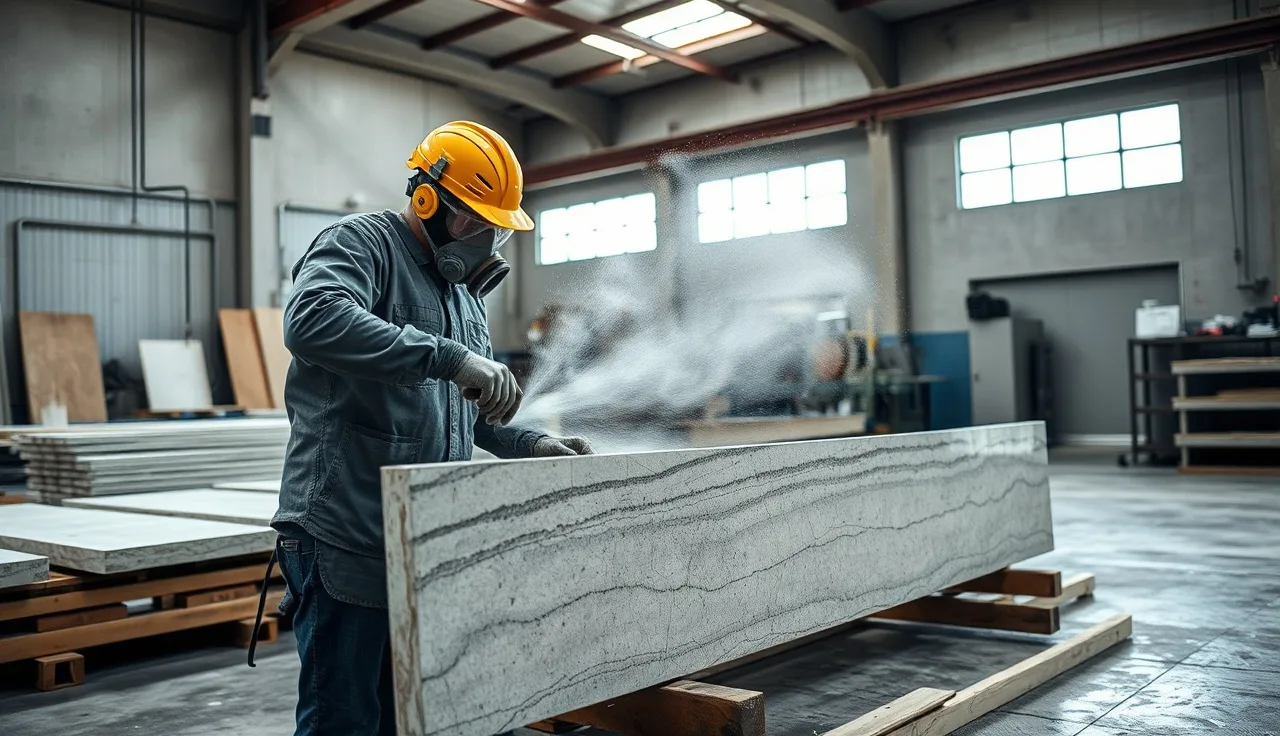
Engineered stone (quartz composite countertops) contains 40 to 93 percent crystalline silica by weight [1]. Natural granite runs roughly 25 to 30 percent. Marble is lower, closer to 2 to 3 percent. But any cutting, grinding, or polishing on stone makes dust, and that dust can carry respirable particles small enough to reach the deepest part of the lung.
Between 2019 and 2024, OSHA investigated dozens of silicosis cases among countertop workers, and the agency sharpened its enforcement focus on engineered-stone fabricators starting in 2023 [2]. Australia went all the way and banned engineered stone for most uses in 2024. The U.S. has not banned it. But OSHA's permissible exposure limit (PEL) of 50 micrograms per cubic meter of air (µg/m³) as an 8-hour time-weighted average is enforceable right now, today, in your shop [3].
Good training is about more than passing an inspection. Young fabricators are getting sick in their 30s. That is the real reason to take this seriously.
What does OSHA actually require for silica training?
OSHA requires training for every worker who is, or who can reasonably be expected to be, exposed at or above the action level of 25 µg/m³. The rule for general industry is 29 CFR 1910.1053. For construction work, including on-site template and install, the parallel rule is 29 CFR 1926.1153 [3]. Most fabrication shops fall under general industry.
Training has to cover:
- The health hazards of exposure to respirable crystalline silica.
- Specific tasks in your shop that could cause exposure.
- Specific measures you use to protect workers: engineering controls, work practices, and respirators.
- The contents of the OSHA standard itself (workers have a right to know it exists).
- The purpose of the written exposure control plan and how to get a copy.
- The purpose, use, limitations, and instructions for any respirator worn at the site [3].
OSHA writes it into the regulatory text: the employer must ensure that each employee "can demonstrate knowledge and understanding of" these items. That word demonstrate matters. A PowerPoint shown once probably won't satisfy an inspector who asks a worker to explain what a HEPA vacuum is and why you use it.
Repeat the training whenever you have reason to believe a worker doesn't understand the material, and at least once a year when exposure can reasonably be expected to continue [3]. Keep records of training dates, topics covered, and worker signatures for at least three years.
What goes into a written exposure control plan for a stone shop?
The written exposure control plan (ECP) is the spine of your compliance program. OSHA requires it under 29 CFR 1910.1053(f) for any task where a worker can be exposed at or above the action level of 25 µg/m³ [3].
A shop ECP needs at least:
- A description of each task that makes silica dust (cutting slabs, grinding edges, routing sink cutouts, dry polishing)
- The engineering controls for each task (wet saws with continuous water, local exhaust ventilation, HEPA vacuums on angle grinders)
- The work practices required (never dry-cut, keep water lines clear, clean with wet methods or HEPA, no compressed air to blow dust)
- The respiratory protection program, if respirators are part of your controls
- The housekeeping rules (wet wiping or HEPA vacuuming, never dry sweeping or blowing)
- The name of the person responsible for running the plan
Make the ECP available to affected workers. Post it. Put it in new-hire packets. Walk through it during training. OSHA can and does ask workers on the floor whether they've ever seen it.
Update the ECP whenever you add new materials, new equipment, or new operations. Start cutting ultra-compact surfaces (Dekton, Neolith, Lapitec), which also carry significant silica, and that's a material change that triggers a plan update.
Which shop tasks carry the highest silica exposure risk?
Not every task in a shop makes the same amount of dust. Aim your training at the highest-risk operations so workers understand where the real danger lives instead of treating every job the same.
| Task | Relative Exposure Risk | Common Control |
|---|---|---|
| Dry cutting with angle grinder | Very high | Eliminate: always use wet or local exhaust |
| Dry routing/grinding without LEV | Very high | Local exhaust ventilation + HEPA vac |
| Wet saw cutting (saw in good condition) | Moderate | Continuous water, check flow rate |
| CNC machining without enclosure/LEV | Moderate to high | Enclosed CNC or LEV + water mist |
| Hand polishing dry | High | Wet method or LEV |
| Dry sweeping the shop floor | High | Replace with HEPA vac or wet mop |
| Seam setting and grinding | Moderate | Wet grinding, HEPA vac on grinder |
| Sink cutout (jigsaw/router) | High | Water delivery to blade, HEPA vac |
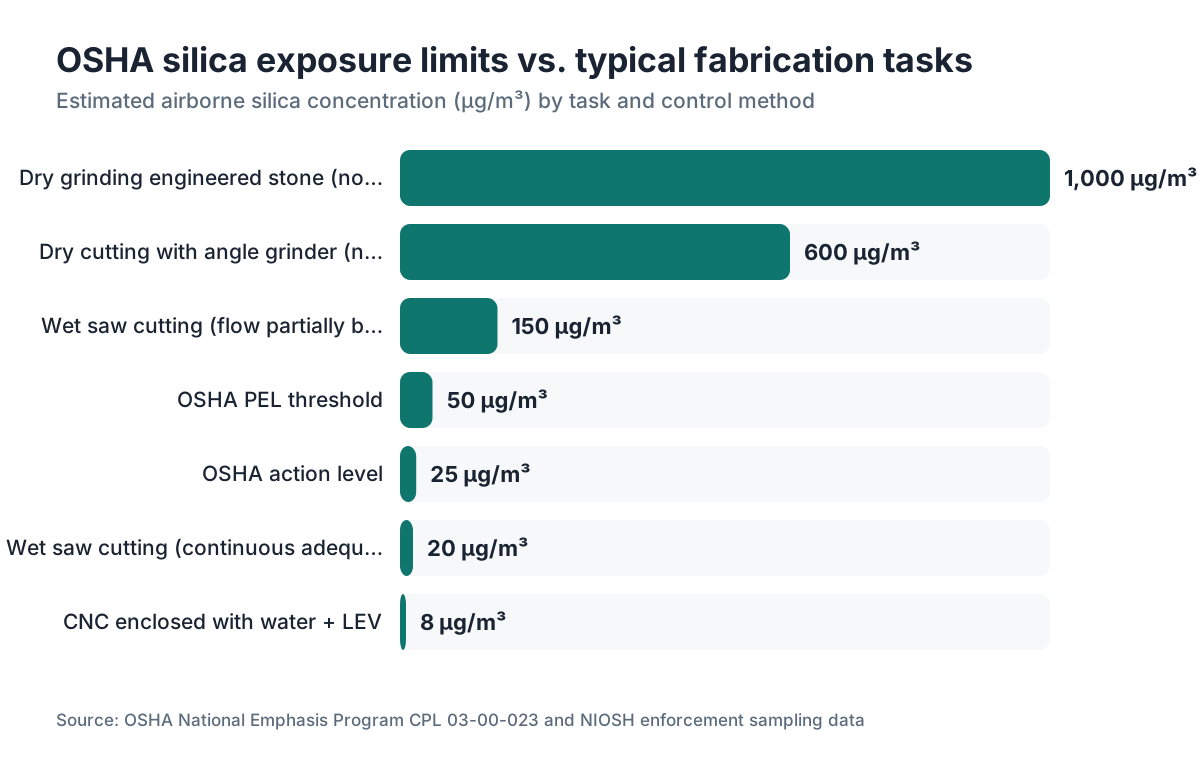
Engineered stone puts more silica in the air for the same task than natural stone does, because of its higher silica content and the fine particles it makes during fabrication [1]. OSHA sampling from enforcement actions found dry-grinding exposures on engineered stone above 1,000 µg/m³, twenty times the PEL [2].
Train the hierarchy out loud. "Wet cutting cuts exposure, but only when the water is actually reaching the blade and running the whole time" beats a vague instruction to "follow safety procedures."
How do you actually run a silica training session that sticks?
A 45-minute talk with a handout and a sign-in sheet is the legal floor. It won't change behavior on the shop floor. Here's what does, drawn from OSHA's training guidance and general industrial hygiene training practice [4].
Open with one hard fact: silicosis has no cure. Keep it short, keep it honest. Workers who grasp that the harm is permanent make different daily choices than workers who think it's like a bad cough.
Walk the floor, not the classroom. Stand at the wet saw and show the water delivery system. Show a blocked nozzle. Show the difference between good flow and bad flow. Show how a HEPA vacuum attaches to an angle grinder. A demo at the real workstation beats a slide deck every time.
Cover respirators on their own. If your program leans on N95s or half-face respirators, workers need to know an N95 only works when it's fit-tested and worn right. Facial hair breaks the seal. A respirator hanging around the neck during grinding is not a control. Walk through donning and doffing, storage, and when to swap cartridges.
Give a short written check. Not a trick quiz, just five plain questions: What's the exposure limit? What does HEPA mean? What do you do if the water line to the saw is blocked? What respirator do we use for grinding? Where is the written plan? A worker who answers those has the core content in their head.
For workers who don't speak English well, train in their primary language. OSHA requires training delivered in a manner and language workers understand [3]. Not optional. Print the ECP in both languages. A lot of shops have a bilingual lead co-run the session.
What respirators are required and how do you fit-test your crew?
Respirators in a silica program are either required or voluntary, depending on whether your engineering controls alone get you under the action level. In most shops doing any dry or partly-dry work, respirators are required as part of a written Respiratory Protection Program under 29 CFR 1910.134 [5].
For respirable silica, the minimum respirator above the PEL is a half-face air-purifying respirator with N95 or P100 filters, or a powered air-purifying respirator (PAPR) with the right cartridges. A surgical mask or a floppy dust mask does nothing against respirable silica.
Fit test before a worker uses a tight-fitting respirator in a hazardous environment [5]. OSHA accepts two methods. Qualitative uses a test agent like saccharine or Bitrex that the worker tastes if the seal leaks. Quantitative uses a PortaCount machine that measures actual particle penetration. Qualitative is cheaper and more common in small shops. Quantitative is more reliable.
Fit test at hire, again whenever the worker says the seal feels different, and at least once a year [5]. Keep the records. If a worker changes their facial hair or gains or loses a lot of weight, retest.
Here's what shops get wrong: voluntary respirator use (when exposure is below the action level) still requires a written program and a medical evaluation. The evaluation is a questionnaire reviewed by a physician or other licensed health-care professional (PLHCP). OSHA does not require a physical exam for voluntary use, but the questionnaire is mandatory [5].
What medical surveillance does OSHA require for stone fabricators?
Medical surveillance is where shops most often fall short, because it feels detached from the daily grind. It's required. Under 29 CFR 1910.1053(i), any worker exposed at or above the action level for 30 or more days a year gets it [3].
The required surveillance includes:
- A medical exam within 30 days of initial assignment (or before, if you can)
- Periodic exams every three years after that
- An exam if the worker develops signs or symptoms of a silica-related condition
Each exam has to include a medical and work history, a physical focused on the respiratory system, a chest X-ray read by a NIOSH-certified B reader (a specific NIOSH qualification for reading occupational lung-disease films), and a pulmonary function test [3].
The employer pays for all of it. Workers cannot be charged.
Keep medical records for the duration of employment plus 30 years [3]. That long retention exists because silicosis has a long latency. A worker exposed today may not show symptoms for 10 to 20 years.
NIOSH runs a free B-reader program and spirometry guidance at cdc.gov/niosh [6]. Setting up surveillance for the first time? Start there to find qualified providers.
How do you document silica training so it holds up in an OSHA inspection?
Documentation is where shops with genuinely good practices fall apart under inspection. OSHA's recordkeeping rules for the silica standard are less prescriptive than, say, hazard communication, but the agency still cites shops when records are missing or thin.
Keep at least:
- A training log with each session's date, topics covered, the trainer's name, and a signed acknowledgment from every worker who attended
- A copy of the written exposure control plan with a revision history
- Fit-test records for every worker in the respiratory protection program
- Medical surveillance records, with access controls noted (workers can see their own records, but you can't share them without consent)
- Any air monitoring results, with sampling dates, workers or job titles sampled, the task being run, and results in µg/m³
Retention is specific: training records for at least three years, exposure and medical records for the duration of employment plus 30 years [3].
A binder on a shelf works. A digital folder works. Some shops track job-level records inside their quoting and operations software. If your shop runs SlabWise for quoting and shop management, keep a parallel safety compliance folder tied to your employee records, even if the safety docs live in a separate system.
When an inspector shows up (from a referral, a complaint, or a programmed inspection aimed at the stone industry), they ask for the written ECP first, then interview workers about what they know. A worker who has never heard of the exposure control plan is a citation waiting to happen.
What are the engineering controls that training should reinforce?
Training works best when it explains the why behind each control, more than the rule. A worker who understands how a control works is more likely to keep it working.
Wet methods knock down dust at the source. On a wet saw, the water has to hit the blade or bit the whole time you're cutting. A flow of at least 1 liter per minute at the blade is a common shop target, though the real rate depends on cut depth, speed, and material. Check nozzle position and flow at the start of every shift, not once a week. A saw with a blocked water line is a dry saw.
Local exhaust ventilation (LEV) catches dust at the source where water isn't practical (some edge profiling, dry grinding for color matching). LEV needs regular checks: make sure the vacuum and ductwork aren't clogged, capture velocity holds up, and filters are HEPA-rated. A HEPA filter captures 99.97 percent of particles at 0.3 microns, which covers the respirable silica range [7].
Enclosed CNCs with integrated water delivery and dust collection cut operator exposure hard. If you're upgrading equipment and silica compliance is part of the reason, an enclosed CNC with proper ventilation is one of the best single investments you can make.
Housekeeping: compressed air blowdown is banned for silica dust. Use a HEPA vacuum or wet mopping. This is one of the most common violations OSHA finds, because blowing down with an air line is fast and habitual. Hit it directly, every session, until HEPA vacuuming becomes the reflex.
For workers handling granite countertops or marble countertops, silica content is lower than engineered stone, but the same controls apply. Never assume natural stone is safe to cut dry.
How often should you retrain and what triggers an off-cycle session?
Annual retraining is the OSHA baseline for ongoing silica exposure. Several things should trigger an off-cycle session before the year runs out.
New hires need training before they touch any task that could expose them. Not negotiable. A two-week onboarding grace period is not acceptable. If the new worker runs a saw, grinder, or CNC on day one, they get silica training on day one.
New materials trigger a review. Switch from natural stone to engineered quartz, or add ultra-compact surfaces to the mix, and you update the ECP and retrain. Same goes if a supplier changes a product formula.
New equipment changes the control picture. A new saw, a new edge profiler, a new vacuum system: each one can shift the exposure profile for a task.
An incident, a near-miss, or a worker complaint about dust means immediate review. If a worker reports that the water line ran dry for half a shift and nobody caught it, that's a training failure and a systems failure both, and it deserves a real response, not a verbal reminder.
OSHA also requires retraining whenever you have reason to believe a worker lacks the understanding [3]. Catch a worker dry-grinding without a respirator and that's more than a discipline issue. It's evidence of a training gap. Document the retraining.
How does silica exposure affect engineered stone specifically, and what should workers know about it?
Engineered stone is the material driving the current wave of silicosis cases among fabricators. Knowing why is a real part of worker training.
Engineered stone countertops (sold as Silestone, Caesarstone, Cambria, and many others) are made by binding crystalline silica particles with a polymer resin under vacuum and pressure. The result is very hard, so cutting and grinding it throws off fine respirable particles. Because silica content runs 40 to 93 percent by weight [1], even a small amount of airborne dust carries a big silica dose.
A 2020 study in Occupational and Environmental Medicine found countertop workers exposed to engineered stone had much higher silicosis rates than workers in other stone trades [8]. Australia's Safe Work agency found engineered-stone silicosis rates high enough to push that country toward its ban [9].
The practical takeaway for workers is simple: engineered stone gets your strictest controls. Wet cutting, maximum water flow, HEPA vacuuming at every grinder, respirators any time water isn't fully controlling the dust. No exceptions, no shortcuts on a busy install day.
Training should name the specific brands and products in your shop and tie each one to its silica content and required controls. A worker who knows the slab in front of them is 90 percent silica makes different decisions than one following a general rule about stone.
Shops that fabricate Cambria countertops or similar engineered quartz should make sure the ECP and training call out the higher silica content of these materials versus natural stone.
What are the OSHA penalties for silica violations in fabrication shops?
OSHA penalty amounts adjust every year for inflation. As of 2024, the maximum for a serious violation is $16,131 per violation, and willful or repeated violations can reach $161,323 per violation [10].
In practice, OSHA splits related problems (no written ECP, no training, no medical surveillance, no fit testing) into separate citations, each with its own penalty. A shop cited on all four could face a total over $60,000 before any reductions for good faith or cooperation.
OSHA's National Emphasis Program on Respirable Crystalline Silica, updated in 2020 and still active, names stone products manufacturing and countertop fabrication as targets [2]. Inspectors running silica-targeted inspections are trained to check the full set of requirements, more than the obvious ones.
Penalties aside, the workers' comp and liability exposure from a worker developing silicosis is huge. Silicosis claims are among the costliest occupational disease claims in construction and manufacturing.
The cleanest financial case for a full training and controls program is the comparison: training materials, fit testing, and a few HEPA vacuums might run a small shop $3,000 to $8,000 to set up right. A single serious OSHA citation can cost more than that before you've fixed the underlying problem.
Frequently asked questions
Do I need silica training if my shop only cuts natural stone, not engineered quartz?
Yes. Natural granite contains 25 to 30 percent crystalline silica, enough to make hazardous airborne dust during cutting and grinding. OSHA's silica standard at 29 CFR 1910.1053 applies to any worker with potential exposure at or above the action level of 25 µg/m³, whatever the material. Engineered stone carries higher risk, but natural stone is not safe to cut dry.
How long does silica training take, and can it be done online?
A compliant initial session usually runs 45 to 90 minutes. Online training can handle the knowledge-transfer part, but OSHA's standard requires workers to demonstrate understanding, which usually means a hands-on walkthrough of your actual equipment and controls. Online-only training is hard to defend if a worker later can't explain how to check water flow on your saw.
What is the difference between the OSHA action level and the PEL for silica?
The action level (AL) is 25 µg/m³ as an 8-hour time-weighted average. Hitting the AL triggers exposure assessment, medical surveillance, and training. The permissible exposure limit (PEL) is 50 µg/m³, the maximum allowed. Going over the PEL requires immediate corrective action. Both thresholds sit under 29 CFR 1910.1053 for general industry.
Does OSHA require air monitoring in a countertop fabrication shop?
Not automatically. OSHA requires you to assess worker exposure, but that assessment can use objective data (published industry sampling showing a task reliably exceeds the action level), a prior assessment, or actual sampling. If you use published data instead of sampling your own shop, document your reasoning. If you do sample, use an OSHA-accredited lab for the analysis.
Can workers opt out of silica training or medical surveillance?
No worker can opt out of training. Medical surveillance is employer-provided at no cost, and workers have the right to decline individual exams, but your obligation to offer surveillance continues. OSHA requires you to provide the opportunity; it can't force a worker to participate. Document your offer and any declination in writing.
What type of respirator is required for countertop fabrication tasks that produce silica dust?
At minimum, a half-face air-purifying respirator with N95 or P100 filters for tasks above the PEL. A P100 (99.97% filtration) is preferred for grinding engineered stone. Surgical and cloth masks do nothing against respirable silica. All tight-fitting respirators require fit testing and must be part of a written Respiratory Protection Program under 29 CFR 1910.134.
How do you train workers who speak limited English on silica safety?
OSHA requires training in a manner and language the worker understands. Provide written materials, the exposure control plan, and safety signage in the worker's primary language. Use a bilingual supervisor or trainer to co-run the session. OSHA offers some silica materials in Spanish at osha.gov. Document that translated training was delivered, and have the worker sign in their own language.
What is a B-reader and why does the silica medical surveillance require one?
A B-reader is a physician certified by NIOSH to classify pneumoconiosis (dust-caused lung disease) from chest X-rays using the International Labour Organization classification system. OSHA requires B-reader interpretation for silica chest films because general radiologists often miss early silicosis changes. NIOSH runs the B-reader program at cdc.gov/niosh.
Is dry sweeping a shop floor a silica violation?
Yes, if silica dust is present. OSHA's silica standard bans compressed air for cleaning clothing or surfaces, and dry sweeping is prohibited where wet sweeping, HEPA vacuuming, or other dust-free methods are feasible. Use a HEPA vacuum or wet mop for floor cleanup. This is one of the most commonly cited violations during silica inspections.
How much does it cost to set up a complete silica safety program for a small countertop shop?
A rough setup estimate: HEPA vacuum for grinder attachment ($300 to $600), fit testing for 5 workers ($200 to $400), written ECP and training materials ($500 to $1,000 in-house, more if outsourced), medical evaluations ($150 to $300 per worker), and P100 respirators ($30 to $60 each). Startup for a shop of 5 runs roughly $2,500 to $5,000, less than one serious OSHA penalty.
What OSHA standard applies when a fabricator does on-site countertop installation?
On-site work, including cutting, trimming, and grinding at a job site, falls under 29 CFR 1926.1153, the construction silica standard. The exposure limits are the same (AL 25 µg/m³, PEL 50 µg/m³), but the compliance methods differ a bit. The construction standard includes specific Table 1 control methods for listed tasks, including wet-cutting with handheld saws.
How do I update my exposure control plan when I add a new stone product?
Request the Safety Data Sheet (SDS) for the new material from your supplier. Check the silica content in Section 3 (composition) of the SDS. If the new material has higher silica than your existing products, decide whether your current controls are enough. Update the ECP to list the material, its silica content, and its assigned controls. Retrain all affected workers before they start cutting it.
Can a fabricator use the OSHA Table 1 compliance option for countertop cutting tasks?
Table 1 is part of the construction standard (1926.1153) and lists specific tasks with pre-approved engineering controls. A handheld power saw used outdoors with integrated water delivery and a wet-rated blade is a listed Table 1 task. But most shop-based fabrication falls under general industry (1910.1053), which has no Table 1. Shops should use exposure assessment and engineering controls under 1910.1053.
Sources
- NIOSH, Silica page (cdc.gov/niosh): Engineered stone countertops contain 40 to 93 percent crystalline silica by weight, higher than natural stone products.
- OSHA, National Emphasis Program on Respirable Crystalline Silica (CPL 03-00-023): OSHA's active National Emphasis Program on Respirable Crystalline Silica targets countertop fabrication and stone products manufacturing for enforcement inspections.
- OSHA, 29 CFR 1910.1053 Respirable Crystalline Silica (General Industry): OSHA requires a written exposure control plan, training, medical surveillance, and recordkeeping for workers exposed at or above the action level of 25 µg/m³.
- OSHA, Silica, Crystalline safety and health topics page: OSHA provides training guidance and compliance materials for respirable crystalline silica, including hands-on control demonstration expectations.
- OSHA, 29 CFR 1910.134 Respiratory Protection: Fit testing is required before initial use of a tight-fitting respirator and annually thereafter; voluntary respirator use still requires a written program and medical evaluation.
- NIOSH, B Reader Program (cdc.gov/niosh): NIOSH certifies B-readers to classify pneumoconiosis from chest X-rays; OSHA requires B-reader interpretation for silica medical surveillance chest films.
- EPA, What is a HEPA filter?: A HEPA filter captures 99.97 percent of particles at 0.3 microns, covering the respirable silica particle size range.
- Occupational and Environmental Medicine (BMJ journals): A 2020 study in Occupational and Environmental Medicine found significantly higher silicosis rates among countertop workers exposed to engineered stone compared to other stone trades.
- OSHA, Penalties: As of 2024, the maximum OSHA penalty for a serious violation is $16,131 per violation; willful or repeated violations can reach $161,323 per violation.
- OSHA, 29 CFR 1926.1153 Respirable Crystalline Silica (Construction): On-site countertop installation and cutting tasks fall under the construction silica standard, which includes Table 1 engineering control options for specific listed tasks.
Last updated 2026-07-11