TL;DR
- Training a countertop installation helper takes 4 to 8 weeks of structured, on-the-job progression.
- Start with jobsite safety and tool names, move to carry and set technique, then sink cutouts and seaming.
- Most helpers are independently useful by week 6 if you give them deliberate reps and correct mistakes the same day they happen.
Why does training a helper properly actually matter?
A bad helper costs you more than no helper at all. Dropped slabs. Stripped sink clips. A chipped edge on a $4,000 quartzite island, or a granite piece cracked on a wall corner because someone tilted it the wrong way. The exposure is real money: natural stone countertops average $40 to $100 per square foot installed [1], and one broken slab on a mid-size kitchen can eat a week's margin.
The labor market for experienced installers is thin. Bureau of Labor Statistics data groups countertop installers under tile and stone finishers, a trade with only about 47,000 workers nationally and a median wage of $22.28 per hour as of May 2023 [2]. You almost certainly cannot hire someone who already knows the work. You grow them yourself.
Structured training also protects you legally. If a helper gets hurt because nobody showed them how to lift a 200-pound slab, OSHA's general duty clause (Section 5(a)(1) of the Occupational Safety and Health Act) holds the employer responsible for a workplace free from recognized hazards [3]. Documented training, even the informal kind, matters in an inspection or a workers' comp dispute.
Here's the good news. Countertop installation is a learnable trade, and the physical skills come faster than most people expect. The judgment part, knowing a seam placement is wrong before the piece gets cut, takes longer. Plan for both.
What should a helper know before the first jobsite?
Before anyone touches a slab, they need three things: the names of the tools, basic PPE habits, and a picture of what a crew is trying to get done on any given day. Spend an hour in the shop first. It pays for itself on the first job.
Tool names come first. Suction cups (singles and A-frame pairs), grout bag, shims, pencil grinder, angle grinder, polishing pads, diamond blade, seam setter, color-matched epoxy, silicone caulk, tape measure, level, and scribing tool. Quiz them. A helper who says "the spinny thing" when you need a pencil grinder during a rush is a friction point you don't want.
PPE is non-negotiable from day one. Safety glasses whenever any grinding or cutting is happening. Hearing protection near angle grinders, because dry grinding can push past 100 dB, above OSHA's 90-dB eight-hour permissible exposure limit [8]. Cut-resistant gloves rated ANSI A4 or higher for handling raw slab edges [9]. Steel-toed boots. A back brace if the helper wants one, though a brace is no substitute for lift mechanics.
Then walk them through a slab in the shop. Show which way the grain runs, where the face is, how a factory edge differs from a finished edge. Show a sink template. Explain what a seam is and why you hide it at a less-visible spot. None of this takes long, and it gives them a mental map for everything they'll see in the field.
How do you teach proper slab lifting and carrying technique?
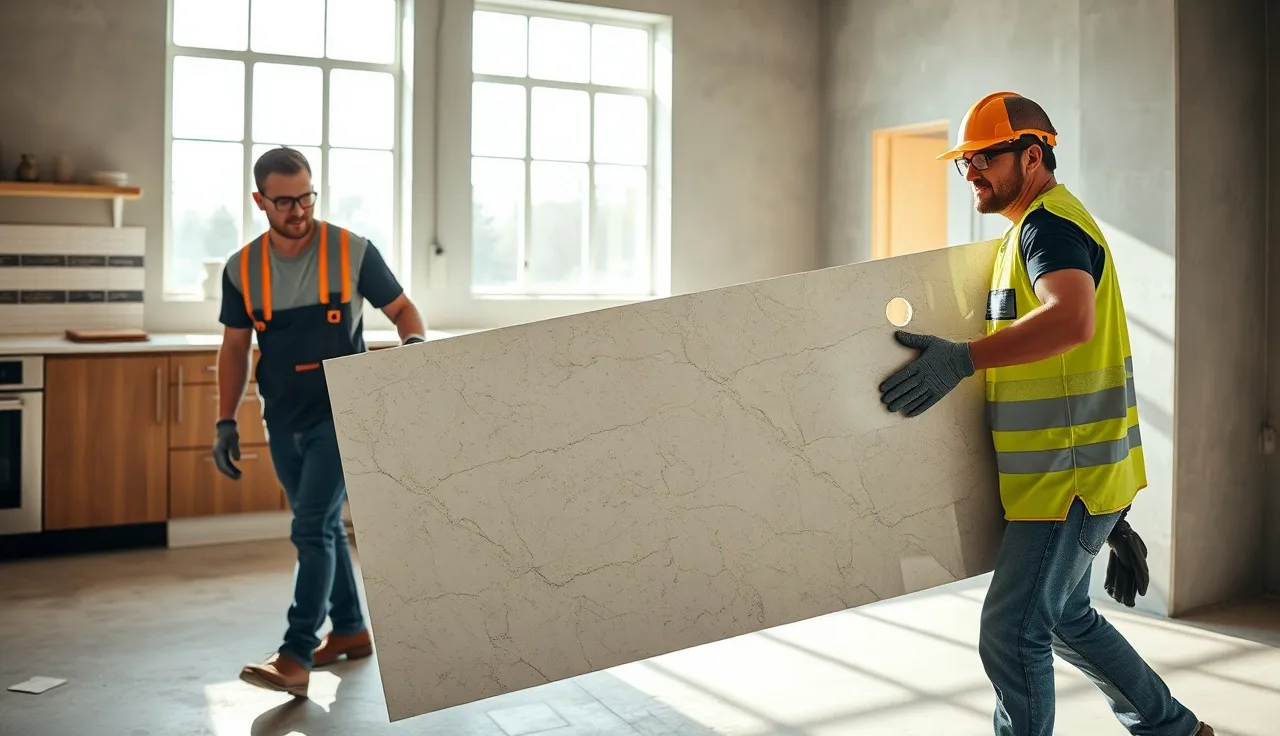
This is the most important physical skill and the one most trainers rush. A 3-centimeter granite slab runs roughly 13 pounds per square foot [4]. A 30-square-foot island piece weighs close to 400 pounds. Even a smaller 15-square-foot section hits 195 pounds. Nobody lifts that off the floor with a straight-back squat. You carry stone on edge, vertical, never flat.
The rules:
- Always carry on edge. Flat carries flex the slab and can snap it, especially over any unsupported span.
- Two people minimum for anything over 60 pounds. Three people for pieces over 150 pounds or any piece longer than 7 feet.
- Suction cups go within 12 inches of each end, on the face side, on a clean dry surface. Test pull before you commit weight.
- Walk in sync. Whoever is at the front calls the steps on stairs or thresholds.
- Back straight, hips loaded, core braced. Bend the knees to lower the piece, not the spine.
Practice with scrap. Cut a few pieces of 3cm granite or quartz down to 2-foot by 3-foot rectangles. Have the helper carry them around the shop, set them down, pick them back up. Correct grip and posture every single time. Muscle memory built wrong is harder to fix than muscle memory built right from scratch.
Vehicle loading is its own skill. Slabs ride vertical in an A-frame rack. The helper needs to know how the rack straps work, where the padding goes, and how to confirm a piece is secure before the van moves. An unsecured slab that shifts in transit and cracks is a total loss.
What's the right week-by-week progression for a new helper?
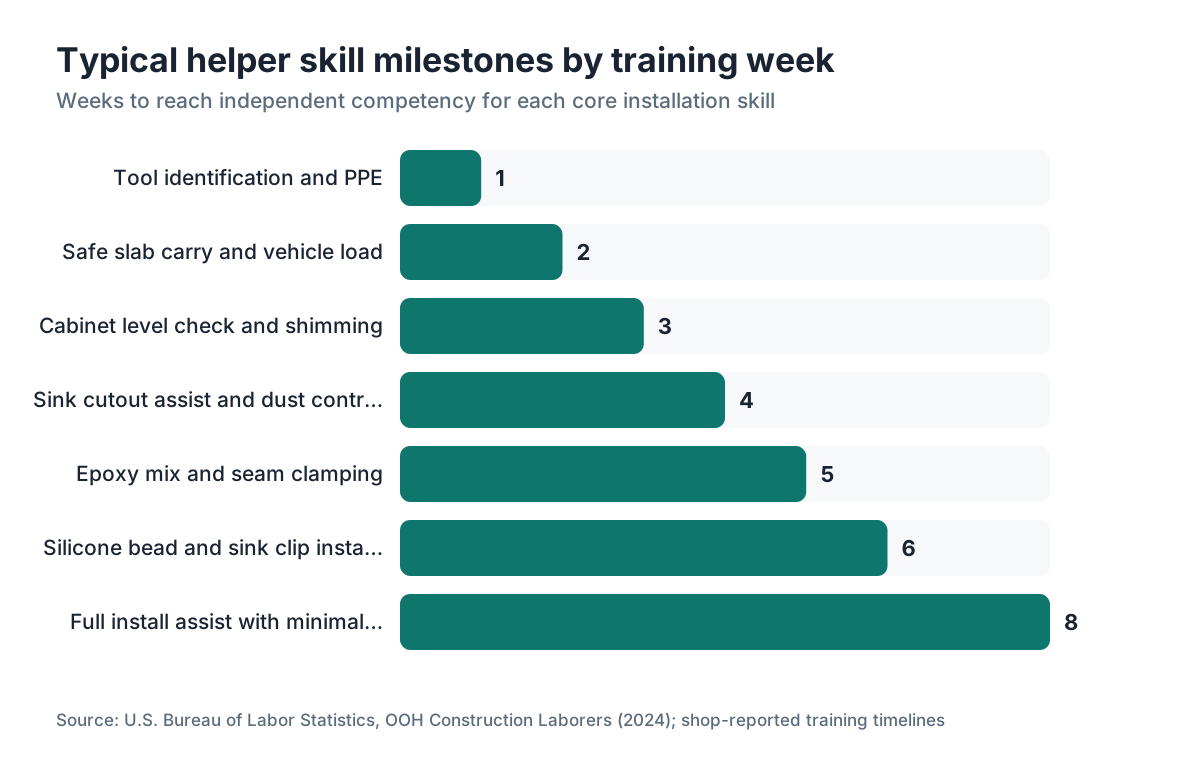
Here's a timeline that holds up in most shops. It assumes a helper who works full-time and goes on every job. Part-timers or warehouse-only helpers will need more calendar time to hit the same marks.
| Week | Primary Focus | What They Should Be Doing Independently by End of Week |
|---|---|---|
| 1 | Tool names, PPE, shop safety, ride-along observation | Name every tool, apply PPE correctly, assist with unloading |
| 2 | Carry and set technique, vehicle loading | Carry pieces safely with supervision, secure van load |
| 3 | Cabinet leveling prep, shim placement | Check cabinet level, place and adjust shims under direction |
| 4 | Sink cutout assist, vacuuming, cleanup | Hold workpiece, manage dust control, clean up epoxy drips |
| 5 | Seam clamping, epoxy mixing, color match | Mix and apply seam epoxy under close supervision |
| 6 | Silicone application, undermount sink clip install | Run a consistent silicone bead, install sink clips correctly |
| 7-8 | Full install assist with minimal supervision | Run a standard install alongside lead with rare corrections |
Weeks 1 and 2 feel slow. Resist the urge to skip ahead. A helper who doesn't have carry and set locked in is a liability on every job forever. Get that right first, everything else builds on it.
By week 6, a good helper should save you 90 minutes or more on an average kitchen install. If they're not, something in the training or the person isn't working, and you need to figure out which.
How do you teach helper skills specific to different countertop materials?
The carry and set fundamentals are the same across materials. Each material has quirks a helper needs to know before touching it. Spend at least 30 minutes explicitly covering each type your shop handles. Don't assume they'll pick it up from context.
Granite is heavy and fairly forgiving of mild flex. Its main hazard is fissures, natural cracks that look like seams and can propagate if a piece gets stressed wrong. Helpers should know how to spot a fissure and flag it before the carry, not after.
Quartz (engineered stone) is denser and more uniform than granite. It hides fewer fissures but chips at corners far more easily. When setting a quartz piece, the corners never touch the wall or cabinet first.
Marble and quartzite are beautiful and unforgiving. Marble countertops and quartzite crack more readily under point stress than granite does. Helpers need to understand that "close enough" shimming, the kind that's fine on granite, can crack a marble piece over time.
Laminate and Formica countertops are lighter but carry their own trouble. The substrate swells if water hits it during install, and the decorative layer peels at cuts when the blade is dull. Helpers cutting or handling laminate need to keep cut edges dry and scribe carefully.
Butcher block countertops are heavy for their size (dense hardwoods run 40 to 50 pounds per cubic foot) [5], and they need sealing and expansion-gap awareness that most stone helpers don't expect.
How do you teach seam work and epoxy to a helper?
Seam work is where a helper goes from useful to actually skilled. It's also where the expensive mistakes live.
Start with the theory. A seam is two slab edges butted together with color-matched epoxy filling the gap. The goal is near-invisibility: matched color, matched surface height, no ridge, no valley. Show them a good seam and a bad one side by side. If you have scrap with a rushed seam, show that too. Visual benchmarks teach faster than words.
For practice, use scrap of the same material they'll meet on real jobs. Have them:
- Mix epoxy in the correct ratio. Two-part polyester and epoxy systems have specific mix ratios, and the wrong ratio means it never cures right.
- Tint the epoxy against the actual slab until the color match holds up in daylight.
- Apply to the seam, clamp with seam setters or suction clamps, and wipe the excess.
- Let it cure, then scrape and polish flush.
The common helper mistakes here: too much epoxy (overflow that's hard to scrape without scratching), uneven clamping (one side rides high), and not wiping squeeze-out before it starts to gel.
Hold this line. No epoxy on a paying job until they've done it correctly on scrap at least five times. That's not excessive. Reworking a seam in a client's kitchen is expensive and embarrassing.
What safety training is legally required for a helper?
OSHA's standards apply to almost every employer in the US, and they are not optional. For countertop work, the standards that matter most are Hazard Communication (29 CFR 1910.1200) for epoxy resins, silicone, and solvent-based products [3]; respiratory protection (29 CFR 1910.134) if grinding produces silica dust and engineering controls aren't enough [3]; and hearing conservation (29 CFR 1910.95) if noise hits actionable levels [8].
Silica is the big one. Cutting or grinding granite, quartz, and engineered stone generates respirable crystalline silica. OSHA's silica standard for general industry (29 CFR 1910.1053) sets a permissible exposure limit of 50 micrograms per cubic meter of air as an eight-hour time-weighted average [3]. Wet cutting, local exhaust ventilation, or a fit-tested N95 respirator can bring exposure below that limit, but you need to know which control is adequate for your setup. NIOSH puts it plainly, recommending wet methods and enclosed vacuum systems as the primary controls for stone fabrication dust [6].
Helpers must get silica awareness training before working around any cutting or grinding of stone. Handing them a dust mask does not count.
Document everything. A sign-off sheet with the date, the topic, and the helper's signature is minimal, but it's a record. Some shops add short written quizzes. Either one shows you took training seriously if an inspection happens.
How do you give feedback that actually improves a helper's skills?
Most trade training happens by watching and doing, which is fine, but the feedback loop is usually broken. The lead says nothing when something's done wrong, then explodes when there's a real consequence. Silence teaches nothing. Explosions teach fear. Neither builds skill.
Correct mistakes the same day, the same hour if you can. Working memory is short. "Remember last Tuesday when you mixed the epoxy wrong?" doesn't land the way "your mix ratio is off, here's how I know, here's how to fix it" does in the moment.
Be specific. Not "you're carrying that wrong" but "your outside hand needs to be under the piece, not gripping the top edge. It can slip off the top grip. It can't slip off a bottom support." The more specific the correction, the faster the behavior changes.
Give specific praise too. "That seam color match was really close" tells them what to repeat. "Good job" tells them nothing.
End every job day with a two-minute debrief. One thing they did well. One thing to do differently next time. Keep it short. Done consistently, this one habit compounds faster than almost anything else you can do.
When should a helper move up to running installs independently?
There's no magic number of weeks, but there are signals you can watch for. A helper is ready to lead when they can do all of this without prompting: verify cabinet level before unloading the van, plan the carry route into the kitchen before picking up a piece, mix and apply seam epoxy to an acceptable finish, install undermount sink clips correctly, run a clean silicone bead, and leave a jobsite clean enough that you'd send the client photos without checking first.
Most people hit that threshold somewhere between 3 and 6 months of full-time work, assuming steady jobs and steady feedback. Some hit it faster. Some take longer, usually because they didn't get enough volume of jobs.
Make the transition gradual. Send them to lead a simple single-slab bathroom vanity with you on the phone. Then a simple kitchen. Then a kitchen with an island. Add complexity one step at a time.
Pay matters here. A helper who knows they're being developed toward a lead role with a matching pay bump will invest in getting better. A helper who feels like they're carrying slabs forever won't. Be explicit about what the path looks like and what the pay is at each stage.
How do shops track helper progress and job performance?
Most small shops track nothing, so they have no idea whether a helper is improving or just showing up. Tracking doesn't have to be complicated, and five minutes a week is enough to tell the difference.
A simple weekly log works: date, jobs attended, skills practiced, one observation about performance. After eight weeks you have a clear read on progression or stagnation.
For performance specifically, track callbacks. If a helper's work keeps generating callbacks for silicone adhesion failures, chipped edges, or uneven seams, that's measurable. If callbacks drop as they gain experience, that's measurable too, and worth noting at review time.
Time tracking by job phase helps as well. A well-trained helper should cut your total install time by 20 to 30 percent on most jobs compared to working alone, an estimate drawn from general construction crew productivity data, since countertop-specific studies are scarce [10]. Shops running job costing software can track this against labor hours per project.
SlabWise, countertop fabrication software built for quoting and job management, lets shops attach labor notes and time estimates to individual jobs. That makes it easier to see whether your crew's actual hours are tracking against quoted hours over time. The data tells you whether your training is paying off in the field.
For countertop installation leads looking to develop a helper into a full crew member, job-level data turns a gut feeling about progress into something you can point at during a review.
What are the most common training mistakes shop owners make?
Skipping the basics because the helper seems smart. Intelligence doesn't transfer to physical skill. Someone with a mechanical engineering degree still needs to practice carrying a slab on edge before you trust them with a $3,000 piece.
Not differentiating between materials. Assuming that because someone can handle granite countertops they're automatically ready for marble countertops or Cambria countertops. Each material has a different risk profile. Cover them one by one.
Only training on easy jobs. A helper who has only ever seen simple rectangular kitchens will freeze on an L-shape with a cooktop cutout and an integrated backsplash return. Bring them on the hard jobs even when it would be faster without them.
No written documentation. If OSHA audits you or a workers' comp claim lands, verbal training you can't prove is the same as no training. Keep a simple log.
Not adjusting for the individual. Some people learn by watching. Others need to do it themselves right away. Some need more reps on the physical skills, others struggle more with product knowledge. Watch where a specific helper gets stuck and go after that directly instead of running the same generic onboarding for everyone.
And the biggest one: giving up too early. A helper who seems slow in week 2 can be a strong installer by week 10. Give people a real chance before you write them off.
Frequently asked questions
How long does it take to train a countertop installation helper?
Most helpers are genuinely useful on basic installs within 4 to 6 weeks of full-time work. Being ready to lead a simple install independently typically takes 3 to 6 months. The timeline depends heavily on job volume: a helper who goes on 4 or 5 jobs per week advances much faster than one who works part-time or spends most days in the shop.
What should a countertop helper be paid?
Bureau of Labor Statistics data puts the median wage for tile and stone finishers, the closest occupational category, at $22.28 per hour as of May 2023. Entry-level helpers typically start below that, often $16 to $19 per hour depending on region, with increases tied to demonstrated skill milestones. Being explicit about the pay progression during hiring reduces turnover significantly.
Do I need to provide OSHA training for a countertop installation helper?
Yes. OSHA's general duty clause requires employers to provide a workplace free from recognized hazards, and specific standards cover silica dust, hazard communication for epoxy and solvents, and hearing protection. Silica training is especially important: cutting granite or engineered stone without proper controls can expose workers to respirable crystalline silica above OSHA's permissible exposure limit of 50 micrograms per cubic meter.
What tools should a helper know before their first job?
At minimum: suction cups, A-frame carrier, angle grinder, pencil grinder, polishing pads, diamond blade, seam setter, shims, tape measure, level, silicone gun, and color-matched epoxy equipment. Quiz them on names before the first real job. A helper who can't name the tool you need in a rush creates friction at exactly the wrong moment.
How do you teach a helper to carry heavy stone slabs safely?
Stone always carries on edge, never flat. Use suction cups within 12 inches of each end on a clean dry face surface. Test the cup pull before committing weight. Two people for anything over 60 pounds, three people for pieces over 150 pounds or longer than 7 feet. Practice with scrap pieces first. Correct posture and grip every time until muscle memory is right.
Should a helper learn epoxy and seaming right away?
No. Seam work should come after carry and set, cabinet prep, and sink cutout assistance are solid. Most shops introduce epoxy mixing and color matching around week 4 or 5, starting on scrap pieces. A helper should complete at least five successful practice seams before touching a paying job. Reworking a seam in a client's kitchen is expensive and time-consuming.
What's the difference in training for different countertop materials?
The carry fundamentals are the same, but material-specific risks differ. Granite has fissures to spot. Quartz chips at corners easily. Marble and quartzite crack under point stress more readily than granite. Laminate substrates swell with water exposure. Butcher block needs expansion gap awareness. Cover each material explicitly rather than assuming granite skills transfer automatically to other stone types.
How do you give feedback to a helper without demoralizing them?
Correct mistakes the same day, ideally in the moment, with specific language about what was wrong and exactly how to fix it. General criticism doesn't change behavior. End each job day with a two-minute debrief: one thing done well, one thing to do differently. Consistent, specific, same-day feedback compounds fast and keeps helpers invested in improving.
How do you know when a helper is ready to run installs on their own?
They're ready when they can independently verify cabinet level, plan a carry route, mix and apply seam epoxy to a passing finish, install undermount sink clips correctly, run a clean silicone bead, and leave a clean jobsite. Transition to lead gradually: start them with a simple single-slab bathroom vanity, then simple kitchens, then more complex layouts.
What documentation should I keep for helper training?
At minimum, a dated sign-off sheet for each training topic the helper covers: safety topics, tool training, lift technique, material-specific hazards. A weekly log of jobs attended and skills practiced takes five minutes and creates a record that matters in OSHA inspections or workers' comp disputes. Written quizzes on silica and PPE are worth the 20 minutes they take.
What are the biggest safety risks for a countertop installation helper?
Silica dust from cutting and grinding stone is the top long-term hazard. Acute risks include dropped slabs (a 3cm granite piece runs about 13 pounds per square foot), angle grinder cuts, and hearing damage from sustained grinding noise. All three are controllable with proper PPE: wet cutting or vacuum shrouds for silica, cut-resistant gloves, hearing protection, and safety glasses during any grinding.
Can a helper with no construction background learn countertop installation?
Yes, and many shops prefer it because there are fewer bad habits to unlearn. No construction background means you teach from scratch, which takes longer in week one but often produces someone who does things your way instead of fighting prior experience. The physical skills come in weeks. The material judgment takes longer regardless of background.
How many helpers does a typical countertop installation crew need?
Most residential countertop installation jobs run with two people: one lead and one helper. Large commercial jobs or installs with heavy island pieces may use three. Running a one-person install is possible on small bathroom vanities but is physically risky and slower. Two-person crews are the standard, which is why training a reliable helper has a direct impact on job capacity and scheduling.
Sources
- HomeAdvisor / Angi, Countertop Installation Cost Guide: Natural stone countertops average $40 to $100 per square foot installed
- U.S. Bureau of Labor Statistics, Occupational Employment and Wage Statistics, Tile and Stone Finishers (SOC 47-2044): Median wage for tile and stone finishers was $22.28 per hour as of May 2023; approximately 47,000 workers nationally
- U.S. Occupational Safety and Health Administration, OSHA Standards: General duty clause Section 5(a)(1), Hazard Communication 29 CFR 1910.1200, Respiratory Protection 29 CFR 1910.134, Hearing Conservation 29 CFR 1910.95, Silica standard 29 CFR 1910.1053 with PEL of 50 micrograms per cubic meter
- Natural Stone Institute (formerly Marble Institute of America), Stone Weight Reference: 3-centimeter granite slab weighs approximately 13 pounds per square foot
- USDA Forest Service, Wood Handbook: Wood as an Engineering Material: Dense hardwoods used in butcher block range from approximately 40 to 50 pounds per cubic foot
- NIOSH (CDC), Silica Controls for the Stone Fabrication Industry: NIOSH recommends wet methods and enclosed vacuum systems as primary controls for silica exposure during stone cutting and grinding
- OSHA, Crystalline Silica Rule (Construction Standard 29 CFR 1926.1153, Table 1): Wet cutting and local exhaust ventilation specified as engineering controls for stone cutting operations
- OSHA, Occupational Noise Exposure standard 29 CFR 1910.95 (Permissible Noise Exposure Table G-16): OSHA permissible exposure limit for noise is 90 dB over an eight-hour period; angle grinder noise can exceed 100 dB
- American National Standards Institute, ANSI/ISEA 105 Hand Protection Classification: ANSI A4 cut resistance rating recommended for handling raw stone slab edges
- U.S. Bureau of Labor Statistics, Occupational Outlook Handbook, Construction Laborers and Helpers: Construction crew productivity data used as basis for 20 to 30 percent install time reduction with a trained helper
Last updated 2026-07-11