
TL;DR
- Most fabricators charge $75 to $200 for a countertop template visit.
- The number moves with kitchen size, travel distance, and whether you shoot a digital template or cut a physical one.
- Pricing it as its own line item recovers labor you were eating for free and makes the value obvious to the customer.
- This guide shows how to set that number and defend it.
Why should fabricators charge for templating separately at all?
Templating used to disappear into the job price. The fabricator sent a crew, they took measurements, and the cost got buried somewhere inside the per-square-foot rate. That math worked when margins were fat. It does not work now.
Templating costs real money. A two-person crew driving 30 minutes each way, spending 45 to 90 minutes on site, then returning to the shop to process a digital file or transfer a physical template has burned two to three hours of billable labor before anyone touches a slab. At $25 to $35 per hour fully loaded (wages plus payroll taxes plus vehicle wear), that is $100 to $210 in raw cost before overhead [1].
Charging separately does three things. It recovers cost from customers who cancel or stall after the template is done, which happens more than most owners admit. It tells homeowners that templating is skilled work, not a formality. And it hands you a real data point to check against your actual costs as you grow.
The pushback is customer resistance. Some homeowners expect the template visit to be free because a competitor down the road offers it that way. Real problem. But the fix is explaining the value, not absorbing the cost. More on that below.
What does countertop templating typically cost, and what drives the price?
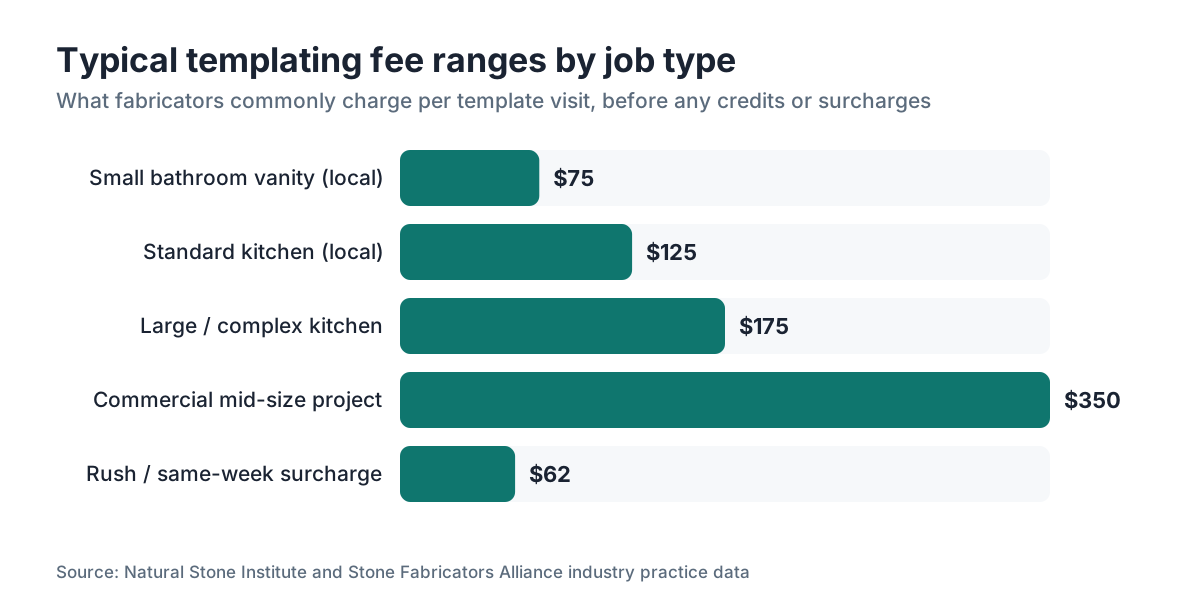
The common range across the trade is $75 to $200 for a residential kitchen or bathroom template visit [2]. That is a starting point, not a fixed number. A handful of factors move it.
Job size. A small bathroom vanity might take 20 minutes on site. A full kitchen with an island, two peninsulas, and a bar top can eat two hours. Plenty of shops price by square-footage bracket instead of a flat rate, something like $75 under 30 square feet and $150 to $200 for larger kitchens.
Travel distance. Fuel, time, and vehicle wear are real costs. A shop in a dense metro might absorb local travel, but anything past 20 to 30 miles usually earns a trip charge. Some fabricators add $1 to $2 per mile beyond a set radius.
Digital vs. physical templates. A Laser Products LT-2D3D or similar digital system [3] runs $15,000 to $40,000 upfront, but it cuts on-site time and produces tighter data. Shops that made that investment often charge a small premium, and most customers accept it because turnaround is faster and remakes drop.
Complexity. Radius edges, custom sink cutouts, cooktop cutouts, or a room full of out-of-square walls all add time. Some shops tack on a flat complexity surcharge of $25 to $50 for anything past a plain straight-run kitchen.
Revisits. If the cabinets are not installed and level when the crew shows up, somebody has to drive back. A revisit fee of $50 to $100 is standard and fair.
| Scenario | Typical charge |
|---|---|
| Small bathroom vanity, local | $75 |
| Standard kitchen, local | $100 to $150 |
| Large kitchen or complex layout | $150 to $200 |
| Trip charge beyond 25 miles | $1.50 to $2.00/mile |
| Revisit / cabinets not ready | $50 to $100 |
| Rush / same-week template | $50 to $75 surcharge |
How do you calculate your actual cost to template a job?
Start with labor. Count every person on the crew and every hour they spend, drive time both ways included. Multiply by your fully loaded labor rate, which should carry wages, employer payroll taxes (7.65% in FICA alone [4]), workers' comp, and any benefits.
Add vehicle cost next. The IRS standard mileage rate for business use was 70 cents per mile for 2025 [5]. That is a fair proxy for what a vehicle actually costs to run, though your number will differ if you drive a bigger truck or van.
Then factor equipment if you shoot digital. A $25,000 laser unit spread over five years is $5,000 a year. If your shop does 400 template visits a year, that is $12.50 per visit in equipment cost alone.
Last, add a slice of overhead: shop rent, software, insurance, admin time. Most fabricators allocate overhead as a percentage of direct labor. A 50% rate on $80 of direct labor adds another $40.
Here is what a standard kitchen might actually cost:
| Cost element | Amount |
|---|---|
| Two hours of labor, two people at $30/hr loaded | $120 |
| 30 miles round trip at $0.70/mile | $21 |
| Equipment amortization | $13 |
| Overhead allocation (40% of labor) | $48 |
| Total cost | $202 |
Charge $150 against a $202 cost and you are subsidizing every template you run. Most shops have never done this math.
Should you charge a flat fee or price per square foot?
Both models work. The right one depends on how much your jobs vary.
A flat fee is easy to say and easy to accept. "We charge $125 for the template visit" is a clean sentence. The catch is that a flat fee undercharges on big or complex jobs and overcharges on small ones, and both directions feel unfair to somebody.
A square-footage or tiered model scales better when your job mix is wide. Charge $75 up to 20 square feet, $125 for 20 to 60, and $175 above that. It is more honest and it lets you recover cost on big kitchens without scaring off vanity customers.
Some shops run a hybrid: a $50 base trip fee that covers travel, plus $2 to $4 per square foot for the measurement work. Transparent and simple to explain.
Run mostly residential in a tight geographic area? A tiered flat fee is usually cleanest. Wider commercial and residential mix with longer drives? A base-plus-mileage model recovers cost more accurately.
One thing to skip: so many fee categories your quote reads like a phone bill. Three tiers max, one revisit surcharge, one rush surcharge. Keep it readable.
How do you present a templating fee to customers without pushback?
Most resistance comes from customers who have no idea what templating involves. They picture a guy with a tape measure and a notepad. The real thing is a trained tech with specialized gear producing a precise layout file that drives the CNC.
Explaining that changes the conversation. A few points land well.
Templating accuracy decides whether your countertop fits. A bad measurement means a gap at the wall or a top that will not seat on the cabinet. The template visit is where that error gets caught, instead of after install when it is expensive.
Digital templating cuts remake rates. A remake on natural stone can cost $500 to $2,000 or more in material alone. The template fee is cheap insurance.
The fee usually credits toward the final job price. Most shops do this. The customer pays nothing extra overall; they just pay a slice earlier. That protects you if the job dies and protects them by confirming both sides are committed.
Put the fee on your website and in every quote before the visit. A surprise fee feels like bait and switch. A fee disclosed upfront feels like a policy. Same dollar amount, very different reaction.
If a competitor truly templates for free, say the honest thing: the cost is still in there, just buried in the per-square-foot price. That is not a knock on the competitor. It is how business works.
Is a templating fee applied as a credit toward the final countertop price?
This is one of the most common questions homeowners ask, and the answer depends on the shop. Most fabricators credit the full fee when the job proceeds.
The customer pays $125 or $150 at the time of templating, and that amount comes off the final invoice. It recovers cost if the job cancels, and it does not raise the price for customers who move forward. Clean on both ends.
Some shops credit only part of it, usually if they run expensive digital gear or long drives. A $75 credit against a $175 fee, for example.
A smaller group treats the fee as non-refundable and non-creditable, a true standalone charge. Harder to sell, but fully legitimate when disclosed upfront.
For most residential fabricators, the full-credit model is the right call. It kills the customer's main objection ("I'm paying more than I would elsewhere") while still covering the real risk you carry: doing skilled work on a job that walks.
Get the terms in writing. A short agreement stating the fee, the credit terms, and what happens if the customer does not proceed protects everybody. This is not a legal document. A line or two in your standard quote does the job.
How do digital and physical templating methods affect your pricing?
Physical templating, using thin strips of luan or cardboard templating material, costs almost nothing in equipment. A roll of templating material runs $30 to $60 [6]. The tradeoff is more time on site, harder archiving, and the need to physically haul the template back to the shop before programming can start.
Digital templating, using systems like Laser Products or the Prodim Proliner, carries a high upfront cost of $15,000 to $45,000 depending on the setup [3]. But on-site time drops to 20 to 40 minutes for a typical kitchen, the file shares instantly, and accuracy tightens to roughly 1/16 of an inch or better.
For pricing, digital justifies a small premium, maybe $25 to $50 over physical, because it delivers faster turnaround and lower remake risk. Most customers who hear that accept it.
The bigger question is not which method you use. It is whether your price covers the true cost of either one. Shops that upgraded to digital and kept the old physical-template price are recouping zero of that equipment investment.
Quoting software that tracks template visit cost against job profitability gives you much better data on where this sits. SlabWise, for one, lets fabricators build templating as a standalone line item, so the cost and the credit are both visible to the customer and to the shop's margin tracking.
What should a templating service agreement or line item include?
Whether you use a formal contract or a detailed quote, a few things need to be in writing. Vagueness is what creates disputes later.
Fee amount: the exact dollar figure, not a range.
Payment timing: when the fee is due. Most shops collect at the template visit or as a deposit to book it.
Credit terms: whether and how the fee applies to the final job price.
Cancellation policy: what happens if the customer cancels before the visit, after the visit, or once the job is in production. A reasonable structure is a full refund if cancelled 48 hours before the visit and no refund after the visit is done.
Revisit fee: the charge to come back if the site is not ready. Disclose this before the visit, never after.
Scope: what the template covers. Add a bathroom vanity after the kitchen template got shot? That is a separate trip charge.
For countertop installation, the template is the foundation of everything that follows. A clear agreement here heads off most of the disputes that show up later in the project.
You do not need a lawyer for this. A paragraph in your standard proposal covering these points is legally adequate in most states for a service of this size. If you are unsure, your state contractor licensing board and the SBA both publish plain-language guidance on written agreements for residential work [7].
How do commercial countertop jobs change the templating pricing model?
Commercial work is a different animal. A restaurant, hotel, or office buildout can mean dozens of linear feet across multiple rooms, tight construction schedules, and coordination with general contractors who expect detailed submittals.
Charge more for commercial templates. You should. The reasons are real: sites run less organized than residential kitchens, you may need to coordinate with other trades, and the liability for an error climbs when the GC is on a schedule.
Commercial template fees of $200 to $500 for a single visit are reasonable on mid-size projects. Bigger jobs may warrant a templating and shop-drawing package priced as a percentage of the contract, usually 2% to 4% of the fabrication total.
Some commercial GCs push back on any template fee, expecting it eaten. Hold the line. A GC who controls the schedule and calls you back three times before the site is ready has already cost you money. Charge for your time.
On multi-phase commercial projects, consider a retainer for templating: the client pays a monthly or per-phase fee covering scheduled visits. That smooths your cash flow and gives the GC a predictable cost.
What are other fabricators actually charging? Market rate data
Honest answer: no centralized industry survey tracks templating fees specifically. The Natural Stone Institute, which absorbed the old Marble Institute of America, publishes general business data but does not break out templating as its own line item [9].
The numbers in this article ($75 to $200 residential, $200 to $500 commercial) come from aggregating public quotes on fabricator websites, discussion in trade forums like the Stone Fabricator Alliance [10], and contractor bidding platforms that show itemized quotes. Directionally reliable. Not peer-reviewed, and I will not pretend otherwise.
What is clear: the range is wide because cost structure swings hard by location, labor market, and equipment. A shop in rural Tennessee with one van and physical templates has a very different cost floor than a shop in suburban Boston running three digital units and $40-an-hour labor.
The right number for your shop is your cost plus a fair margin, checked against what customers in your market will actually pay. Running your own cost calc (see the section above) beats chasing a national average.
For kitchen countertops, where the template is the most complex and time-consuming, leaning toward the high end of your range is defensible and usually accepted by homeowners who understand what they are buying.
Should you offer a free template visit to win competitive bids?
Sometimes. But think before you make it a habit.
A free template as a competitive move makes sense in exactly one case: you are confident the job is yours once you get in front of the customer, and the template cost is less than the margin you will earn. That is a real calculation, and sometimes the math works.
The trap is that "free template" turns into a race to the bottom. Advertise it and you have to keep it, and customers start expecting it even on small jobs where the template eats a big chunk of your profit. You have also pulled in price shoppers who are getting free quotes from three other shops at the same time.
Better play for competitive spots: offer to credit the full fee if the customer signs a job agreement within 14 days of the template visit. That protects you from tire-kickers while making the effective cost feel like zero for anyone who commits.
For granite countertops and other natural stone where the customer is spending $3,000 or more, a $125 to $175 template fee is under 5% of the job. Customers who balk at that number were rarely going to be your best customers.
The shops I have watched hold firm on template fees tend to have better margins and, oddly enough, better customer relationships. The fee sets a professional tone from the first paid interaction.
How do you handle templating fees in your quoting software and accounting?
Templating belongs on every quote as a named line item, not a note buried in the total. Two payoffs: the customer sees it plainly, which normalizes it, and your books can track it as its own revenue category.
In your chart of accounts, put template fees in service revenue, separate from fabrication revenue. Now you can see at a glance how much revenue comes from services versus materials, which matters for cash flow and taxes.
For job costing, log the actual hours and miles per template visit against the fee charged. After 20 or 30 jobs you will have real data on whether the fee covers the cost. Most fabricators who run this exercise find they are undercharging by 20% to 40%.
Quoting platforms that let you build a reusable template service item, with a description, a default price, and a credit rule, save real admin time. SlabWise lets you add templating as a standalone service, assign it a default price, and flag it as creditable toward the job total, so the final invoice reflects the credit automatically.
On taxes, template fees collected before the job finishes may count as deferred revenue depending on your accounting method. If you are on accrual accounting and the credit has not been applied yet, ask your accountant about timing [11].
Frequently asked questions
What is the average cost of a countertop template visit?
For residential projects, most fabricators charge $75 to $200 for a template visit. Small bathroom vanities land at the low end. Large kitchens with islands, complex layouts, or long drive times push toward $150 to $200. Commercial template visits typically run $200 to $500. These figures reflect direct labor, travel, and equipment costs.
Is the templating fee usually refundable or credited toward the countertop price?
Most fabricators apply the full template fee as a credit when the job proceeds, so the effective cost to the customer is zero if they complete the project. The fee is typically non-refundable after the visit is complete, which protects the shop from doing skilled work on a job that cancels. Always disclose credit terms in writing before the visit.
Can a fabricator legally charge for a template visit if the customer cancels?
Yes, as long as the fee and cancellation policy were disclosed and agreed to before the visit. A written quote or proposal stating the fee amount, when it is due, and what happens on cancellation is generally enforceable for small service charges in most states. You do not need a formal contract; a signed proposal or emailed confirmation usually suffices.
How long does a countertop template visit take?
On-site time ranges from 20 minutes for a simple bathroom vanity to 90 minutes or more for a large kitchen with an island and multiple cutouts. Add drive time both ways. Digital templating systems reduce on-site time significantly compared to physical cardboard or luan templates, which is part of why shops with digital systems can justify a premium.
How do digital templating systems affect pricing compared to physical templates?
Digital systems (Laser Products, Prodim Proliner, and similar) cost $15,000 to $45,000 upfront but reduce on-site time and improve accuracy. Shops using digital systems often charge $25 to $50 more per visit to recover equipment investment, and most customers accept this because turnaround is faster and the risk of a misfit countertop is lower.
Should I charge a separate templating fee or bundle it into the per-square-foot price?
Charging separately is better for margin visibility and customer communication. Bundling hides the cost and forces you to absorb it when jobs cancel after the template. A separate line item, even if fully credited on completion, protects your cash flow and signals to customers that templating is a professional service. Most fabricators who switch to separate templating fees do not go back.
What happens if the cabinets are not ready when the template crew arrives?
Charge a revisit fee. A standard range is $50 to $100 for a return trip when the site was not ready at the scheduled time. Disclose this policy before the visit, not after. Including it in your initial quote or templating agreement prevents disputes and incentivizes customers to have the site ready, which saves everyone time.
How should I price templating for commercial countertop projects?
Commercial templates are typically priced at $200 to $500 per visit for mid-size projects, reflecting longer on-site times, coordination with other trades, and higher schedule risk. For larger commercial jobs, some fabricators price templating and shop drawings as 2% to 4% of the fabrication contract. Commercial GCs who push back on template fees should be held to the same standard as residential customers.
How do I calculate my true cost to template a countertop job?
Add fully loaded labor (wages plus payroll taxes plus benefits) for all crew hours including drive time, vehicle cost at roughly $0.70 per mile, equipment amortization if you use a digital system, and an overhead allocation. A typical residential kitchen template with two people and a 30-mile round trip often costs $150 to $220 all-in before any margin.
Do customers accept a separate templating fee, or does it cause too much pushback?
Most customers accept it when it is disclosed upfront and explained clearly. The key is framing: templating is a skilled measurement service that determines whether your countertop fits correctly, not an administrative errand. Offering to credit the fee toward the final job price removes most objections. Shops that handle disclosure well report minimal friction.
What should be in a templating service agreement?
At minimum: the fee amount, when it is due, credit terms if the job proceeds, the cancellation and refund policy, the revisit fee if the site is not ready, and the scope (which areas are included in the visit). This can live in your standard quote rather than a separate document. Written disclosure of all terms before the visit is what matters.
Is it worth offering a free template visit to win competitive bids?
Occasionally, if the job margin justifies it and you are confident you will close the deal. As a standing policy, free templating attracts price-sensitive customers and erodes margin. A better competitive offer is crediting the full template fee against a signed job agreement within a set window, which protects you from tire-kickers while keeping the effective cost low for committed buyers.
How do I track templating revenue and cost in my accounting system?
Record template fees as a separate service revenue category, not mixed into fabrication revenue. For job costing, log actual hours and miles per visit and compare against the fee charged. After 20 to 30 jobs, you will have real data on your margin. Track any deferred revenue if you are on accrual accounting and the credit has not yet been applied.
Does the stone or countertop material type affect what I should charge for templating?
Not directly, since the template visit cost is driven by labor, travel, and equipment rather than material. But jobs involving natural stone like granite or marble tend to be larger and more complex than laminate or tile, so they naturally land in higher template fee tiers. For materials like laminate or Formica, simpler jobs may justify the lower end of your pricing range.
Sources
- U.S. Bureau of Labor Statistics, Occupational Employment and Wage Statistics: Labor wage data for construction and fabrication trades used to estimate fully loaded labor cost ranges
- Natural Stone Institute, Industry Resources: General residential countertop templating fee ranges cited from industry practice discussions
- Laser Products Industries, Digital Templating Systems: Digital templating system cost range of approximately $15,000 to $45,000 depending on configuration
- IRS Publication 15 (Circular E), Employer's Tax Guide: Employer FICA tax rate of 7.65% on employee wages (6.2% Social Security plus 1.45% Medicare)
- IRS, Standard Mileage Rates for 2025: IRS standard mileage rate for business use of a vehicle was 70 cents per mile for 2025
- Natural Stone Institute, Technical Resources: Physical templating materials such as luan and cardboard templating stock cost roughly $30 to $60 per roll
- U.S. Small Business Administration, Business Guide: Written service agreements and contractor documentation guidance for small residential service businesses
- Natural Stone Institute, Education and Certification Programs: Stone industry education resources and general stone fabrication business practice data
- Natural Stone Institute (formerly Marble Institute of America): Marble Institute of America merged with Building Stone Institute to form the Natural Stone Institute
- Stone Fabricators Alliance, Community Forums: Fabricator discussion of templating fee practices and market rates in industry forums
- IRS, Publication 538, Accounting Periods and Methods: Accrual accounting treatment of deferred revenue for service fees received before services are fully performed
- U.S. Bureau of Labor Statistics, Consumer Price Index: General labor cost inflation context for construction-related trades 2020 to 2025
Last updated 2026-07-11