TL;DR
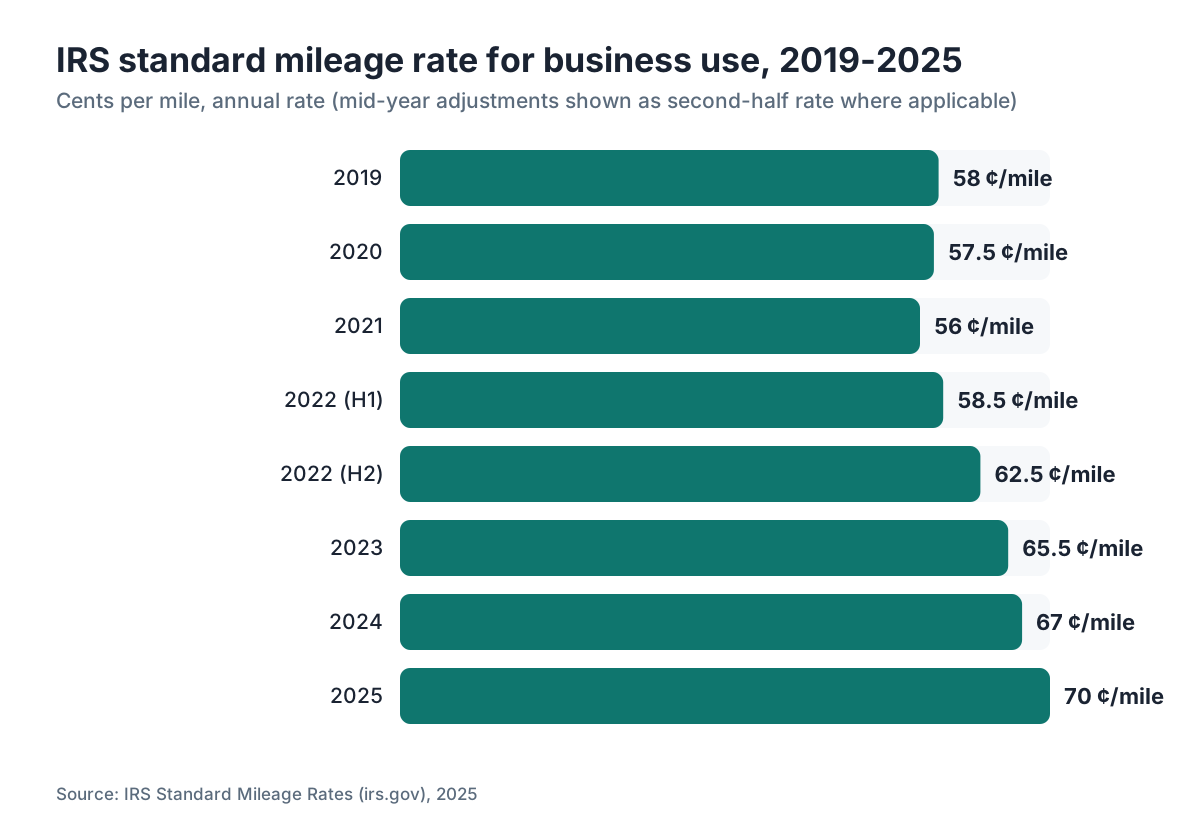
- Countertop fabricators charge travel three ways: per-mile at or near the IRS rate (70 cents/mile in 2025), a flat trip fee by distance zone, or a job minimum that absorbs the drive.
- Homeowners within 20 miles rarely see a line item.
- Those 40-plus miles out almost always do.
- Here's how both sides should think about it.
Why do countertop shops charge for mileage at all?
Stone fabrication carries high fixed costs, and every trip out the door spends some of them. A template trip sends at least one trained technician, a laser templater or physical template kit, and a vehicle out for two to four hours counting drive time. An installation trip does the same with a crew of two or three, a cargo van or box truck, and sometimes a second support vehicle. Neither trip is free.
Fuel alone runs $0.15 to $0.20 per mile in a loaded work van at current prices, but that's the small part. The IRS 2025 standard mileage rate of 70 cents per mile is the agency's estimate of the true all-in cost of running a business vehicle, covering depreciation, insurance, maintenance, and fuel together [1]. A shop that ignores those costs isn't being generous. It's quietly losing money on distant jobs.
Mileage charges feel arbitrary to homeowners until you run the math. A two-person crew driving 60 miles each way burns four hours of labor plus $84 in IRS-equivalent vehicle cost just to reach your house and get home. That's before anyone touches your countertop.
What is the current IRS mileage rate and should fabricators use it?
The IRS standard mileage rate for business use of a vehicle in 2025 is 70 cents per mile [1]. The agency resets this figure most Januarys, so confirm the current number at irs.gov before you lock in annual pricing.
Using the IRS rate as your per-mile charge is clean and defensible. Customers can look it up. It doesn't read like a profit center. Plenty of shops pick it for exactly that optics reason.
The rate was built for tax deductions, though, not as a billing floor or ceiling. It's a national average across every vehicle type and driving pattern [1]. A shop running a heavy diesel truck in a high-cost state may find the IRS rate falls short of real cost. A shop with a paid-off van in a rural low-cost county may find it runs high. Treat it as a baseline, not a wall.
So the practical question: charge the IRS rate per mile, or something else? Most per-mile shops bill 65 to 85 cents as of 2025. A few large commercial shops charge less because they negotiate fuel contracts and run high volume. Smaller custom shops often charge more because their vehicles sit idle between jobs while depreciation keeps ticking.
What are the main models fabricators use to charge for travel?
Four approaches show up in real shops. Each one trades something.
Per-mile rate. Charge round-trip mileage from your shop to the job site times a per-mile rate. Transparent, defensible, easy to justify. The downside: customers sometimes haggle, and it adds a calculation step to every quote.
Zone-based flat fee. Split your service area into rings, say 0-25 miles, 26-50, 51-75. Each ring gets a flat charge like $0, $75, $150. Faster to quote, and it kills the 'what's your mileage from my address' phone call. The catch is that the customer at mile 24 and the one at mile 50 pay the same fee, and the mile-50 customer notices the deal.
Minimum job size. Skip itemized travel entirely. Require a $1,500 or $2,000 minimum order beyond a certain radius. This works for shops with a full pipeline because it screens out small margin-negative jobs instead of tacking on a fee. It hides the real travel cost, but the quote stays clean.
Hourly travel time. Charge drive time at a crew rate, usually $75 to $150 per hour per tech, beyond a free radius. Commercial and contractor accounts handle this better than retail homeowners, because the numbers can look alarming without context.
Most retail shops land on zone-based fees or a hybrid: a free zone of 15 to 25 miles, then per-mile beyond it. That's the model I'd run for a shop doing mostly residential granite or quartz.
How do shops calculate the mileage for a template or install trip?
The standard is round-trip mileage from the shop (or the slab yard, if that's a different address) to the customer. Some shops bill one-way and call it fair since the techs work the whole route, but customers read round-trip as more honest, and it's the easier argument to win.
Google Maps or any routing tool handles the calculation fine. Pull driving distance, not straight-line, and use the route the crew would actually drive. If you bill per mile, screenshot the route and drop it in the job file in case a customer questions the number later.
One real snag: shops running multiple jobs a day. If your crew hits three houses in sequence, the mileage model gets messy fast. Most shops quote each job independently from the shop, which slightly overstates travel on sequential runs. The alternative is route-optimizing and splitting actual miles, and that's a bookkeeping headache most shops skip. Quote each job from the shop and move on.
Software that stores job addresses and calculates distance automatically clears most of this friction. SlabWise's quoting module, for one, includes travel zone fields so the charge lands on the customer's quote without a manual step.
What should homeowners expect to pay for travel fees?
Within 20 to 25 miles of the shop, expect nothing, or at most a small fee folded into a line you might not notice. Most shops treat that ring as their free zone because local jobs stay profitable even after absorbing the drive.
Between 25 and 50 miles out, travel fees of $75 to $200 per trip are common. Some shops charge per trip, and template and installation are separate visits, so a job 40 miles out might carry two $125 charges. That's $250 in travel stacked on the countertop price.
Beyond 50 miles, you'll usually see $150 to $400-plus per trip. Some shops just decline work outside their radius or require enough material volume to justify the haul. Rural homeowners chasing specialty materials like quartzite or rare granite feel this most.
Here's the honest advice: ask about travel fees before you fall for a shop's headline price. Get the full delivered number (template, installation, and any trip charges) before you compare quotes. A shop that looks $200 cheaper on the slab can end up $150 more expensive once travel lands.
Should fabricators charge separately for the template trip and the installation trip?
Yes, and this is where a lot of shops undercharge without noticing. Template and installation are two separate mobilizations. Each needs scheduling, vehicle prep, crew time, and fuel. A single travel fee covering both only makes sense if the trips happen on back-to-back days with almost no repositioning, which is rare.
A common structure is one template trip fee and one installation trip fee, both set by zone or mileage. Some shops shave the second trip a little on the theory that the customer already saw the pricing and you'd rather avoid sticker shock after the template. Reasonable choice.
Big jobs with field measurements, template, slab delivery, and installation as separate visits should carry a charge on each mobilization. A commercial kitchen 60 miles out with four site visits can rack up serious travel overhead that has to come back somewhere.
The rule I use: if a truck leaves the shop, that trip has a cost. Itemize it or bury it in a minimum, that's a presentation call. Pretending the cost doesn't exist just eats your margin.
How do shops set a free-travel radius, and what's the right number?
The free-travel radius is the distance from your shop where you absorb all travel cost inside your standard pricing. Set it wrong either way and you either leave money on the table or price yourself out of your most reachable market.
Urban and suburban shops commonly run a free radius of 15 to 25 miles. That covers most of a typical metro and keeps pricing simple for the bulk of customers. Dense-metro shops sometimes tighten it to 10 miles because job density is high and tight sequencing keeps per-job travel cheap. Rural shops sometimes stretch it to 30 or 35 miles because their whole market is spread out and charging past 15 miles would push away most of it.
To set yours, calculate average drive time for jobs inside the proposed free zone. If a 25-mile radius means most jobs run under 35 minutes each way and your crew handles two or three jobs a day, you can absorb it. If 25 miles means 55 minutes because of traffic, your real free zone should be smaller.
Distance is not drive time. A shop 15 miles from a packed downtown might eat 45-minute drives. A shop 30 miles from a quiet suburb might see 28. Time is the real cost. Miles are just the proxy customers accept.
How should mileage charges appear on a quote or invoice?
Clear labeling prevents most disputes. Write the line item plainly, something like 'Travel fee: template trip (42 miles round trip at $0.70/mile)' or 'Zone 3 travel fee (26-50 miles): $125.' A vague 'travel and delivery' line with no explanation gets a phone call. The math gets accepted.
For zone pricing, add a note on which zone applies and where the boundaries sit, or link your zone map if you have one. A single sentence works: 'Your address falls in our Zone 2 service area (26-50 miles from our shop).'
Quotes that itemize travel before signing almost never draw disputes. Quotes that spring travel on the final invoice draw friction and the occasional chargeback. Put the travel fee on the first quote, not the last bill.
If you run countertop quoting software, make the travel line flow to both the customer quote and the internal job costing report. You want to see whether travel revenue is actually covering travel cost, and that means tracking the charge separately in your books. Our piece on countertop installation covers more of the job costing side of install logistics.
Can fabricators deduct mileage on their taxes, and how does that interact with billing?
Yes. A fabrication business using the IRS standard mileage method can deduct 70 cents per mile in 2025 for business driving, including template and installation trips [1]. The alternative is the actual expense method, deducting real fuel, insurance, maintenance, and depreciation, which sometimes beats the standard rate on high-operating-cost vehicles [2].
What you deduct and what you charge are separate things. You can bill a customer $0.85 per mile and still deduct $0.70 on your return. The two rates don't have to match, and the IRS never asks them to.
The IRS does require a mileage log for the standard deduction: date, destination, business purpose, and miles per trip [2]. Shop management software or a plain spreadsheet handles it. Apps like MileIQ or Everlance automate the log.
One planning note: if you pick the standard mileage rate the first year a vehicle goes into business use, you can switch to actual expenses in later years. Start with actual expenses, and you cannot later switch to the standard rate for that vehicle [2]. That matters the year you buy a new delivery truck.
What's the difference between mileage charges and delivery fees for countertops?
Often the same thing wearing two names, sometimes not. A mileage charge covers vehicle operating cost tied to distance. A delivery fee sometimes bundles vehicle cost, crew time for loading and unloading, slab handling gear, and overhead. Delivery fees show up when a separate slab delivery happens before installation, for example when a third-party slab yard ships material straight to the site.
On most residential jobs, template and installation trips fold into the labor, and the travel fee covers the vehicle. No separate delivery happens because the crew brings slabs on the install truck. On large commercial jobs, or jobs where slabs arrive on their own, you might see both a delivery fee and a travel fee on one invoice, which is fine as long as each line is explained.
Homeowners comparing quotes should ask one question: does the price include delivery of the stone and installation, or is delivery separate? Some shops quote fabrication only, with delivery and installation as their own lines. When a $3,400 quote from Shop A sits next to a $3,100 quote from Shop B, the gap can be nothing more than Shop A folding in delivery that Shop B left out.
What do other trade businesses charge for travel, and how does countertop compare?
Plumbers, electricians, and HVAC techs usually charge a service call or trip fee of $75 to $200 for residential visits, some adding per-mile beyond a set radius [3]. Appliance repair techs often run $75 to $150 for a diagnostic visit plus mileage past a certain range [4]. Kitchen and bath designers bill travel at their hourly consulting rate.
Countertop fabricators sit right in the middle of the trades market. A $100 to $150 travel fee for a template or installation trip is typical and lines up with what homeowners pay other skilled trades. The difference is the total transaction is bigger, usually $2,000 to $8,000 for a kitchen [7], so a $150 travel fee is a small slice of the job.
The table below compares travel fee structures across common trades as a market reference.
| Trade | Typical Service Area | Trip/Travel Fee Range | Per-Mile Rate |
|---|---|---|---|
| Countertop fabricator | 25-50 mile radius | $75-$300 per trip | $0.65-$0.85/mile |
| Plumber (residential) | 20-40 mile radius | $75-$200 service call | Varies |
| Electrician | 20-40 mile radius | $75-$150 service call | Varies |
| HVAC tech | 25-50 mile radius | $85-$200 trip fee | Varies |
| Appliance repair | 15-30 mile radius | $75-$150 diagnostic | Sometimes per-mile |
Sources: Angi national cost guides, 2024 [3][4].
How does mileage pricing affect competitiveness for distant jobs?
A shop 60 miles out rarely wins a job on price alone against a shop 15 miles away, even with a lower per-square-foot number. Travel cost, longer real lead times, and the friction of a long-distance relationship all favor the local shop. Cutting the travel fee to compete on far jobs is usually a mistake. You're paying the customer to shop far.
Specialty fabricators with real capability (rare stone expertise, waterjet inlay, hard-to-source materials) can justify travel to customers with a need local shops can't meet. There the travel fee is part of the value, not a discount to apologize for. Charge it plainly and explain why people drive past nearer shops to reach you.
For a fabricator wondering how to grow past a local radius: usually the answer is more revenue per square foot by moving upmarket, not a wider service area and a pile of travel logistics. A shop doing beautiful marble countertops or tight-tolerance granite countertops at premium prices has customers who'll travel for pickup or wait out a longer lead time. Stretching the radius while holding mid-market pricing tends to be break-even once travel is counted.
Model the true cost before you commit to longer runs. A job 70 miles out with two site visits burns 280 miles of vehicle operation plus four to six crew-hours of drive time. At the 2025 IRS rate, that's $196 in vehicle cost alone before a dollar of labor [1]. A $150 travel fee on that job isn't recovering cost. It's subsidizing the homeowner.
What should you do if a customer refuses to pay the travel fee?
First, check that it was in the original quote. If the customer is refusing a fee that appeared clearly on the document they signed, hold the line. The signed quote is your contract.
If the fee showed up after the fact or was never disclosed, you're in a weaker spot. Small claims judges rarely side with surprise fees added after signing. The lesson repeats itself: always put travel fees on the initial quote.
When a customer pushes back on a disclosed fee, you can reduce or waive it as a goodwill move on a job you want to keep. Do it rarely and on purpose, never as your standard reply. Waive the fee every time someone complains and you've trained your whole sales process that the fee is optional.
The better move is to explain the math calmly. 'We're 48 miles from your address, round trip is about 95 miles, and we charge $0.70 a mile to cover vehicle costs, the same rate the IRS uses for business vehicles.' Most reasonable customers accept that. A customer who still refuses after an honest explanation is often not a customer worth keeping.
Frequently asked questions
How much do countertop shops typically charge per mile for template and installation trips?
Most shops charge between $0.65 and $0.85 per mile for round-trip distance from the shop to the job site. The IRS 2025 standard mileage rate of $0.70 per mile is a common anchor because it's publicly verifiable and covers real vehicle costs including depreciation, insurance, and fuel. A few shops go slightly higher for diesel trucks or in high-cost areas.
Do fabricators charge for the template trip and the installation trip separately?
Many do, yes. Template and installation are two separate mobilizations, each requiring crew time and vehicle use. Some shops charge a travel fee for each trip independently. Others charge a single combined travel fee if template and installation happen within a short window. Ask your fabricator how they handle this before signing; a 50-mile job with two separate trip fees can add $200-400 to the total price.
Is a countertop travel fee negotiable?
Sometimes, but don't count on it. Shops with healthy pipelines rarely discount travel fees because those fees reflect real costs. A shop that's slow or trying to win your business might roll in the travel fee or discount it, especially if you're ordering a large volume of material. The better tactic is to ask upfront rather than after you've already chosen the shop, so you can compare total delivered prices across quotes.
What radius do most countertop shops consider their free service area?
Typically 15 to 25 miles from the shop location. Urban shops sometimes set this lower, around 10-15 miles, because dense traffic makes even short distances time-consuming. Rural shops sometimes extend it to 30-35 miles because their whole market is spread out. Beyond the free radius, a trip fee or per-mile charge kicks in, and some shops decline jobs beyond a hard outer limit.
Can a countertop fabricator deduct mileage on taxes for template and installation trips?
Yes. Business mileage for template, installation, and site visits is deductible. In 2025, the IRS standard mileage rate is 70 cents per mile. Alternatively, businesses can deduct actual vehicle expenses. A mileage log with date, destination, purpose, and miles is required for the standard rate deduction. Many shop management software tools or apps like MileIQ handle this automatically.
How do zone-based travel fees work for countertop shops?
The shop divides its service area into concentric rings by distance from the shop, usually in bands like 0-25, 26-50, and 51-75 miles. Each ring carries a flat travel fee, for example $0, $100, and $200. It simplifies quoting because the fee is fixed regardless of exact address within a zone. The tradeoff is that customers near zone boundaries might feel the pricing is imprecise, but most accept it.
Should mileage fees appear on the customer quote or only on the final invoice?
Always on the initial quote. Travel fees added for the first time on a final invoice create disputes and damage trust. Clearly show the zone or mileage calculation on the quote the customer signs. Something like 'Template trip fee: Zone 2 (26-50 miles) - $125' is enough. If the fee is on the signed document, it's rarely contested.
What if a countertop job requires multiple site visits, like a field measure, a template, and an installation?
Each mobilization has a real cost, and each should carry a travel charge. For jobs with three or more site visits, many shops negotiate a package travel rate or a per-job travel cap rather than charging full per-trip fees for every visit. This is worth discussing upfront on complex jobs, especially large kitchens or commercial projects where site conditions often require more than two visits.
How do I compare countertop quotes when different shops handle travel fees differently?
Ask every shop for a total delivered price that includes fabrication, edge work, cutouts, template, installation, and any travel fees. Get this number for your specific address. A shop quoting $3,200 all-in with a 40-mile trip charge factored in is directly comparable to another shop quoting $3,000 plus $150 in trip fees. Reduce every quote to a single all-in number before comparing.
Do travel fees apply to large commercial countertop jobs, and are they different from residential jobs?
Yes, but they're often structured differently. Commercial accounts may negotiate a blanket travel rate per visit or a project-level travel budget rather than per-trip fees. Hourly travel-time billing is more common in commercial work because project managers understand it. Residential homeowners generally prefer flat fees or per-mile rates they can look up and verify.
How far will most countertop fabricators travel for an installation?
Most residential-focused shops have an effective service radius of 50 to 75 miles, though they'll sometimes go further for large orders or specialty work. Beyond that radius, travel logistics, lead time, and cost of return trips for defect corrections make the math work against both parties. Homeowners in rural areas often need to look for larger regional fabricators or be prepared for meaningful travel fees.
What's the difference between a delivery fee and a mileage charge on a countertop invoice?
A mileage charge compensates specifically for vehicle operating cost per mile. A delivery fee more often bundles vehicle cost, loading and unloading time, and slab handling equipment. On residential jobs where the installation crew brings the slabs, these are often the same thing under different names. On commercial jobs where slabs ship separately from the fabricator, you may see both a delivery fee and a separate installation trip fee.
How should fabricators track mileage for both billing and tax purposes?
Keep a simple log: job address, round-trip distance from the shop, date, and crew. Your quoting or job management software should store the job address and calculated distance. For tax purposes, the IRS requires a mileage log showing date, destination, purpose, and miles for each trip claimed under the standard mileage method. Automated apps or shop software that logs this automatically reduce the bookkeeping burden significantly.
Sources
- IRS, Standard Mileage Rates: The IRS standard mileage rate for business use of a vehicle in 2025 is 70 cents per mile
- IRS Publication 463, Travel, Gift, and Car Expenses: Businesses can use the standard mileage rate or actual expense method; the IRS requires a mileage log with date, destination, business purpose, and miles; switching from actual expenses to standard rate is restricted
- Angi, How Much Does a Plumber Cost: Plumbers charge a service call or trip fee of $75 to $200 for residential visits
- Angi, Appliance Repair Cost Guide: Appliance repair technicians often charge $75-150 for a diagnostic visit plus mileage beyond a set range
- IRS, Topic No. 510 Business Use of Car: The IRS describes the two methods for deducting vehicle expenses and confirms the standard mileage rate covers depreciation, insurance, maintenance, and fuel
- U.S. General Services Administration, POV Mileage Rates: GSA publishes mileage reimbursement rates for federal employees, providing a cross-reference point for the IRS business rate
- Angi, Cost to Install Countertops: Typical kitchen countertop installation costs range from $2,000 to $8,000 for a standard kitchen, providing context for what travel fees represent as a share of the job
- IRS Internal Revenue Bulletin: IRS formally sets and publishes the standard mileage rates annually via revenue procedure
Last updated 2026-07-11