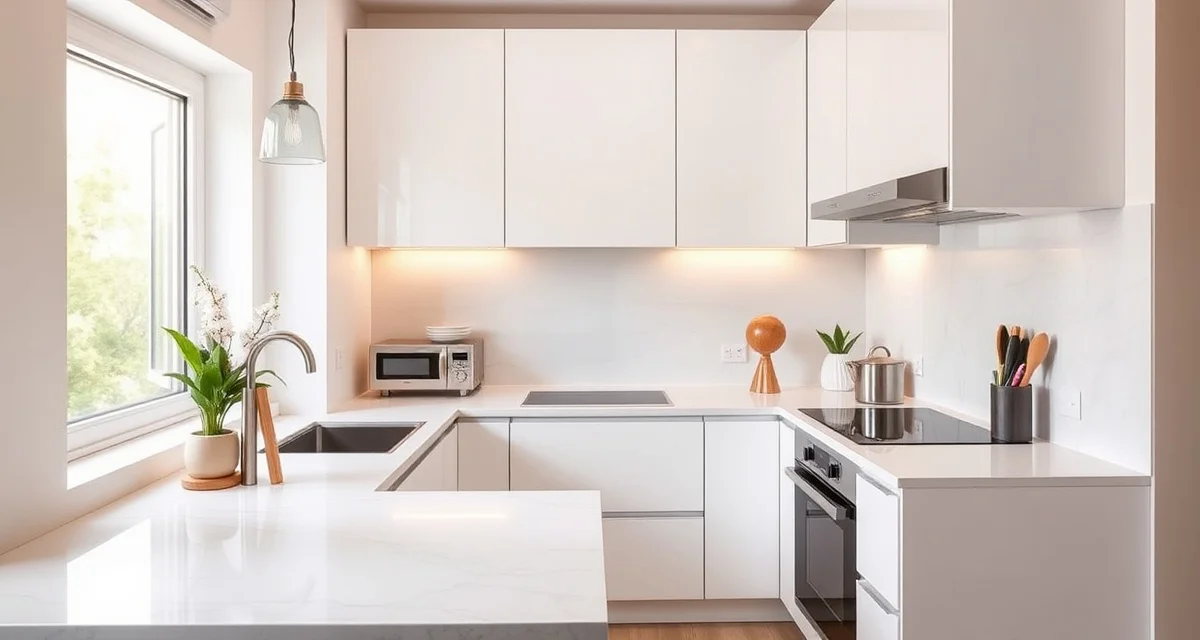
Countertop Ideas for Small Kitchens
What You Need to Know in 60 Seconds
Small kitchens under 100 square feet benefit from smart countertop choices that maximize both workspace and visual appeal. The right material, color, and layout can make a compact kitchen feel significantly larger, while the wrong choices make it feel cramped. This guide covers material selection, layout strategies, and fabrication tricks that help small kitchens punch above their weight.
TL;DR
- Light-colored countertops visually expand small kitchens by reflecting light and reducing visual weight
- A typical small kitchen has 15-25 sq ft of counter space - material cost is lower, so you can often afford a premium upgrade
- Continuous countertop runs without breaks feel larger than segmented surfaces
- Fewer seams = better appearance in tight spaces where every detail is visible up close
- Thin-profile edges (eased, beveled) keep small kitchens from feeling heavy
- Integrated features (built-in drainboards, flush cooktops) save counter space
- Budget $1,500-$4,000 for most small kitchen countertop projects depending on material
Why Small Kitchens Are Actually a Countertop Advantage
Most people think of a small kitchen as a limitation. From a countertop perspective, it is actually an opportunity. Here is why.
Calculate your material waste savings
See exactly how much slab material and money you could save with optimized cutting layouts.
Try the free Waste CalculatorLower Total Material Cost
A small kitchen with 20 sq ft of counter space at $75/sq ft installed costs $1,500. The same material in a large kitchen with 50 sq ft runs $3,750. The smaller footprint means you can often step up to a premium material - quartzite, marble, or high-end quartz - for less than what you would spend on mid-grade material in a larger kitchen.
Fewer Seams
Most small kitchen countertops can be cut from a single slab, eliminating seams entirely. No seams means no color-matching issues, no visible joints, and a cleaner visual flow. In a small space where you are always within arm's length of the countertop, this matters.
Higher Impact Per Dollar
In a 300 sq ft kitchen, premium countertops are one of many design elements competing for attention. In a 70 sq ft kitchen, the countertops dominate the visual landscape. A $2,000 upgrade is far more noticeable in a small kitchen than a large one.
Best Materials for Small Kitchens
Light Quartz - The Space-Expanding Go-To
White, cream, and light gray quartz countertops make small kitchens feel measurably larger. The uniform surface reflects ambient and under-cabinet light, brightening the space and reducing visual clutter. Quartz also requires zero maintenance - a big plus in small kitchens where cleaning and sealing routines are more cumbersome.
Top picks for small kitchens: Calacatta-look quartz (white with gray veining), solid white, light concrete-look patterns.
Light Granite
Light-colored granite with minimal movement keeps the space feeling open while adding natural character that quartz patterns sometimes miss. Look for slabs with consistent background color and subtle veining rather than bold, busy patterns.
Avoid in small kitchens: Heavy-movement granites with large blotches of contrasting color. They can overwhelm a small space and make it feel chaotic.
Butcher Block
Butcher block warms up a small kitchen and pairs well with white cabinets and open shelving - two staples of small kitchen design. The natural wood tone adds character without visual weight.
Consideration: Butcher block requires regular oiling and is not ideal around sinks where water exposure is constant. In a small kitchen, the sink area is often close to everything, so placement matters.
Marble
If your small kitchen counter area is under 20 sq ft, marble becomes surprisingly affordable. A small marble countertop in a well-designed kitchen creates a boutique or professional chef feel that no other material matches at this scale.
Layout Strategies That Maximize Counter Space
The Galley Kitchen
Galley kitchens (two parallel counters) are among the most efficient layouts for cooking. Countertop strategy here focuses on creating the longest possible unbroken work surface on each side.
Tips:
- Undermount sinks preserve counter continuity (no rim to interrupt the surface)
- Flush-mount or slide-in cooktops keep the work surface level
- Keep the same material on both sides for visual unity
- Standard countertop depth (25.5 inches) works well; avoid reducing depth to gain floor space as it sacrifices too much function
The L-Shaped Small Kitchen
L-shaped layouts give you a corner to work with. The corner section is prime real estate for continuous counter space.
Tips:
- Avoid lazy susans or corner cabinet voids that waste the counter surface above
- A single-slab countertop that wraps the corner eliminates the seam at the most visible point
- Consider a small peninsula extension off one end for extra prep and casual seating
The Single-Wall Kitchen
Common in apartments, condos, and micro-homes. All countertops, appliances, and storage sit along one wall.
Tips:
- Every inch counts - choose a flush-mount sink and cooktop to maximize usable surface
- A fold-down counter extension provides prep space when needed and disappears when not
- Light countertops prevent the single wall from looking like a dark stripe across the room
Adding Counter Space
| Strategy | Added Space | Cost | Difficulty |
|---|---|---|---|
| Kitchen cart/island on wheels | 4-8 sq ft | $100-$500 | DIY |
| Fold-down wall-mounted counter | 3-6 sq ft | $200-$600 | Moderate DIY |
| Small peninsula extension | 4-8 sq ft | $400-$1,200 (stone) | Professional |
| Over-sink cutting board | 2-3 sq ft | $30-$80 | DIY |
| Stove cover/cutting board | 2-4 sq ft | $40-$100 | DIY |
Color Strategies for Small Kitchen Countertops
Color choice has a bigger impact on perceived size in a small kitchen than in any other room.
Light Colors Expand
White, cream, and light gray countertops reflect light and reduce the visual mass of counter surfaces. When paired with light cabinets, the kitchen area feels open and airy even at 70 sq ft.
Dark Countertops Can Work - With Conditions
Dark countertops in small kitchens are not automatically a mistake, but they need supporting elements:
- Light-colored cabinets above and below to provide contrast
- Strong under-cabinet lighting to prevent the counter from becoming a dark void
- Light backsplash to break up the dark surface visually
- Minimal items on the counter (dark surfaces in small spaces feel cluttered faster)
Patterned vs. Solid
Busy patterns with high contrast (think exotic granite with bold veining) can overwhelm small spaces. If you want visual interest, choose materials with subtle variation - light quartz with soft veining, granite with gentle movement, or honed finishes that add texture without busy patterns.
Edge Profiles for Small Kitchens
Edge selection matters in small kitchens because you are always close to the countertop edge. Both comfort and visual impact are affected.
Best Edges for Small Kitchens
- Eased (slightly rounded square edge): Clean, minimal, does not add visual bulk. The default choice for most small modern kitchens.
- Small beveled: Adds a subtle detail line that catches light without adding thickness. Good for transitional styles.
- Half-bullnose: Comfortable rounded edge that works in small kitchens with children. The curve reduces the visual "line" of the counter edge.
Edges to Skip
- Full bullnose: The heavy rounded profile adds visual thickness that makes small kitchen counters feel bulky.
- Ogee: The ornate S-curve reads as fussy in a small space and collects crumbs in the detail.
- Mitered/thick-look: Adding visual mass to countertop edges in a small kitchen works against the goal of keeping things light and open.
Fabrication Considerations for Small Kitchens
Small kitchens have specific fabrication requirements that differ from larger projects.
Template Precision Is Critical
In a large kitchen, a quarter-inch gap between the countertop and wall gets caulked and forgotten behind the toaster. In a small kitchen, that gap is visible, noticeable, and bothersome. Every dimension in a small kitchen is viewed close up.
Digital templating systems that measure to 1/16-inch accuracy are especially valuable for small kitchen projects where precision makes the difference between a custom fit and visible compromise. SlabWise's Template Verification catches these dimensional errors before fabrication begins.
Single-Slab Advantage
Most small kitchen countertops (under 25 sq ft total) can be cut from a single slab, even after accounting for cutouts. This eliminates seams entirely - a significant quality advantage in a small space. Confirm with your fabricator that your layout can be cut from one slab before signing the contract.
Cutout Planning
Sink and cooktop cutouts consume a larger percentage of total counter area in a small kitchen. An undermount sink cutout in a 20 sq ft kitchen removes roughly 15-20% of your total surface area compared to 8-10% in a 50 sq ft kitchen. Plan cutout placement to preserve the longest possible unbroken work surface.
Material Waste and Cost
Slab nesting - how efficiently your countertop pieces are arranged on the raw slab - matters for cost. A small kitchen's pieces can sometimes be nested alongside another project's pieces, reducing your per-project waste cost. Ask your fabricator about this. Shops using optimization software like SlabWise's Slab Nesting tool are more likely to offer savings from efficient slab sharing.
Smart Features for Small Kitchen Countertops
Integrated Drainboard
A drainboard grooved directly into the stone next to the sink eliminates the need for a separate drying rack, reclaiming 1-2 sq ft of counter space. This is a standard fabrication add-on that most shops can do.
Flush-Mount Sink
Undermount sinks are better than drop-in for small kitchens because they preserve the countertop line and make cleaning easier. The smooth transition from counter to sink also makes the counter feel longer.
Extended Countertop Overhang for Seating
Even a 12-inch overhang on one end of a small kitchen counter can accommodate one or two stools, turning dead space into a breakfast bar without adding a separate table.
What is the best countertop for a small kitchen?
Light-colored quartz in the $55-$80/sq ft range offers the best combination of visual space expansion, durability, and value for small kitchens. It brightens the space, requires no maintenance, and the uniform color works well in tight spaces where every detail is visible.
How much counter space does a small kitchen need?
The National Kitchen & Bath Association recommends a minimum of 158 inches (about 13 linear feet) of countertop frontage. For small kitchens, aim for at least 15 sq ft of usable counter space after sink and cooktop cutouts. Below this threshold, daily cooking becomes frustrating.
Should I use the same countertop on all surfaces in a small kitchen?
Yes. Using one material throughout a small kitchen creates visual continuity that makes the space feel larger. Mixing materials in a small kitchen chops up the visual flow and makes the space feel segmented and smaller.
Can I use marble in a small kitchen?
Absolutely. A small kitchen is one of the most affordable places to install marble because total square footage is low. A 20 sq ft marble countertop installed might cost $1,800-$3,000 - comparable to mid-range quartz in a larger kitchen. Just accept that marble will develop character over time.
How do I maximize counter space in a tiny kitchen?
Use undermount sinks (recovers edge space), flush cooktops, fold-down extensions, over-sink cutting boards, and declutter aggressively. Every appliance on the counter consumes precious workspace. Wall-mounted knife strips, hanging pot racks, and shelf-mounted spice storage all move items off the countertop.
Is an island possible in a small kitchen?
If your kitchen has at least 10 feet of clear floor space in the work area, a small movable island or cart can work. Fixed islands need at least 36 inches of clearance on all working sides (42 inches if the area is a walkway). Many small kitchens cannot accommodate a fixed island without sacrificing too much circulation space.
What countertop color makes a small kitchen look bigger?
White and light gray create the greatest sense of space. Soft whites with gentle veining (Calacatta-style quartz, light granite) add visual interest without shrinking the room. If you prefer warmer tones, light cream and warm beige also expand visual space.
How thick should countertops be in a small kitchen?
Standard 3cm (1.25 inch) thickness works well. There is no functional reason to go thicker in a small kitchen, and the added visual mass of thicker countertops can make a small space feel heavier. Skip the mitered thick-look edges in favor of clean, slim profiles.
Do small kitchens need under-cabinet lighting?
Yes - arguably more than large kitchens. Small kitchens have less ambient light (fewer windows, less ceiling area for fixtures) and you are always working close to the upper cabinets where shadows are worst. LED strip lights under cabinets make a dramatic difference in both functionality and how the countertops look.
What is the average cost for small kitchen countertops?
For a small kitchen with 15-25 sq ft of counter area: laminate runs $300-$800, granite $750-$2,000, quartz $850-$2,200, and marble $1,200-$3,000 installed. These lower total costs make premium materials accessible for small kitchen budgets.
Make Your Small Kitchen Feel Twice Its Size
The right countertop turns a small kitchen from cramped to efficient and attractive. With less square footage to cover, you can afford better materials and higher-quality fabrication than you might expect.
Use SlabWise's project calculator to see exactly what your small kitchen countertop project will cost across different materials. Start your 14-day free trial today.
Try These Free Tools
- Kitchen Visualizer -- Upload a kitchen photo and preview different countertop materials in place.
- AR Overlay -- See the actual stone pattern on your customer's cabinets using AR.
- Sink Finder -- Search compatible sink models by countertop dimensions and cutout specs.
Sources & Further Reading
- Natural Stone Institute - Bathroom Design Guidelines
- National Kitchen & Bath Association - Countertop Selection Guide
- Marble Institute of America - Bathroom Stone Applications
- International Surface Fabricators Association - Residential Bathroom Standards