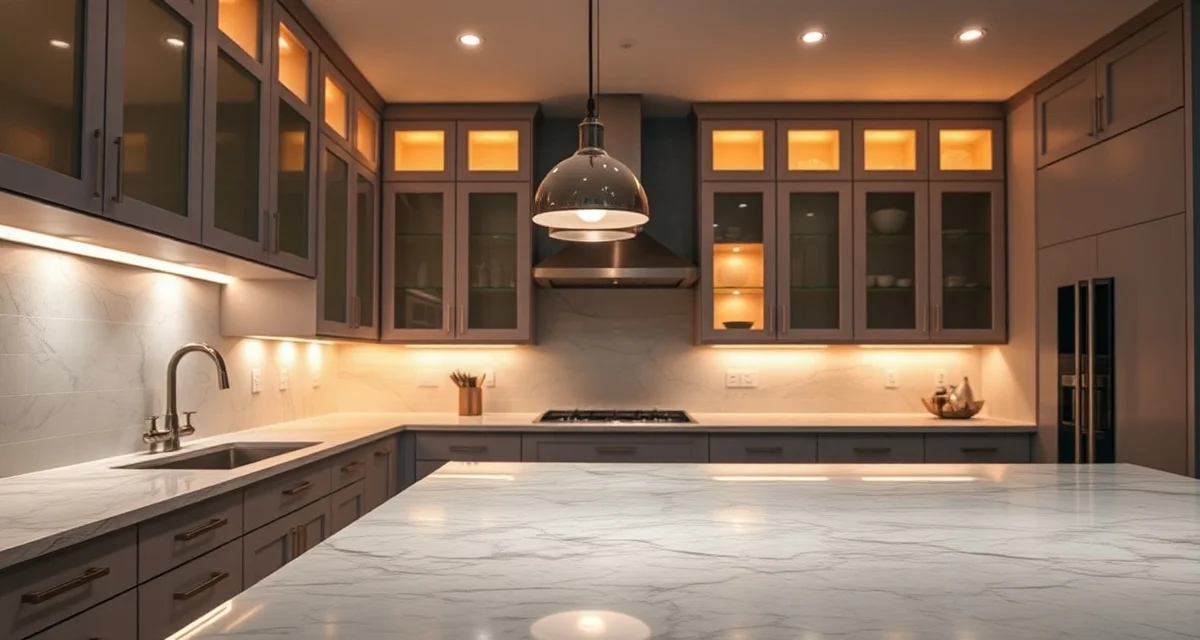
Lighting for Countertop Areas
What You Need to Know in 60 Seconds
The right lighting transforms your countertops from a functional surface into the centerpiece of your kitchen. Poor lighting hides the natural beauty of stone, creates unsafe prep areas, and makes even expensive materials look flat. This guide covers the three layers of kitchen countertop lighting, how to choose fixtures that complement your specific material, and common mistakes that waste money or ruin the look.
TL;DR
- Three lighting layers work together: ambient (general), task (work areas), and accent (decorative highlighting)
- Under-cabinet lighting is the single most impactful upgrade for countertop visibility and appearance
- LED strips have replaced fluorescent and halogen as the standard for under-cabinet fixtures
- Color temperature matters more than brightness - 2700K-3000K for warm stone, 3500K-4000K for cool tones
- Natural stone looks dramatically different under various light sources; always view slabs under similar lighting to your kitchen
- Pendant lights over islands should hang 30-36 inches above the countertop surface
- Budget $500-$2,000 for a complete countertop lighting plan in a standard kitchen
The Three Layers of Countertop Lighting
Good kitchen lighting is not about one big fixture. It is about stacking three types of light that each serve a different purpose.
Calculate your material waste savings
See exactly how much slab material and money you could save with optimized cutting layouts.
Try the free Waste CalculatorLayer 1: Ambient Lighting
Ambient light provides the baseline illumination for the entire kitchen. This is your overhead ceiling fixture, recessed cans, or flush-mount lights. Without adequate ambient light, your task and accent lighting create harsh contrasts and shadows.
Recommended levels: 30-50 lumens per square foot of kitchen floor area. A 150 sq ft kitchen needs roughly 4,500-7,500 total lumens of ambient light.
Best fixture types for countertop-heavy kitchens:
- Recessed LED downlights (4-6 inch) on a dimmer
- Semi-flush mount fixtures for lower ceilings
- Track lighting for adjustable direction
Layer 2: Task Lighting
Task lighting illuminates your countertop work surfaces directly. This is the most important layer for both functionality and showing off your countertop material.
Under-cabinet lighting is the backbone of countertop task lighting. It eliminates the shadow your body casts when standing at the counter and provides even illumination across the entire work surface.
| Under-Cabinet Type | Pros | Cons | Cost Range |
|---|---|---|---|
| LED strip/tape | Even light, thin profile, dimmable | Can show individual LED dots if too close | $30-$150 per run |
| LED light bars | Uniform output, easy install | Visible fixture housing | $40-$120 per fixture |
| Puck lights | Focused spots, easy retrofit | Creates hot spots and shadows between units | $20-$60 per set |
| Integrated LED panels | Sleek, built into cabinetry | Higher cost, harder to replace | $100-$300 per section |
The best choice for most kitchens: Continuous LED strip lights in a diffused channel. The channel softens the individual LED points into a smooth, even wash of light across your countertop.
Layer 3: Accent Lighting
Accent lighting is optional but adds significant visual impact, particularly with natural stone countertops that have interesting veining or movement.
Options include:
- In-cabinet lighting that reflects off countertop surfaces
- LED strips along the countertop toe-kick area for a floating effect
- Uplighting from behind a raised bar top
- Backlit onyx or translucent stone panels (high-end applications)
How Lighting Affects Different Countertop Materials
The same slab of granite can look entirely different under warm incandescent light versus cool fluorescent. Understanding how your material interacts with light helps you make better choices at both the slab yard and the lighting store.
Granite
Granite's crystalline structure catches and reflects light, creating the sparkle and depth that makes it popular. Warm lighting (2700K-3000K) brings out gold, amber, and warm brown tones. Cool lighting (4000K+) emphasizes gray, blue, and black tones.
Tip: If you fell in love with a granite slab at the yard, ask what type of lighting was used. Outdoor natural light is very different from kitchen lighting, and many homeowners are surprised when their slab looks different after installation.
Quartz
Engineered quartz has a more uniform appearance than natural stone, which means lighting effects are subtler but still important. Lighter quartz colors show scratches and marks more readily under direct task lighting, so diffused under-cabinet options work better than focused puck lights.
Quartz with metallic or mirror flecks comes alive under directed lighting but can look flat under diffused ambient light only.
Marble
Marble's translucency is its secret weapon under good lighting. When light hits marble at the right angle, it penetrates slightly into the stone and creates a soft glow that no other material can match. Side lighting and angled task lighting maximize this effect.
Avoid harsh overhead-only lighting on marble - it flattens the veining and eliminates the depth that makes marble special.
Dark Stone Materials
Dark granites, soapstone, and dark quartz absorb light rather than reflecting it. These materials need significantly more task lighting - roughly 40-50% more lumens than light-colored countertops to achieve the same functional brightness.
Under-cabinet lighting is non-negotiable with dark countertops. Without it, prep areas become dangerously dim.
Island Lighting: Getting Pendants Right
Island countertops present a unique lighting challenge because there are no upper cabinets to mount under-cabinet fixtures.
Pendant Sizing and Spacing
- Height: Hang pendants 30-36 inches above the countertop surface (higher for tall household members)
- Width: Each pendant should be about one-third the width of the island
- Spacing: Place pendants 24-30 inches apart, centered over the island
- Number: Most islands work best with 2-3 pendants; islands over 8 feet may need 4
Pendant Style by Countertop Material
| Countertop Style | Pendant Recommendation | Why |
|---|---|---|
| White/light quartz | Matte black or brass metal | Creates contrast and visual interest |
| Dark granite | Clear glass or light-toned fixtures | Prevents the island area from feeling too dark |
| Marble | Simple, clean-lined fixtures | Let the stone be the statement piece |
| Butcher block | Industrial or rustic fixtures | Complements the warm, organic material |
| Concrete | Geometric or minimalist designs | Matches the modern, industrial feel |
Color Temperature: The Most Overlooked Decision
Color temperature is measured in Kelvin (K) and has a bigger impact on how your countertops look than the fixture style or brightness level.
Color Temperature Guide
- 2700K (warm white): Best for warm-toned stones, traditional kitchens, and spaces where you want a cozy feel. Brings out golds, reds, and browns.
- 3000K (neutral warm): The most versatile kitchen temperature. Works with most countertop materials and kitchen styles.
- 3500K (neutral): Good for transitional kitchens. Renders colors more accurately than warmer options.
- 4000K (cool white): Best for modern/contemporary kitchens with white or gray countertops. Creates a clean, bright feel.
- 5000K+ (daylight): Generally too harsh for residential kitchens. Makes warm-toned stone look washed out.
Important: Match your color temperature across all three lighting layers. Mixing 2700K under-cabinet lights with 4000K overhead recessed cans creates a disjointed look that makes your countertop color appear to shift as you move through the kitchen.
CRI Rating Matters
Color Rendering Index (CRI) measures how accurately a light source shows colors compared to natural sunlight (rated at 100). For kitchens with stone countertops, look for fixtures with CRI 90 or higher. Cheap LED strips often have CRI in the 70-80 range, which makes natural stone look dull and artificially colored.
Installation Planning and Common Mistakes
Plan Lighting Before Countertops, Not After
The biggest lighting mistake happens weeks before the first fixture is installed: not planning for lighting during the kitchen design phase.
Electrical rough-in for under-cabinet lights, pendant junction boxes, and dimmer switches needs to happen during construction or remodeling - not as an afterthought. Retrofitting lighting after countertops are installed is possible but significantly more expensive and disruptive.
Common Mistakes to Avoid
- Installing under-cabinet lights too far forward - Mount them at the front of the cabinet (closest to you) to minimize shadows on the countertop
- Skipping dimmers - Full-brightness task lighting at 10 PM feels like a dentist's office. Dimmers let you adjust for different activities and times of day
- Using mismatched color temperatures - Different bulb temperatures in the same sightline create an unpleasant visual conflict
- Over-lighting light countertops - White quartz under maximum LED output creates glare. Start lower and adjust up
- Ignoring the backsplash reflection - Glossy backsplash tiles can bounce task lighting into your eyes. Matte finishes or angled light placement solve this
- Choosing fixtures before choosing countertops - The countertop should drive the lighting decisions, not the other way around
Budgeting for Countertop Lighting
Here is what a countertop lighting plan typically costs for a standard kitchen.
| Component | DIY Cost | Professional Install Cost |
|---|---|---|
| Under-cabinet LED strips (3 runs) | $100-$300 | $400-$800 |
| Island pendants (set of 3) | $150-$600 | $300-$900 |
| Dimmer switches (2-3) | $50-$150 | $150-$400 |
| Recessed can upgrades (4-6) | $200-$400 | $600-$1,200 |
| Total | $500-$1,450 | $1,450-$3,300 |
Under-cabinet LED strips offer the highest impact-per-dollar of any kitchen lighting upgrade. If budget is tight, start there and add other layers later.
Smart Lighting Options for Countertops
Smart lighting adds convenience and lets you dial in the perfect settings for different situations.
Worth considering:
- Smart dimmers that save preset scenes (bright for cooking, dim for dining, off for movie night)
- Motion-activated under-cabinet lights for midnight snack runs
- Color-tunable LEDs that shift from warm to cool throughout the day
- Voice control integration - hands-free adjustment when your hands are covered in flour
Not worth the premium for most people:
- RGB color-changing under-cabinet strips (fun for parties, useless for daily cooking)
- App-controlled individual puck lights
- Bluetooth-only systems without a physical switch backup
What is the best lighting for granite countertops?
Warm to neutral LED under-cabinet lighting (2700K-3000K) with CRI 90+ brings out granite's natural sparkle and depth. Continuous LED strips in a diffused channel provide the most even coverage. Add pendant or recessed fixtures above island areas.
How far should under-cabinet lights be from the wall?
Mount under-cabinet fixtures at the front edge of the cabinet, not against the wall. This positions the light source between you and the countertop, eliminating the shadow your body would otherwise cast on the work surface.
Do LED strip lights get hot enough to damage countertops?
No. LED strips produce minimal heat compared to halogen or fluorescent alternatives. The small amount of heat generated is directed upward into the cabinet, not downward onto the countertop. There is no risk of heat damage to stone, quartz, or any other countertop material from LED fixtures.
How many lumens do I need for countertop task lighting?
Plan for 300-500 lumens per linear foot of counter space for adequate task lighting. A 6-foot section of counter needs roughly 1,800-3,000 lumens of dedicated task light. Dark countertops need the higher end of this range.
Should pendant lights match the countertop or the cabinets?
Pendants should complement both but typically work best when they contrast with the countertop. Dark fixtures over light countertops (and vice versa) create visual interest. Matching metals to hardware (pulls, faucet, appliances) creates a more cohesive look than matching to the stone.
Can I install under-cabinet lighting myself?
Plug-in LED strip systems are a straightforward DIY project. Hardwired systems that connect to wall switches and dimmers should be installed by a licensed electrician. If you are remodeling and walls are open, hardwired is worth the extra cost for a cleaner look.
What is the best color temperature for white quartz countertops?
3000K-3500K works best with white quartz. Going too warm (2700K) can make white quartz look yellowish, while going too cool (4000K+) can make it feel sterile. If your quartz has warm undertones (cream, beige), lean toward 3000K. For blue-white quartz, 3500K is ideal.
How do I light a countertop that is not under cabinets?
For countertop sections without upper cabinets (peninsulas, open walls), use recessed downlights positioned 12-18 inches from the wall and aimed to wash light across the counter surface. Adjustable gimbal recessed fixtures let you direct light precisely.
Does countertop lighting affect home resale value?
Yes. Well-planned kitchen lighting, especially under-cabinet fixtures, is consistently cited by real estate agents as a selling feature. It shows attention to detail and makes the kitchen photograph well for listings - a significant factor in online home shopping.
How do I reduce glare on polished countertops?
Use diffused light sources rather than bare bulbs or focused spots. LED strips with a frosted diffuser channel spread light evenly and minimize glare. Positioning task lights at the cabinet front rather than the back also reduces the angle at which light bounces off polished surfaces.
Light Up Your Countertop Investment
Great countertops deserve great lighting. Whether you are a homeowner planning a kitchen remodel or a fabricator helping clients visualize their new stone, lighting is the detail that makes the difference between good and stunning.
Use SlabWise's project calculator to estimate your full countertop project cost, including recommendations for making the most of your material investment. Start your 14-day free trial today.
Try These Free Tools
- Cost Calculator -- Get instant countertop cost estimates by material and square footage.
- Kitchen Visualizer -- Upload a kitchen photo and preview different materials in place.
- Template Compare -- Upload two templates and see every dimension change highlighted.
Sources & Further Reading
- National Kitchen & Bath Association - Kitchen Lighting Design Guidelines
- Natural Stone Institute - Countertop Care and Maintenance Guide
- International Surface Fabricators Association - Best Practices for Stone Installation
- Remodeling Magazine - Kitchen Lighting Trends and Techniques