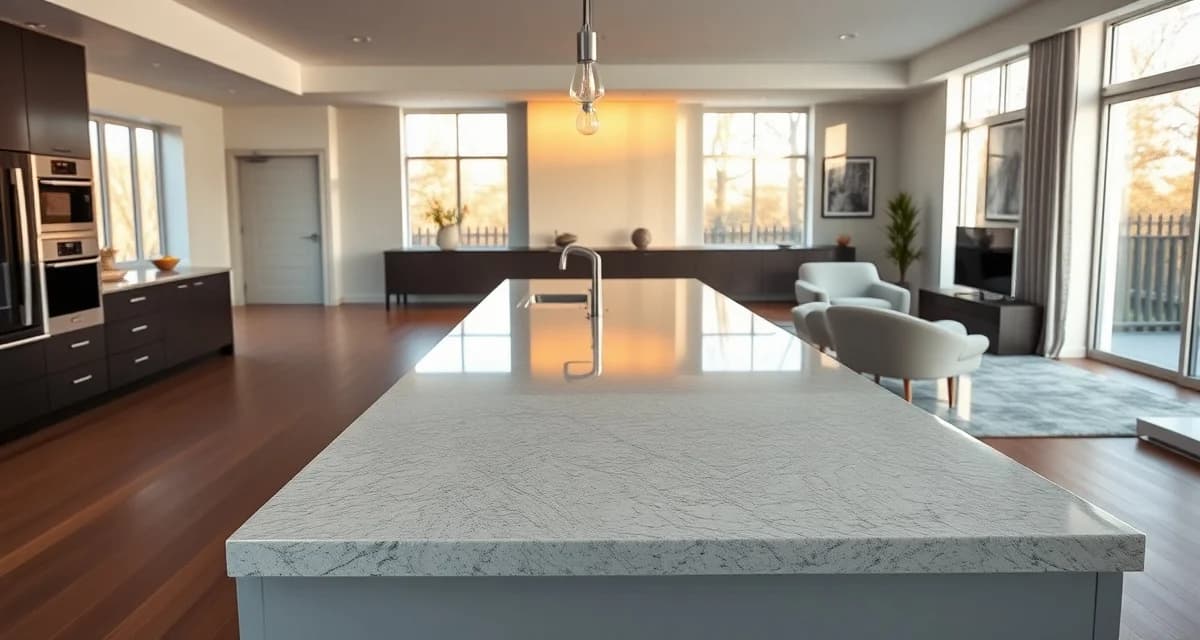
Countertops for Open Concept Kitchens
What You Need to Know in 60 Seconds
Open concept kitchens put your countertops on display from every angle. Unlike a closed kitchen where countertops are mostly functional, open-plan counters serve double duty as work surfaces and visual focal points visible from the living room, dining area, and entryway. Material choice, edge profiles, seam placement, and island design all carry more weight when there are no walls to hide behind.
TL;DR
- Open kitchens demand higher-quality fabrication because countertops are visible from multiple sightlines
- Islands are the centerpiece - invest more per square foot here than on perimeter counters
- Waterfall edges and mitered details add visual weight that anchors an open kitchen
- Seam placement is critical - visible seams from the living room area undermine the entire design
- Consistent material flow matters - your countertop needs to coordinate with flooring and furniture visible in the same space
- Light-colored countertops make open kitchens feel larger; dark countertops add drama but can visually shrink the space
- Budget 10-20% more for an open concept kitchen compared to a closed kitchen of the same size
Why Open Concept Kitchens Change the Countertop Equation
In a traditional kitchen, your countertops are viewed from one or two angles - standing in the kitchen or glancing in through a doorway. In an open concept layout, your countertops are part of the living space. Guests sitting on the couch, friends gathered at the dining table, and family members in the adjacent rooms all have a direct line of sight to your countertop surfaces.
Calculate your material waste savings
See exactly how much slab material and money you could save with optimized cutting layouts.
Try the free Waste CalculatorThis changes three things:
Every Surface Is a Showcase
Perimeter countertops that would be hidden by walls in a closed kitchen become visible backdrops. The island - if you have one - becomes the literal center of your home's most-used space. Materials, edges, and finishes that look acceptable at arm's length in a closed kitchen might not hold up to the scrutiny of being a room's focal point.
Coordination Extends Beyond the Kitchen
Your countertop needs to play well with your living room furniture, dining table, flooring across the entire open space, and any fireplace surround or architectural features. In a closed kitchen, the countertop only needed to match cabinets and backsplash.
Maintenance Is Always on Display
A few water spots or a cutting mark on a countertop in a closed kitchen stay out of sight. In an open layout, every imperfection is visible to everyone in the main living area. This makes material durability and stain resistance more important than they would be otherwise.
Best Countertop Materials for Open Concept Layouts
Quartz - The Versatile Performer
Quartz works exceptionally well in open concept spaces because of its consistency. When your countertop spans 30+ linear feet across perimeter and island surfaces, all visible at once, having uniform color and pattern across every section matters. Natural stone slabs can vary piece to piece; quartz gives you predictable results.
Best for: Modern and transitional open kitchens, families with young children, homeowners who want low maintenance in a high-visibility space.
Granite - Natural Drama for a Focal Point
Granite's natural variation works beautifully on islands that serve as standalone furniture pieces in an open layout. A book-matched granite island can become the statement piece that defines the entire living area.
Caution: For large open kitchens requiring multiple slabs, vein matching between pieces becomes critical. Poorly matched granite slabs are far more obvious in an open layout where you can step back 15 feet and see the whole kitchen at once.
Quartzite - Premium Natural Performance
Quartzite offers the natural beauty of marble with significantly better durability. In open concept homes in the $500K+ range, quartzite has become the go-to choice for homeowners who want a wow factor visible from the entire living space.
Marble - High Impact, High Commitment
Marble makes a powerful statement in an open kitchen but requires acceptance of how it will age. The patina that marble develops over time is part of its character - but in an open layout, that aging process is on display 24/7.
Island Design for Open Concept Spaces
The island is the single most important countertop element in an open concept kitchen. It is the piece that visitors see first, that anchors the kitchen within the larger space, and that gets used the most.
Sizing Your Island Countertop
| Kitchen Width | Recommended Island Size | Counter Overhang for Seating |
|---|---|---|
| 12-14 ft | 4 ft × 2.5 ft | 12 in on seating side |
| 14-16 ft | 5 ft × 3 ft | 12-15 in on seating side |
| 16-20 ft | 6-8 ft × 3.5-4 ft | 12-15 in on seating side |
| 20+ ft | 8+ ft or double island | 12-15 in on seating side |
Waterfall Edges
A waterfall edge - where the countertop material continues down one or both sides of the island to the floor - is one of the most popular design choices for open concept kitchens. It turns the island into a visual anchor that reads as a substantial piece of furniture rather than a simple work surface.
Cost impact: Waterfall edges add $800-$2,500 to an island depending on material and island size. The vein or pattern matching at the corner where the horizontal and vertical pieces meet requires skilled fabrication and precise cutting.
This is where fabrication precision truly matters. A waterfall edge with a poorly matched vein at the corner looks like an error. A well-matched one looks like the stone was carved from a single block. SlabWise's Template Verification catches dimensional errors before cutting begins, which is especially valuable for these high-stakes detail cuts.
Mitered Edges
Mitered edges give the countertop a thicker appearance (typically making a 3cm slab look like 6cm) without the weight and cost of a solid thick slab. On an open concept island viewed from a living room, the added visual weight makes the countertop feel more substantial and intentional.
Seam Strategy for Open Layouts
Seam placement is one of the most overlooked considerations in open concept kitchens, and it can make or break the final result.
The Open Concept Seam Challenge
In a closed kitchen, most seams occur along perimeter counters against the wall. The backsplash, upper cabinets, and close viewing distance minimize their visibility. In an open layout:
- Island seams are visible from 10-20 feet away
- Perimeter seams at L- or U-shaped corners are visible from the living area
- Peninsula seams where the countertop transitions from kitchen to living space are extremely prominent
Seam Placement Best Practices
- Place seams at natural transition points - where the countertop meets a sink cutout, cooktop, or changes direction
- Avoid seams in the middle of an island's visible face - position them near the end or at the waterfall corner
- Match vein direction across seams - this requires careful slab layout planning before any cutting begins
- Use tighter adhesive color matching - the standard color-match that passes in a closed kitchen may not be good enough in an open layout
For fabricators, planning seam placement in open concept kitchens takes extra time during the templating phase. Software that optimizes slab nesting while accounting for vein direction and seam placement - like SlabWise's nesting tools - reduces the trial-and-error of manual layout while improving yield on expensive slabs.
Color and Material Coordination Across Open Spaces
The 60-30-10 Rule Applied to Open Kitchens
Interior designers use the 60-30-10 formula for color balance. In an open concept space where the kitchen is part of the living area:
- 60% dominant color: Walls and large surfaces (typically neutral)
- 30% secondary color: Cabinets, large furniture, flooring
- 10% accent: Countertops, fixtures, decorative elements
Your countertop can play either the secondary or accent role. A large expanse of countertop in an open kitchen becomes secondary (30%) and should coordinate with flooring and cabinets. A smaller, dramatic countertop can serve as the accent (10%) and be bolder.
Material Pairings That Work
| Open Kitchen Style | Countertop | Flooring | Cabinets |
|---|---|---|---|
| Modern minimalist | White quartz | Light hardwood or large tile | White or flat-panel wood |
| Warm contemporary | Warm-veined quartzite | Medium hardwood | Gray or navy |
| Rustic modern | Granite with movement | Wide-plank wood | Natural wood or green |
| Industrial | Concrete or dark quartz | Polished concrete or tile | Metal and wood |
| Coastal | Light marble or quartz | Light wood or tile | White or light blue |
Edge Profile Selection for Open Concept Kitchens
Edge profiles matter more in open layouts because exposed countertop edges are visible from living areas.
Best Profiles for Open Concept
- Eased/straight: Clean, modern look that lets the material speak for itself. Works with any style.
- Mitered: Adds mass and presence. Ideal for islands that serve as room-defining furniture.
- Beveled: A subtle detail that adds interest without being ornate. Good middle ground.
- Waterfall: The boldest statement. Turns the countertop into an architectural element.
Profiles to Use Carefully
- Ogee/dupont: Can look overly ornate from across an open living space. Works better when viewed close up.
- Bullnose: Reads as dated in modern open concept designs. Still works in traditional homes with formal open layouts.
Practical Considerations for Open Plan Living
Noise and Conversation
Stone countertops in open kitchens reflect sound into the living space. If you are choosing between a polished and honed finish, know that honed surfaces absorb slightly more sound than polished. Area rugs and soft furnishings in the adjacent living area help more than any countertop choice.
Cooking Odors and Visibility
An open kitchen means cooking messes are visible from the living area. Higher countertop backsplashes, strategically placed pendant lights, and slightly raised bar-height sections on the living room side of an island can create visual barriers while maintaining the open feel.
Lighting Coordination
Countertop lighting in open kitchens needs to balance with living room lighting. Under-cabinet LEDs that are too bright create a fishbowl effect when viewed from a dimly lit living room. Install dimmers on all kitchen lighting zones so you can balance the kitchen and living area ambiance throughout the day.
What is the best countertop for an open concept kitchen?
Quartz offers the best balance of consistency, durability, and style versatility for open concept layouts. Its uniform appearance across multiple sections creates a cohesive look that holds up when viewed from across the room. For natural stone lovers, quartzite provides a premium natural look with better durability than marble.
How much more does an open concept kitchen countertop cost?
Budget 10-20% more than a comparable closed kitchen. The premium comes from waterfall edges, more careful seam placement, better vein matching across multiple slabs, and the general need for higher-quality fabrication when surfaces are viewed from all angles.
Should I use the same countertop on the island and perimeter?
Using the same material creates a unified, spacious feel. Using different materials (such as quartz perimeter and a statement stone island) adds visual interest and defines the island as a standalone piece. Both approaches work - the key is intentional coordination, not random mixing.
Do waterfall edges increase home value?
Waterfall edges are viewed as a premium feature by homebuyers and real estate agents. They are commonly mentioned in listing descriptions and photographs. The ROI depends on your market, but in homes above $400K, waterfall islands are increasingly expected rather than exceptional.
How do I hide countertop messes in an open kitchen?
A raised section on the living-room side of the island (4-6 inches higher than the work surface) creates a visual barrier that hides cutting boards, dishes, and prep mess while maintaining the open sightline. This adds to fabrication complexity and cost but is a popular solution.
What countertop edge looks best from across the room?
Clean, simple profiles with some visual weight read best from a distance. A mitered edge that creates the appearance of a 2.5-3 inch thick countertop looks substantial and intentional from 15 feet away. Thin eased edges can look flimsy from a distance on a large island.
How important is seam placement in an open kitchen?
Extremely important. A visible seam across the middle of an island that is the centerpiece of your living area is hard to unsee. Discuss seam strategy with your fabricator during the planning phase, not after templating. Slab size, vein direction, and cutout placement all influence where seams land.
Can I use different countertop heights in an open kitchen?
Yes. Multi-level countertops - a standard 36-inch work surface with a raised 42-inch bar section - are common in open kitchens. They create zones for cooking, eating, and socializing while providing visual separation between the kitchen and living area.
What countertop thickness works best for open concept?
3cm (approximately 1.25 inches) is the standard for residential countertops. For open concept islands where the edge is a prominent visual element, mitered edges that create the appearance of 6cm+ thickness add presence. Actual 6cm solid slabs are rare and extremely heavy.
How do I coordinate my countertop with living room furniture in an open layout?
Bring countertop material samples home and view them alongside your existing furniture, flooring, and decor under your actual home lighting. What looks great in a showroom may clash with your living room sectional. Neutral countertops (whites, grays, warm beiges) coordinate with the widest range of furniture styles.
Design Your Open Concept Kitchen with Confidence
An open kitchen puts your countertop investment front and center. Getting the material, fabrication quality, and design details right makes the difference between a kitchen that anchors your living space and one that distracts from it.
Try SlabWise's project calculator to estimate costs for your open concept kitchen and see how different materials and edge options compare. Start your 14-day free trial and plan your project with precision.
Try These Free Tools
- Kitchen Visualizer -- Upload a kitchen photo and preview different countertop materials in place.
- AR Overlay -- See the actual stone pattern on your customer's cabinets using AR.
- Sink Finder -- Search compatible sink models by countertop dimensions and cutout specs.
Sources & Further Reading
- Natural Stone Institute - Bathroom Design Guidelines
- National Kitchen & Bath Association - Countertop Selection Guide
- Marble Institute of America - Bathroom Stone Applications
- International Surface Fabricators Association - Residential Bathroom Standards