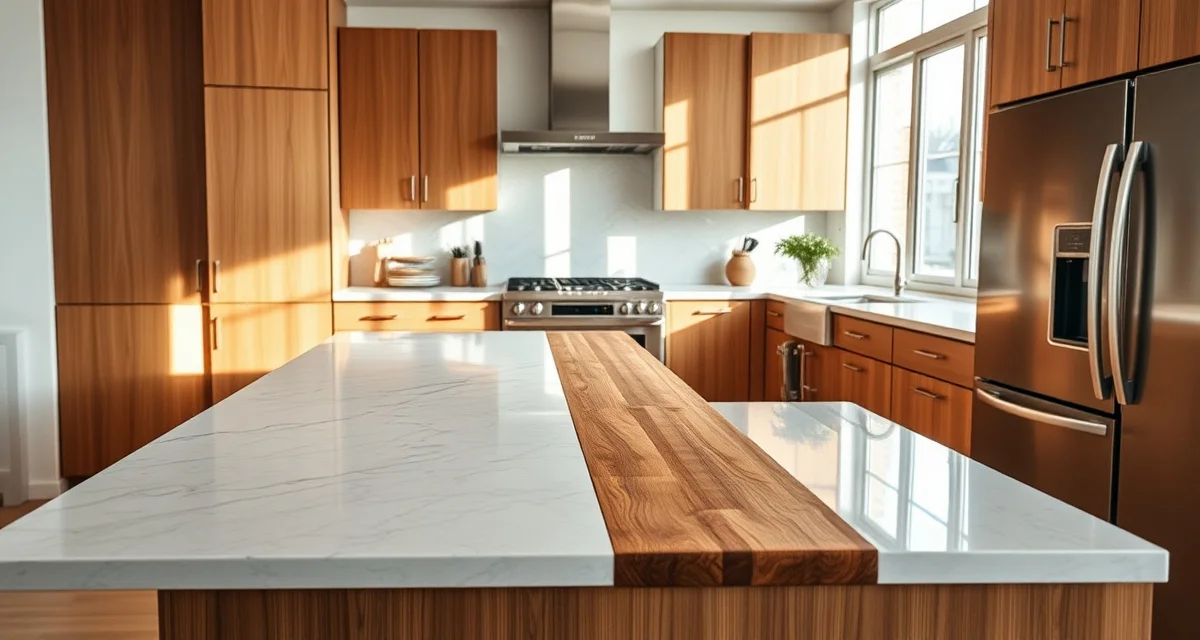
Mixing Countertop Materials in One Kitchen
What You Need to Know in 60 Seconds
Using two different countertop materials in the same kitchen is a deliberate design strategy that creates visual interest, saves budget, and zones your kitchen by function. The key is making the mix look intentional, not like you ran out of material. This guide covers which combinations work, where to place each material, how to handle transitions, and what mistakes to avoid.
TL;DR
- Two materials maximum - three or more creates visual chaos in most kitchens
- The island is the natural place for a different material than the perimeter
- Mixing saves money - use premium material on the focal point, practical material everywhere else
- Color temperature must match - both materials should be warm or both neutral; mixing warm and cool clashes
- Each material should have a functional reason - wood for prep, stone near the stove, marble for baking
- Transition points should occur at natural breaks - where countertop sections are already separate
- Budget savings of 15-30% are common when mixing premium and mid-range materials
Why Mix Countertop Materials?
Visual Interest
A kitchen with one material throughout can feel flat, especially in larger spaces. Two materials add dimension and define different zones, making the kitchen more visually engaging from multiple viewpoints.
Calculate your material waste savings
See exactly how much slab material and money you could save with optimized cutting layouts.
Try the free Waste CalculatorFunctional Zoning
Different materials serve different purposes. Wood is ideal for cutting and prep. Stone handles heat from pots and pans. Marble stays cool for pastry work. Mixing materials lets each zone perform its best function.
Budget Strategy
Premium materials on the most visible surface (usually the island) with a more affordable but coordinated material on the perimeter is one of the smartest budget moves in kitchen design. You get the visual impact of premium stone where it matters most without the cost of covering every surface.
Example savings: A 45 sq ft kitchen with quartzite everywhere at $100/sq ft = $4,500 in material. Same kitchen with quartzite island (15 sq ft = $1,500) and quartz perimeter (30 sq ft at $65/sq ft = $1,950) = $3,450. That is $1,050 saved while the most visible surface still has premium stone.
Design Versatility
Mixing materials opens combinations that a single material cannot achieve. A warm butcher block island with cool gray quartz perimeter creates a temperature contrast that neither material delivers alone.
Combinations That Work
Tested Material Pairings
| Combination | Style | Why It Works |
|---|---|---|
| Quartz perimeter + butcher block island | Farmhouse, transitional | Warm wood vs. clean stone contrast |
| Granite perimeter + marble island | Traditional, luxury | Practical stone + prestige stone zoning |
| Quartz perimeter + quartzite island | Modern, contemporary | Consistent look with premium focal point |
| Quartz perimeter + concrete island | Industrial modern | Manufactured precision + handmade character |
| Granite perimeter + butcher block island | Transitional, eclectic | Natural materials, different textures |
| Dark stone perimeter + light stone island | Any style | Light/dark contrast defines zones |
The Rule of Contrast
Successful material mixing creates intentional contrast. The two materials should be obviously different - different textures, different tones, or different material categories entirely. Subtle differences (two similar granites, or two quartz patterns that almost match) look like a mistake rather than a design choice.
Clear contrast examples:
- Polished stone + natural wood (material contrast)
- White quartz + dark soapstone (color contrast)
- Smooth quartz + rough concrete (texture contrast)
Unclear contrast (avoid):
- Two similar gray granites
- White quartz + cream quartz
- Two different marble varieties with similar veining
Where to Place Each Material
The Island Gets the Premium Material
In most kitchens, the island is the focal point. Placing the more expensive or visually striking material here and using a practical material on the perimeter is the standard approach.
Why: The island is seen from all sides, sits at the center of the room, and is often the first thing visitors notice. The perimeter is partially hidden by upper cabinets, backsplash, and appliances.
Exceptions to the Rule
Sometimes the perimeter is the right place for the statement material:
- Galley kitchens without islands: The perimeter IS the focal point
- Kitchens with a dramatic backsplash: A full-height stone backsplash + counter in the same material creates impact; the island can be something different
- Open shelving kitchens: When upper cabinets are replaced with open shelves, the perimeter counter and backsplash area becomes highly visible
Functional Placement
If mixing for function rather than aesthetics:
- Wood near the prep area (cutting, chopping)
- Heat-resistant stone near the stove (granite, quartzite)
- Easy-clean material near the sink (quartz, granite)
- Cool marble at the baking station (pastry prep benefits from marble's naturally cool temperature)
Color Temperature Coordination
This is the most common mistake when mixing materials. Two materials that clash in color temperature - one warm, one cool - create a jarring visual conflict no matter how nice each material is individually.
What Is Color Temperature?
- Warm: Gold, cream, yellow, orange, warm brown, warm gray undertones
- Cool: Blue, blue-gray, bright white, silver, cool gray undertones
- Neutral: True gray, soft white, warm white (these work with both warm and cool)
Coordination Rules
- Both warm: Butcher block + warm granite. Marble with gold veining + cream quartz.
- Both cool: Gray quartz + blue-gray soapstone. White quartz + white marble.
- One neutral + one warm or cool: Gray quartz (neutral) works with both warm butcher block and cool marble.
- Avoid: Warm gold granite + cool blue-white quartz. Warm butcher block + icy white quartz with blue undertones.
Test before committing: Get samples of both materials and view them side by side under your kitchen's actual lighting. What looks compatible in a showroom with broad-spectrum lighting may clash under the warm LEDs in your kitchen.
Handling Transitions Between Materials
Natural Break Points
The easiest transitions occur where countertop sections are already physically separate:
- Island vs. perimeter (no transition needed - they are separate pieces)
- Peninsula vs. main counter run (the corner turn provides a natural break)
- A separate beverage station or baking center (physically separated from the main counter)
When Materials Meet on the Same Run
Occasionally, two materials need to join along a continuous counter - for example, a butcher block section transitioning to stone within the same counter run. This requires a clean joint and decision about how to handle it.
Options:
- Butt joint: Two materials meet flush. Requires precise fabrication to keep the surfaces level. A thin expansion gap filled with flexible caulk prevents cracking from different thermal expansion rates.
- Metal strip: A thin stainless or brass strip at the joint provides a clean visual transition and hides any gap.
- Reveal: A deliberate small gap (1/8 inch) between materials, often with a shadow line, that communicates "these are intentionally different."
Fabrication consideration: Different materials have different thicknesses even at nominally the same measurement. A 3cm granite slab and a 1.5-inch butcher block are close but not identical. The fabricator must account for this to keep the surface level at the joint. SlabWise's Template Verification catches these dimensional discrepancies before they become installation problems.
Design Mistakes to Avoid
Using Three or More Materials
Two materials create intentional contrast. Three or more materials make a kitchen look like a showroom display or a renovation done in stages. The only exception is very large kitchens (60+ sq ft of counter space) where a third material might work in a physically separate zone like a butler's pantry.
Matching Too Closely
Two materials that look almost the same - but not quite - appear unintentional. If someone has to ask whether your island and perimeter are the same material, the mix is not working. The contrast should be immediately obvious.
Ignoring the Rest of the Kitchen
Your two countertop materials also need to coordinate with cabinets, flooring, backsplash, and hardware. Adding a second countertop material adds another element that must play well with everything else. Run the full coordination check before committing.
Splitting Costs Evenly
If you are mixing to save money, put 60-70% of your countertop budget on the focal point material and 30-40% on the secondary. An even split often means both materials are mid-range, and neither makes a statement.
Forgetting About Maintenance Differences
Two materials may need different cleaning products and maintenance schedules. Butcher block needs oiling; granite needs sealing; quartz needs neither. If you mix materials, you are signing up for two maintenance routines.
How Mixing Affects Fabrication and Installation
Multiple Vendors
If your materials come from different suppliers (stone from one, wood from another), coordinate delivery and installation timing. The stone fabricator templates first, then the wood fabricator templates the remaining sections. Or one fabricator handles everything - ask whether your shop works with multiple material types.
Timeline Impact
Mixed-material kitchens may take slightly longer to fabricate and install because two separate production processes are involved. Plan for 1-2 additional days compared to a single-material kitchen.
Cost Structure
You will likely pay two separate fabrication fees if different shops handle each material. Even within one shop, setup time for switching materials adds modest cost. The total fabrication cost for a mixed kitchen is typically 5-10% higher than a single-material kitchen of the same size, offset by the material savings from using a lower-cost secondary material.
Is it okay to mix countertop materials in a kitchen?
Absolutely. Mixing two countertop materials is a recognized design strategy used by professional kitchen designers. The practice has historical roots (different surfaces for different tasks) and is increasingly popular in modern kitchen design for both aesthetic and budget reasons.
What two countertop materials look best together?
Quartz perimeter with butcher block island is the most popular combination, especially in farmhouse and transitional kitchens. For a more upscale pairing, quartz perimeter with quartzite or marble island creates a premium look with controlled budget. The best pairing depends on your specific kitchen style and color scheme.
Can you mix quartz and granite in the same kitchen?
Yes, but choose carefully. Quartz and granite have different visual characteristics - quartz is uniform, granite is varied. For the mix to look intentional, the two should be clearly different (not similar colors) and placed in separate zones (island vs. perimeter, not side by side on the same run).
Does mixing countertops save money?
Typically yes. A common strategy is using premium stone ($80-$150/sq ft) on the island and mid-range quartz ($55-$75/sq ft) on the perimeter. For a 45 sq ft kitchen, this can save $500-$2,000 compared to premium material throughout while still delivering a high-end look.
Should mixed countertops be the same thickness?
At the points where they are visible together (across the kitchen sightline), matching thickness creates a more cohesive look. If they are in separate zones (island vs. perimeter), slight thickness differences are not noticeable. For materials that meet at a joint, matching thickness precisely is critical for a level surface.
Can I mix polished and honed finishes?
Yes, and this is a sophisticated design move. Honed perimeter with polished island (or vice versa) creates a subtle textural contrast while maintaining material consistency. This approach works particularly well with the same material in two finishes - one stone, two textures.
How do I transition between two countertop materials?
The simplest transition is at a natural break point - island vs. perimeter requires no transition detail. Where materials meet on the same run, use a butt joint with flexible caulk, a thin metal divider strip, or a deliberate shadow gap. Your fabricator should discuss transition options during the planning phase.
What if I change my mind about one material later?
Replacing one material in a mixed kitchen is actually easier than replacing a single-material kitchen because the sections are independent. The island can be replaced without touching the perimeter and vice versa. This modularity is an underappreciated advantage of mixed designs.
Do mixed materials affect resale value?
Mixed materials are viewed positively when the combination is intentional and well-executed. Butcher block island with stone perimeter and marble island with granite perimeter are both recognized as desirable by real estate agents. Poorly matched or random-looking mixes can have the opposite effect.
Should my fabricator handle both materials?
If possible, yes. A single fabricator coordinating both materials ensures consistent templating, aligned heights, and coordinated installation timing. If different shops are needed (stone vs. wood, for example), make sure they communicate about dimensions and installation sequence.
Create Your Perfect Material Mix
Mixing countertop materials is one of the most effective ways to create a kitchen with personality, function, and smart budget allocation. The key is intentional contrast, coordinated color temperature, and quality fabrication on both surfaces.
Use SlabWise's project calculator to compare material costs and see how mixing affects your total budget. Start your 14-day free trial today.
Try These Free Tools
- Kitchen Visualizer -- Upload a kitchen photo and preview different countertop materials in place.
- AR Overlay -- See the actual stone pattern on your customer's cabinets using AR.
- Sink Finder -- Search compatible sink models by countertop dimensions and cutout specs.
Sources & Further Reading
- Natural Stone Institute - Bathroom Design Guidelines
- National Kitchen & Bath Association - Countertop Selection Guide
- Marble Institute of America - Bathroom Stone Applications
- International Surface Fabricators Association - Residential Bathroom Standards