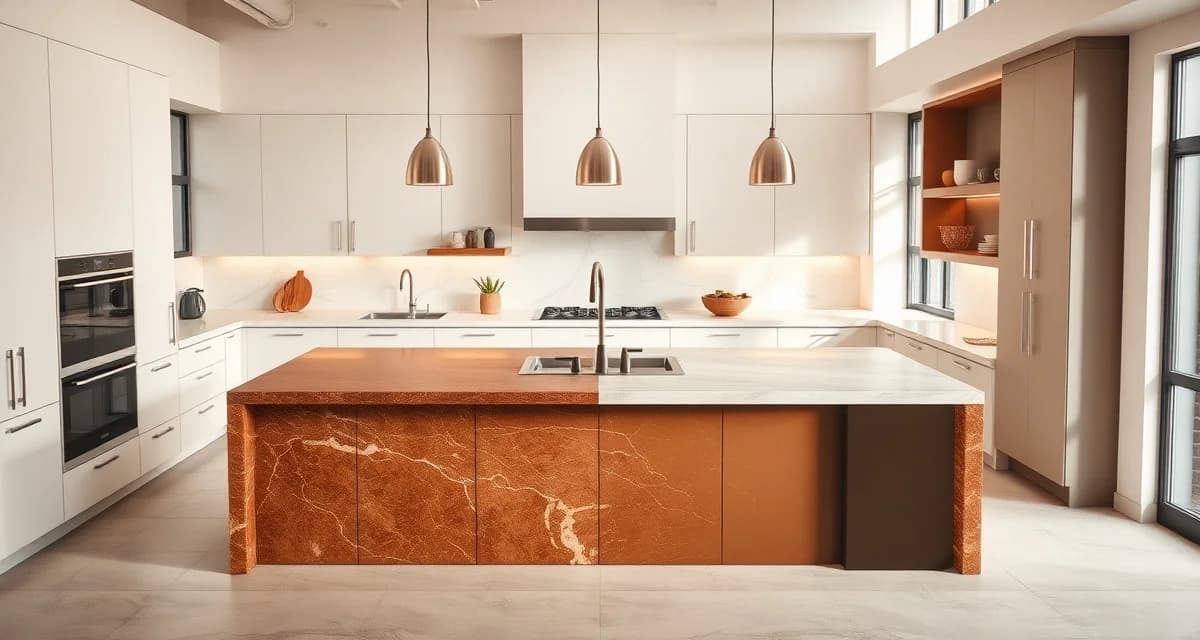
Matching Countertops to Kitchen Island
What You Need to Know in 60 Seconds
Your kitchen island is the focal point of the room, and the countertop material you put on it deserves careful thought. Whether you match the island to your perimeter counters or intentionally contrast them, the decision affects your kitchen's visual impact, functionality, and budget. This guide covers when to match, when to mix, how to size island countertops, and the fabrication details that make island projects successful.
TL;DR
- Matching island and perimeter countertops creates unity; contrasting creates visual interest - both are valid
- Islands get more use and more scrutiny than perimeter counters, so invest in quality here first
- Standard island overhang for seating is 12-15 inches and requires bracket support beyond 10 inches
- Waterfall edges transform an island from work surface to furniture piece at $1,500-$8,000 additional cost
- Seam placement on islands is critical because the surface is visible from all sides
- Most kitchen islands require 25-45 sq ft of countertop depending on size
- Budget 30-50% of your total countertop spend on the island for best visual return
To Match or Not to Match: The Core Decision
This is the first question every homeowner and designer faces. There is no universally correct answer - it depends on your kitchen style, how the island functions, and your design goals.
Calculate your material waste savings
See exactly how much slab material and money you could save with optimized cutting layouts.
Try the free Waste CalculatorWhen to Match Island and Perimeter
Matching materials create a cohesive, unified look. This works best when:
- Your kitchen has a clean, modern aesthetic where material consistency matters
- The space is small - different materials in a compact kitchen can feel busy
- You want the countertop to recede visually and let other elements (cabinets, art, views) take focus
- Your perimeter material is already a statement stone - adding a second statement creates competition
The practical advantage: Matching materials from the same slab lot (or ideally the same slab) ensures perfect color consistency. Ordering island and perimeter materials at different times, even in the same color, risks visible color variation.
When to Contrast Island and Perimeter
Contrasting materials define the island as a separate piece - more furniture than fixture. This works best when:
- The island is large (over 5 feet) and can visually support being a standalone element
- You want the island to be the kitchen's statement piece
- The kitchen style supports mixed materials (farmhouse, transitional, eclectic)
- You want to allocate premium material budget to the most-seen surface only
Popular contrast combinations:
| Perimeter Material | Island Material | Style |
|---|---|---|
| White quartz | Walnut butcher block | Modern farmhouse |
| Granite | White marble | Traditional |
| Gray quartz | Quartzite | Contemporary |
| Quartz | Concrete | Industrial modern |
| Dark granite | Light butcher block | Transitional |
| White quartz | Same quartz with waterfall edge | Modern (same material, different treatment) |
The Third Option: Same Material, Different Treatment
You can use the same stone on both island and perimeter but differentiate through:
- Waterfall edges on the island only - same material, different presentation
- Different edge profiles - mitered on the island, eased on the perimeter
- Different finish - polished island, honed perimeter (or vice versa)
- Different thickness - mitered thick-look island, standard perimeter
This approach maintains material cohesion while giving the island its own identity.
Island Countertop Sizing and Layout
Standard Island Dimensions
| Island Category | Length | Width | Counter Area | Seats |
|---|---|---|---|---|
| Small | 4 ft | 2 ft | 8 sq ft | 2 |
| Medium | 5-6 ft | 3 ft | 15-18 sq ft | 3 |
| Large | 7-8 ft | 3.5-4 ft | 24-32 sq ft | 4 |
| Extra large | 9-10+ ft | 4+ ft | 36-45+ sq ft | 5+ |
Overhang Requirements
For eating/seating areas, the countertop must extend past the cabinet base:
- 12 inches minimum for comfortable seating
- 15 inches is standard and more comfortable
- 18 inches maximum (more requires table-style leg support)
Structural consideration: Any overhang beyond 10 inches needs support - corbels, steel brackets, or a hidden steel reinforcement system. Unsupported stone overhangs will crack. This applies to all stone materials. Quartz is slightly more flexible than granite but still requires support at 10+ inches.
Sink and Cooktop in the Island
Placing a sink or cooktop in the island affects countertop layout significantly:
- Sink cutout removes 4-6 sq ft of usable counter area and creates two separate work zones
- Cooktop cutout removes 3-5 sq ft and requires heat-resistant material (not all quartz is recommended adjacent to hot cooktops)
- Both in the island splits the surface into three zones and limits the usable prep area
For islands under 6 feet long, choose either a sink or cooktop - adding both leaves insufficient work surface on either side.
Fabrication Specifics for Island Countertops
Island fabrication is more demanding than perimeter work for several reasons.
The All-Sides-Visible Challenge
Perimeter counters are viewed from the front. Island counters are viewed from all four sides. This means:
- Every edge must be finished (no rough back edges against a wall)
- Seams are visible from multiple angles
- The underside is more visible (particularly at seating overhangs)
- Edge consistency must be maintained around corners and cutouts
Seam Strategy for Islands
Under 60 inches long: Most slabs can accommodate this in a single piece - no seam needed.
60-100 inches: Possible as a single piece from a full-size slab, but the slab must be wide enough. Discuss with your fabricator before assuming single-piece coverage.
Over 100 inches: Almost always requires a seam. Placement options:
- Center of the island (least visible if well-executed, but creates a line across the most prominent surface)
- At a sink or cooktop cutout (hides the seam at a natural interruption)
- Off-center toward one end (can look intentional if aligned with a design feature)
SlabWise's Slab Nesting tool helps fabricators optimize piece layout to maximize single-piece coverage where possible, reducing seams on high-visibility surfaces like islands.
Template Precision for Islands
Islands often have freestanding cabinetry that is less square and level than wall-mounted perimeter cabinets. The island base can shift slightly during installation, and walls are not there to hide edge gaps.
Digital templating captures the island base's actual dimensions - which are rarely perfectly rectangular. This precision is especially important for waterfall edges where the vertical piece must align perfectly with the base cabinet's face.
Waterfall Island Design
A waterfall edge - where the countertop material continues down one or both ends of the island to the floor - transforms the island from a work surface into an architectural element.
Waterfall Design Options
- Single-end waterfall: Stone falls on one end. More subtle, works as a visual anchor for seating.
- Double-end waterfall: Stone falls on both ends. Maximum impact. The island becomes a solid stone table.
- Waterfall with open shelving: Stone ends with a shelf area visible between the waterfalls.
Vein Matching at the Corner
The visual success of a waterfall edge depends on how well the horizontal and vertical veining aligns at the 90-degree corner. This requires:
- Cutting horizontal and vertical pieces from the same area of the slab
- Maintaining the exact vein position through the cut
- Joining the pieces with a nearly invisible miter joint
- Color-matching the adhesive perfectly
This is a high-skill fabrication task. A poorly matched waterfall corner is worse than no waterfall at all.
Cost and Timeline Impact
| Waterfall Detail | Additional Cost | Additional Fabrication Time |
|---|---|---|
| Single-end waterfall | $1,500-$3,000 | 1-2 days |
| Double-end waterfall | $2,500-$6,000 | 2-3 days |
| Vein-matched waterfall | Add $500-$1,500 | Add 1 day |
| Full perimeter waterfall | $5,000-$10,000+ | 3-5 days |
Island Countertop Edge Profiles
The island edge is more visible and more frequently touched than any other edge in the kitchen. Choose accordingly.
By Kitchen Style
| Style | Best Island Edge | Why |
|---|---|---|
| Modern | Eased or mitered | Clean lines, architectural presence |
| Traditional | Ogee or dupont | Ornate detail, visible craftsmanship |
| Farmhouse | Eased or soft rounded | Simple, unfussy, practical |
| Transitional | Beveled or half bullnose | Detail without ornamentation |
| Contemporary | Waterfall or thin-edge | Sculptural, statement-making |
Comfort at Seating Areas
If your island has a seating overhang, the edge profile there should be comfortable against forearms. A sharp eased edge can dig into arms during extended sitting. Options:
- Half bullnose along the seating side only
- Eased with a slightly larger radius than standard
- Beveled to break the sharp top edge
You can use different profiles on different sides of the same island - eased on the work sides, rounded on the seating side. This mixed approach is common and practical.
Budgeting for Island Countertops
The island typically represents 30-50% of your total countertop budget despite being a smaller surface area than the perimeter. This is because island fabrication is more complex, edges are all finished, and this is where premium details (waterfall, mitered, book-matched) are most commonly applied.
Island-Specific Costs
| Item | Cost Range |
|---|---|
| Material (25-35 sq ft) | $1,375-$5,250 |
| All-side edge finishing | $200-$600 |
| Overhang support brackets | $150-$400 |
| Waterfall edge (if applicable) | $1,500-$6,000 |
| Sink cutout and prep | $200-$400 |
| Basic island total | $1,925-$6,650 |
| Island with waterfall | $3,425-$12,650 |
Should the kitchen island be the same countertop as the perimeter?
Both approaches work. Matching creates unity and is best for small or modern kitchens. Contrasting creates visual interest and is popular in farmhouse, transitional, and larger kitchens. The choice depends on whether you want the island to blend in or stand out.
How thick should an island countertop be?
Standard 3cm (1.25 inches) is appropriate for most islands. For a more substantial look, a mitered edge can make 3cm stone appear 6cm+ thick without the weight and cost of solid thick material. True 6cm islands are rare due to weight concerns.
Can my island countertop be one piece?
If your island is under 60 inches long and under 26 inches deep, a single piece is likely. Larger islands may require a seam. Your fabricator can confirm during the quoting phase based on available slab sizes. Most slabs are roughly 115-125 inches long and 65-75 inches wide.
How far can a countertop overhang without support?
Stone countertops should not overhang more than 10 inches without additional support. Beyond 10 inches, steel brackets, corbels, or a hidden support system is needed. Quartz has slightly more flex than granite but still needs support at the same threshold.
What is the best island countertop for heavy use?
Granite and quartzite are the most durable choices for islands that see heavy daily use, hot pots, and cutting. Quartz is durable for general use but not as heat-resistant. If the island is your primary work surface, prioritize durability over aesthetics.
How do I clean under an island countertop overhang?
The underside of stone overhangs should be sealed like the top surface. Clean with a damp cloth and stone-safe cleaner. For seating areas, crumbs collect along the bottom edge where the stone meets the cabinet - a quick vacuum or wipe-down solves this.
Can I add a countertop to an existing island base?
Yes, and this is a common project. Your fabricator will template the existing island base and fabricate a countertop to fit. The base must be level and strong enough to support the stone's weight (roughly 15-20 lbs per square foot for 3cm granite or quartz).
Do waterfall edges add resale value?
Waterfall edges are viewed as a premium feature in the $400K+ home market. Real estate listings frequently highlight waterfall islands, and they photograph well for online listings. The ROI is best in modern and contemporary homes where buyers expect this detail.
What is the best material for a waterfall island?
Materials with visible veining or pattern (quartzite, marble, dramatic granite) create the most striking waterfall edges because the pattern flow around the corner is what makes the detail impressive. Solid-color materials can still look good in waterfall but the visual payoff is lower.
How long does island countertop installation take?
A standard island countertop installation takes 1-3 hours. An island with waterfall edges takes longer - typically half a day - due to the additional pieces, precise alignment required, and adhesive curing for the vertical panels.
Make Your Island the Centerpiece It Should Be
Your kitchen island countertop gets more attention, more use, and more scrutiny than any other surface in the kitchen. Whether you match it to the perimeter or make it a standalone statement, investing in quality material and precise fabrication here pays off every day.
Use SlabWise's project calculator to estimate your island countertop costs and compare material options for your specific layout. Start your 14-day free trial today.
Try These Free Tools
- Kitchen Visualizer -- Upload a kitchen photo and preview different countertop materials in place.
- AR Overlay -- See the actual stone pattern on your customer's cabinets using AR.
- Sink Finder -- Search compatible sink models by countertop dimensions and cutout specs.
Sources & Further Reading
- Natural Stone Institute - Bathroom Design Guidelines
- National Kitchen & Bath Association - Countertop Selection Guide
- Marble Institute of America - Bathroom Stone Applications
- International Surface Fabricators Association - Residential Bathroom Standards