What Is Proliner? Definition & Guide
Quick Definition
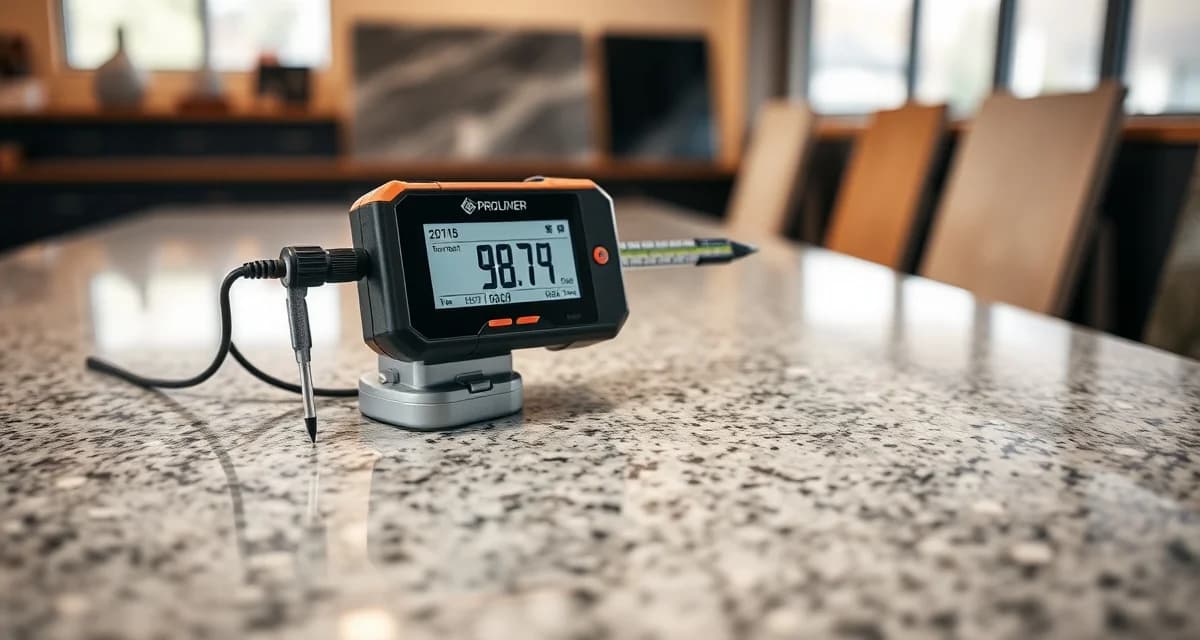
The Proliner is a digital templating device manufactured by Prodim International (Netherlands) that uses a telescopic measuring pen to capture precise 2D and 3D measurements of countertop layouts, floors, walls, and other surfaces. In the countertop fabrication industry, the Proliner competes with the LT-2D3D as the other major digital templating system, with particular strength in measuring complex shapes, curves, and surfaces where laser line-of-sight is obstructed.
TL;DR
- The Proliner is made by Prodim International, a Dutch company specializing in digital measurement
- Uses a telescopic digital pen (not laser) to capture measurements by touching surfaces directly
- Accuracy: +/- 1/16" (1.5mm) across typical spans
- Price: approximately $20,000-$28,000, plus annual software subscription
- Excels at curved surfaces, complex shapes, and obstructed measurement situations
- No line-of-sight requirement - the pen physically contacts each measurement point
- Exports DXF files compatible with Alphacam, SlabSmith, and other fabrication software
Proliner: The Digital Pen Approach to Countertop Templating
How the Proliner Differs from Laser Templating
While the LT-2D3D uses a laser beam to measure distances from a fixed tripod, the Proliner takes a fundamentally different approach. A telescopic measuring arm extends from a compact base unit, and the operator touches the arm's pen tip to each measurement point on the surface.
Calculate your material waste savings
See exactly how much slab material and money you could save with optimized cutting layouts.
Try the free Waste CalculatorThis pen-based method has distinct advantages and trade-offs:
Advantages of pen-based measurement:
- No line-of-sight required - measure behind obstacles, under overhangs, inside corners
- Direct surface contact provides tactile confirmation of measurement points
- Curves and irregular shapes are captured by tracing the pen along the surface
- Works well in tight spaces (small bathrooms, galley kitchens)
Trade-offs:
- The measuring arm has a maximum reach from the base unit (typically 7-10 feet depending on model)
- For large kitchens, you may need to reposition and reference more often than with a laser
- Higher price point than the LT-2D3D
- Slightly steeper learning curve for operators used to laser measurement
Proliner Models for Countertop Work
Prodim offers several Proliner configurations:
| Model | Reach | Best For |
|---|---|---|
| Proliner 7 | 7 ft radius | Small to mid-size residential |
| Proliner 8 | 8 ft radius | Standard residential kitchens |
| Proliner 10 | 10 ft radius | Large kitchens, commercial work |
| Proliner IS | Industrial Series | High-volume commercial projects |
The Proliner 8 is the most common model in US countertop shops. Its 8-foot measuring radius covers the majority of residential kitchen layouts, and the base unit can be repositioned for larger spaces using reference points to maintain measurement continuity.
The Templating Workflow
- Position the Proliner - Place the base unit on a stable surface near the countertop area. The device connects to a Windows tablet or laptop running Prodim's software.
- Measure perimeter - Extend the telescopic pen and touch each corner, wall junction, and edge point. The software builds the countertop outline in real time.
- Trace curves - For curved edges (bar tops, reception desks), drag the pen tip along the surface while the device records continuous measurements.
- Capture heights - Measure backsplash heights, wall angles, and surface levels at multiple points.
- Mark features - Touch sink centers, cooktop corners, and other cutout reference points.
- Export - Save as DXF/DWG for CNC programming import.
Where the Proliner Excels
Complex Residential Work
Curved bar tops, island waterfall edges, and irregular wall shapes are the Proliner's strength. While the LT-2D3D requires line-of-sight and measures in point-to-point fashion, the Proliner can trace a curve continuously, producing a smoother and more accurate digital representation.
Commercial Projects
Commercial countertop work - nurse stations, reception desks, hotel vanities - often involves unusual shapes, tight access, and long runs. The Proliner's ability to measure around obstacles and trace complex geometry makes it the preferred tool for many commercial fabrication shops.
Retrofit and Remodel
When templating in a kitchen with existing upper cabinets, appliances, and fixtures still in place, the Proliner's pen can reach behind and underneath obstacles that block a laser's line of sight.
Proliner vs. LT-2D3D: The Full Comparison
| Feature | Proliner | LT-2D3D |
|---|---|---|
| Manufacturer | Prodim (Netherlands) | Laser Products Industries (USA) |
| Measurement Method | Telescopic pen/stylus | Laser beam |
| Accuracy | +/- 1/16" | +/- 1/16" |
| Price Range | $20,000-$28,000 | $18,000-$22,000 |
| Annual Software | $2,000-$3,500 | $2,000-$3,000 |
| Line of Sight Required | No | Yes |
| Curves | Continuous tracing | Point-to-point approximation |
| Large Spans | Requires repositioning more often | Handles long sight lines well |
| US Market Share | ~30-35% of digital templating | ~55-60% of digital templating |
| Best For | Complex shapes, commercial, retrofit | Standard residential, high volume |
Cost Analysis for Fabricators
The Proliner costs $2,000-$6,000 more than the LT-2D3D upfront. Whether that premium pays off depends on your project mix:
Proliner pays off when:
- 30%+ of your jobs involve curved or irregular shapes
- You do significant commercial work (bars, hotels, offices)
- Your templaters frequently encounter line-of-sight obstacles
- You need to measure behind existing fixtures in remodel work
LT-2D3D is the better value when:
- 80%+ of your work is standard residential kitchens and baths
- High volume (20+ templates/week) with straightforward layouts
- Budget is a primary concern
For many mid-size shops, the answer is "both." A shop doing 30+ kitchens per month might have an LT-2D3D for standard residential work and a Proliner for commercial and complex jobs.
Maximizing Proliner Accuracy
Take more points than you think you need. On straight runs, measure every 12-18 inches rather than just endpoints. This catches wall irregularities that create fit problems at installation.
Always verify cabinet level. Use the Proliner's 3D capability to check cabinet level at multiple points. Out-of-level cabinets are responsible for a significant share of countertop fit issues at installation.
Verify before you fabricate. Regardless of which digital templating device you use, template files should be verified before CNC programming. SlabWise's 3-layer template verification automatically checks Proliner DXF exports for common errors - impossible angles, missing dimensions, conflicting measurements - catching problems that cost $1,500-$4,000 per remake if they reach the shop floor.
How much does a Proliner cost?
The Proliner ranges from approximately $20,000-$28,000 depending on the model, plus an annual software subscription of $2,000-$3,500.
Is the Proliner better than the LT-2D3D?
Neither is universally better. The Proliner excels at complex shapes, curves, and obstructed measurements. The LT-2D3D is more cost-effective for standard residential countertop work. Many shops own both.
Who makes the Proliner?
The Proliner is manufactured by Prodim International, headquartered in Helmond, Netherlands. They have US sales and support operations.
How accurate is the Proliner?
The Proliner achieves +/- 1/16" (1.5mm) accuracy across typical measurement spans, comparable to the LT-2D3D.
Can the Proliner measure curved surfaces?
Yes. Continuous curve tracing is one of the Proliner's primary advantages. The operator drags the pen tip along the curve, and the device records the shape continuously.
What file formats does the Proliner export?
The Proliner exports DXF and DWG files, which are compatible with Alphacam, SlabSmith, and other CNC programming and nesting software.
How long does it take to learn the Proliner?
Most operators reach basic proficiency in 2-3 weeks and full proficiency in 4-6 weeks. Prodim provides training with purchase and offers ongoing support.
Does the Proliner need line of sight?
No. Unlike laser-based systems, the Proliner's telescopic pen physically contacts measurement points, so it works around corners, behind fixtures, and under overhangs.
Can one person operate the Proliner?
Yes. The Proliner is designed for single-operator use, though an assistant can be helpful for very large commercial projects.
How portable is the Proliner?
The Proliner base unit weighs approximately 20 pounds and fits in a carrying case. Including the tablet/laptop and accessories, the complete kit is manageable for a single person.
Verify Every Proliner Template with SlabWise
Digital templating captures precise measurements, but files still need verification before fabrication. SlabWise checks every Proliner export for errors, conflicts, and missing data - stopping costly remakes before they start.
Start your 14-day free trial at SlabWise.com
Try These Free Tools
- Nesting Optimizer -- AI-powered slab layout that maximizes yield considering vein direction and defects.
- Defect Mapping -- Upload a slab photo and AI maps every fissure, pit, and color issue.
- Value Engineering -- Find dollar-quantified suggestions to save material without cutting margin.
Sources & Further Reading
- Natural Stone Institute - Fabrication Guidelines and Best Practices
- International Surface Fabricators Association - Waterjet Cutting Technology Standards
- ASTM International - Standard Guide for Abrasive Waterjet Machining
- OSHA - Safety Guidelines for Waterjet Operations