What Is LT 2D3D? Definition & Guide
Quick Definition
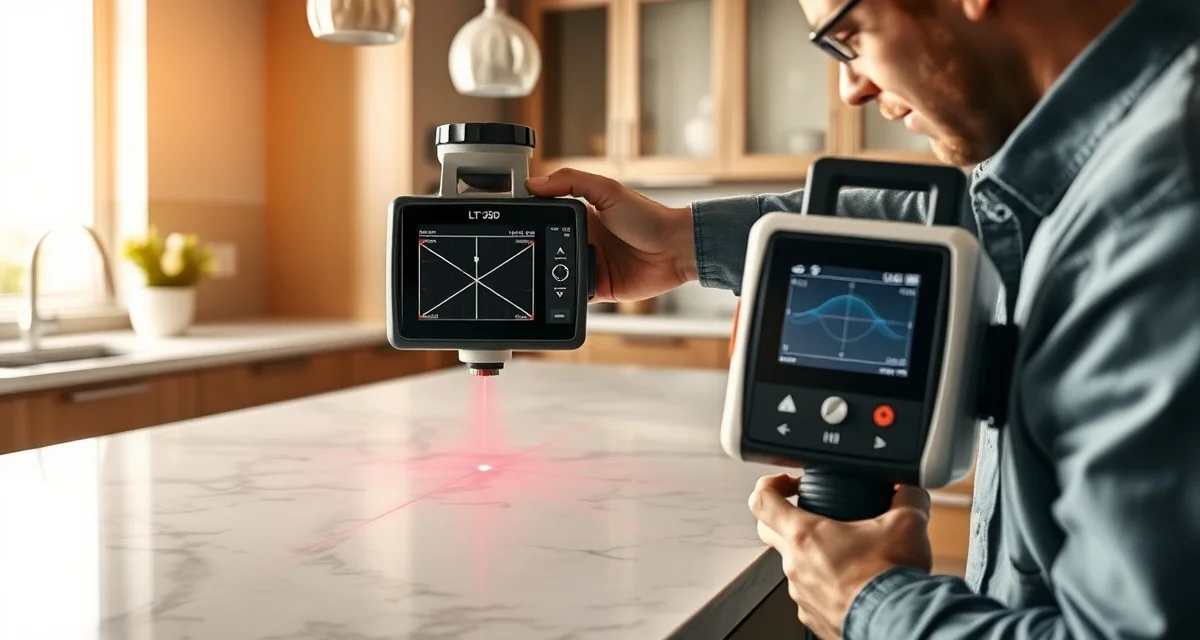
The LT-2D3D is a laser templating device manufactured by Laser Products Industries (LPI) that allows countertop fabricators to create precise digital templates of kitchen and bathroom countertop layouts on-site at the customer's home. It uses laser measurement technology to capture 2D and 3D dimensions, which are then exported as DXF/DWG files for CNC fabrication - replacing the traditional method of creating physical templates from strips, cardboard, or plywood.
TL;DR
- The LT-2D3D is the most widely used digital templating device in the US countertop industry
- It replaces physical strip/cardboard templating with laser-precise digital measurements
- Accuracy: +/- 1/16" (1.5mm) over typical kitchen spans
- Creates DXF files that feed directly into CNC programming software (Alphacam, etc.)
- Price: approximately $18,000-$22,000 for the device, plus annual software subscription
- Reduces template-to-fabrication errors that cause costly remakes ($1,500-$4,000 each)
- Templating time: 20-45 minutes per average kitchen (comparable to physical templating)
LT-2D3D: The Laser Templating Standard for Countertop Shops
Why Digital Templating Matters
Before digital templating, countertop fabricators created physical templates - thin strips of wood, luan plywood, or cardboard - arranged on the customer's existing countertop or cabinet framework to capture the exact shape and dimensions. These physical templates were then transported back to the shop, where fabricators traced them onto the slab.
Calculate your material waste savings
See exactly how much slab material and money you could save with optimized cutting layouts.
Try the free Waste CalculatorThe problems with physical templating:
| Issue | Impact |
|---|---|
| Strips shift during transport | Dimensions change by 1/8" to 1/4", causing misfit at installation |
| Template material warps in heat/humidity | Seasonal accuracy issues, especially in the South and Southwest |
| Manual tracing onto slab | Additional error source between template and cut |
| No digital file for CNC | Operator must manually program each cut |
| Template storage | Physical templates consume shop space |
Digital templating with the LT-2D3D eliminates these issues by creating a precise digital file at the job site that transfers directly to CNC programming software.
How the LT-2D3D Works
The LT-2D3D sits on a tripod and uses a laser to measure distances, angles, and 3D profiles. The operator positions the device and then aims the laser at key points - corners, walls, backsplash intersections, sink locations, cooktop cutouts, and other critical dimensions.
The basic templating workflow:
- Setup - Position the LT-2D3D on its tripod near the countertop area. The device connects to a Windows tablet or laptop running LPI's software.
- Measure perimeter - Aim the laser at each corner, wall junction, and edge point around the countertop area. The software builds a 2D outline in real time.
- Capture 3D profiles - Use the 3D measurement mode to capture wall angles, backsplash heights, and surface level variations (important for out-of-level cabinets).
- Mark cutouts - Measure sink, cooktop, and other cutout locations.
- Annotate - Add notes for edge profiles, seam locations, overhangs, and special requirements.
- Export - Save the file as DXF/DWG format for import into CNC programming software.
Accuracy and Reliability
The LT-2D3D achieves +/- 1/16" (approximately 1.5mm) accuracy across a typical 10-12 foot kitchen span. This is significantly better than most physical templating methods, which typically achieve +/- 1/8" to 1/4" accuracy depending on the material used and the care taken during transport.
However, accuracy depends on operator skill. Common sources of error include:
- Insufficient measurement points - Taking too few perimeter points on curved or irregular walls
- Tripod movement - Bumping the tripod mid-measurement requires a reference point check
- Ignoring level variations - Cabinets out of level by 1/4" or more can cause countertop fit issues if not captured in 3D mode
LT-2D3D vs. Proliner
The two major digital templating devices in the countertop industry are the LT-2D3D and the Proliner. Here's how they compare:
| Feature | LT-2D3D (Laser Products) | Proliner (Prodim) |
|---|---|---|
| Measurement Method | Laser | Digital pen/stylus |
| Accuracy | +/- 1/16" | +/- 1/16" |
| Price (approximate) | $18,000-$22,000 | $20,000-$28,000 |
| Best For | Standard countertop templating | Complex shapes, curves, irregular surfaces |
| Learning Curve | Moderate (2-4 weeks to proficiency) | Moderate (2-4 weeks to proficiency) |
| Portability | Tripod-mounted, ~15 lbs | Arm-mounted, ~20 lbs |
| Line of Sight Required? | Yes (laser must see target) | No (pen touches surface directly) |
| Software | LPI Templating Software | Proliner software suite |
The LT-2D3D dominates the US residential countertop market because of its lower price, adequate accuracy for standard kitchen/bath layouts, and strong integration with popular CNC software like Alphacam.
The Proliner excels in commercial work, complex shapes (curved bar tops, reception desks), and situations where line-of-sight to measurement points is obstructed.
Integration with Fabrication Software
The LT-2D3D exports DXF/DWG files that import into:
- Alphacam - Industry-standard CNC programming software
- SlabSmith - Slab layout and visualization software
- SigmaNEST - Nesting optimization software
- Various CNC controller software - Direct import for machine programming
This digital workflow means the template taken at the customer's home on Monday morning can be programmed and ready for CNC cutting by Monday afternoon - versus the overnight delay typical with physical templates that need to be transported and traced.
Cost Justification for Fabricators
The LT-2D3D costs $18,000-$22,000 upfront plus an annual software subscription ($2,000-$3,000/year). For a shop doing 20+ kitchens per month, the math works quickly:
- Remake prevention: If the LT-2D3D prevents just 1 remake per month (at $1,500-$4,000 average cost), it pays for itself in 6-12 months
- CNC programming time savings: Eliminating manual slab tracing saves 15-30 minutes per job, or 5-10 hours per month for a busy shop
- Customer confidence: Digital measurements feel more professional and reduce disputes about fit at installation
Getting the Most from Your LT-2D3D
Verify templates before fabrication. A digital template is only as good as the measurements taken. SlabWise's 3-layer template verification checks every LT-2D3D file for common errors - missing measurements, impossible angles, dimension conflicts - before the job reaches your CNC saw. Catching a template error at the verification stage costs $0. Catching it after fabrication costs $1,500-$4,000.
Train multiple operators. Don't depend on a single templater. Cross-train at least two team members on the LT-2D3D so illness, vacations, or turnover don't halt your template pipeline.
Calibrate regularly. The LT-2D3D should be calibrated according to LPI's maintenance schedule. Even small calibration drift compounds across large spans, turning a 1/16" accuracy spec into a 1/8" reality.
How much does the LT-2D3D cost?
The LT-2D3D typically costs $18,000-$22,000 for the hardware, plus an annual software subscription of $2,000-$3,000.
How accurate is the LT-2D3D?
The LT-2D3D achieves +/- 1/16" (1.5mm) accuracy under normal operating conditions across typical kitchen spans.
How long does it take to template a kitchen with the LT-2D3D?
An experienced operator can template an average kitchen (30-50 sq ft of countertop) in 20-45 minutes, including setup and annotation.
Does the LT-2D3D work with Alphacam?
Yes. The LT-2D3D exports DXF/DWG files that import directly into Alphacam and other CNC programming software.
Is the LT-2D3D better than the Proliner?
Neither is objectively better - they serve different strengths. The LT-2D3D excels for standard residential countertop work and costs less. The Proliner is better for complex shapes and situations without clear line-of-sight.
Can one person operate the LT-2D3D?
Yes. The LT-2D3D is designed for single-operator use. One person can template a kitchen without assistance.
How long does it take to learn the LT-2D3D?
Most operators reach basic proficiency in 1-2 weeks and full proficiency in 3-4 weeks of regular use. LPI provides training with purchase.
Does the LT-2D3D require line of sight?
Yes. The laser must have a clear line of sight to each measurement point. Obstructions require repositioning the device and using reference points to maintain accuracy.
What software does the LT-2D3D run on?
The LT-2D3D runs LPI's proprietary templating software on a Windows tablet or laptop. The device connects via USB or Bluetooth.
Can the LT-2D3D measure 3D surfaces?
Yes. The LT-2D3D has a 3D measurement mode that captures surface heights, wall angles, and level variations - critical for countertops on out-of-level cabinets.
Verify Every LT-2D3D Template with SlabWise
Your LT-2D3D captures precise measurements, but errors still happen - missed points, wrong annotations, dimension conflicts. SlabWise's 3-layer template verification catches these problems before fabrication starts, preventing remakes and protecting your margins.
Start your 14-day free trial at SlabWise.com
Try These Free Tools
- Nesting Optimizer -- AI-powered slab layout that maximizes yield considering vein direction and defects.
- Defect Mapping -- Upload a slab photo and AI maps every fissure, pit, and color issue.
- Value Engineering -- Find dollar-quantified suggestions to save material without cutting margin.
Sources & Further Reading
- Natural Stone Institute - Fabrication Guidelines and Best Practices
- International Surface Fabricators Association - Waterjet Cutting Technology Standards
- ASTM International - Standard Guide for Abrasive Waterjet Machining
- OSHA - Safety Guidelines for Waterjet Operations