Proliner Review: Should You Buy at $30K?
Last October I watched Marco, a shop owner in Raleigh running about 22 kitchens a week, unbox a Proliner 10C on his loading dock. His lead templator, Danny, picked up the stylus, looked at it, looked at the tablet, and said, "Thirty-two thousand dollars for a fishing reel and an iPad." Six weeks later Danny was templating a full kitchen in under 30 minutes by himself, the remake rate had dropped from around 4 percent to under 1.5, and Marco told me the unit was already on pace to pay for itself by spring. "I should've bought it two years ago," he said, which is the most common sentence in the stone industry right after "we're three weeks out."
That story is not universal. Whether a Proliner earns its price tag depends on shop size, job mix, and whether the rest of your workflow is ready to accept a clean digital file. This article sits in the Stone Shop Equipment Reviews cluster. If you want the wider view of how a Proliner fits into the full fab workflow, the Complete Guide to Countertop Fabrication connects every cluster into one frame.
One disclosure up front: Slabwise integrates with Proliner files through DXF middleware that pushes templated geometry straight to the CNC and bridge saw. So the perspective here is from a shop already running digital templates, asking whether the spend pencils out.
What $30K Actually Buys You
The Proliner 10C, the model most stone shops land on, runs between $28,500 and $33,000 depending on configuration, training package, and which Prodim distributor you're dealing with. In the box: measuring arm, stylus, tablet running Prodim's Plug & Play software, calibration tools, hard case, and one to two days of on-site training.
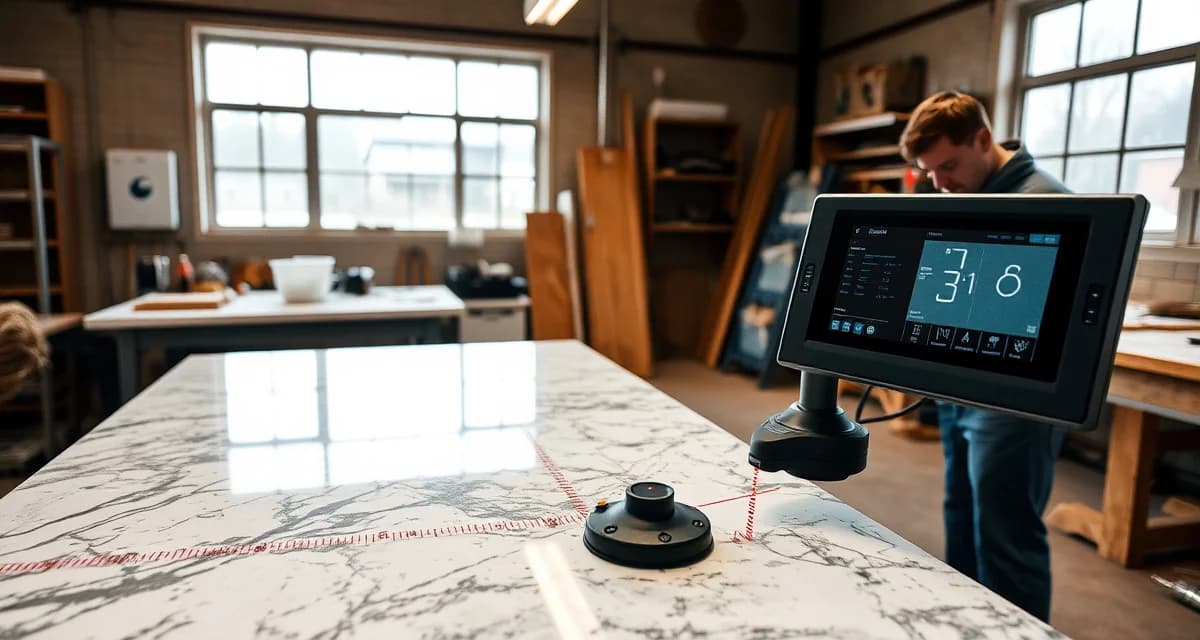
The unit measures by physically pulling a steel cable from a fixed origin while the tablet plots each point in real time. Think of it like a 3D version of one of those retractable dog leashes, except accurate to plus or minus 0.2 mm over a 3-meter radius (per Prodim's published spec sheet). Battery runs about 8 hours. The cable assembly is rated for several million pulls before the spring needs attention.
For a shop running 4 to 6 templates a day, the realistic field productivity gain over cardboard is 30 to 50 percent on time and roughly 60 to 70 percent on rework. Those figures come from fabricator surveys published by Stone Update and ISFA member case studies, not from Prodim's marketing team.
The Comparison Nobody Wants to Make Honestly
Here's the thing: a Proliner competes against cardboard that costs you $200 and a photo-based system at roughly half the price. Pretending otherwise is bad salesmanship.
Calculate your material waste savings
See exactly how much slab material and money you could save with optimized cutting layouts.
Try the free Waste Calculator| Spec | Prodim Proliner 10C | Manual Cardboard Template | ETemplate Photo System |
|---|---|---|---|
| Up-front price | $28,500 to $33,000 | Under $200 | $18,000 to $22,000 |
| Accuracy | plus or minus 0.2 mm | 1 to 3 mm typical | plus or minus 0.5 mm |
| Time per kitchen | 25 to 40 minutes | 60 to 120 minutes | 35 to 60 minutes |
| Crew size | 1 templator | 2 templators | 1 templator |
| File output | DXF, DWG, native Plug & Play | none | DXF, DWG |
| Annual service | $1,500 to $2,500 | $0 | $1,000 to $1,800 |
| Best for | High-volume stone, complex shapes | Hobby, occasional, very small shops | Medium shops, flat work, photographic detail |
Prices sourced from current Prodim, Laser Products, and photogrammetry tool quotes shared in fabricator forums and cross-checked against published distributor sheets. Service contracts vary by region.
The LT-2D3D from Laser Products ($26,000 to $29,000) is the closest spec-for-spec rival. ETemplate uses photogrammetry with coded targets, which is faster to set up but less precise on complex 3D geometry like out-of-square walls and waterfall returns. Shops choosing between these three usually pick based on local support quality, operator preference, and file format compatibility with whatever back-office software they're already running. None of the three is a bad choice for a serious fab shop.
Where the Proliner Pays for Itself (and Where It Doesn't)
The honest case for a Proliner is volume and complexity. A shop pushing 15 to 30 kitchens a week with multiple seams, waterfall edges, miter returns, and walls that haven't been square since the Nixon administration saves real money in templating time and downstream rework.
A clean template at 0.2 mm accuracy means the CNC operator doesn't have to fight the file. Slab nesting software gets clean geometry. The install crew shows up with a piece that drops in. Published case studies show cycle time from quote to install dropping from a typical 14 days down to 7 to 9 days.
At that volume, the unit pays for itself within the first year on labor savings alone. Add the reduction in remakes and the math gets very friendly.
Now, the other side. If you're doing under 4 kitchens a week and you're the one driving to the job site with the stylus in your passenger seat, the payback stretches to 3 to 5 years. There is zero shame in running cardboard if the volume doesn't support the investment. I'd argue buying a Proliner for a 2-kitchen-a-week shop is worse than buying no digital templator at all, because you've sunk $30K into a tool that sits in its case four days out of five while you worry about cash flow.
The other scenario where a Proliner fails: when the back office can't handle the file output. Plug & Play exports DXF and DWG cleanly, but if your shop is still hand-drawing CNC files on a whiteboard, the Proliner just creates a digital backlog instead of fixing a paper one. The Proliner is an upstream tool. It only pays back when the downstream is ready to receive it.
The ROI Math, Simplified
The Proliner pays back faster when:
- The shop runs at least 4 templates a week
- The shop pays a templator at least $25 an hour fully loaded
- A CNC or bridge saw downstream can consume a clean DXF
- Remakes currently cost more than 2 percent of monthly revenue
The Proliner pays back slower when:
- The shop runs under 2 templates a week
- The owner is the templator and the labor cost is invisible
- The shop still uses paper templates and manual saw setups downstream
- Job mix is mostly simple rectangular kitchens with no out-of-square walls
These benchmarks come from shop-floor data shared in Stone World and ISFA case studies. Your numbers will vary with crew, volume, and job mix.
Living With the Thing Day to Day
Prodim's training is one to two days on-site for the first templator, with optional advanced sessions at the factory. Most experienced templators are productive by day three and genuinely proficient within two weeks. It's not a steep learning curve so much as a trust curve: your templator needs to stop second-guessing the device and start trusting the numbers.
Support is one of the cleaner stories in stone equipment (a low bar, admittedly). Prodim has US service centers and a European support line. Tickets get answered same day during business hours. Replacement parts ship within a week for most items. The cable assembly is field-serviceable.
That said, the unit is not indestructible. The stylus tip wears. The cable can fray on rough job sites where someone drags it across a granite edge repeatedly. Shops that drop the unit off a tailgate learn fast that a $30,000 tool demands the same respect as a $30,000 saw. Maybe more, because the saw doesn't break when it falls three feet.
How It Connects to Everything Else in the Shop
The point of any digital templator is the file that comes off it. A Proliner exports to DXF, DWG, or native Plug & Play. Slabwise's middleware reads those files, runs the slab nesting against current inventory, and pushes the cut file to the CNC and bridge saw without anybody re-typing a single dimension.
For shops running AlphaCAM, Helix, or Stone Profit Systems, the Proliner file drops in directly. For shops still relying on paper handoffs, the real upgrade path is to digitize the back office at the same time you bring in the templator. Buying a Proliner and then hand-keying dimensions into the saw operator's spreadsheet is the most expensive possible way to use the machine. It's like buying a Ferrari and towing it behind a pickup.
The connected workflow is what turns the Proliner from a $30,000 expense into a $30,000 profit center.
The Silica Compliance Footnote
Templating itself doesn't generate respirable crystalline silica. The fabrication that follows does. OSHA 29 CFR 1926.1153 sets the permissible exposure limit at 50 micrograms per cubic meter of air over an 8-hour time-weighted average. Wet cutting, fit-tested respirators, and HEPA-filtered shop vacs are the baseline. A Proliner doesn't change the silica exposure picture, but every job a Proliner enables flows into the saw, the CNC, and the polishing line, which do generate exposure. Plan accordingly.
Frequently Asked Questions
How long does a Proliner take to pay for itself? For shops running 4 or more templates a week with a fully loaded templator labor cost, the typical payback is 12 to 18 months from labor savings alone. Add remake reduction and the window shortens. Smaller shops see 3 to 5 year payback periods.
Can one person really template a full kitchen with a Proliner? Yes. The Proliner is designed for single-operator use. A two-person team is faster on complex jobs, but a single trained templator handles a standard kitchen in 25 to 40 minutes.
What is the annual cost of ownership? Plan on $1,500 to $2,500 a year in service, calibration, and consumables. Software updates are typically included in the service contract from most Prodim distributors.
Is the Proliner accurate enough for waterfall edges and miters? Yes. The 0.2 mm accuracy spec sits well inside the tolerance window for waterfall, miter, and book-matched seams. The bigger question is whether your downstream CNC can hold the same tolerance.
Does Slabwise integrate with Proliner files? Yes. Slabwise reads DXF and DWG output from the Proliner directly, runs slab nesting against current inventory, and pushes the cut files to the CNC and bridge saw without manual re-entry.
Should a one-truck shop buy a Proliner? Usually no. A one-truck shop running under 4 templates a week will struggle to justify the $30,000 spend. The exception is a shop doing high-end custom work where the remake cost on a single botched job can reach five figures.
What is the warranty? Prodim offers a one-year manufacturer warranty on the hardware with extended service contracts available. The cable assembly and stylus are wear items not covered under warranty.
Where to Go From Here
Start with the Stone Shop Equipment Reviews hub for the full overview of physical equipment shop owners buy alongside Slabwise. From there, the Complete Guide to Countertop Fabrication ties every piece of the fab shop into one operational view.
Related articles worth reading next:
- Prodim Proliner vs ETemplate: Which Templator Wins for Stone Shops?
- How to Choose a Templator for Your Stone Shop
- Best Stone CNC Machines 2026: Top 6 Brands Compared
From the Digital Templating cluster, the Prodim Proliner: Complete Guide covers the broader templating workflow including handoff to fabrication.