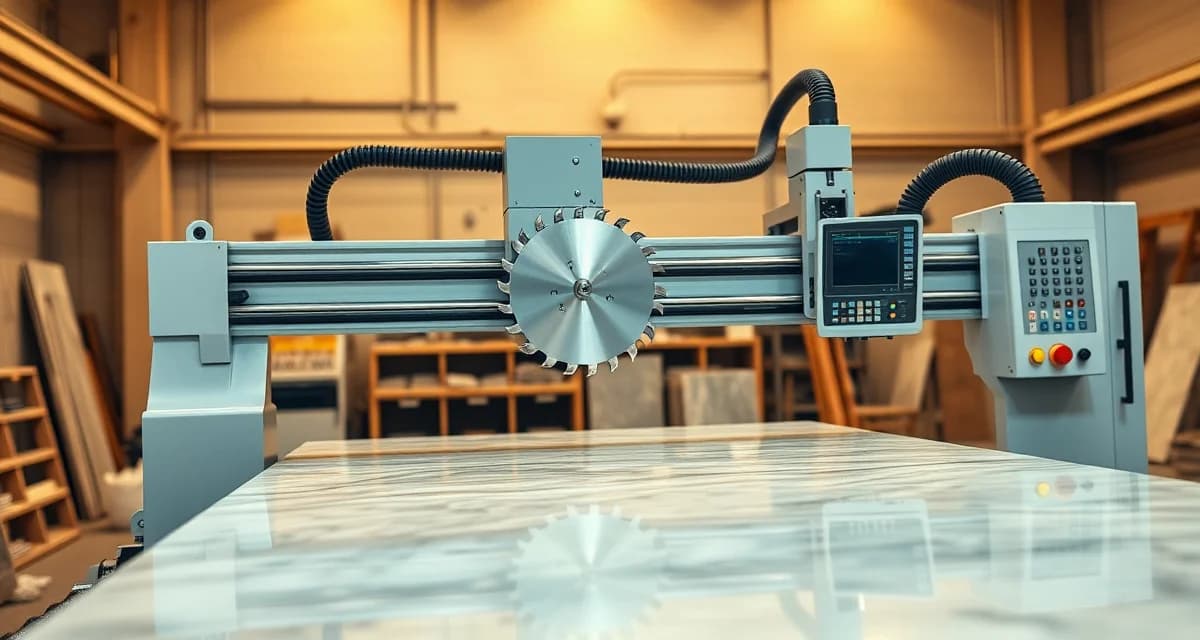
What Is a CNC Bridge Saw?
A CNC bridge saw is a computer-controlled stone cutting machine used in countertop fabrication. It consists of a saw blade mounted on a bridge (a horizontal beam that spans the cutting table) that moves along X, Y, and Z axes based on programmed instructions from a digital file. The CNC (Computer Numerical Control) system reads DXF template files or nesting layouts and executes precise cuts on granite, quartz, marble, quartzite, and other stone materials - without manual guidance from an operator.
TL;DR
- CNC bridge saws cut stone slabs into countertop pieces using computer-programmed toolpaths
- Typical cutting accuracy: ±0.5mm (vs. ±2-3mm for manual bridge saws)
- Major brands: Park Industries, Breton, Intermac, BACA Systems, Donatoni
- Price range: $80,000-$400,000+ depending on axes, features, and automation level
- 3-axis saws handle straight cuts and basic angles; 5-axis saws add miter cuts and complex profiling
- CNC saws integrate directly with digital templates and nesting software, eliminating manual layout
- Wet cutting is standard, using water to suppress silica dust and cool the blade
How a CNC Bridge Saw Works
Basic Components
| Component | Function |
|---|---|
| Bridge | Horizontal beam spanning the work table; carries the spindle |
| Spindle | Rotating head that holds the cutting blade or tooling |
| Diamond blade | Cuts through stone; 14-20" diameter is standard for countertop work |
| Work table | Flat surface (often with vacuum hold-down) supporting the slab |
| Water system | Delivers water to the cutting point for cooling and dust suppression |
| CNC controller | Computer that reads programmed files and controls all machine movements |
| Touch probe (optional) | Measures slab position and thickness before cutting |
The Cutting Process
- Slab loading: The stone slab is placed on the work table, typically using a bridge crane or vacuum lifter.
- Slab registration: The CNC machine uses a touch probe or laser to identify the slab's exact position, dimensions, and thickness on the table.
- Program loading: The operator loads the nested DXF file (from nesting software) into the CNC controller.
- Cutting: The machine executes the programmed cuts automatically - straight lines, curves, cutouts, and angles - following the toolpath at programmed feed rates.
- Edge profiling (if 5-axis): On machines with 5-axis capability, the saw can tilt to create mitered edges, bevels, and other profiles without moving the piece to a separate router.
- Piece removal: Cut pieces are removed from the table for further processing (polishing, edge finishing) or directly for installation.
3-Axis vs. 5-Axis CNC Bridge Saws
| Feature | 3-Axis | 5-Axis |
|---|---|---|
| Movement | X, Y, Z (left-right, front-back, up-down) | X, Y, Z + A and C rotation (tilt and swivel) |
| Straight cuts | Yes | Yes |
| Curved cuts | Yes | Yes |
| Miter cuts | No (requires separate setup) | Yes (blade tilts to cut miters) |
| Edge profiling | Limited | Full profiling with tool changer |
| Sink cutouts | Yes | Yes, with more complex geometries |
| Price range | $80,000-$180,000 | $180,000-$400,000+ |
| Best for | Shops doing primarily straight-run fabrication | Shops offering mitered edges, waterfall islands, complex profiles |
A 5-axis machine is not always necessary. Many successful fabrication shops run 3-axis CNC saws and handle edge profiling on a separate CNC router. The choice depends on your product mix, volume, and whether mitered or complex edge work is a significant portion of your jobs.
Calculate your material waste savings
See exactly how much slab material and money you could save with optimized cutting layouts.
Try the free Waste CalculatorCNC vs. Manual Bridge Saws
| Factor | CNC Bridge Saw | Manual Bridge Saw |
|---|---|---|
| Cutting accuracy | ±0.5mm | ±2-3mm |
| Repeatability | Identical cuts every time | Operator-dependent |
| Setup time | 5-10 min (load file, register slab) | 15-30 min (mark slab, set fences) |
| Operator skill required | CNC program loading and monitoring | Manual stone cutting skill |
| Throughput | 30-50% faster per slab | Baseline |
| Error rate | Under 1% (given verified templates) | 3-5% |
| Integration with digital templates | Direct - reads DXF files | Manual - operator interprets template |
The shift from manual to CNC bridge saws is the single biggest quality and productivity upgrade in modern countertop fabrication. CNC saws don't eliminate the need for skilled operators - but they shift the skill requirement from manual cutting technique to CNC programming and quality monitoring.
Choosing a CNC Bridge Saw
Key Factors
Table size. Standard tables accommodate slabs up to 130" x 78" (the most common full-size slab dimensions). Ensure your machine handles the largest slabs you'll process.
Spindle power. 15-20 HP handles most countertop materials. Higher power (25-30 HP) is needed for thick quartzite or high-speed production cutting.
Tool changer. Machines with automatic tool changers can switch between cutting blades, profile bits, and drilling tools without manual intervention - significantly reducing setup time between operations.
Water management. Wet cutting is mandatory for silica dust control. Check the water recycling system capacity and filtration requirements.
Software compatibility. Ensure the machine accepts DXF files from your templating system and nesting software. Most modern CNC saws support standard DXF import, but verify before purchasing.
Popular Brands in Countertop Fabrication
| Brand | Origin | Known For | Approximate Price Range |
|---|---|---|---|
| Park Industries | USA | Reliability, service network | $100,000-$350,000 |
| Breton | Italy | Precision, advanced 5-axis | $150,000-$400,000+ |
| Intermac | Italy | Mid-range with strong features | $120,000-$300,000 |
| BACA Systems | USA | Robotic integration | $80,000-$250,000 |
| Donatoni | Italy | Heavy-duty production | $130,000-$350,000 |
Maintenance and Operating Costs
| Expense | Typical Cost | Frequency |
|---|---|---|
| Diamond blade replacement | $300-$800 per blade | Every 500-2,000 sq ft cut |
| Water system maintenance | $100-$300 | Monthly |
| Spindle servicing | $500-$2,000 | Annually |
| Calibration check | $200-$500 (if done by technician) | Quarterly |
| Total annual operating cost | $8,000-$20,000 | Varies by volume |
How much does a CNC bridge saw cost?
Entry-level 3-axis models start around $80,000-$120,000. Mid-range 5-axis machines run $180,000-$300,000. Premium production models with robotic loading and tool changers can exceed $400,000.
How long does it take to learn CNC bridge saw operation?
Basic operation (loading files, starting programs, monitoring cuts): 2-4 weeks. CNC programming and optimization: 2-4 months. Most machine manufacturers include training with purchase.
Can a CNC bridge saw cut all stone types?
Yes - granite, quartz, marble, quartzite, porcelain, sintered stone, and concrete. Feed rates and blade selection vary by material hardness, but the machine handles all common countertop materials.
How accurate is a CNC bridge saw?
±0.5mm (approximately 1/50 of an inch) is standard for modern CNC bridge saws. This precision is critical for tight seam fitting and accurate cutout positioning.
Do I still need a CNC router if I have a 5-axis saw?
A 5-axis saw can handle many profiling tasks, reducing the need for a separate router. However, dedicated CNC routers often produce finer edge finishes and handle polishing steps that saws cannot. Most high-volume shops run both.
How does a CNC bridge saw connect to templating software?
Digital templates (from laser or LiDAR devices) are saved as DXF files. These files are loaded into nesting software, which arranges pieces on the slab and generates a CNC toolpath. The toolpath is transferred to the CNC saw via USB, network, or direct connection.
What safety features do CNC bridge saws include?
Standard safety features include emergency stop buttons, light curtains or area scanners that pause operation when someone enters the cutting zone, blade guards, and water containment systems for dust suppression.
How much water does a CNC bridge saw use?
Most systems use 3-8 gallons per minute during cutting. Water recycling systems reclaim and filter 80-90% of the water, reducing actual consumption significantly.
Pair Your CNC With Verified Templates
A CNC bridge saw is only as accurate as the files it reads. SlabWise verifies every template before it reaches your CNC - catching dimension errors, edge profile mismatches, and cutout problems. Better input means better output.
Start Your 14-Day Free Trial →
Try These Free Tools
- Photo to Template -- Snap a photo of an existing countertop and get an AI-generated DXF template.
- Template Compare -- Upload two templates and see every dimension change highlighted instantly.
- AI Template Verification -- Cross-check your template against manufacturer specs before cutting.
Sources & Further Reading
- National Kitchen & Bath Association - Kitchen Sink Selection Guide
- International Surface Fabricators Association - Sink Cutout and Installation Standards
- Natural Stone Institute - Countertop Sink Integration Best Practices
- Remodeling Magazine - Apron Front Sinks: Design and Installation Considerations