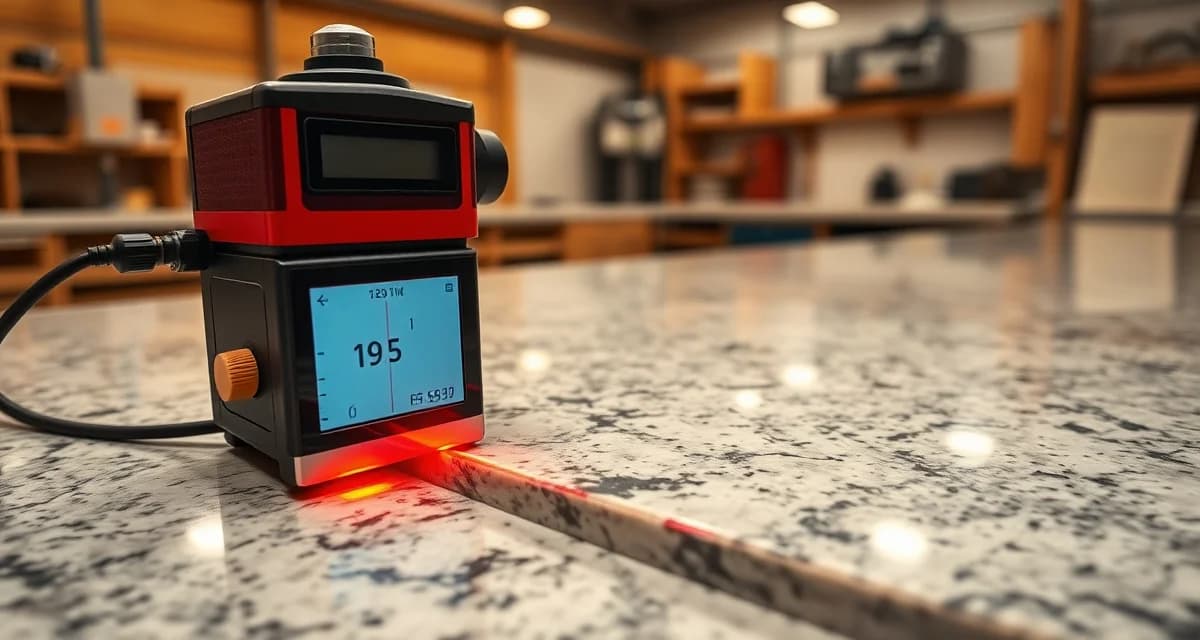
What Is Digital Templating?
Digital templating is the process of using a laser or LiDAR measuring device to capture the exact dimensions and shape of a countertop space. Instead of creating physical stick templates (strips of wood, foam, or cardboard assembled to match the counter shape), a digital templater captures precise measurements electronically and exports them as a DXF file that feeds directly into CNC fabrication equipment. The result is accuracy within 1/16 of an inch, no physical template to transport, and no manual transcription between measurement and cutting.
TL;DR
- Digital templating uses laser or LiDAR devices to measure countertop spaces electronically
- Accuracy: within 1/16" (1.5mm) vs. 1/8"-1/4" for stick templates
- Produces DXF files that transfer directly to CNC saws - no manual data entry
- Eliminates 35-40% of remake-causing measurement errors
- Template time: 30-60 minutes per kitchen (similar to stick templating)
- Major templating devices: Proliner, LPI, Laser Products Industries
- Cost: $15,000-$35,000 for the device, with a typical payback period of 6-12 months
How Digital Templating Works
The Process
-
Setup: The technician places the templating device in the kitchen or bathroom, positioning it where it can "see" the countertop area.
Calculate your material waste savings
See exactly how much slab material and money you could save with optimized cutting layouts.
Try the free Waste Calculator -
Point capture: Using a laser pointer or LiDAR scanner, the technician touches or targets key points along the counter surface - walls, corners, edges, cabinet faces, sink locations, and any obstacles.
-
Shape building: The device connects the captured points into a continuous outline representing the countertop shape. The software displays the shape in real time on a built-in screen or connected tablet.
-
Detail capture: The technician records additional information: backsplash height, overhang dimensions, sink and cooktop cutout positions, edge profiles, and any special features.
-
Export: The completed template is saved as a DXF file and transferred to the fabrication shop via USB, cloud, or shop management software.
What the Template Captures
| Measurement | How It's Recorded |
|---|---|
| Counter outline | Point-by-point along all edges |
| Wall contours | Including any out-of-square or bowed walls |
| Sink/cooktop locations | Center point and dimensions |
| Cabinet positions | For alignment during installation |
| Backsplash dimensions | Height, length, and any outlets/switches |
| Overhangs | Front, side, and island overhang measurements |
Digital vs. Stick Templating
| Factor | Digital Templating | Stick Templating |
|---|---|---|
| Accuracy | ±1/16" (1.5mm) | ±1/8"-1/4" (3-6mm) |
| Template time on-site | 30-60 minutes | 30-60 minutes |
| Transportation | DXF file (digital) | Physical template (fragile, bulky) |
| Transcription to CNC | Direct file import | Manual measurement and CAD entry |
| Remake rate impact | 35-40% fewer measurement-related remakes | Baseline |
| Wall irregularity capture | Measures exact wall contours | Approximates with straight strips |
| Cost per template | Minimal (device already purchased) | $5-$15 in materials per template |
The biggest advantage isn't the measurement itself - it's the elimination of every step between measurement and CNC cutting. Stick templates must be physically transported to the shop, measured by hand, and manually entered into CAD software. Each of those steps introduces potential error.
Common Digital Templating Devices
| Device | Manufacturer | Technology | Approximate Cost |
|---|---|---|---|
| Proliner | Prodim | Touch-probe with laser | $20,000-$35,000 |
| LT-2D3D | Laser Products Industries | Laser measurement | $15,000-$25,000 |
| LiDAR templaters | Various | LiDAR scanning | $18,000-$30,000 |
| CT-750 | Laser Products Industries | Laser measurement (portable) | $12,000-$18,000 |
All major devices output standard DXF files compatible with CNC fabrication equipment.
Why Digital Templating Matters for Quality
The Remake Prevention Factor
Template measurement errors cause 35-40% of all fabrication remakes. Each remake costs $1,500-$4,000 in material and labor. A shop doing 80+ templates per month with stick templates might produce 3-4 measurement-error remakes monthly - costing $4,500-$16,000.
Digital templating reduces measurement-error remakes by approximately 60-70%. That's 2-3 fewer remakes per month, saving $3,000-$12,000 - enough to pay for the templating device within 3-6 months.
The Verification Connection
Digital templates generate structured DXF files that can be automatically verified by template verification software. The software checks:
- Dimension ranges (flagging unlikely measurements)
- Cutout positions relative to edges (too close = structural risk)
- Consistency between adjacent piece dimensions
- Edge profile specifications against the CNC's tool library
This automated verification isn't possible with stick templates, which must be manually interpreted before any digital checking can occur.
Getting the Most From Digital Templating
Train thoroughly. The device is only as accurate as the operator. Invest 3-5 days in manufacturer training and follow up with regular calibration checks.
Verify every template. Digital doesn't mean error-free. Technicians can still target the wrong point, miss a wall contour, or record incorrect overhang dimensions. Run every template through verification software before fabrication.
Communicate with customers on-site. Use the real-time display to show customers their countertop layout, confirm sink placement, and finalize edge profiles during the template appointment. This prevents costly change orders after fabrication.
Calibrate regularly. Most devices need calibration checks every 30-60 days. Out-of-calibration devices introduce systematic errors that affect every template.
Is digital templating more accurate than stick templating?
Yes. Digital templating is accurate to within 1/16" (1.5mm). Stick templates are typically accurate to 1/8"-1/4" (3-6mm). The difference is most visible on long runs, curved sections, and walls that aren't perfectly straight.
How long does a digital template appointment take?
30-60 minutes for a standard kitchen - roughly the same as stick templating. The time savings come later, in the shop, where the digital file eliminates manual measurement interpretation and CAD entry.
Do I need to keep my stick template capability?
Many shops maintain stick template capability as a backup for situations where the digital device malfunctions or for very small jobs (single vanity tops) where the setup time isn't justified. However, 95%+ of jobs should go through digital templating.
How quickly does a digital templating device pay for itself?
At $15,000-$35,000 for the device and 2-3 prevented remakes per month ($3,000-$12,000/month saved), most shops see full payback within 3-12 months. Higher-volume shops pay back faster.
Can digital templates capture curved countertops?
Yes. Digital templaters capture curves precisely by recording multiple points along the arc. The DXF file stores this as arc or spline data that the CNC machine follows exactly - a significant advantage over stick templates, which approximate curves with straight segments.
What training is required for digital templating?
Manufacturers provide 2-5 days of initial training. Most technicians become proficient within 20-30 template appointments. Ongoing calibration and software updates require occasional refresher training.
Does digital templating work for bathroom vanities?
Yes. Small projects like vanity tops are faster to template digitally than large kitchens. Some technicians still use stick templates for very simple, rectangular vanities, but digital works for any size and shape.
How does digital templating connect to nesting and CNC?
The digital template produces a DXF file. This file is imported into nesting software, which arranges template shapes on a slab. The nested layout generates a CNC toolpath. The CNC saw reads the toolpath and cuts the stone. Every step is digital - no manual re-entry.
Verify Every Digital Template Automatically
Digital templating captures accurate measurements. SlabWise template verification confirms those measurements are correct before fabrication starts - checking dimensions, edges, and cutouts in a 3-layer automated process.
Start Your 14-Day Free Trial →
Try These Free Tools
- Nesting Optimizer -- AI-powered slab layout that maximizes yield considering vein direction and defects.
- Defect Mapping -- Upload a slab photo and AI maps every fissure, pit, and color issue.
- Value Engineering -- Find dollar-quantified suggestions to save material without cutting margin.
Sources & Further Reading
- Natural Stone Institute - Fabrication Guidelines and Best Practices
- International Surface Fabricators Association - Waterjet Cutting Technology Standards
- ASTM International - Standard Guide for Abrasive Waterjet Machining
- OSHA - Safety Guidelines for Waterjet Operations