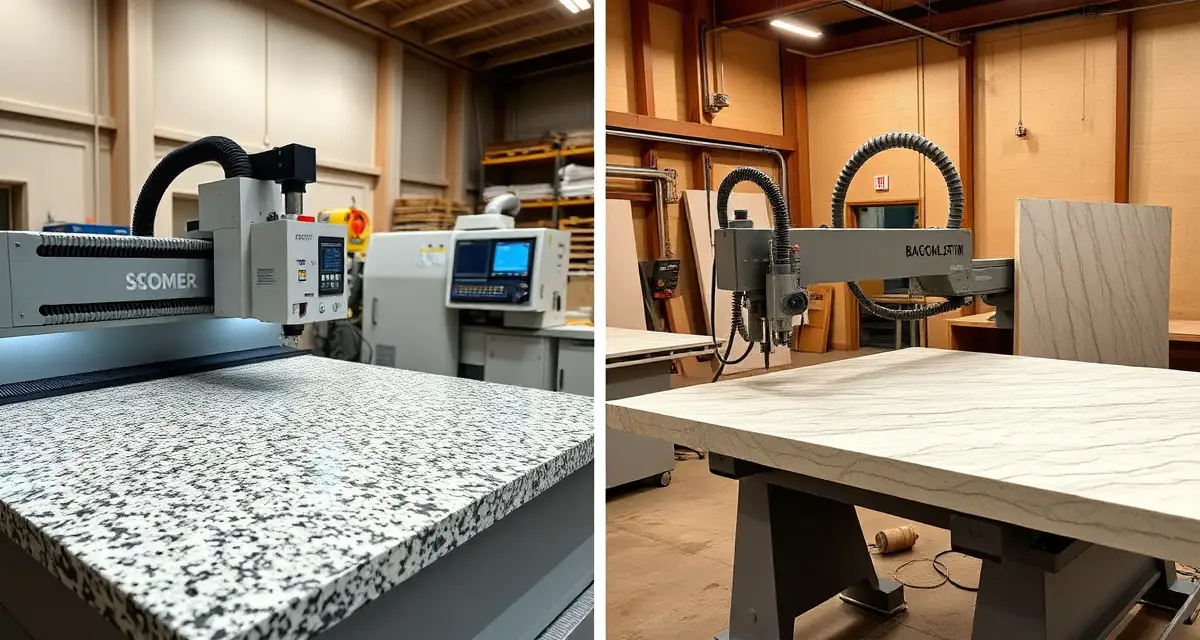
CNC Router vs Bridge Saw
What's the Difference?
A CNC router and a bridge saw serve different purposes in a countertop fabrication shop. A bridge saw makes straight cuts and miters to break slabs into rough pieces. A CNC router handles edge profiling, drilling, sink cutouts, and precision shaping. Most productive shops need both - they're teammates, not competitors.
TL;DR
- Bridge saws excel at fast straight cuts (30-60 in/min through granite)
- CNC routers handle edge profiling, drilling, cutouts, and 3D shaping
- A bridge saw costs $40K-$150K; a CNC router runs $60K-$200K+
- Shops processing 20+ kitchens/month typically need both machines
- A 5-axis bridge saw can replace some CNC router functions (miters, basic profiles)
- CNC routers reduce hand-polishing labor by 60-80%
- The right sequencing between machines directly impacts daily throughput
Bridge Saw: What It Does Best
Core Functions
A bridge saw is fundamentally a large circular saw mounted on a movable bridge that spans the cutting table. Here's what it handles:
Calculate your material waste savings
See exactly how much slab material and money you could save with optimized cutting layouts.
Try the free Waste Calculator- Straight cuts: Ripping slabs into countertop-width pieces
- Miter cuts (on 5-axis models): 45-degree cuts for waterfall edges and mitered edge buildup
- Angle cuts: Cuts on angles other than 90 degrees for diagonal layouts
- Basic curves: Some CNC-capable bridge saws can follow programmed curves
Speed Advantage
For straight cuts, nothing beats a bridge saw. Typical cutting speeds through 3cm granite:
| Cut Type | Bridge Saw | CNC Router |
|---|---|---|
| Straight rip (3cm granite) | 30-60 in/min | 15-30 in/min |
| Straight rip (3cm quartz) | 40-80 in/min | 20-40 in/min |
| Miter cut (3cm granite) | 15-30 in/min | N/A (different approach) |
That speed difference matters when you're breaking down 10+ slabs a day.
Types of Bridge Saws
Manual bridge saws ($15,000-$40,000): The operator guides the cut manually. Suitable for small shops doing a few kitchens per week.
CNC bridge saws ($60,000-$150,000): Programmable cuts from DXF files. The operator loads the slab and starts the program.
5-axis CNC bridge saws ($100,000-$200,000+): Add tilt and rotation for miter cuts, basic edge profiling, and angle cuts. These hybrid machines blur the line between saw and router.
Limitations
- Cannot profile edges (except basic chamfer on 5-axis models)
- Cannot drill holes
- Minimum inside radius limited by blade diameter
- Rougher cut finish than CNC router on curved cuts
- Requires manual handling to reposition for multiple cuts
CNC Router: What It Does Best
Core Functions
A CNC router uses spinning bits (diamond-tipped for stone) controlled by computer to perform:
- Edge profiling: Bullnose, ogee, bevel, dupont, and dozens of other profiles
- Sink cutouts: Undermount, drop-in, and farm sink openings
- Faucet holes: Precise drilling for fixtures
- Surface texturing: Engraving, fluting, and decorative work
- Through-cuts: Full cutout of shapes (though slower than a saw for straight lines)
- Backsplash details: Scribing, outlet notches, and end returns
Precision and Finish Quality
| Metric | CNC Router | Bridge Saw |
|---|---|---|
| Positional accuracy | ±0.002"-0.005" | ±0.010"-0.030" |
| Edge finish (profile) | Ready to polish | N/A |
| Repeatability | Identical across runs | Operator-dependent |
| Surface finish (cut edge) | 80-120 grit equivalent | 40-60 grit equivalent |
Labor Savings
Before CNC routers became standard, edge profiling was done by hand with portable routers and polishing pads. A CNC router:
- Cuts edge profiling time from 45-90 min/kitchen to 15-25 min/kitchen
- Eliminates most hand-polishing (the machine goes through grit sequences automatically)
- Reduces skill requirements - a trained operator replaces a master edge polisher
- Produces consistent results regardless of operator fatigue
For a shop doing 30 kitchens per month, switching from hand-profiling to CNC typically saves 40-60 labor hours monthly.
Machine Types
3-axis CNC routers ($60,000-$120,000): X, Y, and Z movement. Handles flat profiling, drilling, and cutouts. Most common entry point.
3+1 axis ($80,000-$150,000): Adds a rotating spindle (A-axis) for edge profiling without repositioning the slab.
5-axis CNC routers ($150,000-$300,000+): Full freedom of movement. Can approach the stone from any angle. Handles complex 3D profiling, undercuts, and specialty shapes.
Head-to-Head Comparison
| Factor | Bridge Saw | CNC Router |
|---|---|---|
| Primary purpose | Slab breakdown, straight cuts | Profiling, cutouts, drilling |
| Straight cut speed | 30-80 in/min | 15-40 in/min |
| Edge profiling | Basic chamfer only (5-axis) | Full profile library |
| Drilling | No | Yes |
| Sink cutouts | Rough (needs finishing) | Finished-ready |
| Initial cost | $40K-$150K | $60K-$200K+ |
| Hourly operating cost | $5-$15 | $8-$20 |
| Tooling cost/month | $200-$600 (blades) | $400-$1,200 (bits, pads) |
| Floor space | 200-400 sq ft | 250-500 sq ft |
| Learning curve | 1-4 weeks | 4-12 weeks |
| Operator skill needed | Moderate | Moderate to high |
| Water usage | 3-8 GPM | 2-5 GPM |
When You Need Both
If you're running a shop that processes more than about 15-20 kitchens per month, having both machines is almost always more efficient than trying to do everything on one.
The Ideal Workflow
- Bridge saw breaks the slab into rough pieces (straight cuts, miters)
- CNC router handles edge profiling, sink cutouts, and drilling
- Final hand-polish touch-ups (if needed)
This workflow keeps each machine doing what it's fastest at. A bridge saw sitting idle while the CNC router makes straight cuts is money lost.
Throughput Example
Shop A: CNC router only
- 3cm granite kitchen (35 sq ft): 2.5-3 hours total machine time
- Daily output: 2-3 kitchens per machine
Shop B: Bridge saw + CNC router
- Bridge saw cuts: 20-30 minutes
- CNC router profiling and cutouts: 45-75 minutes
- Daily output: 4-6 kitchens (with staggered scheduling)
Shop B produces roughly twice the volume with lower per-kitchen machine time.
What to Buy First
Starting from scratch (budget under $100K)
Start with a CNC bridge saw with basic programming capabilities. It handles straight cuts and gives you some automation. Do edge profiling by hand until volume justifies a CNC router.
Growing shop (budget $100K-$200K)
A manual or semi-automatic bridge saw ($20K-$40K) paired with a 3+1 axis CNC router ($80K-$150K). The CNC router is where your labor savings will be greatest.
High-volume shop (budget $200K+)
5-axis CNC bridge saw + 5-axis CNC router + possibly a waterjet for complex cutouts. At this level, your bottleneck shifts from machines to material handling and scheduling.
Software and Integration
Both CNC bridge saws and CNC routers run on programmed files - typically DXF or proprietary formats exported from CAD/CAM software. The efficiency of your overall operation depends heavily on how well your software ties everything together:
- Templating software captures the job site dimensions
- CAD/CAM software generates cutting programs for each machine
- Nesting software optimizes how parts are laid out on slabs
This is where digital fabrication platforms make a measurable difference. SlabWise's nesting tools help fabricators arrange cuts for 10-15% better material yield across both bridge saw and CNC operations. When you're spending $50-$150 per square foot on material, that optimization directly hits your bottom line.
Maintenance Comparison
| Task | Bridge Saw | CNC Router |
|---|---|---|
| Daily | Check blade, water flow, alignment | Check spindle, tool wear, coolant |
| Weekly | Clean rails, check belt tension | Grease linear guides, check collet |
| Monthly | Calibrate, replace wear parts | Calibrate axes, inspect bearings |
| Annual | Full alignment, electrical inspection | Spindle service, full calibration |
| Blade/bit budget | $200-$600/mo | $400-$1,200/mo |
Can a 5-axis bridge saw replace a CNC router?
Partially. A 5-axis saw can do miters, chamfers, and basic straight edge profiles. It cannot match a CNC router for complex profiles (ogee, dupont), drilling, or fine sink cutout work. High-volume shops still need both.
Which machine has a faster ROI?
For most shops, the CNC router pays for itself faster because it directly replaces expensive hand labor. A CNC router eliminating 40 hours/month of hand polishing at $25/hr saves $12,000/year in labor alone.
How much floor space do I need for both machines?
Plan for 500-900 square feet total, including material staging areas. Each machine needs 3-4 feet of clearance on all sides for maintenance access and material loading.
Can I run both machines with one operator?
Yes, with proper scheduling. While the CNC router runs a profiling program (15-30 minutes unattended), the operator can load and run cuts on the bridge saw. This staggered approach is how many mid-size shops maximize throughput.
What training is required for CNC equipment?
Most manufacturers offer 3-5 days of on-site training with purchase. Budget 1-4 weeks for bridge saw proficiency and 4-12 weeks for full CNC router proficiency (including CAM programming).
Do I need different water systems for each machine?
They can share a water recycling system, but each machine needs its own water supply line. Bridge saws typically use more water (3-8 GPM vs 2-5 GPM for CNC routers).
What about a combination machine that does both?
Combination saw/router machines exist, but they involve tradeoffs. They're slower at both cutting and profiling than dedicated machines. For shops doing fewer than 10 kitchens per month, they can be a reasonable compromise.
How do I justify the investment to my business partner?
Focus on labor savings (CNC router) and throughput increases (both machines). A shop doing 25 kitchens/month that adds a CNC router typically sees ROI in 8-14 months from reduced labor costs alone.
Maximize Your Machine Investment
Whether you're running a bridge saw, CNC router, or both, the biggest gains come from what happens before the cutting starts - accurate templates, optimized nesting, and efficient scheduling.
SlabWise helps countertop fabricators reduce material waste by 10-15% through smarter slab nesting, while cutting quote time from 20 minutes to 3 minutes. That means more jobs through your machines with less wasted material.
Start your 14-day free trial and put your machines to work smarter.
Try These Free Tools
- Photo to Template -- Snap a photo of an existing countertop and get an AI-generated DXF template.
- Template Compare -- Upload two templates and see every dimension change highlighted instantly.
- AI Template Verification -- Cross-check your template against manufacturer specs before cutting.
Sources & Further Reading
-
Natural Stone Institute - ADA Compliance Guidelines for Natural Stone Installations
-
National Kitchen & Bath Association - Universal Design and ADA Standards for Kitchen Countertops
-
ASTM International - Standard Practice for Accessible Counter and Work Surface Design