What Is CNC Fabrication?
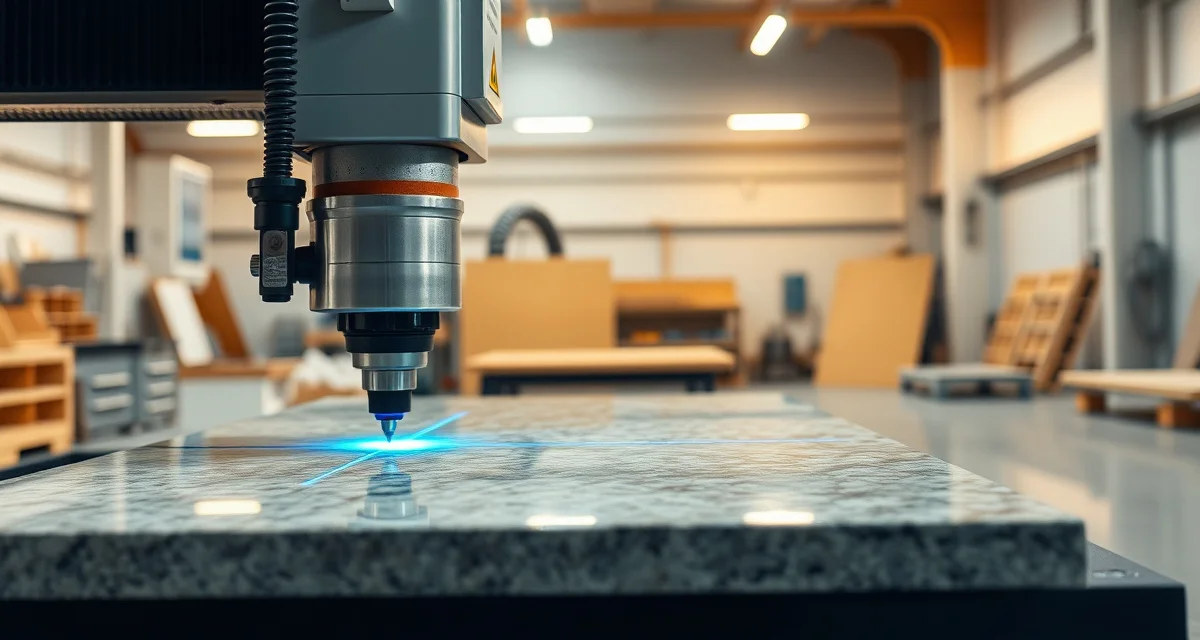
CNC fabrication in the countertop industry is the use of Computer Numerical Control machines to cut, shape, and finish stone slabs. A CNC machine follows programmed instructions to route countertop shapes from raw slabs with accuracy down to ±1/32 inch - far beyond what's achievable by hand. These machines handle everything from cutting the basic countertop shape to routing sink cutouts, drilling faucet holes, and profiling edges. CNC fabrication has become the standard for mid-to-large fabrication shops, with over 60% of US shops now using at least one CNC.
TL;DR
- CNC stands for Computer Numerical Control - machines that cut stone from digital instructions
- Accuracy: ±1/32 inch or better, compared to ±1/8 inch for skilled hand cutting
- A CNC can process a full kitchen countertop in 45-90 minutes (cutting and edging)
- Machine cost: $150,000-$500,000+ for countertop-specific CNC saws and routers
- Over 60% of US fabrication shops use CNC equipment
- CNC handles cutting, edging, sink cutouts, faucet holes, and complex profiles
- Manual fabrication is still used for on-site adjustments and by smaller shops
How CNC Machines Work in Countertop Fabrication
A CNC machine in a stone shop is essentially a large, computer-controlled cutting and routing system. Here's the basic workflow:
Calculate your material waste savings
See exactly how much slab material and money you could save with optimized cutting layouts.
Try the free Waste Calculator1. Digital Input
The machine receives a digital file (typically DXF or DWG format) containing the countertop layout. This file comes from the CAD software where the template data was converted into cutting instructions. It includes:
- Piece outlines and dimensions
- Sink and cooktop cutout positions
- Faucet hole locations
- Edge profile specifications
- Seam locations
2. Slab Positioning
The stone slab is placed on the machine bed and secured using vacuum cups, clamps, or a combination of both. The machine's sensors detect the slab edges and map the cutting area.
3. Tool Path Generation
The CNC software generates a tool path - the exact route the cutting and routing tools will follow. This accounts for:
- Tool diameter and kerf width
- Approach and exit angles to prevent chipping
- Cutting speed based on material hardness
- Water flow for cooling and dust suppression
4. Automated Cutting
The machine executes the program:
- Primary cuts - A diamond saw blade cuts the basic piece shapes from the slab
- Routing - A diamond router bit finishes edges, cuts sink holes, and creates edge profiles
- Drilling - Diamond core bits drill faucet holes and other penetrations
- Polishing - Some CNC machines include polishing heads for edge finishing
5. Quality Verification
Pieces are measured against the original file to confirm accuracy. Any minor adjustments happen at this stage.
Types of CNC Machines in Countertop Shops
CNC Saw (Bridge Saw)
The most common CNC stone machine. A large diamond blade mounted on a bridge moves across the slab, making straight and angled cuts.
| Specification | Typical Range |
|---|---|
| Blade diameter | 14-20 inches |
| Cutting depth | Up to 4 inches |
| Table size | 10' x 6' to 12' x 8' |
| Accuracy | ±1/32 inch |
| Price | $80,000-$250,000 |
| Key manufacturers | Park Industries, Breton, Intermac, BACA Systems |
CNC Router
A routing spindle moves in X, Y, and Z axes to cut profiles, sink openings, and decorative edges. Some routers also handle primary cutting.
| Specification | Typical Range |
|---|---|
| Spindle speed | 1,000-9,000 RPM |
| Working area | 10' x 5' to 14' x 8' |
| Z-axis travel | 6-12 inches |
| Accuracy | ±1/64 inch |
| Price | $120,000-$400,000 |
| Key manufacturers | Park Industries, Northwood, Intermac, Breton |
Combination Machines (SawJet)
These combine a saw blade and a waterjet on the same bridge, allowing both straight cuts and complex curved cuts from a single machine.
| Specification | Typical Range |
|---|---|
| Saw + waterjet combo | Yes |
| Cutting speed | Moderate (waterjet is slower) |
| Complexity capability | Very high - curves, inlays, intricate shapes |
| Price | $200,000-$500,000+ |
| Key manufacturers | Park Industries, BACA Systems, Breton |
5-Axis CNC
Advanced machines with five axes of movement can create 3D profiles, mitered edges, and complex geometric shapes that would be impossible with standard 3-axis equipment.
| Specification | Typical Range |
|---|---|
| Axes of movement | 5 (X, Y, Z + 2 rotation) |
| Capability | Miters, 3D profiles, complex edge work |
| Price | $300,000-$600,000+ |
| Use case | High-end custom fabrication |
CNC vs. Hand Fabrication
| Factor | CNC Fabrication | Hand Fabrication |
|---|---|---|
| Accuracy | ±1/32 inch | ±1/8 inch (skilled operator) |
| Speed (full kitchen) | 45-90 minutes | 4-8 hours |
| Consistency | Identical results every time | Varies with operator skill |
| Edge profile options | Extensive, programmable | Limited by tool and skill |
| Startup cost | $150,000-$500,000 | $5,000-$20,000 in tools |
| Labor skill required | CNC programmer + operator | Highly skilled fabricator |
| On-site capability | No (shop only) | Yes |
| Complex shapes | Excellent | Difficult |
When Hand Fabrication Still Wins
- On-site adjustments - When a piece needs minor trimming during installation, hand tools are the only option
- Very small shops - Shops doing 5-10 jobs per month may not justify CNC investment
- Specialty repairs - Chip repairs, seam touch-ups, and small modifications are hand work
- Unique one-off projects - Sometimes it's faster to cut a simple piece by hand than to program the CNC
The Economics of CNC Fabrication
Cost to Operate
| Expense Category | Monthly Cost |
|---|---|
| Machine payment (lease or loan) | $3,000-$8,000 |
| Tooling (blades, bits, polishing pads) | $2,000-$5,000 |
| Water and filtration | $500-$1,500 |
| Electricity | $800-$2,000 |
| Maintenance and repairs | $500-$2,000 |
| Total monthly | $6,800-$18,500 |
Return on Investment
A CNC machine's ROI comes from three places:
- Labor savings - One CNC operator replaces 2-4 hand fabricators
- Material savings - Precise cuts mean less waste from errors
- Throughput increase - More jobs per day means more revenue
For a shop doing 40+ jobs per month, a CNC machine typically pays for itself within 2-3 years through labor savings alone.
How CNC Fabrication Connects to the Broader Workflow
CNC doesn't exist in isolation. It's one step in a larger chain:
Templating → Quoting → Material Selection → CNC Programming → CNC Cutting → Finishing → Installation
Each handoff between steps is a potential source of error. When a digital template feeds directly into CNC programming (instead of being manually redrawn), errors drop significantly.
Fabrication platforms like SlabWise connect these steps digitally. Template data flows through AI verification (catching dimensional errors before cutting), then into AI-powered slab nesting (optimizing piece layout for 10-15% better material yield), and finally to CNC program generation. This end-to-end digital workflow is where CNC fabrication delivers its greatest value - not just in faster cutting, but in fewer mistakes across the entire process.
FAQ
What does CNC stand for in stone fabrication?
CNC stands for Computer Numerical Control. It refers to machines that follow programmed digital instructions to cut and shape stone automatically.
How much does a CNC machine cost for a countertop shop?
Entry-level CNC saws start around $80,000. Full CNC router systems range from $120,000 to $400,000+. Combination machines (SawJet) can exceed $500,000.
Can a CNC machine do everything a hand fabricator can?
Most things, yes - and with better accuracy. However, on-site adjustments, small repairs, and certain specialty work still require hand tools.
How long does it take to learn CNC stone fabrication?
Basic CNC operation can be learned in 2-4 weeks. Becoming proficient at programming, troubleshooting, and optimizing takes 3-6 months. Mastery takes 1-2 years.
Do all fabrication shops use CNC machines?
No. As of 2024, roughly 60% of US fabrication shops use CNC equipment. Smaller shops and those focused on simple projects may still fabricate entirely by hand.
What materials can a CNC machine cut?
Granite, marble, quartz, quartzite, soapstone, porcelain slabs, sintered stone, and most other countertop materials. Cutting parameters (speed, tool type, water flow) are adjusted for each material.
How accurate is CNC stone cutting?
±1/32 inch for standard CNC saws. CNC routers achieve ±1/64 inch on routing operations. This level of accuracy means pieces fit together tightly and cutouts match sink dimensions precisely.
Does CNC fabrication produce less waste than hand cutting?
Yes, for two reasons: (1) more accurate cuts mean fewer remakes, and (2) CNC nesting software can optimize piece layout on the slab better than visual estimation.
What maintenance does a CNC stone machine need?
Daily: cleaning, water system checks. Weekly: tool inspection, rail lubrication. Monthly: calibration verification, filtration system service. Annually: full mechanical and electrical inspection.
Can CNC machines cut curves in stone?
Yes. CNC routers excel at curves. CNC saws can cut curves to some extent, and SawJet combinations (saw + waterjet) handle even intricate curved cuts.
How many countertops can a CNC process per day?
A well-run CNC can process 8-15 kitchen countertop sets per day, depending on complexity. That's a substantial increase over hand fabrication (2-4 per day per fabricator).
Is CNC-fabricated stone better quality than hand-fabricated?
The stone material is the same. CNC fabrication provides more consistent accuracy, tighter seams, and more precise cutouts. The quality difference is in workmanship and fit, not the stone itself.
Connect Your CNC to Smarter Fabrication Software
SlabWise integrates with your CNC workflow through AI template verification and slab nesting, reducing errors before they reach the machine and improving material yield by 10-15%. Start your 14-day free trial at slabwise.com.
Try These Free Tools
- Photo to Template -- Snap a photo of an existing countertop and get an AI-generated DXF template.
- Template Compare -- Upload two templates and see every dimension change highlighted instantly.
- AI Template Verification -- Cross-check your template against manufacturer specs before cutting.