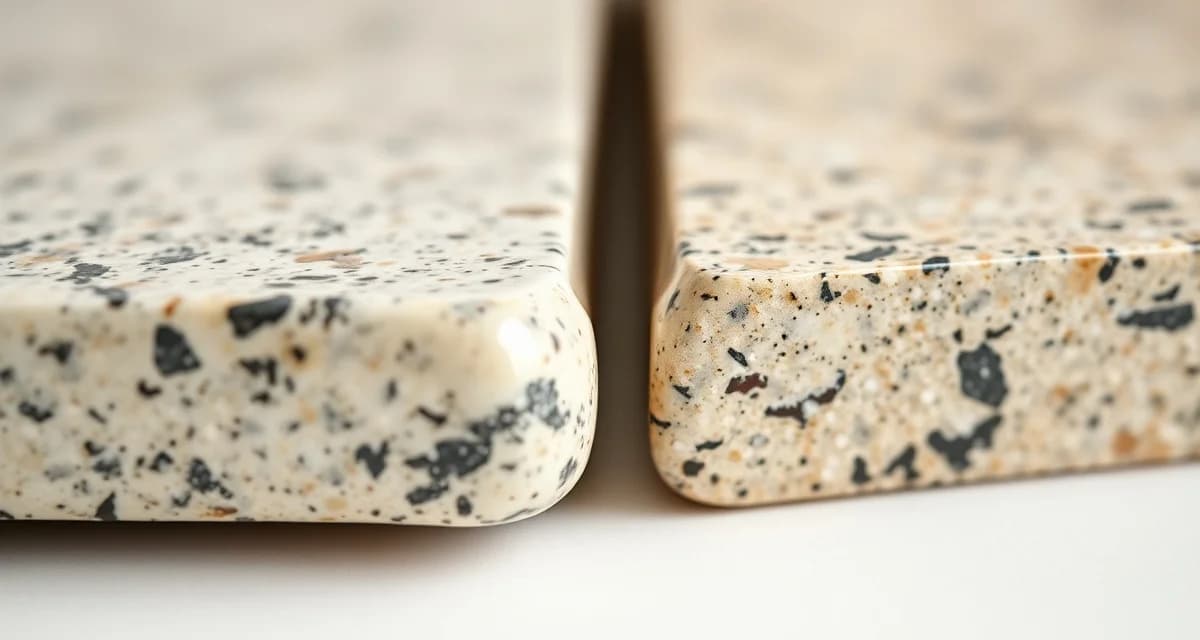
Pencil Edge vs Eased Edge
Last October I watched Marcus, a shop owner in Burnsville, Minnesota, pull a 3cm Calacatta Laza slab off the CNC bridge saw and run his thumb along the freshly cut edge. His templater had marked "pencil" on the digital layout. The homeowner's designer had written "eased" on the spec sheet. Marcus caught the discrepancy at 6:15 a.m., before the router bit touched stone. "That fifteen-second thumb check saves me about $400 in rework every time," he said. "And it happens twice a month."
That right there is the whole pencil edge vs eased edge conversation in miniature. Two profiles that look similar to a homeowner standing four feet from a countertop, but that carry real differences in tooling, labor time, visual weight, and (if you're the fabricator) margin.
This article sits in the CNC Fabrication & Edge Profiles cluster, anchored by the Eased Edge hub. For the full operational picture of how edge selection fits into shop workflow, the Complete Guide to Countertop Fabrication ties it all together. What follows is the working answer from a shop-floor perspective.
What We're Actually Talking About
An eased edge is a flat, square-cut edge with just the sharp 90-degree arris knocked off, usually a light 1/16" to 1/8" chamfer or a very slight rounding. You can still feel the flat face of the slab. The profile reads as clean, geometric, contemporary.
A pencil edge (sometimes called a pencil round) takes that rounding further. The top arris gets a consistent convex radius, typically 3/16" to 1/4", producing a smooth, half-round lip that looks and feels noticeably softer than eased. Think of the cross-section of, well, a pencil.
Here's the thing: in casual conversation, plenty of designers and even some fabricators use the terms interchangeably. They shouldn't. The CNC toolpath is different. The wheel is different. The customer expectation is different. If your showroom sample and your shop's CNC library don't match what the designer spec'd, you own the callback.
How They Look, Feel, and Wear
Side by side on a sample board, the difference jumps out. Eased holds a sharper visual line. It casts a crisper shadow where the countertop meets the cabinet face. Pencil softens that line and catches light differently, reading as slightly more traditional or transitional.
Calculate your material waste savings
See exactly how much slab material and money you could save with optimized cutting layouts.
Try the free Waste CalculatorFeel matters too. Run your hand along an eased edge and you'll notice the flat face, then a crisp break to the radius. A pencil edge is one continuous curve from the top surface to the vertical face. For families with small kids who drag their foreheads across countertop height, pencil is marginally more forgiving. (Marginally. Neither is a bullnose.)
Durability is roughly equivalent. Both profiles resist chipping better than a raw, un-profiled square edge, but less than a half bullnose or full bullnose. On harder quartzes and granites, both hold up fine for decades. On softer marbles or limestones, either can micro-chip from impact, though pencil's continuous curve distributes force a little more evenly.
CNC Setup and Labor Cost
For a CNC-equipped shop, the incremental cost difference between eased and pencil is almost trivial. On most bridge saw / router combos, eased is a single pass with a chamfer bit or a quick hand break at the polisher. Pencil requires a profiling wheel (usually a radius wheel in the 3mm to 6mm range), which adds one pass and maybe 30 to 90 seconds of polishing per linear foot on quartz.
In practice, most shops include both eased and pencil in Tier 1 pricing (no upcharge) because the time delta is so small it's not worth invoicing separately. The real labor gap shows up when you move from Tier 1 profiles to something like an ogee or dupont, where hand-polishing on quartzite can run $25 to $45 per linear foot in labor alone.
A clean pricing tier structure that works for most shops:
- Tier 1 (included): Eased, pencil
- Tier 2 (included on residential, small upcharge on commercial): Quarter round, half bullnose
- Tier 3 ($12 to $20/LF upcharge): Ogee, dupont
- Tier 4 (priced per job): Mitered edges, laminated waterfall, custom profiles
If you're still pricing edges flat across the board, you're leaving margin on the table every time a customer picks ogee and you absorb the labor.
When to Recommend Which
Opinionated take: most modern kitchens look better with eased. It matches the clean geometry of slab-front cabinetry, undermount sinks, and the overall direction residential design has been heading for the last decade. Pencil fits better in transitional spaces, bathrooms where the countertop depth is shallow and the softer edge reads as intentional, and renovation work where the homeowner wants "updated but not ultra-modern."
The exception is thick slabs. On a 3cm piece with no lamination, eased can look thin and sharp in a way some clients find cold. Pencil adds a hair of visual weight. On a laminated 6cm edge (two pieces glued to simulate a thick slab), eased is almost always the winner because that extra mass gives you enough visual heft without softening.
Ask the customer two questions and you'll land on the right profile in under a minute:
- Do you want your countertop edge to look crisp and modern, or soft and rounded?
- Are there small children in the house who might bump into the counter height?
If the answer to both is "crisp/modern" and "no kids," eased. If either answer leans the other direction, pencil. You don't need a 20-minute design consultation for this.
The Edge Profile Library Every Shop Needs
Every shop should keep a current edge profile library: physical sample pieces for the showroom, reference photos in the fabrication file, and (critically) matching profiles programmed in the CNC software so the name on the work order maps exactly to the toolpath.
The profiles that show up most often in residential work: eased, pencil, half bullnose, full bullnose, ogee, double ogee, dupont, mitered. Eased and pencil are the bread and butter of modern kitchens. Bullnose has fallen out of fashion in newer construction but still appears in renovation and senior living work. Ogee and dupont command a premium and tend to land in higher-end homes.
If your showroom samples are three years old, replace them. Stone materials shift, customer expectations shift, and a yellowed quartz sample with a chipped edge doesn't sell anything.
Switching Your Default Profile Without Wrecking the Workflow
If you've been running eased as your standard and you want to add pencil (or vice versa), the switch is small but worth doing deliberately.
- Update the CNC library first. Program the profile, run a test piece, verify the radius matches your showroom sample. Measure it. Don't eyeball it.
- Update your template software and work order system so the profile name is consistent end to end. "Pencil" in the CRM should mean "pencil" on the saw.
- Brief the team. A five-minute standup with your fabricators and your templater. Show the sample. Confirm everyone's on the same page.
- Run the first three to five jobs with an extra QC check at the polishing station. After that, it's muscle memory.
The whole transition should take a few days, not weeks. It's a profile change, not a software migration.
A Quick Note on Silica Safety
Anywhere a saw, router, or polisher meets engineered stone, respirable crystalline silica is part of the conversation. OSHA's permissible exposure limit is 50 micrograms per cubic meter of air as an 8-hour time-weighted average. Wet cutting, proper ventilation, and fit-tested respirators are the baseline. Shops cutting corners on silica controls are taking on liability that no margin improvement can offset. This applies whether you are templating, profiling, fabricating, or installing.
Frequently Asked Questions
What's the actual visual difference between pencil edge and eased edge?
Eased is a flat, square edge with just the sharp corners knocked off, typically a 1/16" to 1/8" chamfer. Pencil rounds the top arris into a smooth convex curve, usually 3/16" to 1/4" radius. Eased looks geometric and modern. Pencil looks softer and slightly more traditional.
Does pencil edge cost more than eased edge?
In most shops, no. The CNC time difference is 30 to 90 seconds per linear foot, so both profiles typically fall into the same included tier. The cost gap only becomes meaningful at very high volume or if your shop is hand-profiling without CNC.
Is pencil edge safer for families with small children?
Marginally. The continuous curve distributes impact slightly better than the crisper break of an eased edge. But neither profile is as forgiving as a half bullnose or full bullnose. If child safety is the primary concern, consider stepping up to a rounder profile.
Which edge profile is more popular right now?
Eased dominates new residential construction and remodels trending toward contemporary or transitional design. Pencil still has a solid following in traditional and transitional kitchens, bathrooms, and renovation work.
Can I switch from eased to pencil (or the other way) after the countertop is installed?
Technically, a skilled fabricator can re-profile an installed edge with a hand router and polishing pads. Practically, it's messy, time-consuming, and rarely looks as clean as a factory profile. Get it right at fabrication.
Should my shop include both eased and pencil at no upcharge?
Yes. The labor difference is negligible, and offering both in your base tier removes a friction point from the sales process. Save your upcharges for profiles that actually cost you time: ogee, dupont, mitered.
How do I make sure the designer's spec matches what my CNC actually cuts?
Keep a physical sample board in the showroom that's cut on your own machines, and label each profile with the exact name your CNC software uses. When a designer spec comes in, match it to the board before the work order hits the shop floor. That fifteen-second check (just ask Marcus) will save you hundreds in rework.
Related Reading
Start with the cluster hub on Eased Edge for the full overview of CNC fabrication and edge profiles in a modern fab shop. From there, the Complete Guide to Countertop Fabrication connects every cluster into one workflow.
Inside this cluster, related supporting articles worth reading next:
- Half Bullnose Edge Countertop: Complete Guide
- Cove Edge: Complete Guide
- Dupont Edge Countertop: Complete Guide
From adjacent clusters:
For the broader shop-floor view, the Complete Guide to Countertop Fabrication brings every cluster into one frame, and the Eased Edge hub is where the rest of the CNC fabrication and edge profiles articles live.