Bullnose vs Half-Bullnose Edge: Which to Choose?
Quick Definition
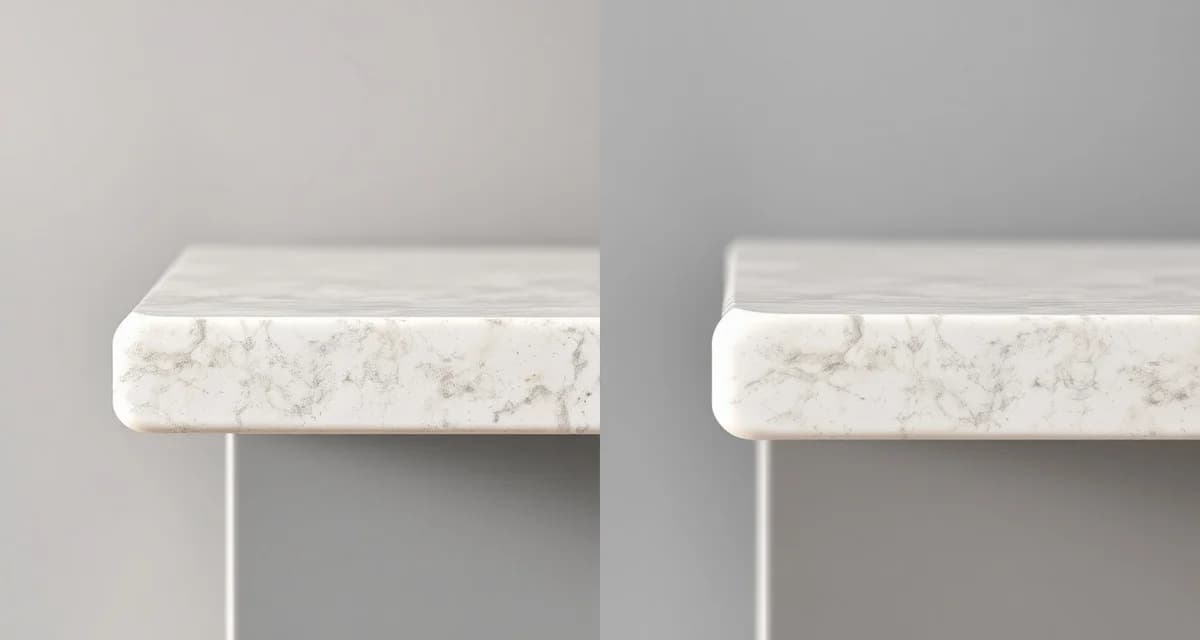
Bullnose and half-bullnose (also called demi-bullnose) are closely related countertop edge profiles that both feature rounded edges. Full bullnose rounds the entire edge from top to bottom, creating a complete semicircle. Half-bullnose rounds only the top portion of the edge while leaving the bottom flat and square. The result is a profile that is softer on top where hands and arms contact the counter, but maintains a clean bottom line.
TL;DR
- Full bullnose rounds the entire edge (top and bottom) into a semicircle, costing $8-$15/LF
- Half-bullnose rounds only the top edge, leaving the bottom square, costing $5-$10/LF
- Half-bullnose is the more popular choice in current design trends -- it splits the difference between modern and traditional
- Full bullnose is better for families with small children (rounded top and bottom)
- Both profiles work on granite, quartz, marble, and quartzite without issues
- Half-bullnose fabricates slightly faster (only one radius to cut and polish)
- Full bullnose makes the slab appear thicker; half-bullnose shows the true bottom edge
Visual Comparison
| Feature | Full Bullnose | Half-Bullnose |
|---|---|---|
| Top edge | Fully rounded | Fully rounded |
| Bottom edge | Fully rounded | Flat/square |
| Cross-section shape | Semicircle | Quarter-circle on top, flat bottom |
| Visual weight | Heavy, thick appearance | Moderate, transitional |
| Bottom shadow line | Soft, curved | Defined, straight |
| Design style | Traditional | Transitional to traditional |
Cost Comparison
| Cost Factor | Full Bullnose | Half-Bullnose |
|---|---|---|
| Edge fabrication per linear foot | $8-$15 | $5-$10 |
| Typical 40-LF kitchen upcharge | $320-$600 | $200-$400 |
| Fabrication time per linear foot | 3-5 minutes | 2-3.5 minutes |
| Polishing area | Full radius (top + bottom) | Half radius (top only) |
| Tooling | Full radius bit | Half radius bit or adjusted full |
The cost savings of half-bullnose over full bullnose are modest -- typically $3-$5/linear foot. On a 40-LF kitchen, that translates to $120-$200. Clients rarely switch between the two based on cost alone; the decision is almost always about the look.
Calculate your material waste savings
See exactly how much slab material and money you could save with optimized cutting layouts.
Try the free Waste CalculatorDurability and Maintenance
Chip Resistance
Both profiles share strong chip resistance on the top edge -- the rounded surface distributes impact force effectively. The key difference is on the bottom:
- Full bullnose: The rounded bottom is forgiving if something impacts the underside of the counter (pushing a chair rail against it, for example)
- Half-bullnose: The square bottom edge is slightly more susceptible to chipping from impacts directed at the underside. In practice, this happens infrequently because the bottom edge is partially concealed by the countertop overhang
Cleaning
Both profiles are easy to clean. Full bullnose has a slight advantage because there are no sharp transitions anywhere on the edge -- everything curves smoothly. Half-bullnose has a small transition where the top radius meets the flat bottom face, which can collect minor residue over time.
Child Safety
Full bullnose is the safer option for families with young children. The fully rounded edge eliminates all sharp corners, both top and bottom. Half-bullnose rounds the top (where most contact occurs) but retains a defined bottom corner. For homes with toddlers who pull themselves up on counters, the fully rounded bottom of full bullnose provides an extra margin of safety.
Design and Style Fit
When to Choose Full Bullnose
- Traditional kitchens: Full bullnose pairs with raised-panel cabinets, ornamental hardware, and classic design elements
- Bathrooms and vanities: The softer profile suits smaller vanity countertops where the edge is prominent
- Retrofit projects: Replacing older countertops in traditional homes where rounded edges are expected
- Maximum comfort: For counters where people lean on the edge frequently (breakfast bars, open kitchen counters)
When to Choose Half-Bullnose
- Transitional kitchens: Half-bullnose bridges modern and traditional -- soft on top, clean on the bottom
- Shaker-style cabinets: The flat bottom of half-bullnose complements the clean lines of shaker doors
- Modern-leaning traditional: Clients who want some softness but not the full traditional look of bullnose
- Quartz installations: Half-bullnose is one of the most popular quartz edge profiles because it matches transitional design trends
Visual Impact by Material
| Material | Full Bullnose Effect | Half-Bullnose Effect |
|---|---|---|
| White quartz | Soft, approachable | Clean, refined |
| Dark granite | Heavy, substantial | Defined, modern-traditional |
| Marble | Classic, timeless | Contemporary-classic |
| Exotic stone | May compete with pattern | Lets pattern show through |
Fabrication Perspective
Production Comparison
| Metric | Full Bullnose | Half-Bullnose |
|---|---|---|
| Router passes | 2 (top + bottom radius) | 1 (top radius only) |
| Polishing surfaces | Full curve (top + bottom) | Half curve (top only) + bottom flat |
| Average time per 10 LF | 30-50 min | 20-35 min |
| CNC programming | Standard radius program | Modified radius program |
| Hand finishing needed | Minimal on straight runs | Minimal on straight runs |
Half-bullnose saves 25-35% fabrication time compared to full bullnose, primarily because you are routing and polishing one radius instead of two. For shops running 6-8+ kitchens per day, this time difference is meaningful.
Transition Point Quality
The critical quality point on half-bullnose is where the top radius meets the flat bottom face. This transition should be:
- Smooth and consistent along the entire edge run
- Free of visible steps or ridges
- Polished to the same finish level as the top radius and front face
On CNC equipment, this transition is programmed and consistent. On manual edge polishing, the operator needs to blend the transition carefully. Inspect this area on sample pieces before committing to half-bullnose from a new fabricator.
Inside Corner Treatment
Both profiles require hand finishing at inside corners (where an L-shaped counter turns). Full bullnose inside corners are slightly more complex because the bottom radius must continue around the corner. Half-bullnose inside corners are marginally simpler because the flat bottom only needs a small ease at the turn.
Client Decision Framework
When a client is choosing between full and half-bullnose, walk them through these questions:
- What style is your kitchen? Traditional = full bullnose. Transitional = half-bullnose.
- Do you have young children? If yes, full bullnose provides safer bottom corners.
- Do you want the counter to look thick or refined? Full bullnose emphasizes thickness. Half-bullnose feels lighter.
- What cabinets are you using? Raised-panel = full bullnose. Shaker or flat-panel = half-bullnose.
- Is budget a deciding factor? Half-bullnose saves $120-$200 on a typical kitchen. Small but worth mentioning.
Most clients decide within 30 seconds of seeing and touching both profiles side by side. Keep sample edges available in your showroom.
What is the difference between bullnose and half-bullnose?
Full bullnose rounds the entire edge (top and bottom) into a complete semicircle. Half-bullnose rounds only the top half of the edge, leaving the bottom flat and square. The visual difference is on the underside of the countertop overhang.
Which is more popular -- bullnose or half-bullnose?
Half-bullnose has been gaining ground on full bullnose for the past several years as transitional kitchen design has become the dominant residential style. Both remain popular, but half-bullnose is now specified more frequently in new construction and remodels.
Does half-bullnose cost less than full bullnose?
Yes, typically $3-$5/linear foot less. On a 40-linear-foot kitchen, that saves $120-$200. The savings come from reduced fabrication time (one radius instead of two).
Can I see the difference between them in a finished kitchen?
Yes, if you look at the bottom of the countertop overhang. Full bullnose shows a curved underside; half-bullnose shows a flat underside. When standing in the kitchen at normal height, the difference is visible but subtle.
Which edge profile is better for granite?
Both work well on granite. Full bullnose is traditional and pairs with classic granite colors. Half-bullnose works better with more modern granite selections and transitional kitchen designs. The stone itself does not affect the fabrication quality of either profile.
Is half-bullnose the same as demi-bullnose?
Yes. Half-bullnose and demi-bullnose are the same profile -- different fabricators and regions use different names. Some shops also call it "top-round" or "half-round."
Which is easier to repair if damaged?
Full bullnose chip repairs require matching a curved surface, which is moderately difficult. Half-bullnose repairs depend on where the chip occurs: the curved top is similar to fix, while the flat bottom is easier to repair with standard epoxy techniques.
Can I switch from bullnose to half-bullnose after installation?
Not easily. Changing the edge profile requires removing the countertop, re-fabricating the edges, and reinstalling -- essentially a new project. Choose your edge profile before fabrication begins.
Does the bottom edge ever matter functionally?
Rarely. The bottom edge is mostly concealed under the countertop overhang. It matters when someone sits at a counter with bar stools and their legs or arms contact the underside, or when cleaning under the overhang. Full bullnose is more comfortable for prolonged sitting at a counter.
Which profile do fabricators prefer to make?
Most fabricators are neutral between the two. Half-bullnose is slightly faster to produce, which is a minor advantage in high-volume shops. Neither profile presents unusual fabrication challenges.
Build Quotes That Account for Every Edge Detail
Edge profile pricing affects your margins on every job. SlabWise's Quick Quote tool calculates costs per linear foot for any profile, factoring in material type, inside corners, and project complexity. Generate client-ready quotes in 3 minutes and stop leaving money on the table on edge work.
Try These Free Tools
- Cost Calculator -- Compare material costs instantly across different countertop options.
- Compare Materials -- Side-by-side material comparison with pricing, durability, and maintenance.
- Kitchen Visualizer -- Let customers preview countertop materials in their actual kitchen.
Sources & Further Reading
-
Natural Stone Institute - Technology and Software Solutions for Stone Fabricators
-
International Surface Fabricators Association - Fabrication Software and Digital Tools
-
National Kitchen & Bath Association - Technology Integration in Countertop Design
-
Marble Institute of America - Digital Fabrication and Software Standards
Internal Links
- Bullnose vs Eased Edge -- Compare bullnose with the most popular simple edge
- Ogee vs Bullnose Edge -- See how bullnose compares to ornate profiles
- Countertop Pricing Calculator -- Calculate edge costs accurately
- Beveled vs Eased Edge -- Compare two popular modern alternatives