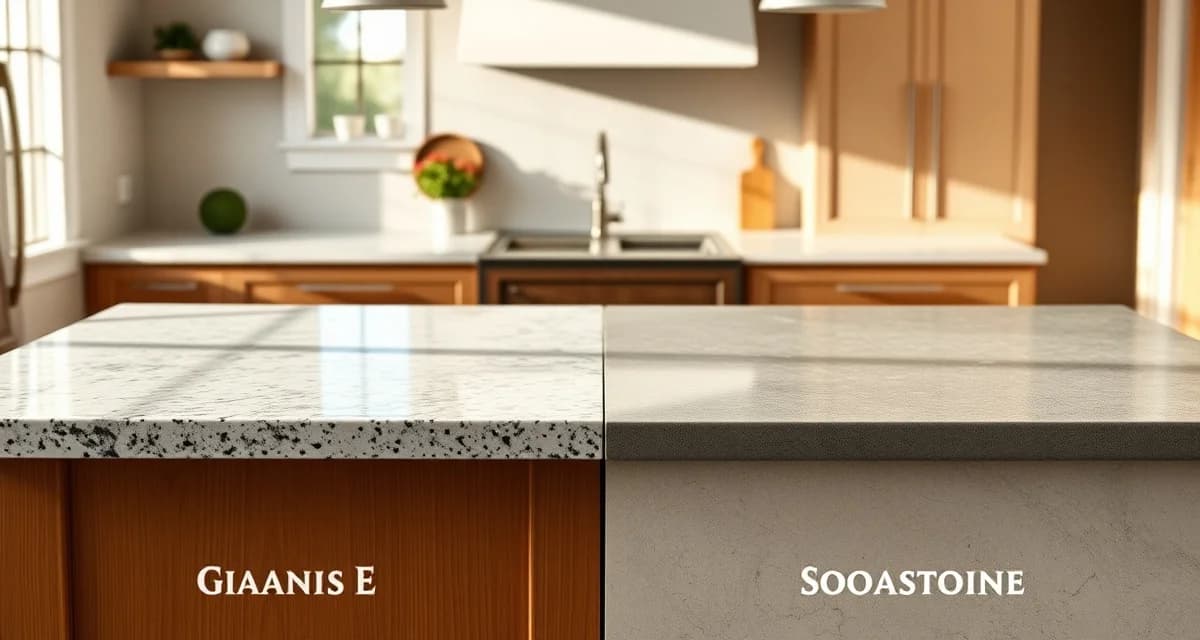
Granite vs Soapstone Countertops: 2026 Comparison
Granite and soapstone are both natural stones, but they could not be more different in look, feel, and behavior. Granite is hard, speckled, and available in every color. Soapstone is soft, smooth, and comes only in shades of gray. Both are excellent countertop materials, and this guide helps you choose between them.
TL;DR
- Granite is much harder (6-7 Mohs) than soapstone (1-2 Mohs) and resists scratches far better
- Soapstone is fireproof and handles heat better than any countertop material; granite also handles heat well
- Soapstone is naturally non-porous and never needs sealing; granite needs sealing every 1-3 years
- Soapstone is chemically inert - acids cause zero damage; granite can be affected by acids over time
- Granite has far more color options (hundreds) vs. soapstone (grays and charcoals only)
- Soapstone develops patina and darkens over time; granite maintains its original appearance
- Pricing overlaps: granite $40-$100/sq ft, soapstone $70-$120/sq ft installed
Side-by-Side Comparison
| Feature | Granite | Soapstone |
|---|---|---|
| Type | Igneous (hard, crystalline) | Metamorphic (talc-based, soft) |
| Hardness (Mohs) | 6-7 | 1-2 |
| Installed Cost (per sq ft) | $40-$100 | $70-$120 |
| Sealing | Every 1-3 years | Never required |
| Heat Resistance | Excellent | Exceptional (fireproof) |
| Scratch Resistance | High | Low (scratches easily) |
| Stain Resistance | Moderate (sealed) | High (non-porous) |
| Acid Resistance | Low-Moderate | Excellent (chemically inert) |
| Color Range | Very wide | Very limited (grays) |
| Patina | None | Darkens over time |
| Repairability | Difficult | Easy (sand and oil) |
| Lifespan | 50+ years | 100+ years |
Hardness vs. Heat
The core trade-off between granite and soapstone is hardness vs. heat performance.
Calculate your material waste savings
See exactly how much slab material and money you could save with optimized cutting layouts.
Try the free Waste CalculatorGranite is one of the hardest countertop stones. Knives, cookware, and daily use leave no marks. Granite surfaces stay pristine for decades. But granite needs sealing to prevent stains, and while it handles heat well, it does not match soapstone's level of thermal immunity.
Soapstone scratches from normal use - even a fingernail can leave a mark. But it is completely fireproof, non-porous without any sealant, and chemically inert. The scratches are repairable (sand with 220-grit, re-oil), and many owners consider them part of the stone's character.
Maintenance
Granite maintenance: Seal every 1-3 years. Clean with pH-neutral soap and water. Avoid acidic cleaners that can degrade the sealant. Annual time: ~30 minutes.
Soapstone maintenance: No sealing required. Clean with any product (chemically inert). Optional: apply mineral oil periodically to enhance color and patina. Sand out scratches as desired. Maintenance is optional and cosmetic rather than protective.
Aesthetics
Granite offers extraordinary variety: black, white, blue, green, red, gold, multi-colored, speckled, veined, and everything between. If color matching to a specific kitchen design matters, granite has options for every palette.
Soapstone is limited to gray tones - ranging from light silvery gray to deep charcoal, sometimes with subtle green or blue undertones. New soapstone gradually darkens over months and years. The look is distinctly rustic, warm, and historically grounded.
Soapstone's aesthetic works beautifully in farmhouse, colonial, traditional, and some modern kitchen designs. It does not work for bright, colorful, or highly varied kitchen palettes.
Cost Comparison
Soapstone is consistently more expensive than most granite, though the ranges overlap:
| Kitchen Size | Granite Installed | Soapstone Installed | Difference |
|---|---|---|---|
| Small (25 sq ft) | $1,000-$2,500 | $1,750-$3,125 | $750-$625 |
| Medium (40 sq ft) | $1,600-$4,000 | $2,800-$5,000 | $1,200-$1,000 |
| Large (60 sq ft) | $2,400-$6,000 | $4,200-$7,500 | $1,800-$1,500 |
Soapstone's limited supply drives higher pricing. Only a handful of quarries worldwide produce architectural-grade soapstone, compared to hundreds of granite sources. Availability varies by region, and some fabricators charge a premium because they handle soapstone less frequently.
Maintenance Costs
Granite needs sealing every 1-3 years ($30-$100 per application). Soapstone never needs sealing because it's naturally non-porous. However, many soapstone owners choose to oil their countertops monthly ($5-$10 in mineral oil per application) to darken the surface and achieve the classic aged look faster.
If you skip the oiling, soapstone will darken naturally over time through normal use. The stone's patina develops on its own; oil just speeds up the process.
Daily Kitchen Experience
Granite in Practice
Granite holds up well in busy kitchens. It resists scratching from knives and cookware, handles moderate heat well (no concerns up to 500F), and comes in enough colors and patterns to match virtually any kitchen design. The main responsibility is keeping up with sealing.
Soapstone in Practice
Soapstone is the only natural countertop material that handles boiling water, hot pots, and even open flame without any risk of damage. Labs and chemistry classrooms use it for exactly this reason. It's also chemically inert, meaning lemon juice, vinegar, and wine don't etch or stain the surface.
The trade-off is softness. Soapstone scratches easily from knives, rough-bottomed pans, and even heavy ceramic dishes. Most scratches can be sanded out and re-oiled in minutes, but if visible scratches bother you, soapstone demands more active care than granite.
Fabrication Differences
Granite and soapstone both require CNC or bridge saw fabrication with wet cutting. But soapstone's softness changes the shop experience:
- Soapstone cuts much faster than granite, reducing fabrication time by 20-30%
- Softer material means less tooling wear and longer blade life
- Edge profiles in soapstone need more careful handling because the material chips more easily
- Fewer fabricators have experience with soapstone, which can mean longer lead times and higher labor rates
- Soapstone's limited color palette (grays, greens, blacks) means less time on design decisions
Resale Value
Granite is universally recognized by homebuyers as a premium countertop material. It adds value to any home in any market.
Soapstone is more niche. In markets where farmhouse and traditional styles are popular, soapstone can be a genuine selling point. In modern or contemporary markets, it may not appeal to as many buyers. That said, soapstone's durability and unique aesthetic attract design-conscious buyers who appreciate materials with character.
Best Uses
Choose Granite When:
- Scratch resistance is important for daily kitchen use
- Color variety matters for your design vision
- You want a surface that maintains its original appearance over time
- Budget starts at $40/sq ft
- The kitchen style calls for a wide range of color and pattern options
Choose Soapstone When:
- Ultimate heat resistance matters (no trivets needed, ever)
- You want a zero-sealing, chemically inert surface
- Farmhouse, rustic, or historical design aesthetic is the goal
- You appreciate a surface that develops character and patina over time
- Acid resistance is important (lemon juice, vinegar won't etch it)
FAQ
Is soapstone softer than granite?
Significantly. Soapstone ranks 1-2 on the Mohs scale; granite ranks 6-7. A knife easily scratches soapstone but cannot scratch granite. However, soapstone scratches are simple to repair with sandpaper.
Does soapstone stain?
Soapstone is naturally non-porous and resists staining without any sealant. Oil spots may temporarily darken the surface but will even out as the patina develops. Soapstone's stain resistance is actually better than unsealed granite's.
How long does soapstone last?
Soapstone is one of the longest-lasting countertop materials. Well-maintained soapstone can last 100+ years. Many soapstone installations in historic homes are still in daily use after 150+ years.
Is soapstone more expensive than granite?
Soapstone's floor ($70/sq ft) is higher than granite's ($40/sq ft). At the mid-range ($70-$100/sq ft), they overlap. Soapstone saves money over time by never needing sealant, but the upfront cost is typically higher.
Can you use soapstone in a modern kitchen?
Yes, though it works best in modern designs that embrace natural materials and dark tones. Pairing soapstone with white cabinets and modern hardware creates a striking contrast that feels both contemporary and timeless.
Does granite resist acids?
Granite can be dulled by prolonged acid contact, and acids can degrade the sealant over time. Soapstone is completely acid-proof - you can pour lemon juice on it without any effect.
Which is better for resale value?
Granite is more universally recognized and appeals to a wider range of buyers. Soapstone appeals strongly to buyers who specifically love its look but may be unfamiliar to others. For maximum resale appeal, granite is the safer choice.
Can I have both in one kitchen?
Yes. Some homeowners use granite on the main work surfaces and soapstone on a baking station or island. This is an uncommon but distinctive combination that plays to each material's strengths.
Pick Your Natural Stone
Granite and soapstone are both genuine natural stones with decades of proven performance. Granite is the practical all-rounder. Soapstone is the characterful specialist. Both will serve your kitchen beautifully for a very long time.
Get a cost estimate with our countertop cost calculator. Fabricators can try SlabWise free for 14 days to manage all natural stone projects.
Try These Free Tools
- Cost Calculator -- Compare material costs instantly across different countertop options.
- Compare Materials -- Side-by-side material comparison with pricing, durability, and maintenance.
- Kitchen Visualizer -- Let customers preview countertop materials in their actual kitchen.
Sources & Further Reading
-
Natural Stone Institute - Technology and Software Solutions for Stone Fabricators
-
International Surface Fabricators Association - Fabrication Software and Digital Tools
-
National Kitchen & Bath Association - Technology Integration in Countertop Design
-
Marble Institute of America - Digital Fabrication and Software Standards