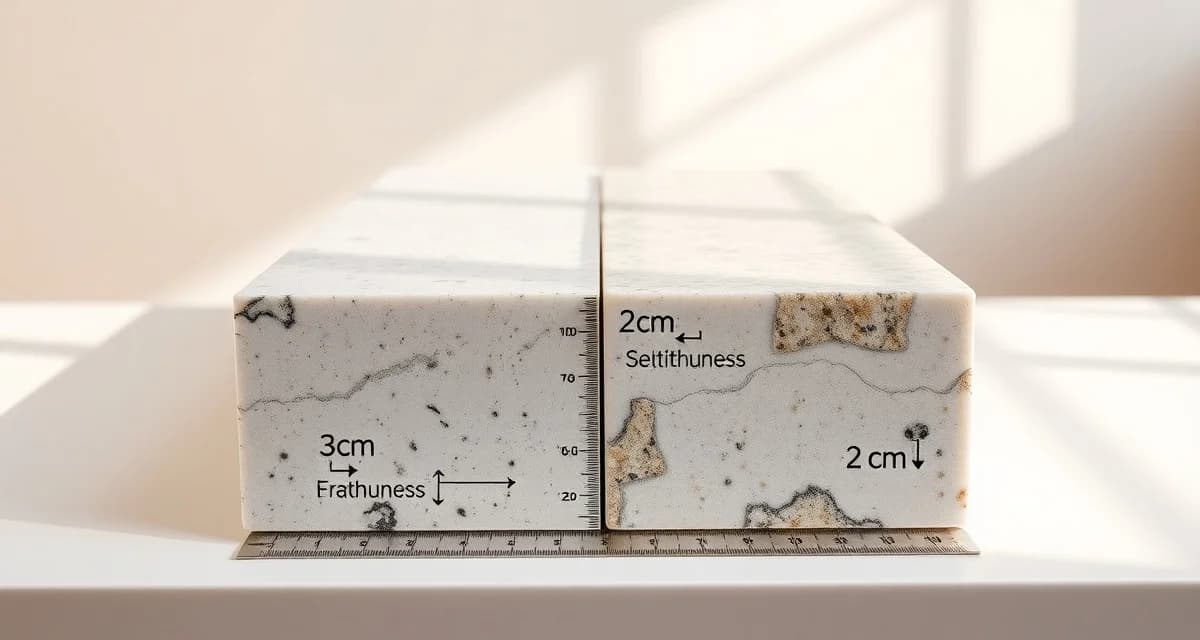
3cm vs 2cm Countertop Thickness: Which Should You Choose?
Quick Answer
3cm (1.18 inches) is the standard thickness for most kitchen countertop installations in the US. It's strong enough to span cabinets without plywood support, accommodates all edge profiles, and supports undermount sinks without issue. 2cm (0.79 inches) is thinner and lighter, but typically requires a plywood substrate for support. 2cm costs about 20-30% less in material but the plywood adds back some of that savings. For kitchens, 3cm is the clear default. For bathrooms, backsplashes, and some commercial applications, 2cm is a practical and cost-effective option.
TL;DR
- 3cm is 1.18 inches thick; 2cm is 0.79 inches thick
- 3cm can span cabinets without plywood support; 2cm usually needs a plywood subtop
- 3cm supports all edge profiles; 2cm is limited to simpler edges
- 3cm material costs 20-30% more than 2cm for the same stone
- 2cm + plywood + labor narrows the cost gap to about 10-15%
- 3cm handles undermount sinks better due to more material for clip anchoring
- 2cm is common for bathroom vanities, backsplashes, and some commercial projects
- 3cm is the US industry standard for kitchen countertops
Side-by-Side Comparison
| Feature | 3cm (1.18") | 2cm (0.79") |
|---|---|---|
| Weight per sq ft | 18-22 lbs | 12-15 lbs |
| Plywood support needed | No (standard cabinet spacing) | Yes - 3/4" plywood subtop typically required |
| Maximum unsupported span | 24 inches (standard) | 12-16 inches (limited) |
| Edge profile options | All profiles (bullnose, ogee, mitered, etc.) | Limited - eased, small bevel, pencil |
| Undermount sink support | Excellent - ample material for clips | Adequate with plywood; less margin |
| Material cost | Higher (20-30% more than 2cm) | Lower |
| Total installed cost | $50-$120/sq ft | $40-$100/sq ft (including plywood) |
| Strength | Very strong - handles normal kitchen loads easily | Strong with plywood support; more fragile without |
| Visual appearance | Thick, substantial look | Thinner, lighter look |
| Best for | Kitchens, islands, bars | Bathrooms, backsplashes, wall cladding |
Why 3cm Is the US Standard for Kitchens
The US countertop industry standardized on 3cm for residential kitchens because it solves several problems at once:
Calculate your material waste savings
See exactly how much slab material and money you could save with optimized cutting layouts.
Try the free Waste CalculatorNo Plywood Needed
Standard kitchen cabinets are built with 24-inch depth and support rails spaced at or under 24 inches apart. A 3cm slab can span these distances without deflecting or cracking. This eliminates the need for a plywood subtop, which:
- Saves $3-$5 per square foot in plywood and labor
- Removes a potential moisture trap (plywood between stone and cabinet can hold water)
- Simplifies installation (fewer steps)
Undermount Sink Support
3cm stone provides 1.18 inches of material for undermount sink clips to anchor into. That's enough depth for a secure mechanical connection. With 2cm stone (0.79 inches), sink clips have less material to grip, making the connection less strong - especially for heavy cast iron sinks.
Edge Profile Versatility
The extra thickness allows for full-profile edges:
| Edge Profile | 3cm | 2cm |
|---|---|---|
| Eased (straight) | Yes | Yes |
| Pencil round | Yes | Yes |
| Small bevel | Yes | Yes |
| Half bullnose | Yes | Marginal - very thin at the curve |
| Full bullnose | Yes | No - not enough material |
| Ogee | Yes | No - profile requires more depth |
| Dupont | Yes | No |
| Mitered edge | Yes | Difficult - fragile join |
| Laminated (stacked look) | Yes | Can be done to simulate 3cm+ |
| Waterfall | Yes | Possible but fragile at joints |
If the homeowner wants anything beyond a basic eased or pencil edge, 3cm is required.
Structural Strength
3cm stone is roughly 50% thicker than 2cm, which translates to significantly more bending strength. For kitchen use - where heavy pots, stand mixers, and the occasional person sitting on the countertop are realities - the extra strength provides a meaningful safety margin.
When 2cm Makes Sense
2cm isn't inferior - it's just designed for different applications.
Bathroom Vanities
Bathroom countertops are typically narrower (19-22 inches deep vs. 25.5 inches for kitchen), sit on a fully supported vanity cabinet, and don't bear heavy loads. 2cm stone on a bathroom vanity:
- Provides a sleeker, lighter appearance
- Costs less (meaningful for a material upgrade in a secondary space)
- Works well with vessel sinks (no undermount weight concerns)
- Looks proportional on smaller vanities
Backsplashes
2cm is the standard thickness for stone backsplashes. The backsplash is mounted vertically against the wall and bears no weight. Using 3cm for a backsplash adds unnecessary cost and makes the projection from the wall more prominent.
Wall Cladding and Feature Walls
Full-height stone accent walls use 2cm (or thinner) slabs to reduce weight on the wall structure. Porcelain slabs are available as thin as 6mm for wall applications.
Commercial Projects With Plywood Support
In multi-family housing and hotel construction, 2cm stone on a plywood subtop is common. The material savings across 200+ units is substantial:
| Scale | 3cm Material Cost (per unit) | 2cm + Plywood Cost (per unit) | Savings per Unit |
|---|---|---|---|
| 40 sq ft kitchen | $2,400-$4,400 | $1,900-$3,700 | $400-$700 |
| 200 units | $480,000-$880,000 | $380,000-$740,000 | $80,000-$140,000 |
For developers building hundreds of units, the 2cm cost savings is significant enough to justify the additional plywood labor.
European-Style Kitchens
In Europe, 2cm with a plywood subtop has been the standard for decades. European kitchen cabinets are designed with this in mind. Some US homeowners prefer the thinner, more refined European aesthetic that 2cm provides.
Cost Breakdown
For a typical 40 sq ft kitchen countertop:
| Cost Component | 3cm | 2cm + Plywood |
|---|---|---|
| Stone material | $1,600-$3,600 | $1,100-$2,500 |
| Plywood subtop | Not needed ($0) | $120-$200 (material + labor) |
| Fabrication | $800-$1,600 | $700-$1,400 |
| Installation | $600-$1,200 | $700-$1,300 (extra step for plywood) |
| Total | $3,000-$6,400 | $2,620-$5,400 |
The net savings for 2cm is typically 10-15% after accounting for the plywood requirement. On a $5,000 kitchen, that's $500-$750.
Weight Considerations
Weight matters for specific situations:
| Scenario | 3cm Weight (40 sq ft) | 2cm Weight (40 sq ft) |
|---|---|---|
| Granite | 720-880 lbs | 480-600 lbs |
| Quartz | 800-1,000 lbs | 520-680 lbs |
| Marble | 700-840 lbs | 460-560 lbs |
The weight difference matters for:
- Upper-floor installations - carrying 800+ lbs up stairs vs. 550 lbs
- Cabinet load capacity - older or budget cabinets may have lower weight ratings
- Island countertops - large islands (80+ sq ft) in 3cm can weigh over 1,500 lbs
- Elevator access - commercial buildings with service elevator weight limits
Can You Mix 2cm and 3cm in the Same Kitchen?
Yes, and some designers do this intentionally:
- 3cm for perimeter countertops (where edge profiles, sink cutouts, and daily use demand it)
- 2cm for the island (where a thinner, lighter look is desired)
- 2cm for backsplash (standard practice)
The thickness difference is visible if the two areas are adjacent, so this approach works best when the different thicknesses are on separate surfaces (perimeter vs. island).
Fabrication Differences
From the fabricator's perspective:
| Process | 3cm | 2cm |
|---|---|---|
| Cutting speed | Standard | Slightly faster (less material) |
| Blade wear | Standard | Lower |
| Breakage risk | Lower | Higher - more fragile during handling |
| Edge polishing | Standard | Faster (less edge surface) |
| Transport risk | Lower | Higher - more flex and vibration vulnerability |
2cm slabs require more careful handling throughout the fabrication and installation process. The thinner material is more susceptible to cracking during transport and more likely to flex and break if not fully supported.
Is 3cm always better than 2cm?
For kitchen countertops, 3cm is the better choice in almost all cases - it's stronger, doesn't require plywood, supports all edge profiles, and handles undermount sinks better. For bathroom vanities, backsplashes, and wall applications, 2cm is often the smarter and more cost-effective choice.
Can you do an undermount sink with 2cm?
Yes, but it requires more careful installation. The thinner material provides less depth for sink clips. A plywood subtop helps distribute the load. For heavy sinks (cast iron), 3cm is strongly recommended.
How much does 3cm cost compared to 2cm?
The raw material costs about 20-30% more. After adding the plywood subtop required for 2cm, the total installed cost difference narrows to about 10-15%.
Is 2cm more fragile?
Yes. 2cm stone is more likely to crack during handling, transport, and installation. It also has less margin for error around cutouts (sink, cooktop) where the remaining material is thin. Experienced fabricators handle it successfully, but the risk is higher.
What does 3cm mean in inches?
3cm equals 1.18 inches. 2cm equals 0.79 inches. The actual thickness can vary slightly (manufacturers' tolerances), but these are the standard measurements.
Can I get a thick edge look with 2cm stone?
Yes - through edge lamination. A strip of the same stone is glued to the edge to create the appearance of 3cm, 4cm, or even thicker stone. This adds $15-$30 per linear foot but lets you keep the cost savings of 2cm material while getting a substantial edge appearance.
Does my fabricator carry both 2cm and 3cm?
Most fabricators stock primarily 3cm for kitchen work. 2cm is typically available in popular colors but may have a longer lead time for less common stones. Ask your fabricator about 2cm availability for specific materials.
Why do European kitchens use 2cm?
European cabinets are traditionally designed with a plywood subtop built into the cabinet. The stone is thinner, lighter, and less expensive. The plywood provides the structural support that the thicker US-standard 3cm provides on its own.
Quote Both Thickness Options Accurately
When homeowners ask about 2cm vs. 3cm pricing, having accurate quotes for both options ready speeds up the decision. SlabWise's Quick Quote generates estimates for either thickness in about 3 minutes, including plywood costs for 2cm installations.
Start your 14-day free trial to quote faster and win more jobs.
Try These Free Tools
- Cost Calculator -- Compare material costs instantly across different countertop options.
- Compare Materials -- Side-by-side material comparison with pricing, durability, and maintenance.
- Kitchen Visualizer -- Let customers preview countertop materials in their actual kitchen.
Sources & Further Reading
-
International Surface Fabricators Association - Countertop Fabrication Standards
-
National Kitchen & Bath Association - Countertop Selection and Installation Guidelines
-
ASTM International - Standard Specification for Natural Stone Dimension