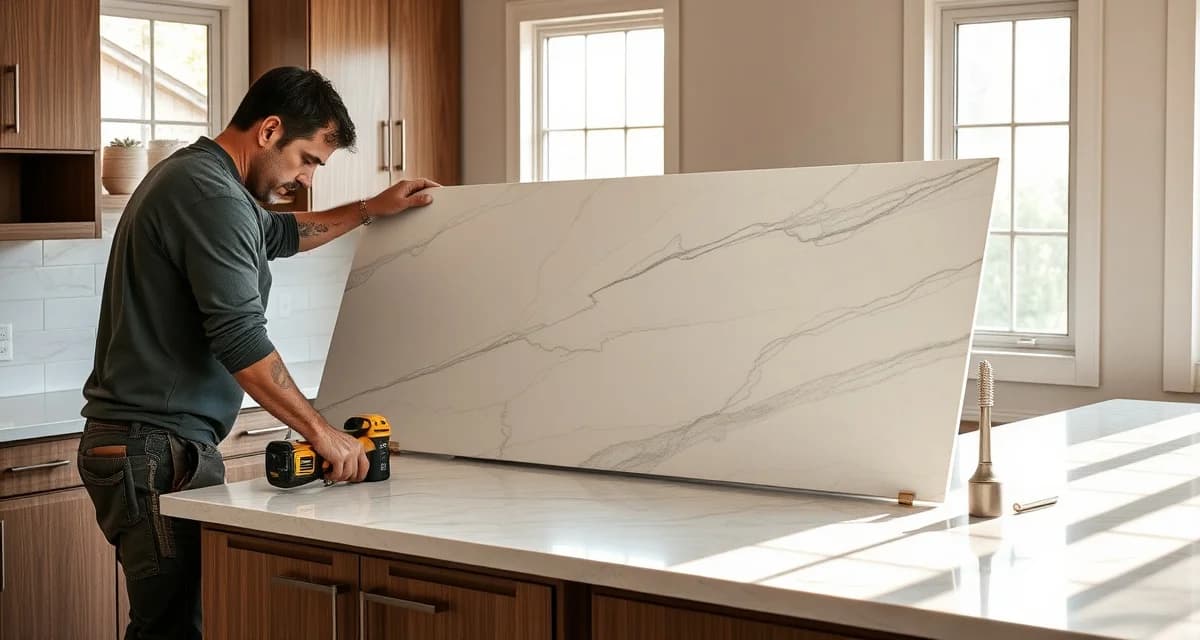
What to Expect During Installation
Quick Definition
What to expect during installation is a practical question for anyone planning a countertop project.
Countertop installation day is the final step in a process that typically spans 2-3 weeks from initial template to finished surface. A professional crew arrives with your pre-cut stone or quartz pieces, dry-fits them on the cabinets, bonds seams with color-matched epoxy, secures everything with silicone adhesive, and installs the sink. The actual work takes 2-4 hours for a standard kitchen. Your kitchen will be out of commission for the day, and adhesives need 24 hours to fully cure before normal use.
TL;DR
- Installation day takes 2-4 hours for a standard kitchen, 4-6 hours for complex layouts
- A 2-person crew handles most residential installs
- Prepare the night before by clearing counters, disconnecting plumbing, and securing a clear path from the door
- Expect noise and dust - the crew may need to grind edges or scribe pieces to fit walls
- Seams are assembled on-site with color-matched epoxy and clamped tight
- Wait 24 hours before running water through the sink (adhesive needs to cure)
- Plumbing reconnection may or may not be included - confirm with your fabricator
- Be home during installation to answer questions and approve the final result
Before Installation Day: Your Preparation Checklist
The work you do the night before (or morning of) directly affects how smoothly installation goes. Here is what needs to happen:
Calculate your material waste savings
See exactly how much slab material and money you could save with optimized cutting layouts.
Try the free Waste CalculatorThe Night Before
- Clear everything off the countertop area. Small appliances, dishes, dish racks, soap dispensers - all of it needs to move temporarily.
- Empty the cabinets under the sink. The crew needs access for sink installation and plumbing work.
- Disconnect the kitchen sink plumbing. Turn off water supply valves under the sink, disconnect the supply lines and drain. If you are not comfortable doing this, schedule a plumber for the morning of installation.
- Disconnect the cooktop or range if it sits in a cutout opening.
- Disconnect the dishwasher supply line from the sink drain assembly.
- Move the refrigerator if it blocks access to a countertop section.
- Plan alternative meals. Your kitchen will be unusable for most of the day, and the sink should not be used for 24 hours after installation.
The Morning Of
- Confirm the installation time with your fabricator if you have not heard from them.
- Clear a path from the front door to the kitchen. The crew carries pieces weighing 150-400 lbs each and needs a wide, unobstructed route.
- Protect flooring along the carry path. Most crews bring their own floor protection, but laying down old blankets or cardboard as backup is smart.
- Secure pets in a separate room. Heavy stone being moved through the house is not compatible with a curious dog underfoot.
- Arrange childcare if possible. The installation involves heavy lifting, sharp edges, and power tools.
Hour by Hour: What Happens During Installation
Hour 1: Arrival and Staging (30-60 minutes)
What you will see:
The crew arrives in a truck with your countertop pieces secured on padded A-frame racks. They will:
- Introduce themselves and walk through the project briefly
- Inspect the cabinets for level and stability
- Verify that the old countertop is removed and plumbing is disconnected
- Begin carrying pieces from the truck to the kitchen
What to expect:
Finished countertop pieces are heavy. Each piece weighs 150-400 lbs depending on size. The crew uses suction cup lifters, carrying clamps, and sometimes a rolling dolly to move pieces safely. They will navigate doorways, hallways, and corners carefully. Clear the path and stay out of the way during this phase.
There may be minor scuffing on walls or door frames despite careful handling. Most professional crews are very careful, but the physics of moving large, heavy objects through residential spaces occasionally leaves small marks.
Hour 2: Dry Fitting and Adjustments (30-60 minutes)
What you will see:
Each piece is placed on the cabinets without adhesive to verify the fit. The crew checks:
- Front overhang consistency (should be 1-1.5" along the entire front edge)
- Seam alignment (mating pieces should meet tightly with minimal gap)
- Wall fit (the back edge should sit close to the wall, accounting for irregularities)
- Level (the surface should be flat, with no rocking or high spots)
- Cutout alignment (sink and cooktop openings should line up with plumbing and utilities)
Adjustments you might see:
- Scribing to walls. If your walls are not straight (common in older homes), the crew marks the wall contour on the back edge of the stone and uses a grinder to remove a small amount of material. This creates a snug fit against the actual wall shape.
- Shimming. If the cabinets are not perfectly level, the crew places thin plastic or composite shims under the countertop to level the surface. Shims are hidden from view once installation is complete.
- Minor trimming. Occasionally, a piece needs a slight trim for fit. The crew uses a handheld grinder with a diamond blade. This is noisy and generates some dust.
Your involvement:
The crew may ask you questions during dry fitting:
- "How much overhang do you want here?" (if there is an area where it was not specified)
- "Is this seam location acceptable?" (if adjustments were needed)
- "Is this height okay for the bar section?" (for raised areas)
This is your last opportunity to flag concerns before adhesive is applied. Speak up if something looks off.
Hour 3: Bonding and Seam Assembly (30-60 minutes)
What you will see:
Once the dry fit is approved, the crew works methodically:
- Silicone adhesive is applied in beads along the top of the cabinet frames. This holds the countertop in place and provides a slight cushion.
- The first piece is set - usually the longest straight section or the piece with the primary sink cutout.
- Seams are bonded. The installer mixes color-matched epoxy (a two-part adhesive tinted to match your stone), applies it to both edges of the seam, presses the pieces together, and clamps them tight with specialized seam-setting tools.
- Excess epoxy is cleaned before it hardens - the installer has a 10-15 minute window.
What to expect:
Epoxy has a strong chemical smell. It dissipates within an hour, but you may want to open windows or turn on a kitchen exhaust fan. The clamping process involves tightening metal tools across the seam, which can be noisy.
Hour 4: Sink, Finishing, and Walkthrough (30-60 minutes)
What you will see:
- Undermount sink installation. The sink is positioned beneath the cutout and secured with clips and silicone. This step requires access under the cabinets.
- Silicone caulking along the back wall where the countertop meets the wall (or backsplash).
- Backsplash installation if stone backsplash pieces are included in the project.
- Final cleaning. The crew wipes down all surfaces and cleans up adhesive residue, dust, and debris.
- Walkthrough with you. The crew walks you through the finished installation, points out seam locations, shows you the sink attachment, and reviews care instructions.
Your walkthrough checklist:
- Run your hand along all seams - they should feel smooth and flush
- Check the overhang along the entire front edge - it should be consistent
- Look at the countertop-to-wall joint - it should be tight with clean caulk
- Verify the sink is centered in the cutout and level
- Check that all pieces are level (place a water bottle on the surface - it should not roll)
- Note any chips, scratches, or rough spots
- Confirm that any backsplash pieces are properly installed
If you notice issues, point them out before the crew leaves. Documented concerns are much easier to resolve than problems discovered after the crew is gone.
After Installation: The First 48 Hours
First 24 Hours
- Do not use the sink. The silicone sealant around the sink cutout needs 24 hours to cure and form a waterproof barrier.
- Do not place heavy objects on the countertop. Adhesives are still curing.
- Avoid sitting or leaning on overhangs. The silicone between the countertop and cabinets is not yet at full strength.
- It is okay to place lightweight items (plates, food prep) on the surface.
24-48 Hours
- Reconnect plumbing. Either do it yourself or have a plumber come back to reconnect water supply, drain, faucet, and dishwasher.
- Test for leaks after reconnection by running water and checking all connections.
- Apply granite sealer if you have natural stone and the fabricator did not seal at the shop. Wait at least 48 hours after installation for best adhesion.
First Week
- Use the countertop normally. After 48 hours, all adhesives are fully cured.
- Clean with mild dish soap and water. Do not use harsh chemicals for the first cleaning.
- Observe seams. If any seam adhesive has contracted or a gap has appeared, contact the fabricator for a touch-up. This is uncommon but should be addressed quickly.
Common Questions and Concerns on Installation Day
"There is a gap between the countertop and the wall."
Small gaps (up to 1/4") are normal and are filled with caulk. Larger gaps indicate a wall irregularity that was not fully captured during templating. The crew can usually address this on-site with caulk or by scribing the piece. Gaps wider than 1/2" may indicate a more serious template issue.
"I can see the seam."
Some seam visibility is normal, especially in solid-color materials. The seam should be flat (no lip on either side), tight (less than 1/16" gap), and color-matched. If the seam is wide, uneven, or poorly color-matched, ask the installer to address it before leaving.
"There is a chip on the edge."
Small chips can occur during transport or installation. Minor edge chips are typically repaired on-site with color-matched epoxy. Larger chips may require the piece to be recut, which means a return visit.
"The countertop is not level."
If you notice the surface is not level, tell the crew immediately. They can adjust shims under the countertop to correct the issue. After adhesive cures, releveling is much harder.
How Template Accuracy Affects Your Installation Day
The single biggest factor in whether installation day goes smoothly or becomes a headache is the accuracy of the template taken days earlier. When the template is precise:
- Pieces fit against walls with minimal scribing
- Seams meet tightly without gaps
- Cutouts align with plumbing on the first try
- The crew finishes faster with less on-site grinding
When the template has errors, the crew spends extra time scribing, shimming, and making on-site adjustments - or worse, discovers that a piece simply does not fit and a remake is needed.
Fabricators using template verification software catch these discrepancies before the slab is cut. SlabWise's 3-layer check validates measurements against expected parameters, flags anomalies, and verifies cutout clearances. The result: installation day goes as planned, the crew finishes on time, and the homeowner gets exactly what was promised.
How long does countertop installation take?
Standard kitchen: 2-4 hours. Complex layouts with islands and multiple seams: 4-6 hours. Simple bathroom vanity: 30-60 minutes.
Do I need to be home during installation?
Yes. The crew may have questions about positioning, overhang depth, or seam placement. Being present also lets you inspect the work and flag any concerns before the crew leaves.
Will the installation damage my cabinets or floors?
Professional crews take precautions, but minor scuffs on walls, door frames, or floors can happen when moving heavy pieces. Discuss floor protection with the fabricator before installation day.
Can I use my kitchen the same day?
You can use the countertop surface lightly, but do not use the sink for 24 hours. Plan meals elsewhere or use a utility sink while adhesives cure.
What if it rains on installation day?
Rain generally does not affect indoor installation. However, if the crew needs to carry pieces from the truck through rain, they will wrap them to prevent water damage to edges and surfaces. Wet conditions can make carrying more hazardous, so the crew may take extra precautions.
Who reconnects my plumbing?
This varies by fabricator. Some include basic plumbing reconnection. Others expect the homeowner to arrange a plumber. Always confirm before installation day.
How soon can I put things on the countertop?
Lightweight items (cutting boards, plates) can go on the surface within a few hours. Wait 24-48 hours before placing heavy items like stand mixers or full dish drying racks.
What if the sink does not fit?
If the undermount sink does not fit the cutout, it usually means the wrong sink model was provided at the time of templating. The fabricator may need to modify the cutout (if it is undersized) or provide a different mounting solution. This is why confirming the exact sink model at template time is critical.
Should I tip the installation crew?
Tipping is not expected but appreciated. $20-$50 per installer is a generous gesture if the work was done well and the crew was professional.
How long until the countertop is fully cured?
Silicone adhesive and epoxy reach full strength in 24-48 hours. After that, the countertop is ready for normal daily use with no restrictions.
What warranty covers the installation?
Most fabricators provide a 1-2 year warranty on workmanship, covering installation-related issues like seam failure, fit problems, and edge defects. Material defects are typically warranted separately by the manufacturer.
Can I have my backsplash tile installed before the countertop?
No. Countertops must be installed before backsplash tile. The tile sits on top of the countertop edge (or above the stone backsplash), so it needs the countertop as its base reference point.
Smooth Installs Start at the Template
For fabricators, a clean installation day means getting everything right upstream - at the template, during verification, and through fabrication. SlabWise's template verification catches measurement discrepancies before cutting, reducing on-site adjustments and eliminating the remakes that turn installation day into a callback. Start your 14-day free trial.
Try These Free Tools
- Photo to Template -- Snap a photo of an existing countertop and get an AI-generated DXF template.
- Template Compare -- Upload two templates and see every dimension change highlighted instantly.
- AI Template Verification -- Cross-check your template against manufacturer specs before cutting.
Sources & Further Reading
- Natural Stone Institute - Countertop Support Guidelines
- International Surface Fabricators Association - Structural Support Requirements
- National Kitchen & Bath Association - Countertop Installation Standards
- ASTM International - C1526 Standard Specification for Serpentine Dimension Stone