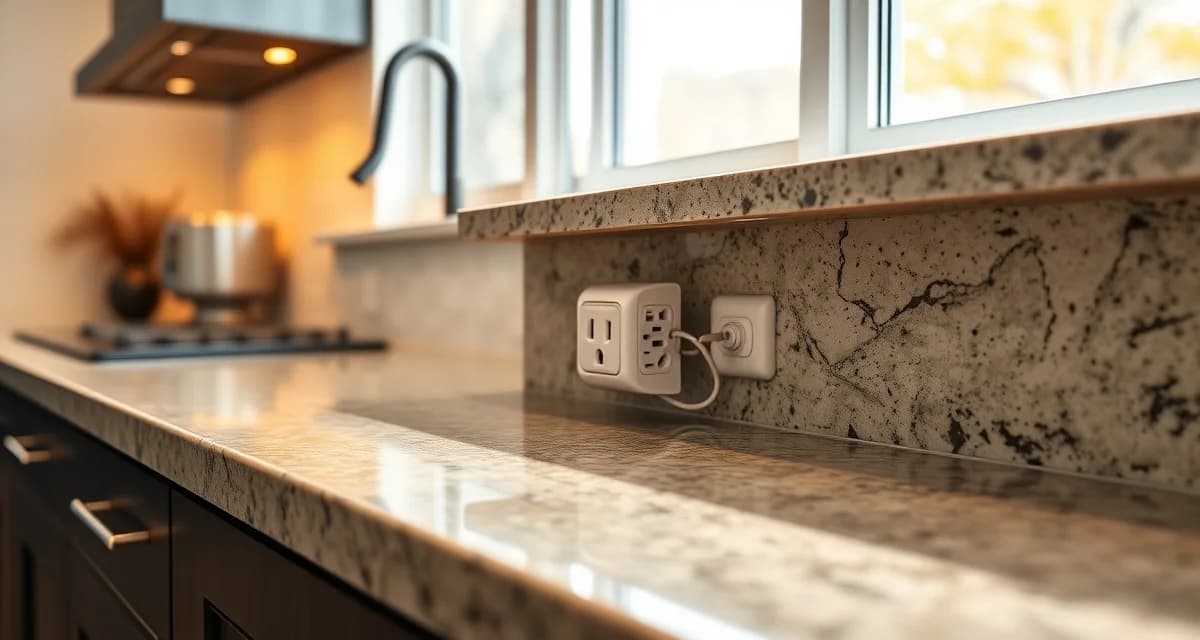
Outlets and Countertop Installation: Placement, Codes, and Coordination
Quick Definition: Electrical outlets near countertops must meet specific building code requirements (NEC Article 210.52), including GFCI protection and maximum spacing of 4 feet between outlets along kitchen countertops. During a countertop installation, outlets are not moved by the countertop crew -- any electrical work must be done by a licensed electrician before or after the countertop is set.
TL;DR
- NEC code requires a GFCI-protected outlet within 2 feet of any point along a kitchen countertop
- Kitchen countertop outlets must be spaced no more than 4 feet apart (measured along the wall)
- Outlets are typically positioned 15-18 inches above the countertop surface (about 48-52" from the floor)
- The electrician handles outlets, not the countertop fabricator or installer
- During countertop installation, outlet covers are removed and replaced afterward
- Pop-up outlets in countertops require a cutout from the fabricator
- If you're adding new outlets, the electrical work should be done before the backsplash but can be before or after countertop installation
- Countertop outlets must be GFCI protected (ground fault circuit interrupter)
NEC Code Requirements for Kitchen Countertop Outlets
The National Electrical Code (NEC) Article 210.52(C) sets the rules for kitchen countertop receptacles. Here are the key requirements:
Calculate your material waste savings
See exactly how much slab material and money you could save with optimized cutting layouts.
Try the free Waste CalculatorSpacing Rules
| Requirement | Code Specification |
|---|---|
| Maximum distance between outlets | 48 inches (4 feet) measured along the wall line |
| Maximum distance from any countertop point to an outlet | 24 inches (2 feet) |
| Island countertops (6+ sq ft) | At least one outlet required |
| Peninsula countertops | At least one outlet required |
| Countertop sections 12" or wider | Must have an outlet |
What This Means in Practice
For a typical 10-foot kitchen wall with countertops, you need at least three outlets spaced along the backsplash area. For a 6-foot island, you need at least one outlet (which can be in the base cabinet, a pop-up in the countertop, or mounted on the island side panel).
GFCI Protection
All kitchen countertop outlets within 6 feet of a sink must be GFCI-protected. In practice, most electricians put all kitchen countertop receptacles on GFCI circuits for safety and code compliance.
GFCI outlets detect ground faults (electrical current going where it shouldn't, like through water or a person) and cut power within milliseconds. They're the outlets with the "Test" and "Reset" buttons.
Outlet Height and Positioning
Standard Outlet Height
Kitchen countertop outlets are typically mounted 15-18 inches above the finished countertop surface, which places them about 48-54 inches from the floor.
The exact height depends on:
- Backsplash height and type
- Personal preference
- Code requirements (NEC doesn't specify exact height, only spacing and GFCI)
- Whether you want outlets above or within the backsplash
Outlets and Backsplash Coordination
This is where planning matters:
Tile backsplash: Outlets are mounted on the wall, with tile cut around the outlet boxes. The outlet height should align with the tile layout to avoid awkward cuts through the middle of a tile.
Stone slab backsplash: Outlets can be cut through the stone slab (requires fabricator to make a rectangular cutout) or positioned above the slab. Cutting outlet holes in stone backsplash adds $50-$100 per cutout.
No backsplash: Outlets are mounted on the drywall above the countertop.
Who Does What
| Task | Responsible Party |
|---|---|
| Running electrical wires to outlet boxes | Electrician |
| Installing outlet boxes in the wall | Electrician |
| Cutting outlet openings in stone backsplash | Fabricator |
| Removing/replacing outlet covers during counter install | Countertop installer |
| Final outlet wiring and cover plate installation | Electrician |
| GFCI outlet testing | Electrician |
Pop-Up Outlets in Countertops
Pop-up outlets are recessed units that sit flush with or below the countertop surface and pop up when needed. They're increasingly popular for islands where running outlets through the backsplash isn't possible.
How Pop-Up Outlets Work with Stone Countertops
- The fabricator cuts a rectangular opening in the countertop for the pop-up housing
- The electrician runs power to the location (through the island base cabinet)
- The pop-up unit is installed into the cutout after the countertop is set
Pop-Up Outlet Considerations
| Factor | Details |
|---|---|
| Cutout size | Varies by model (typically 4"x4" to 6"x12") |
| Cutout cost | $75-$200 from the fabricator |
| Unit cost | $50-$300+ depending on brand and features |
| Electrical cost | $200-$500 for wiring to the island |
| Code compliance | Check local codes -- some jurisdictions don't allow floor-fed outlets for islands |
| Waterproofing | Must be rated for countertop use (IP44 or higher recommended) |
Popular Pop-Up Outlet Brands
- Lew Electric
- Hubbell
- Countertop Pop Up (by Kitchen Power)
- Legrand adorne
Under-Cabinet Power Strips
An alternative to traditional wall outlets, under-cabinet power strips mount to the bottom of upper cabinets, above the countertop. They keep the backsplash clean and uninterrupted.
Pros: Clean backsplash appearance, easy to add more outlets Cons: Cords hang down to the countertop, may not satisfy NEC spacing requirements in all jurisdictions
Coordination During a Countertop Remodel
If You're Keeping Existing Outlets
- Electrician is not needed for countertop installation
- Countertop installer removes outlet cover plates to install backsplash (if applicable)
- Cover plates are reinstalled after backsplash is complete
- Verify GFCI outlets still function properly
If You're Adding or Moving Outlets
- Before countertop installation: Electrician runs wires and installs boxes for new outlet locations
- Countertop installation: Fabricator installs countertop and stone backsplash (if applicable) with cutouts for outlets
- After countertop installation: Electrician completes wiring, installs outlets and cover plates, tests GFCI
Timing Matters
The electrical rough-in (running wires inside the wall) should happen before drywall repair and painting. The finish work (connecting outlets, cover plates) happens after countertop and backsplash installation.
For fabricators, outlet cutout requests are sometimes missed during the quoting and templating process. SlabWise's Template Verification includes an electrical checklist that flags outlet locations on stone backsplash templates, ensuring cutouts are made during fabrication rather than on-site after installation.
FAQ
How many outlets do you need on a kitchen countertop? NEC code requires outlets spaced no more than 4 feet apart along the countertop, with no point on the countertop more than 2 feet from an outlet. A typical kitchen needs 4-8 countertop outlets.
Do kitchen countertop outlets need to be GFCI? Yes. All kitchen countertop outlets within 6 feet of a sink must be GFCI-protected. Most electricians GFCI-protect all kitchen countertop circuits.
Can you put an outlet in a stone countertop? Yes, using a pop-up outlet. The fabricator cuts a rectangular opening in the stone, and the pop-up unit is installed into the cutout. This is common for islands.
Who installs kitchen outlets -- the electrician or the countertop company? The electrician handles all electrical work. The countertop fabricator may cut holes in stone backsplash for outlet boxes, but wiring and outlet installation is electrician work.
How high should outlets be above the countertop? Typically 15-18 inches above the countertop surface (48-54 inches from the floor). The exact height should coordinate with backsplash layout.
Can you have outlets in a kitchen island? Yes, and code requires at least one outlet for islands with 6+ square feet of countertop. Options include pop-up outlets in the countertop, outlets on the island side panel, or floor-fed outlets.
Do I need to move outlets for new countertops? Usually not if the new countertop is at the same height as the old one. If you're changing the counter height or backsplash style, some outlets may need adjustment.
How much does it cost to add an outlet near a countertop? Adding a new GFCI outlet typically costs $150-$400, depending on how far the wire needs to run and local electrician rates.
Can you cut outlet holes in a quartz backsplash? Yes. The fabricator makes rectangular cutouts in the quartz slab for outlet boxes. This is done at the shop during fabrication for best results.
Are pop-up outlets code-compliant? Most pop-up outlets are listed (UL or ETL approved) and meet NEC requirements when properly installed. Check your local jurisdiction, as some areas have additional requirements.
Coordinate Outlets and Cutouts Without the Headaches
For fabricators, missed outlet cutouts in stone backsplash are a common callback. SlabWise's Template Verification cross-references electrical plans with fabrication drawings, catching missing cutouts before the slab leaves your shop.
Try These Free Tools
- Photo to Template -- Snap a photo of an existing countertop and get an AI-generated DXF template.
- Template Compare -- Upload two templates and see every dimension change highlighted instantly.
- AI Template Verification -- Cross-check your template against manufacturer specs before cutting.
Sources & Further Reading
- Natural Stone Institute - Countertop Support Guidelines
- International Surface Fabricators Association - Structural Support Requirements
- National Kitchen & Bath Association - Countertop Installation Standards
- ASTM International - C1526 Standard Specification for Serpentine Dimension Stone