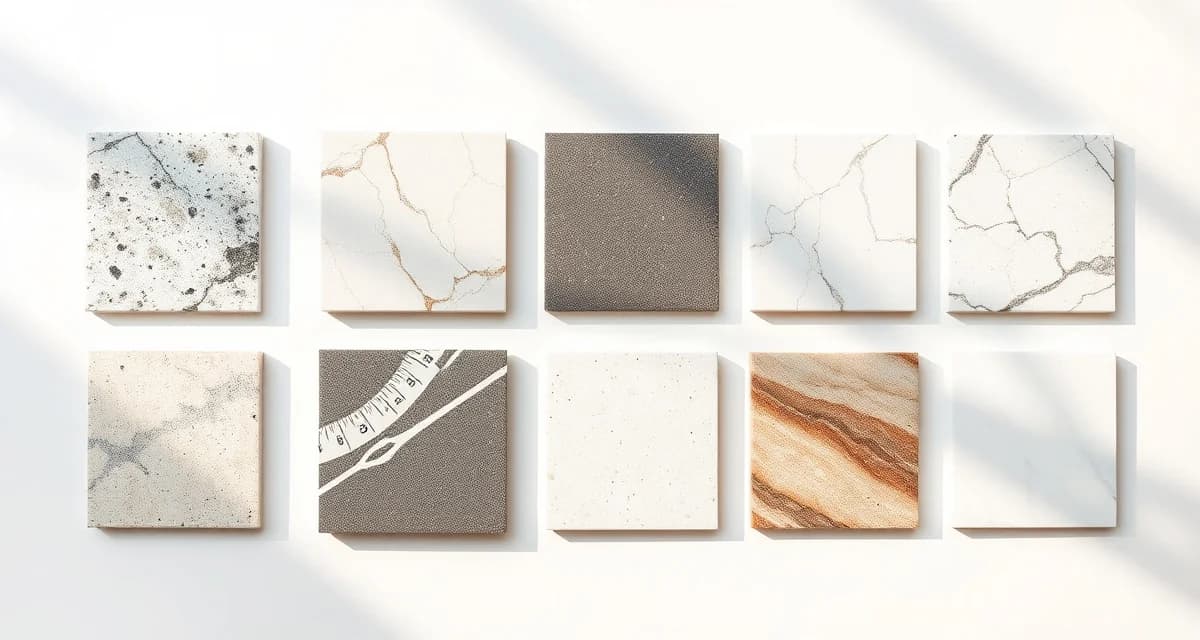
Getting Countertop Material Samples: Where, How, and What to Look For
Quick Definition: Countertop material samples are small pieces of stone, quartz, or other countertop materials that let you see and feel a material before committing to a full slab purchase. Samples are available free or at low cost from fabricators, big box stores, manufacturer websites, and slab yards. While helpful for narrowing options, samples have real limitations -- the actual slab will look different from a small chip.
TL;DR
- Free samples are available from most quartz manufacturers online and in-store at big box retailers
- Fabricator samples are available at local fabrication shops and slab yards (usually free)
- Sample sizes range from 2"x3" chips to 6"x6" squares -- larger is better
- Quartz samples are more representative of the final product than natural stone samples
- Natural stone samples are less reliable because every slab is unique -- visit the slab yard instead
- Always view samples in your actual kitchen lighting, not showroom lighting
- Take samples home and place them next to your cabinets, flooring, and wall colors
- The best way to choose natural stone is visiting the slab yard and selecting your specific slab
Where to Get Countertop Samples
1. Quartz Manufacturer Websites (Free)
Most major quartz brands ship free samples directly to your home:
Calculate your material waste savings
See exactly how much slab material and money you could save with optimized cutting layouts.
Try the free Waste Calculator| Brand | Sample Size | Cost | How to Order |
|---|---|---|---|
| Caesarstone | ~4"x4" | Free | caesarstone.com |
| Cambria | ~3"x3" | Free | cambriausa.com |
| Silestone | ~4"x4" | Free | cosentino.com |
| MSI Q | ~4"x3" | Free | msisurfaces.com |
| LG Viatera | ~3"x3" | Free | lgviaterausa.com |
Most manufacturers limit you to 3-5 samples per order. Shipping takes 5-10 business days.
2. Big Box Stores (Free)
Home Depot, Lowe's, and similar retailers keep sample chips on display in their kitchen countertop sections. You can usually take these samples home. Selection depends on which brands and colors the store carries.
3. Local Fabricators and Slab Yards (Free)
This is the best option for natural stone. Visit a local fabrication shop or slab yard and they'll typically give you sample chips for free or at minimal cost. Better yet, they'll walk you through their inventory and let you see full slabs.
4. Online Sample Services (Low Cost)
Several services specialize in shipping countertop samples:
- SampleBoard and similar platforms offer curated sample kits
- Amazon carries some countertop sample collections
- Individual stone distributors ship samples on request
5. Kitchen Design Showrooms
Kitchen design studios and showrooms (not big box stores) often have a larger sample selection and can provide larger pieces. If you're working with a kitchen designer, they'll usually handle sample procurement.
Sample Sizes and What They Tell You
| Sample Size | What You Can Assess | What You Can't Assess |
|---|---|---|
| 2"x3" chip | Basic color, texture | Pattern movement, veining scale |
| 4"x4" square | Color, small-scale pattern, finish | Large-scale veining, full pattern repeat |
| 6"x6" or larger | Color, finish, small pattern details | Full slab variation, how it looks at scale |
| Full slab visit | Everything | Nothing (this is the gold standard) |
The Fundamental Problem with Samples
A 4"x4" sample of granite shows you a tiny window into a slab that measures roughly 54"x108" (over 40 square feet). The sample might show a quiet area of the stone, while the full slab has dramatic veining or mineral deposits that look completely different.
This is less of a problem with quartz (which is manufactured and more consistent) and a bigger problem with natural stone (where every slab is genuinely unique).
The bottom line: Use samples to narrow your options. Use slab yard visits to make your final decision on natural stone.
How to Use Samples Effectively
Step 1: Narrow to 3-5 Options
Start by browsing online galleries, Pinterest, showroom displays, and manufacturer websites. Get samples for your top 3-5 candidates.
Step 2: View in Your Kitchen
Showroom lighting is designed to make everything look good. Your kitchen has different lighting -- natural light from windows, overhead fixtures, under-cabinet lights. Place samples on your existing countertop (or cabinet top if counters are removed) and observe them at different times of day:
- Morning natural light -- shows true color
- Afternoon direct sunlight -- reveals undertones
- Evening artificial light -- shows how it looks under warm or cool LED
- Under-cabinet task lighting -- the light you'll cook under
Step 3: Compare to Fixed Elements
Place your samples directly next to:
- Cabinet door (or cabinet sample if new cabinets)
- Flooring sample or existing floor
- Wall paint swatch
- Backsplash tile (if already selected)
- Appliance finish (stainless, black, white)
Step 4: Test the Finish
Rub your hand across the sample. Is it polished (glossy), honed (matte), or leathered (textured)? The finish affects both appearance and feel. A honed white marble looks and feels very different from a polished white marble.
Step 5: Visit the Slab Yard
For natural stone, this step is not optional. Go to the slab yard, see the actual slabs standing upright, and tag the specific slab you want. Some things you can only assess on a full slab:
- How the veining pattern flows across the full surface
- Whether there are any natural fissures, pits, or color variations
- How the pattern will look on your island or long countertop run
- Whether two slabs from the same lot are similar enough to use together
For fabricators, sending customers to the slab yard is standard practice but often leads to long phone conversations about scheduling, slab availability, and "which yard do I visit?" SlabWise's Customer Portal lets you share slab inventory photos and yard locations directly with customers, cutting down on scheduling calls and making the selection process smoother.
Samples for Engineered Quartz vs. Natural Stone
Quartz Samples: More Reliable
Because quartz is manufactured, the sample closely represents the final product. The color, pattern scale, and finish will be very similar to the installed countertop. However:
- Large-scale patterns (like marble-look veining) may not be fully visible on a small sample
- Batch-to-batch color variation exists but is minimal
- The sample may be from a different production run than your slab
Natural Stone Samples: Use with Caution
Natural stone samples are useful for understanding the general color family and texture of a stone variety, but:
- Your specific slab will look different from the sample
- Veining, crystal size, and color variation can change dramatically across a quarry
- Even two slabs from the same block can look noticeably different
- The sample might be years old and from a different quarry batch
What to Look for in a Sample
| Factor | What to Check |
|---|---|
| Base color | Does it match your overall color scheme? |
| Undertones | Warm (yellow, gold, brown) or cool (blue, gray, green)? |
| Pattern scale | Are the veins/crystals large or small? |
| Finish | Polished, honed, or leathered? Does it match your style? |
| Texture | Smooth or textured? Run your hand across it |
| Reflectivity | How much does it reflect light? High polish can create glare |
| Edge color | Is the edge the same color as the surface? (Important for waterfall edges) |
FAQ
Where can I get free countertop samples? Quartz manufacturers (Caesarstone, Cambria, Silestone, MSI) ship free samples from their websites. Local fabricators and slab yards also provide free chips. Big box stores have samples available in their kitchen departments.
How big are countertop samples? Typically 2"x3" to 4"x4". Some manufacturers offer larger samples (6"x6") on request. Larger is always better for assessing color and pattern.
Do countertop samples match the actual countertop? For quartz, samples are a close match. For natural stone, samples show the general character but not the exact appearance -- every slab is unique. Visit the slab yard for natural stone.
How many samples should I get? Start with 5-8 to compare broadly, then narrow to 2-3 finalists before visiting a slab yard.
Can I get samples of edge profiles? Some fabricators have edge profile samples (short pieces of stone with different edge shapes). Ask your fabricator if they have these available.
How long does it take to receive samples? Online orders typically arrive in 5-10 business days. In-store samples are available immediately. Fabricator samples are usually available during your showroom or slab yard visit.
Do I need to return countertop samples? Usually not. Most free samples are yours to keep. Some high-end showrooms may ask you to return large format samples.
Should I choose my countertop from just a sample? For quartz, you can make a confident decision from a sample plus online images. For natural stone, always visit the slab yard to see and select your specific slab.
Can I see how the countertop looks with my cabinets without visiting a showroom? Yes. Order samples, place them on your cabinets, and photograph them. Some manufacturer websites also offer virtual kitchen visualizer tools.
Is there a difference between samples from different stores? Samples of the same material and color should be identical (for quartz) or very similar (for natural stone). However, samples from different production batches may have subtle variations.
Help Customers Choose Faster and More Confidently
For fabricators, the sample-to-selection process is one of the longest parts of the sales cycle. SlabWise's Customer Portal lets you share slab photos and availability online, so customers can narrow their choices before visiting your yard -- saving your sales team hours per week.
Try These Free Tools
- Cost Calculator -- Get instant countertop cost estimates by material and square footage.
- Kitchen Visualizer -- Upload a kitchen photo and preview different materials in place.
- Template Compare -- Upload two templates and see every dimension change highlighted.
Sources & Further Reading
-
Natural Stone Institute - Countertop Installation Best Practices Guide
-
National Kitchen & Bath Association - Kitchen Renovation Sequencing Guidelines
-
International Surface Fabricators Association - Professional Installation Standards
-
Remodeling Magazine - Kitchen Remodel Installation Order Best Practices