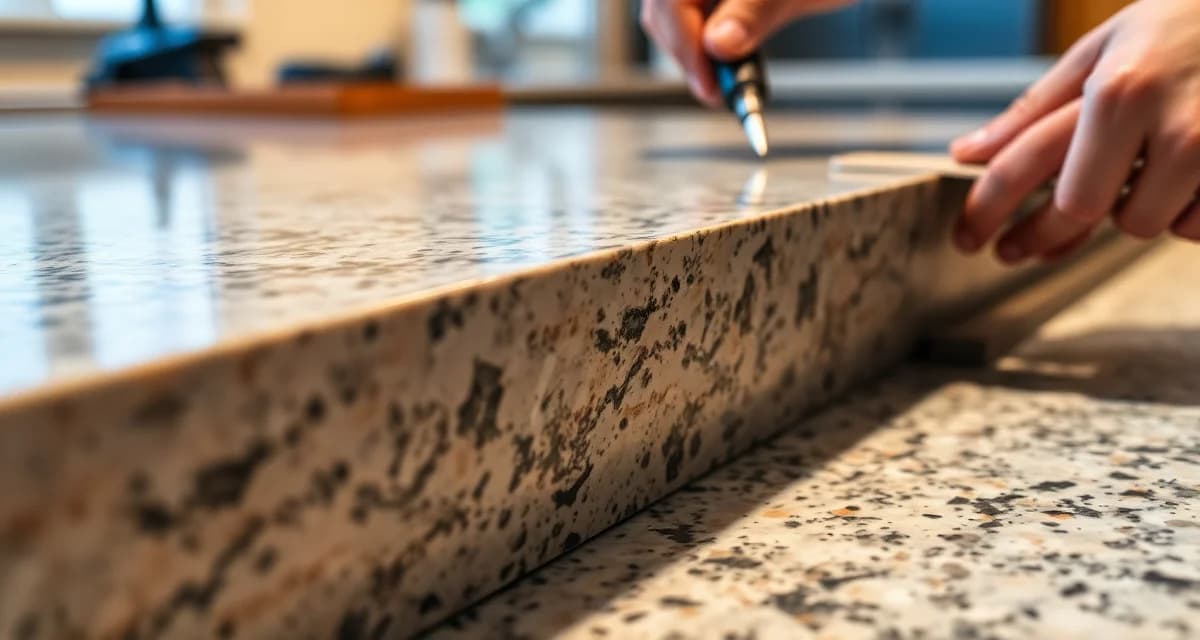
Can You Change Your Countertop Edge After Installation?
Quick Definition: Changing a countertop edge profile after installation is technically possible in some cases, but it comes with significant limitations, costs, and risks. The answer depends on your countertop material, current edge style, desired new edge, and whether a fabricator can work on the slab in place.
TL;DR
- Yes, but with caveats -- some edge profiles can be modified after installation, though it's not always recommended
- Granite and marble edges can sometimes be re-profiled on-site by an experienced fabricator
- Quartz modifications are harder due to resin content and dust concerns
- Going from a thick edge to a thinner one is easier than the reverse
- On-site edge work typically costs $15-$40 per linear foot, depending on complexity
- Removal, re-fabrication, and reinstallation is the safest but most expensive option ($800-$3,000+)
- Prevention is the best fix -- choose your edge profile carefully during the templating stage
Why Homeowners Want to Change Their Edge Profile
It happens more often than you might think. A homeowner picks a simple eased edge to save money during a kitchen remodel, then regrets it six months later when they see a neighbor's gorgeous ogee profile. Or a home buyer inherits countertops with a dated bullnose edge and wants something more contemporary.
Calculate your material waste savings
See exactly how much slab material and money you could save with optimized cutting layouts.
Try the free Waste CalculatorCommon reasons include:
- Aesthetic regret -- the edge looked different in the showroom sample versus a full kitchen
- Home renovation updates -- new cabinetry or backsplash that clashes with the current edge style
- Damage repair -- chips or cracks along the edge that require re-profiling anyway
- Resale preparation -- updating dated edge profiles before listing a home
Can a Fabricator Re-Profile the Edge In Place?
When It Works
On-site edge modification is possible when:
| Factor | Favorable Condition |
|---|---|
| Material | Granite, marble, or quartzite |
| Current edge | Thicker profile (bullnose, ogee, dupont) |
| Desired edge | Thinner or simpler (eased, bevel, pencil) |
| Access | Countertop edges are fully accessible |
| Overhang | Sufficient material extends past the cabinet |
A skilled fabricator can bring portable grinding and polishing equipment to your kitchen and reshape the edge in place. This works best when you're going from a more elaborate profile to a simpler one -- essentially removing material rather than trying to add it.
When It Doesn't Work
On-site modification is risky or impossible when:
- You want a more elaborate edge -- going from an eased edge to an ogee requires removing material in ways that might make the countertop too thin
- The countertop is quartz -- engineered quartz creates hazardous silica dust that requires wet-cutting in a controlled shop environment with proper OSHA-compliant ventilation
- The slab is thin -- 2cm (3/4") slabs have very little material to work with
- There are undermount sinks nearby -- vibration from grinding can compromise the sink bond and adhesive
- Seams are close to the edge -- grinding near a seam can weaken or separate the joint
The Dust and Safety Factor
This is a big deal that many homeowners overlook. Grinding stone creates fine particulate dust, including crystalline silica. OSHA has strict regulations about silica exposure (the permissible exposure limit is 50 micrograms per cubic meter over an 8-hour shift). Any reputable fabricator doing on-site edge work should use:
- Wet grinding/polishing equipment
- HEPA vacuum attachments
- Respiratory protection
- Plastic sheeting to contain dust
If a fabricator shows up planning to dry-grind your countertop edge in your kitchen, that's a red flag. Walk away.
Option 1: On-Site Edge Modification
Best for: Minor changes on granite or natural stone, going from elaborate to simple profiles.
Process:
- Fabricator assesses the current edge and material thickness
- Protective covering is placed over cabinets, floors, and appliances
- Wet grinding equipment is used to reshape the edge profile
- Progressive polishing pads (typically 50 through 3000 grit) restore the finish
- Clean-up and inspection
Cost: $15-$40 per linear foot Timeline: 2-6 hours for a typical kitchen Risk level: Moderate -- there's always a chance of chipping or uneven results
Option 2: Remove, Re-Fabricate, and Reinstall
Best for: Major profile changes, quartz countertops, or when you want guaranteed results.
Process:
- Plumber disconnects sink and faucet
- Countertop sections are carefully removed (risk of breakage exists)
- Slabs are transported back to the fabrication shop
- New edge profile is cut and polished on professional CNC equipment
- Countertops are reinstalled and plumbed
Cost: $800-$3,000+ depending on kitchen size and material Timeline: 1-3 weeks Risk level: Higher -- removal and transport carry breakage risk, especially with longer sections or L-shaped pieces
Option 3: Edge Overlay or Laminated Edge
Best for: Adding thickness or a more dramatic profile without modifying the existing edge.
Some fabricators can bond additional stone strips to the front edge of your countertop, creating a "laminated" or "built-up" edge. This can transform a standard 3cm edge into a 6cm mitered look or add material for a more substantial profile.
Cost: $25-$60 per linear foot Timeline: 1-2 days Risk level: Low to moderate -- depends on bond quality
Cost Comparison Table
| Method | Cost per Linear Foot | Total for 30 LF Kitchen | Downtime |
|---|---|---|---|
| On-site re-profile | $15-$40 | $450-$1,200 | Half day |
| Remove & re-fabricate | $25-$75 + labor | $800-$3,000+ | 1-3 weeks |
| Edge overlay | $25-$60 | $750-$1,800 | 1-2 days |
| Full replacement | $40-$200 | $2,400-$8,000+ | 1-3 weeks |
Edge Profiles: Difficulty of Modification
Not all edge changes are equal. Here's how common transitions rank:
Easier Modifications
- Bullnose to eased/bevel
- Ogee to half-bullnose
- Full bullnose to half-bullnose
- Any profile to a simple chamfer
Harder Modifications
- Eased to ogee or dupont (requires removing significant material)
- Pencil round to bullnose (may not have enough material)
- Any profile on 2cm slabs (very tight tolerances)
How to Avoid the Problem in the First Place
The best approach is choosing the right edge profile before fabrication. Here's how:
- Request full-size edge samples -- not just the small chips in the showroom
- See the edge on a similar countertop -- ask your fabricator for photos of completed kitchens with your chosen profile
- Consider your kitchen style -- contemporary kitchens suit eased and mitered edges; traditional kitchens work with ogee and bullnose
- Think about maintenance -- elaborate profiles have more grooves that collect crumbs and grime
- Ask about cost differences -- some edges are included free while others add $10-$30 per linear foot
For fabricators: this is exactly the kind of customer question that eats up your phone time. A well-designed customer portal -- like what SlabWise offers -- can display edge profile options with photos and pricing, letting customers browse and decide before they ever call your shop.
FAQ
Can you change a countertop edge without removing the countertop? Yes, in many cases. A fabricator can re-profile granite and marble edges on-site using portable wet-grinding equipment. Quartz is harder to modify in place due to silica dust concerns.
How much does it cost to change a countertop edge profile? On-site re-profiling costs $15-$40 per linear foot. Removal and re-fabrication runs $800-$3,000+ for a typical kitchen. Edge overlays fall in the $25-$60 per linear foot range.
Can you change quartz countertop edges after installation? It's possible but not ideal. Quartz generates hazardous silica dust when cut, so the work should be done in a shop with proper dust collection -- meaning the countertop needs to be removed first.
Is it better to replace the countertop or just change the edge? If the countertop material is in good condition and you only dislike the edge, modification is far cheaper. Full replacement only makes sense if the material itself is damaged or outdated.
Can you add a bullnose edge to a countertop that has a straight edge? Sometimes. If the slab has enough thickness (3cm or more) and the overhang is sufficient, a fabricator may be able to round the edge on-site. For a full bullnose, removal and shop work is usually better.
Will changing the edge void my warranty? Most fabricator warranties cover the original installation only. Any modification -- especially by a different company -- will likely void the warranty. Check your contract before proceeding.
How long does on-site edge modification take? Typically 2-6 hours for a standard kitchen (25-35 linear feet), depending on the complexity of the new profile and the material type.
Can you change the edge on a bathroom vanity countertop? Yes, and it's usually easier than a kitchen because vanity tops are smaller, lighter, and simpler to remove if needed.
Does changing the edge affect the countertop's structural integrity? It can. Removing material from the edge reduces thickness, which may weaken the overhang. Your fabricator should assess whether the remaining material can safely support the countertop's span.
Can I change just one section of edge and not the whole countertop? Yes, but matching the finish between the modified section and the untouched sections can be tricky. The polish level and exact profile shape may not be perfectly consistent.
Ready to Get Your Edge Profile Right the First Time?
If you're a countertop fabricator, the best way to prevent edge-change callbacks is to give customers clear, visual edge options before fabrication begins. SlabWise's Customer Portal lets homeowners browse edge profiles with photos and pricing -- reducing those "can I change my edge?" calls by up to 70%.
Try These Free Tools
- Cost Calculator -- Get instant countertop cost estimates by material, edge profile, and square footage.
- Compare Materials -- Side-by-side material comparison with pricing, durability, and maintenance ratings.
- Edge Profile Selector -- Browse edge profiles with cost impact and visual previews.
Sources & Further Reading
- Natural Stone Institute - Stone Thickness Guidelines
- International Surface Fabricators Association - Countertop Specifications
- National Kitchen & Bath Association - Countertop Installation Standards
- ASTM International - Standard Test Methods for Stone Thickness