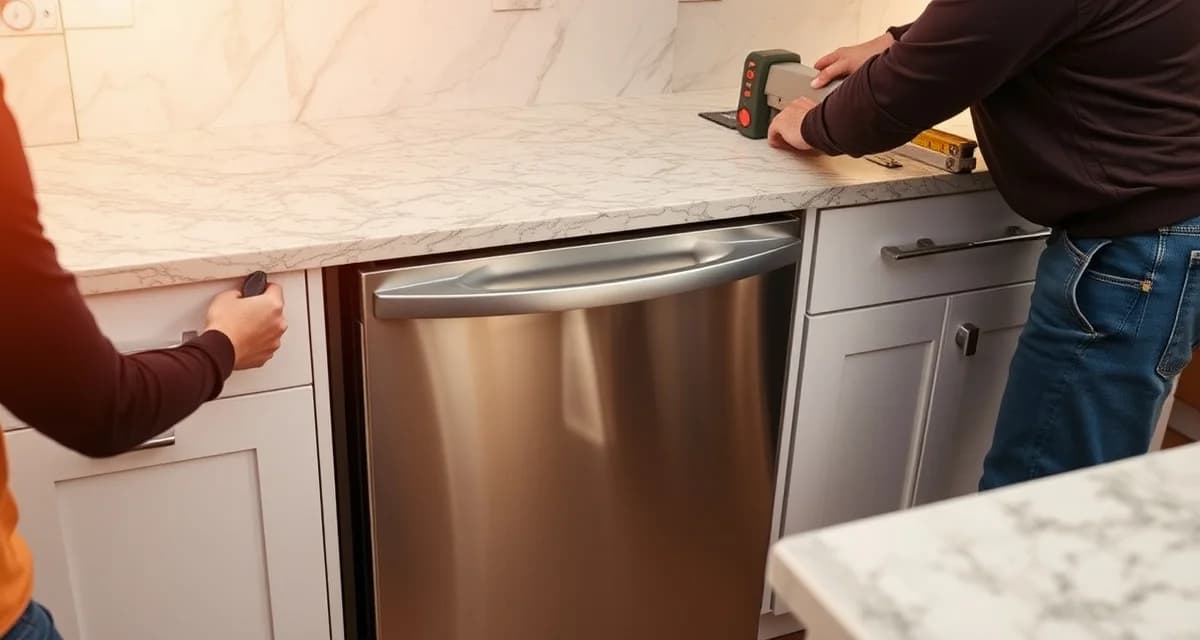
Dishwasher and Countertop Installation: What You Need to Know
Quick Definition: When new countertops are installed, the dishwasher needs to be removed or at minimum rolled forward to allow the old countertop removal and new countertop placement. After installation, the dishwasher must be re-leveled and secured to ensure it fits under the new countertop without rubbing, jamming, or leaving an unsightly gap.
TL;DR
- The dishwasher typically needs to be pulled out or lowered before countertop installation
- Standard dishwasher height is 33.5-34.5" -- designed to fit under a 36" countertop (34.5" cabinet + 1.5" stone)
- Thick countertops (3cm stone = ~1.25") change the clearance -- verify fit before installation
- Granite/quartz is heavier than laminate, which can affect leveling over time
- Dishwashers must be anchored to the countertop or cabinet to prevent tipping (required by code)
- Anti-tip brackets for dishwashers under stone countertops use side-mount clips (you can't screw into stone from below)
- The gap between the dishwasher door and countertop edge should be minimal but not zero
- Tell your fabricator if you're changing dishwasher models -- dimensions vary
The Installation Sequence
Before Countertop Installation
- Disconnect the dishwasher -- unplug the power, disconnect the water supply line, and detach the drain hose
- Slide the dishwasher out -- pull it forward enough to clear the countertop removal path, or remove it entirely
- Protect the flooring -- place cardboard or a drop cloth where the countertop crew will work
During Countertop Installation
The countertop crew installs the stone on the cabinets. The area above the dishwasher opening will have countertop but no dishwasher underneath it. This is the time to:
Calculate your material waste savings
See exactly how much slab material and money you could save with optimized cutting layouts.
Try the free Waste Calculator- Verify the underside clearance for the dishwasher
- Install any mounting brackets on the cabinet sides
- Confirm the dishwasher water supply and drain routing won't be pinched
After Countertop Installation
- Slide the dishwasher back in -- carefully guide it back into the opening
- Adjust the leveling legs -- raise or lower the dishwasher to fit snugly under the new countertop
- Secure the dishwasher -- mount the anti-tip bracket
- Reconnect plumbing and power
- Run a test cycle to check for leaks and proper drainage
Clearance and Height Issues
The Standard Setup
| Component | Height |
|---|---|
| Finished floor to cabinet top | 34.5" |
| Countertop thickness (3cm stone) | ~1.25" |
| Total counter height | ~35.75" |
| Standard dishwasher height range | 33.5"-34.5" (adjustable legs) |
| Available clearance | 0.25"-1.25" |
Most dishwashers are designed to fit under a 34" opening (the space between the floor and the underside of the countertop). With standard 34.5" cabinets and ~1.25" stone countertop, the opening is about 33.25" -- tight but workable since dishwashers have adjustable legs.
When Clearance Gets Tight
Problems arise when:
- Thicker countertop material is used (granite with a laminated edge can be 2.5"+ thick)
- Floor height changes -- new tile flooring in front of the dishwasher but not under it creates a step
- Non-standard cabinets -- some cabinets are shorter than the standard 34.5"
- Tall dishwashers -- some European models (Miele, Bosch 800 series) are taller than standard US units
What to Do if the Dishwasher Won't Fit
| Problem | Solution |
|---|---|
| Dishwasher is 1/4" too tall | Lower the leveling legs to minimum height |
| Dishwasher is 1/2" too tall | Remove the dishwasher's adjustable feet and set it directly on the floor |
| Dishwasher is 1"+ too tall | May need to modify the cabinet opening or choose a different dishwasher |
| New tile floor raised the dishwasher | Lower the leveling legs or install a floor cutout under the dishwasher |
Critical note for fabricators: If you're installing a countertop with a thicker-than-standard profile (laminated edge, mitered edge, or 6cm material), check the dishwasher clearance during templating. A homeowner who can't fit their dishwasher back in after installation will blame the countertop company.
Anchoring the Dishwasher Under Stone Countertops
Building codes (and common sense) require dishwashers to be secured to prevent tipping when the door is open and loaded with heavy dishes. With laminate countertops, installers simply drive screws through the top mounting tabs into the underside of the counter. With stone countertops, you can't screw into the stone.
Mounting Options for Stone Countertops
Option 1: Side-Mount Brackets (Most Common) Metal L-brackets are screwed to the inside of the cabinet side walls, with the horizontal tab resting against the top of the dishwasher frame. This prevents the dishwasher from tipping forward.
Option 2: Granite Clips / Stone Mounting Brackets Specialty clips designed for stone countertops. They adhesive-mount or wedge between the dishwasher and the countertop underside. Popular brands include Granite Grabber and similar products.
Option 3: Wood Strip Mounting A wooden strip is epoxied or siliconed to the underside of the stone countertop. The dishwasher's top mounting tabs are then screwed into the wood strip.
Option 4: Cabinet Face-Frame Mounting The dishwasher is screwed to the face frame of the adjacent cabinet, preventing forward tipping without touching the countertop.
| Mounting Method | Difficulty | Cost | Effectiveness |
|---|---|---|---|
| Side-mount brackets | Easy | $5-$15 | Good |
| Granite clips | Easy | $10-$25 | Good |
| Wood strip on stone | Moderate | $5-$10 | Excellent |
| Face-frame mount | Easy | $5 | Good |
The Gap Between Dishwasher and Countertop
A small gap between the top of the dishwasher door and the countertop edge is normal and actually desirable:
- Too much gap (over 1/2"): Looks unfinished, can allow steam to escape onto the countertop underside
- Right amount (1/8" to 3/8"): Clean look, allows the door to open freely
- No gap / rubbing: The dishwasher door scrapes the countertop edge every time it opens, potentially damaging both the door and the stone
If the gap is too large, raise the dishwasher's leveling legs. If there's no gap and the door rubs, lower the legs.
Dishwasher Steam and Stone Countertops
Dishwashers release steam when opened after a cycle, and some vent steam during the drying phase. This steam rises directly onto the underside of the countertop.
Is Dishwasher Steam a Problem?
- Quartz: No -- non-porous, not affected by steam
- Granite (sealed): Rarely -- well-sealed granite handles moisture
- Granite (unsealed): Possible darkening over time where steam hits
- Marble: Can absorb moisture and potentially discolor over long periods
- Laminate: Can swell or delaminate from repeated steam exposure
Most modern dishwashers direct steam out the front vent or condensation-dry without venting. If you have a steam-heavy model (older units) and natural stone, consider sealing the underside of the stone near the dishwasher opening.
FAQ
Do you remove the dishwasher when installing countertops? Typically yes. The dishwasher needs to be pulled forward or removed entirely to allow old countertop removal and new countertop installation. The installer needs clear access to the cabinet tops.
Can a dishwasher damage stone countertops? Normal operation won't damage stone. However, if the dishwasher door rubs against the countertop edge, it can chip or scratch the stone over time. Ensure proper clearance.
How do you anchor a dishwasher under a granite countertop? Use side-mount brackets, granite clips (adhesive-mounted), or a wood strip epoxied to the underside of the stone. Never try to drill or screw into the granite from below.
What if my dishwasher doesn't fit under the new countertop? Lower the dishwasher's adjustable legs first. If that's not enough, remove the feet entirely or modify the cabinet opening. In rare cases, you may need a shorter-model dishwasher.
Who handles the dishwasher during countertop installation? The countertop installer typically doesn't handle the dishwasher. Either the homeowner, general contractor, or plumber disconnects and reconnects it.
Does dishwasher steam hurt quartz countertops? No. Quartz is non-porous and not affected by moisture or steam from dishwasher operation.
How much clearance does a dishwasher need under a countertop? Standard dishwashers need a minimum opening height of 33.5"-34". With standard cabinets and 3cm stone, the opening is about 33.25", which works with the legs adjusted.
Should I replace my dishwasher when getting new countertops? If your dishwasher is over 10 years old, it's a good time to upgrade. The kitchen is already partially disassembled, and a new dishwasher may have different dimensions that the fabricator should know about.
Can the dishwasher go in before the countertop? The dishwasher should be installed (positioned and leveled) before templating, so the fabricator can verify clearance. It's then removed for countertop installation and re-installed after.
Is there a gap between the dishwasher and the countertop? A small gap (1/8" to 3/8") between the dishwasher door and the countertop edge is normal. This allows the door to open without scraping.
Avoid Dishwasher Clearance Surprises
For fabricators, a dishwasher that won't fit after installation is an embarrassing and expensive callback. SlabWise's Template Verification system flags potential clearance conflicts during the template review, catching the problem before you cut the slab.
Try These Free Tools
- Photo to Template -- Snap a photo of an existing countertop and get an AI-generated DXF template.
- Template Compare -- Upload two templates and see every dimension change highlighted instantly.
- AI Template Verification -- Cross-check your template against manufacturer specs before cutting.
Sources & Further Reading
- Natural Stone Institute - Countertop Support Guidelines
- International Surface Fabricators Association - Structural Support Requirements
- National Kitchen & Bath Association - Countertop Installation Standards
- ASTM International - C1526 Standard Specification for Serpentine Dimension Stone