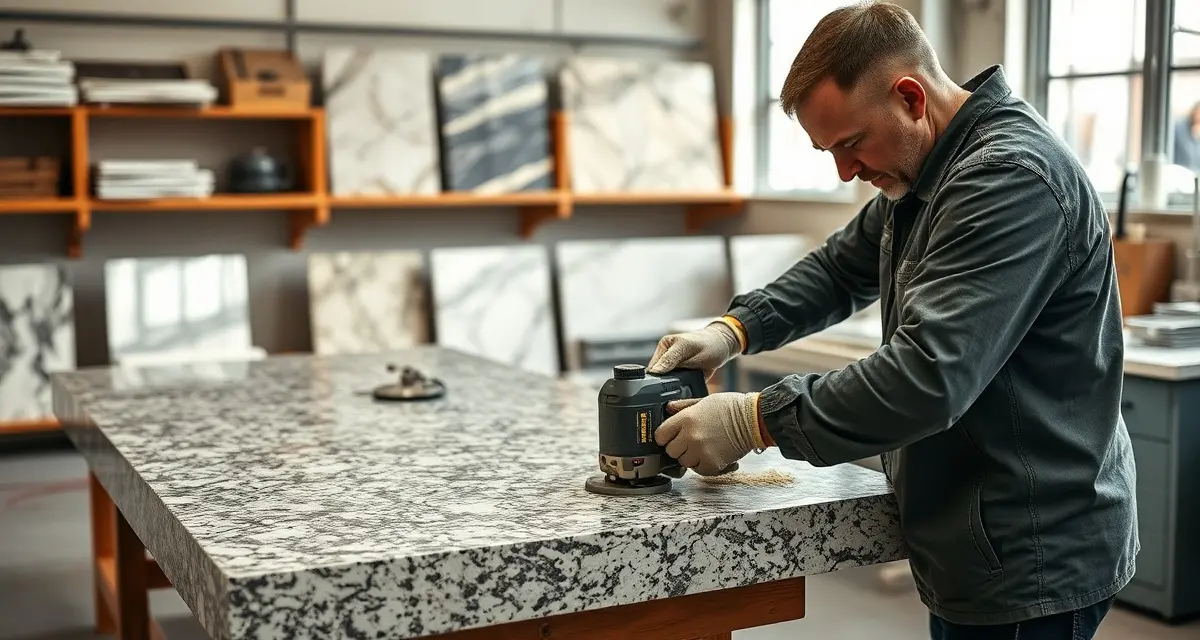
Fabricator vs Installer: What's the Difference?
Quick Definition: A countertop fabricator cuts, shapes, and finishes raw stone slabs into countertops. A countertop installer sets those finished pieces in place in your home. Many companies do both (fabricate and install), but they're distinct skills with different equipment, training, and expertise. Understanding the difference helps you hire the right people and know who to call when something goes wrong.
TL;DR
- Fabricators cut raw slabs into finished countertops using CNC machines, bridge saws, and polishing equipment
- Installers transport and place finished countertops onto cabinets, seal seams, and mount sinks
- Most countertop shops do both -- fabrication and installation are handled by the same company
- Big box stores (Home Depot, Lowe's) don't fabricate -- they subcontract to local fabrication shops
- The fabrication stage is where most errors happen (wrong dimensions, bad cutouts, edge mistakes)
- The installation stage is where fit issues become visible (gaps, unlevel surfaces, seam placement)
- Hiring a single company for both fabrication and installation gives you one point of accountability
- Average fabricator shop has 5-15 employees and handles 15-40 kitchens per month
What a Countertop Fabricator Does
Fabrication is the manufacturing stage. The fabricator takes a raw stone slab and transforms it into a finished countertop ready for installation.
Calculate your material waste savings
See exactly how much slab material and money you could save with optimized cutting layouts.
Try the free Waste CalculatorFabrication Process
| Step | Description | Equipment |
|---|---|---|
| Templating | Measuring the countertop area on-site | Laser templater or physical templates |
| Programming | Converting measurements to CNC cutting files | CAD software (AutoCAD, Slabsmith, etc.) |
| Cutting | Cutting the slab to shape | CNC router or bridge saw |
| Edge profiling | Shaping the edge profile (bullnose, ogee, etc.) | CNC router or hand-held profiling tools |
| Cutouts | Making openings for sinks, cooktops, faucets | CNC router or plunge cut with bridge saw |
| Polishing | Finishing all cut edges to match the slab surface | Polishing pads (50-3000 grit) |
| Quality check | Inspecting dimensions, edges, and surface quality | Measuring tools, visual inspection |
Skills and Training
Fabricators are skilled tradespeople. A competent fabricator needs:
- Knowledge of stone properties (different materials cut differently)
- CNC programming and operation
- Understanding of structural loads and overhang limits
- Precision measurement (tolerances of 1/16" or less)
- Safety training for silica dust, heavy lifting, and wet-cutting equipment
Equipment Investment
A typical fabrication shop has $200,000-$1,000,000+ in equipment:
- CNC router/bridge saw: $100,000-$400,000
- Bridge saw: $50,000-$200,000
- Edge polishing machine: $20,000-$80,000
- Overhead crane: $15,000-$50,000
- Template equipment: $5,000-$30,000
- Dust collection/water treatment: $10,000-$50,000
What a Countertop Installer Does
Installation is the delivery and placement stage. The installer takes the finished countertop pieces and sets them in the customer's home.
Installation Process
| Step | Description |
|---|---|
| Transport | Loading finished pieces onto padded A-frames and driving to the job site |
| Old counter removal | Removing existing countertops (if applicable) |
| Dry fit | Setting pieces in place to check fit before adhesive |
| Leveling | Shimming and adjusting so the countertop sits perfectly flat |
| Seam joining | Bonding multi-piece countertops with color-matched epoxy |
| Sink mounting | Setting undermount sinks with adhesive and clips |
| Caulking | Sealing the countertop-to-wall joint and sink perimeter |
| Backsplash | Installing stone backsplash pieces (if included) |
| Clean-up | Wiping surfaces, removing debris, final inspection |
Skills and Training
Installers need:
- Heavy lifting ability (stone sections can weigh 200-400+ lbs)
- Leveling and shimming expertise
- Epoxy seam work (color matching and clean joining)
- Undermount sink attachment techniques
- Caulking and finishing skills
- Problem-solving on-site (walls are never perfect, cabinets may be unlevel)
Equipment
Installation requires less capital but specific tools:
- Transport truck with A-frame racks: $30,000-$60,000
- Suction cup lifters: $200-$1,000
- Leveling equipment: $100-$500
- Seam setter tools: $500-$2,000
- Caulk guns, epoxy kits, and finishing supplies: $200-$500
Same Company vs. Separate Companies
Most Common: Same Company Does Both
About 80-85% of residential countertop jobs are handled by a single company that fabricates and installs. This is generally the best arrangement because:
- Single point of accountability -- if something doesn't fit, there's no blame game
- Better communication -- the fabrication team knows what the installer will face
- Faster timeline -- no handoff delays between separate companies
- Warranty coverage -- one company stands behind the entire job
When They're Separate
Situations where fabrication and installation might be different companies:
-
Big box stores: Home Depot, Lowe's, and IKEA sell countertops but subcontract fabrication and installation to local shops. You're buying through a middleman.
-
General contractors: A GC managing a kitchen remodel may hire a fabrication shop that doesn't do its own installation, then use a separate installation crew.
-
Stone-only fabricators: Some high-end fabrication shops focus on cutting and finishing. They sell to contractors or homeowners who arrange their own installation.
-
Imported pre-fabricated countertops: Pre-cut countertops (like pre-fab granite from big box stores) are manufactured overseas and installed by a separate local crew.
The Big Box Store Model
When you buy countertops through Home Depot or Lowe's, here's what actually happens:
- You select material and pay the store
- The store assigns the job to a local fabrication subcontractor
- The subcontractor's templater measures your kitchen
- The subcontractor fabricates and installs the countertops
- The store takes a margin (typically 15-30%)
You can often get the same quality for less by going directly to the fabrication shop. The tradeoff: big box stores may offer financing options and a corporate warranty backup.
How to Choose a Good Fabricator
-
Visit the shop. A reputable fabricator will let you see their equipment and workspace. Look for a CNC machine, clean organization, and proper dust/water management.
-
Ask about their equipment. CNC fabrication produces more precise results than manual cutting. Most modern shops use CNC for at least the primary cuts.
-
Check their templating method. Digital/laser templating is more accurate than manual measurement.
-
Review their portfolio. Ask for photos of completed projects, especially kitchens similar to yours.
-
Confirm they handle installation too. If they subcontract installation, ask who they use and whether the warranty covers both fabrication and installation.
-
Get an itemized quote. A professional quote breaks down material, fabrication, edge work, cutouts, and installation as separate line items.
For fabricators reading this: customer trust starts with transparent communication. SlabWise's Customer Portal gives homeowners real-time visibility into their project status -- from template scheduling to fabrication progress to installation date -- reducing "where's my countertop?" calls by up to 70%.
Common Problems and Who's Responsible
| Problem | Usually Caused By | Who Fixes It |
|---|---|---|
| Wrong dimensions | Fabricator (bad template) | Fabricator |
| Countertop doesn't fit against wall | Fabricator (template) or wall irregularity | Fabricator adjusts or caulks |
| Sink cutout wrong size | Fabricator | Fabricator |
| Countertop not level | Installer (shimming issue) | Installer |
| Bad seam (visible, rough, or miscolored) | Installer | Installer |
| Chip during transport | Installer | Installer/fabricator |
| Edge profile wrong | Fabricator | Fabricator |
| Crack after installation | Depends on cause | Investigation needed |
FAQ
Is a fabricator the same as an installer? No. A fabricator cuts and finishes raw stone into countertops. An installer places the finished countertops in your home. Most companies do both, but they're different skills.
Do I need to hire a fabricator and installer separately? Usually not. Most countertop companies handle both fabrication and installation. This is the recommended approach for single-point accountability.
Who templates my kitchen -- the fabricator or installer? The fabricator (or their templater). The template feeds directly into the fabrication process, so the company cutting the stone needs to control the measurements.
Are big box store countertops fabricated in-store? No. Home Depot, Lowe's, and similar retailers subcontract fabrication and installation to local shops. The store acts as a middleman.
How do I find a good local fabricator? Visit local slab yards and ask which fabrication shops they recommend. Check Google reviews, visit the shop in person, and ask to see examples of completed work.
What certifications should a fabricator have? Look for membership in the Natural Stone Institute or accreditation from the Marble Institute of America. These indicate professional standards and training.
Can I buy my own slab and have it fabricated? Yes, many fabricators will work with customer-supplied slabs. Some charge a "fabrication only" rate. Be aware that if the slab has a defect, the fabricator isn't responsible for the material.
Who do I call if my countertop cracks after installation? Contact the company that fabricated and installed the countertop. They should assess whether the crack is due to fabrication, installation, or an external cause (like structural settling).
How much does fabrication cost vs. installation? Fabrication typically accounts for 60-70% of the total price, and installation accounts for 30-40%. On a $5,000 job, that's roughly $3,000-$3,500 for fabrication and $1,500-$2,000 for installation.
What's the difference between a stone yard and a fabricator? A stone yard (or slab yard) sells raw slabs of stone. A fabricator buys or receives those slabs and cuts them into finished countertops. Some companies operate both a slab yard and a fabrication shop.
Run Your Fab Shop More Efficiently
Whether you're a 5-person shop or a 30-person operation, SlabWise helps fabricators simplify the entire workflow -- from Quick Quotes (3 min vs. 20 min) to Template Verification (3-layer check) to Customer Portal (70% fewer calls).
Try These Free Tools
- Photo to Template -- Snap a photo of an existing countertop and get an AI-generated DXF template.
- Template Compare -- Upload two templates and see every dimension change highlighted instantly.
- AI Template Verification -- Cross-check your template against manufacturer specs before cutting.
Sources & Further Reading
- Natural Stone Institute - Countertop Support Guidelines
- International Surface Fabricators Association - Structural Support Requirements
- National Kitchen & Bath Association - Countertop Installation Standards
- ASTM International - C1526 Standard Specification for Serpentine Dimension Stone