TL;DR
- Granite cracks come in three flavors: hairline surface cracks, natural fissures (not structural), and full breaks.
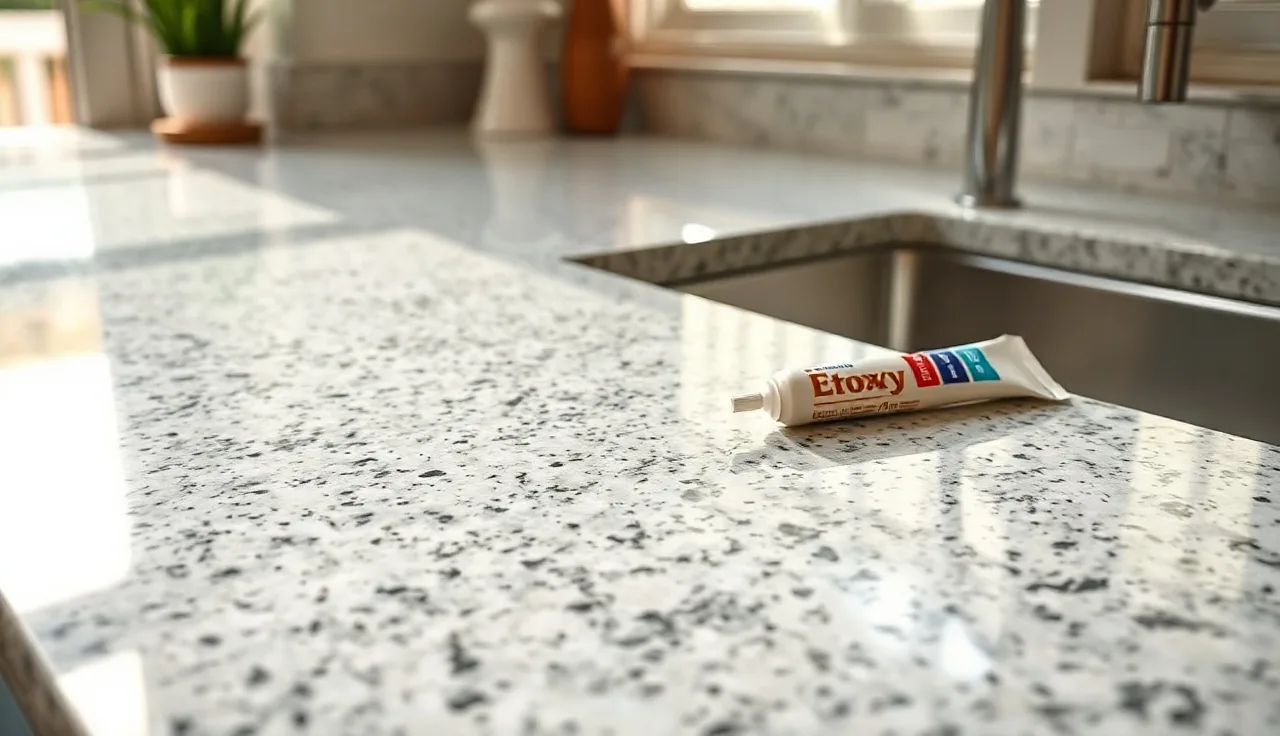
- A hairline crack or small chip repairs with color-matched two-part stone epoxy for $20-$80 in materials.
- Full breaks or cracks through a sink cutout need a professional fabricator, usually $200-$600.
- Replacement is a last resort, not the default answer.
Is that actually a crack, or just a fissure?
Before you buy epoxy or dial a fabricator, figure out what you're looking at. Granite forms under enormous pressure and heat, and the stone naturally carries linear marks called fissures. A fissure is a separation inside the crystal structure that happened millions of years before your countertop was cut. It is not a defect.
Here is the test. Run your fingernail across the mark. If your nail glides over without catching, it is almost certainly a fissure. If your nail drops in or catches an edge, it is a crack. Try a second check too: lay a flashlight flat against the surface at a low angle. A fissure shows as a consistent grain-line pattern. A crack throws a jagged shadow with slightly raised or depressed edges on one side.
Fissures need no repair. Filling one with epoxy usually makes it look worse, because the filler sits on top of the surface texture instead of blending in. Unsure? Photograph the mark and send it to a local fabricator for a read before you touch it. Most will answer for free.
The Natural Stone Institute (formerly the Marble Institute of America) states in its technical guidance that fissures are a natural characteristic of granite and are not considered defects, while cracks come from stress or impact after quarrying [1].
What types of cracks can you actually fix yourself?
Some granite cracks are a Saturday afternoon. Others are a call you should make before you make things worse. Three things decide it: crack size, location, and whether the slab is still holding together structurally.
Hairline surface cracks are the best DIY candidates. These run under 1/8 inch wide and stop short of going all the way through the stone. They show up at stress points: corners of sink cutouts, cooktop cutouts, or the edge of the slab where cabinet support ends. A color-matched two-part epoxy fills and stabilizes them well.
Chips along an edge or corner are good candidates too. The stone did not crack through; it lost a fragment. Still have the piece? A strong stone adhesive (often sold as "granite glue") re-bonds it. Fragment gone? A tinted epoxy fills the void.
Full breaks, where the slab has parted into two or more pieces, sit on the fence. A fabricator can re-join a slab with structural epoxy and reinforcing rods, but the job needs precise alignment and clamping pressure that is brutally hard to get in place. If the break runs through a sink or cooktop cutout, the slab is compromised and any repair is temporary at best.
Cracks longer than 6 inches, cracks that follow the width of the slab, or cracks that move when you press on either side all warrant a professional look before you do anything.
What materials do you need to fix a cracked granite countertop?
The right material tracks the crack type. Here is what each repair actually calls for.
For hairline cracks and small chips: a two-part epoxy or polyester resin made for stone. Tenax, Akemi, and Laticrete StoneTech all make stone-specific adhesives [6][7]. Skip generic hardware-store epoxy. It cures opaque or yellow and ends up more visible than the crack itself. You want a product that cures clear or takes universal pigments to match your stone.
For re-bonding a broken fragment: cyanoacrylate (super glue) works for very small chips because it wicks into tight gaps and sets fast. For larger fragments, use a two-part stone epoxy with a longer open time so you can line the piece up properly.
Tinting pigments: most pro stone repair kits ship with a set of universal pigments. You mix tiny amounts into the uncured epoxy until the color matches your granite background. This takes practice. Test the tinted mix on a scrap or a hidden spot before you fill the real crack.
Everything else: acetone or denatured alcohol for cleaning, painter's tape to mask the area, plastic spreaders or a putty knife, a single-edge razor blade for scraping cured excess, 220- to 400-grit wet/dry sandpaper, and polishing compound to bring back sheen after sanding.
A basic DIY repair runs $20-$80 in materials, depending on whether you buy a kit or piece it together. Pre-packaged kits from Tenax and similar brands sell at stone supply houses and some home improvement stores for around $30-$50 [6].
Step-by-step: how to repair a hairline crack in granite
Work in a well-ventilated space. Epoxy and acetone both off-gas.
Step 1: Clean the crack. Use a cotton swab or toothpick to clear debris from inside the crack. Wipe the surrounding area with acetone on a clean cloth. Let it dry all the way, 10-15 minutes minimum. Any moisture or grease and the epoxy will not bond.
Step 2: Mask the area. Run painter's tape along both sides of the crack, leaving just the crack exposed. This makes cleanup easier and keeps the polished surface safe from a stray razor blade later.
Step 3: Mix and tint the epoxy. Follow the manufacturer's ratio exactly. Two-part epoxies are fussy about mix ratio. Too much hardener cures brittle; too little stays tacky. Add pigment a hair at a time. Aim slightly lighter than the stone, since most granites have a lighter ground color with darker minerals floating through it.
Step 4: Fill the crack. Press the epoxy in with a plastic spreader or the flat edge of a putty knife. Work it from several directions to push out air pockets. Overfill a touch, because the epoxy needs to sit a hair proud of the surface so you can sand it flush after it cures.
Step 5: Let it cure fully. Most stone epoxies reach handling strength in 20-30 minutes but want a full 24-hour cure before you sand or stress the repair. Check the spec sheet.
Step 6: Scrape and sand. Hold a sharp single-edge razor blade flat to the surface and shave off the bulk of the excess. Then sand with 220-grit, then 400-grit wet/dry paper until the repair is flush. Keep the paper flat so you don't round the edges.
Step 7: Polish. Work a granite polishing compound over the repair with a soft cloth in small circles. This restores sheen and helps the fill blend. You will still see the crack line under direct light. The goal is color match and structural stability, not invisibility.
How do you re-bond a broken granite piece?
Re-bonding a detached piece, whether a corner fragment or a broken edge, is one of the more satisfying stone repairs, because a clean result can read as nearly invisible.
Start with a dry fit. Hold the piece in place with no adhesive and check the alignment. If the break is clean and the faces meet tight with no rocking or gaps, your odds are good. If there are gaps or the faces are chewed up, you may need to fill voids with tinted epoxy on top of the adhesive.
For a clean break on a small fragment (edge chip under 2 inches), cyanoacrylate does the job. Lay a thin bead on one surface only, set the fragment, and press firmly for 30-60 seconds. Wipe any squeeze-out immediately with acetone before it cures. Full strength lands in about 24 hours.
For larger pieces, use a two-part stone epoxy. You need the extra open time to align the piece right. Butter epoxy on both faces, press together, then clamp or tape firmly while it cures. A vertical edge is friendlier than a flat horizontal surface, where gravity fights you the whole time. Some fabricators drop hot glue around the perimeter to hold the piece in position while the structural epoxy cures underneath.
One honest caveat: even a perfect re-bond leaves a visible seam line in most light. The crack does not vanish. If the fragment sits somewhere everybody looks, like the front edge near a sink, a fabricator has color-matching compounds and polishing gear that beats a DIY result by a wide margin.
When should you call a professional fabricator instead?
Sometimes DIY is the wrong move. Knowing when to stop keeps a manageable problem from turning into an expensive one.
Call a pro when the crack runs through or near a cutout. Sink and cooktop cutouts concentrate stress, and a crack there means the remaining stone carries load across a weakened cross-section. A fabricator can judge whether reinforcing epoxy and rods restore the strength, or whether section replacement is the only real fix.
Call a pro when the slab has moved. Feel a height difference between the two sides of the crack as you run your hand across it? The slab has shifted. That usually points to weak substrate support, water damage to the cabinet, or bad installation. Fill the crack without fixing the cause and it reopens.
Call a pro when the crack tops 6 inches or spans more than a third of the counter's width. Those are structurally significant, and epoxy alone will not carry the load across that span.
Here is how a fabricator handles a full slab break in place: clean both faces, apply a structural two-part polyester or epoxy adhesive, clamp the joint with bar clamps or dedicated stone clamps, then rout a series of undercut slots perpendicular to the crack on the underside. Fiberglass or metal reinforcing rods get epoxied into those slots to bridge the crack. Done on an installed countertop, this runs $200-$600 depending on crack length, location, and whether the surface needs refinishing [2].
Cracked recently with no obvious impact? Call your installer. Cracks inside the first year often trace back to poor substrate support or a stone defect, and that can be a warranty matter.
How much does professional granite crack repair cost?
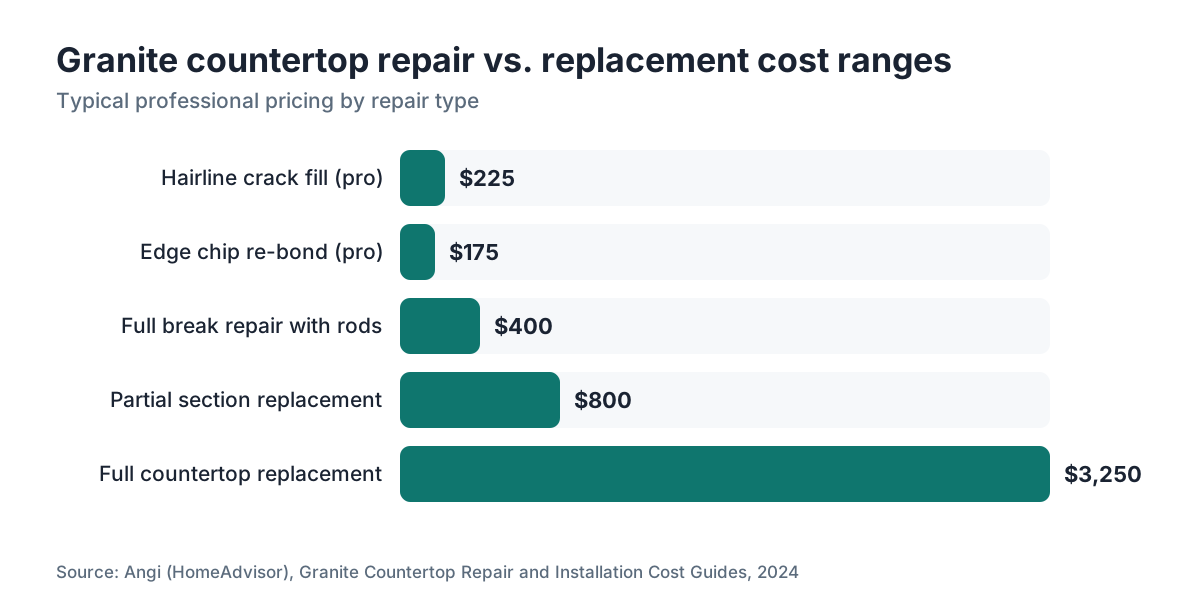
Professional granite crack repair usually runs $150-$300 for a hairline fill, $100-$250 for an edge chip, and $200-$600 for a full break that needs reinforcing rods. Cost swings with crack type, location, and your region. Here is the breakdown.
| Repair Type | Typical Cost Range | Notes |
|---|---|---|
| Hairline crack fill (professional) | $150-$300 | Includes color matching and surface polish |
| Edge chip re-bond | $100-$250 | Cost rises if the fragment is missing |
| Full slab break repair (in-place) | $200-$600 | Includes reinforcing rods on large breaks |
| Partial section replacement | $400-$1,200+ | If repair isn't viable; new stone cut and installed |
| Full countertop replacement | $1,500-$5,000+ | Depends on slab size, stone type, and edge profile |
Those repair figures come from aggregated contractor pricing reported by Angi (formerly HomeAdvisor) [2][3]. Regional spread is real: a repair that costs $200 in a mid-sized Midwestern city can run $400 or more in a major coastal market, tracking the skilled-trade labor differences the U.S. Bureau of Labor Statistics documents across metro areas [5].
Get at least two quotes before you commit to a replacement. Plenty of homeowners assume a cracked slab has to go, but a fabricator with real repair chops can make a crack functionally invisible and structurally sound for a fraction of replacement cost.
For fabricators quoting repair jobs, the labor math is tricky. A job that looks simple can turn into a color-matching nightmare on heavily figured stone. Price at 1.5 to 2 times your standard hourly rate to cover the rework risk. Tools like SlabWise help you build repair quotes that carry material and labor overhead so you don't underprice the job.
Can granite countertop cracks be prevented?
Some cracks you can't dodge, especially in stone that showed up from the quarry with natural stress lines. Plenty of others come down to installation and habits.
The single most common cause of post-installation cracking is weak cabinet support. Granite needs continuous support along its full length, and especially near cutouts. The Natural Stone Institute recommends support within 6 inches of any cutout edge [1]. If your cabinets leave a large unsupported span and the granite bridges it with no center support rail, that is a crack waiting to happen.
Heavy point loads crack stone too. Stand or sit on a granite counter near a cutout, or drop a cast iron pan on it, and you concentrate stress that granite handles poorly. Granite is strong in compression but brittle under bending and impact.
Thermal shock rarely cracks kitchen granite. The idea that a hot pan on granite causes cracking is not well supported. Granite's thermal conductivity is high enough to spread the heat. The real risk from direct heat is damage to the sealer or resin-filled pores, not the stone.
Sealing on schedule (typically every 1-3 years, depending on porosity and product) does nothing to prevent cracks, but it keeps water out of micro-cracks that already exist. Water that seeps into a hairline crack and freezes expands and widens it. That is mostly an outdoor-granite concern, though it applies near a leaky kitchen faucet too.
For more on caring for natural stone, see our guide on how to clean stone countertops.
Does homeowners insurance cover cracked granite countertops?
Almost always, no. Standard homeowners insurance covers sudden and accidental damage from named perils: fire, certain water damage, theft, and the like. A countertop crack from normal use or a dropped object gets shoved into "wear and tear" or excluded, depending on how the insurer files it.
The exception is a crack caused by a covered event. If a kitchen fire's thermal stress cracks the granite, that damage likely falls under your fire coverage. If a burst pipe causes structural damage that cracks the counter, you have an argument for a claim.
On coverage questions, the Insurance Information Institute advises reading your policy's "perils insured against" section and calling your agent before you file, since a denied claim can still ding your claims history in some states [4].
Some premium home warranty programs (service contracts, not insurance) cover countertop cracking under accidental damage riders. Read the fine print. Most carry a $100-$250 deductible per claim and may cover only full replacement, not repair.
A fabricator warranty is a separate thing. It typically covers defects in workmanship, which includes bad support or a botched install that led to cracking. It does not cover impact or misuse.
What if the whole slab needs to be replaced?
Sometimes repair isn't the answer. If the crack is severe, if the slab carries several cracks, or if the original was a remnant that no longer exists as a match, replacement makes more economic sense than repair.
New granite installed runs roughly $40-$100 per square foot, which lands at $1,500-$5,000 for a typical kitchen depending on square footage and edge complexity [3][5]. The range is wide because granite itself varies hugely. A common Level 1 granite might run $35-$50 per square foot installed, while an imported exotic Level 4 stone runs $80-$150.
Replacing just a section? Know that matching the existing stone is often impossible. Granite is natural: the same named stone from the same quarry can look meaningfully different slab to slab. If partial replacement is the plan, go to the stone yard in person with a photo and, better yet, a small sample of your existing top.
Replacement also opens the door to a different material. Quartz countertops are engineered to be more uniform and more crack-resistant than natural granite, though they are not indestructible. If your kitchen sees heavy use and you want less maintenance, quartz is worth weighing against marble countertops or other natural stones.
For fabricators pricing replacement, an accurate takeoff matters as much as material cost. SlabWise lets you build a quote from a real layout so you're not guessing at square footage or seam placement when you tell a customer the number.
Common mistakes people make when trying to fix granite cracks
The repairs that go worst are almost always the ones where somebody grabbed whatever was handy instead of the right product.
Caulk is the top offender. It's flexible, which sounds good, but it stays soft after curing and grabs dirt and staining agents forever. A caulk-filled crack looks worse after a few months than the day it cracked. The only place caulk belongs on a granite counter is the joint between the stone and the backsplash or wall, where you actually want movement allowance.
Wrong-color epoxy with no test first is the second big one. A crack filled with white or clear-cured epoxy on a black galaxy granite reads like a bright scar. Test your color mix on a sample or a hidden spot every time before you touch the crack.
Sanding too hard is another. 80-grit paper on polished granite strips the polish and leaves a dull patch that's harder to fix than the crack was. Use 220-grit or finer, keep the paper flat, and finish with polishing compound.
Ignoring the cause guarantees a short-lived repair. If the counter cracked from weak support, the new epoxy cracks in the same spot. Fix the support first.
Last one: repairing a slab that has moved (one side sitting higher than the other) locks the misalignment in place forever. You cannot push a shifted countertop back to level after you've filled the crack. If there's vertical displacement, the repair starts with re-leveling, which usually means pulling and re-setting the top.
Frequently asked questions
Can a cracked granite countertop be repaired, or does it always need to be replaced?
Most granite cracks can be repaired, not replaced. Hairline cracks and edge chips are strong candidates for epoxy repair costing $20-$80 in DIY materials or $150-$300 professionally. Full breaks near a sink cutout are harder and sometimes warrant replacement, but a skilled fabricator can reinforce most breaks with structural epoxy and rods. Replacement is a last resort, not the default.
What kind of epoxy do I use to fix cracked granite?
Use a two-part stone-specific epoxy or polyester resin, not generic hardware-store epoxy. Products from Tenax, Akemi, or Laticrete StoneTech cure at the right hardness and take universal pigments to match your stone color. Generic epoxy often cures yellow or opaque and ends up more visible than the original crack.
How do I tell if a line in my granite is a crack or a natural fissure?
Run your fingernail across the line. A fissure sits flush and your nail passes over smoothly. A crack has a slightly raised or depressed edge that catches your nail. Under a flashlight held at a low angle, fissures show as consistent grain-pattern lines while cracks throw a shadow with an irregular edge. Fissures need no repair.
How much does it cost to fix a cracked granite countertop professionally?
Professional granite crack repair typically runs $150-$300 for a hairline fill, $100-$250 for an edge chip, and $200-$600 for a full slab break needing reinforcing rods. Partial section replacement runs $400-$1,200 or more. Regional labor rates vary a lot; coastal metro areas generally run 30-50% above the national midpoint.
Will my homeowners insurance pay for a cracked granite countertop?
Standard homeowners insurance almost never covers countertop cracks from normal use or accidental impact; those get classified as wear and tear or maintenance. Coverage applies only when the crack results from a covered peril like fire or a burst pipe. Some home warranty service contracts cover accidental damage with a separate rider, but deductibles typically run $100-$250 per claim.
Can I fix a granite countertop crack myself without professional help?
Yes, for hairline cracks, small chips, and clean edge breaks. The job needs a stone-specific two-part epoxy, tinting pigments, acetone for prep, and patience with color matching. Expect a visible seam line under direct light; the goal is color match and structural stability. Full breaks near cutouts, cracks over 6 inches long, or cracks with vertical displacement need professional assessment.
What causes granite countertops to crack?
The most common causes are weak substrate support (especially near sink or cooktop cutouts), heavy point loads like standing on the counter, and impact from dropped heavy objects. Pre-existing internal stress in the stone or damage during transport or installation also cause cracks. Thermal shock from hot pans is a common fear but a relatively rare cause in kitchens.
Is a crack in a granite countertop a structural safety concern?
A hairline surface crack is cosmetic, not structural. A crack through or near a sink or cooktop cutout is more serious, because those areas already concentrate stress and the remaining stone carries load across a narrower section. If you see visible deflection or a height difference across the crack, that is structural, and the countertop should not bear weight there until it's assessed.
How long does a granite crack repair last?
A well-prepared epoxy repair on a hairline crack with no movement can last 10 or more years. It hinges on surface prep (the crack must be completely clean and dry), a quality stone epoxy, and fixing the root cause. If the support problem that caused the crack goes unaddressed, the epoxy re-cracks in the same spot, often within months.
Can you fill a granite crack with caulk?
No. Caulk stays permanently flexible, which sounds appealing, but it keeps grabbing grease, bacteria, and staining agents and discolors fast. Within a few months a caulk-filled crack looks worse than the original. Caulk belongs only at the joint between the granite and the backsplash or wall, never within the stone surface itself.
How do you fix a chip on the edge of a granite countertop?
If you have the fragment, re-bond it with cyanoacrylate (super glue) for small chips or two-part stone epoxy for larger pieces. Apply adhesive to one face, align carefully, and press for 30-60 seconds. Wipe squeeze-out immediately with acetone. If the fragment is lost, fill the void with tinted two-part epoxy, cure 24 hours, then sand flush with 220-grit paper and polish to restore sheen.
Does a granite crack affect the resale value of a home?
A visible, unrepaired crack can affect buyer perception and negotiation, though there are no reliable studies putting a dollar figure on it. A professionally repaired crack that's disclosed honestly is generally a non-issue. An unrepaired crack near a sink or cooktop that hints at structural compromise will draw scrutiny from inspectors and buyers and may bring a price-reduction request.
How do I prevent granite countertops from cracking again after repair?
Verify the cabinets provide continuous support, especially within 6 inches of any cutout edge. Avoid heavy point loads near unsupported spans. Do not stand on the countertop. If a specific event caused the crack (dropped object, settling cabinet), fix that root cause before or during the repair. Re-sealing the stone every 1-3 years also keeps water out of micro-cracks.
Can granite be repaired if it has multiple cracks?
Multiple cracks point to either a systemic support problem or stone that was heavily stressed before installation. Each crack can potentially be repaired on its own, but once you hit three or more, professional repair cost starts approaching section replacement. Get a fabricator's assessment first. Fixing a support issue once and replacing a section often makes more long-term sense than repeated repairs.
Sources
- Natural Stone Institute (formerly Marble Institute of America), Technical Handbook for Natural Stone: Fissures are a natural characteristic of granite and not considered defects; the NSI also recommends support within 6 inches of any cutout edge for granite slabs.
- Angi (HomeAdvisor), Granite Countertop Repair Cost Guide: Professional granite crack repair typically costs $200-$600 for a full break repair; hairline crack fills run $150-$300.
- Angi (HomeAdvisor), Granite Countertop Installation Cost Guide: Average granite countertop installation cost runs $40-$100 per square foot installed, or $1,500-$5,000 for a typical kitchen.
- Insurance Information Institute, Homeowners Insurance Basics: Standard homeowners insurance covers sudden and accidental damage from named perils; wear and tear and maintenance issues are typically excluded.
- U.S. Bureau of Labor Statistics, Occupational and regional wage data: Regional labor cost variation for skilled trades; used to contextualize geographic price differences in countertop repair and installation.
- Tenax USA, Stone Repair Products Technical Data: Two-part stone epoxy and polyester resin products for granite repair; pre-packaged kits retail $30-$50 and can be tinted with universal pigments.
- Laticrete International, StoneTech Professional Products: Stone-specific adhesive and repair products formulated for natural stone including granite; used to corroborate recommended repair material types.
- U.S. Geological Survey, Granite Mineral Resources: Granite forms under high pressure and heat; internal linear marks (fissures) are a natural result of the stone's crystal structure formation.
- National Association of Home Builders, Residential Construction Performance Guidelines: Countertop installation performance guidelines including substrate support requirements that relate to post-installation cracking.
- Home Innovation Research Labs (formerly NAHB Research Center), Kitchen and Bath Market Study: Granite remains one of the most common natural stone countertop materials in U.S. kitchens; data used to contextualize repair vs. replacement decisions.
Last updated 2026-07-10