
TL;DR
- Collect the final payment before your crew leaves the job site, every time.
- The industry standard is 50% deposit at signing and 50% due on installation day, collected before you pack the tools.
- Cash, check, and card all work.
- Your contract should name the exact trigger, the penalty for non-payment, and your lien rights.
What is the standard payment structure for countertop jobs?
Most countertop fabricators split payment in two: a deposit at contract signing and the balance on installation day. The most common split is 50% upfront and 50% on completion, though some shops use 40/60 or add a third draw at template. No single law mandates a specific split, but many state contractor licensing boards cap the maximum deposit you can collect before starting work.
California caps the initial deposit for home improvement contracts at $1,000 or 10% of the contract price, whichever is less [1]. Most other states are looser, but a handful, including Michigan and Oregon, have similar limits. If you operate across state lines, check each state contractor board before setting your deposit policy.
The deposit covers your material cost, which is the biggest exposure a fabricator has. You cut the slab after templating, and that stone cannot go back. The final payment covers labor, edge work, cutouts, and overhead. Collecting it on installation day, before you leave, is the cleanest model because the work is visible, the customer can inspect it, and you still hold every card.
When exactly should you collect the balance on installation day?
Collect before your crew loads the van. Not after. The second you walk off the property with the job done, your bargaining position is gone and you are chasing money.
The practical sequence looks like this: your installer arrives, the crew does the job, the lead walks the customer through the finished counters, the customer signs off on a completion form, and then you collect. That sign-off step matters because it documents that the customer accepted the work in good condition. Disputes about chips or lippage get much harder to manufacture after a signed acceptance sheet exists.
Some fabricators collect before the final sink connection is made, treating the plumbing hookup as a punch-list item handled only after payment. That is a legitimate approach, though it can feel aggressive to homeowners. A softer version is to collect right after the walkthrough, with the installer still on site and able to knock out any punch items in real time. Either way, do not drive off until you have payment in hand or a confirmed electronic transfer.
If the customer is not home during installation, arrange payment in advance. Many shops keep a credit card on file that gets charged automatically on completion, with a confirmation text sent to the customer. That removes the awkward conversation entirely.
What payment methods work best at the job site?
The four real options are cash, check, credit or debit card, and bank transfer (ACH or Zelle or similar). Each carries a different risk profile.
| Method | Risk to Fabricator | Processing Cost | Settlement Speed |
|---|---|---|---|
| Cash | Lowest risk | None | Immediate |
| Check | Medium (can bounce) | None | 2-5 days to clear |
| Credit card | Low (chargebacks possible) | 2.5-3.5% typically | 1-2 business days |
| ACH/Zelle/Venmo | Low to medium | Low or none | Minutes to 1 day |
Cash still shows up on smaller residential jobs, but on a $4,000 final balance it is awkward and creates handling risk. Checks are familiar to homeowners but can bounce, and a bounced check means you have already left the site. Card payments through a mobile reader (Square, Stripe, or your shop's integrated processor) are fast and give you a paper trail, but the 2.5-3.5% fee on a large balance adds up. On a $6,000 final payment, a 3% card fee is $180 out of your pocket.
Some fabricators pass the card fee to the customer, which is legal in most states since the Supreme Court's 2017 ruling in Expressions Hair Design v. Schneiderman struck down New York's surcharge ban and opened the door to surcharge policies nationwide, though state-level rules still vary [2]. If you want to surcharge, disclose it in writing before the customer signs, not at payment time.
Bank transfers via Zelle or Venmo Business keep gaining ground for residential final payments. They settle fast, cost little or nothing, and most homeowners already have the apps. The one downside is that peer-to-peer transfer disputes are harder to reverse than credit card disputes, which actually favors the fabricator.
What should your contract say about final payment?
Your contract needs to answer five questions about final payment: when it is due, how it is calculated, what methods you accept, what happens if it is not paid, and what dispute process applies.
On timing, the cleanest language is something like: "The balance of [X]% is due in full upon completion of installation, prior to the installation crew departing the premises." Avoid vague phrases like "due upon completion" without defining completion. Courts have split on what that means in contractor disputes.
On calculation, if your contract allows change orders, spell out that the final balance includes all approved change orders. Cutouts added during templating, edge upgrades, or extended overhangs should each carry a signed change order that rolls into the final invoice.
On methods, list exactly which payment methods you accept and whether a card surcharge applies. Some contracts specify that personal checks are not accepted at installation and that payment must be cash, card, or wire.
On non-payment, include a late fee clause (typically 1.5% per month, which is 18% annually, a common benchmark in commercial contracts) and a provision that you keep the right to file a mechanic's lien against the property. That lien right is the strongest tool a fabricator has, and many homeowners do not realize it exists.
On disputes, an arbitration clause or a small claims court limitation (for disputes under your state's small claims threshold) keeps resolution accessible and avoids expensive litigation over a few hundred dollars.
Can a fabricator put a lien on a house if the homeowner doesn't pay?
Yes, in every U.S. state. A mechanic's lien (also called a materialman's lien in some states) is a legal claim against real property by someone who supplied labor or materials that improved the property and was not paid [3]. For a countertop fabricator, the stone and the installation labor both qualify.
The process varies by state but generally requires three steps: serving a preliminary notice (often called a "Notice to Owner" or "pre-lien notice") within a set number of days of first furnishing materials or labor, filing the lien with the county recorder within a deadline after your last day on the job (often 60 to 90 days), and then enforcing the lien through a foreclosure action within another deadline (often 1 year).
The preliminary notice step trips up many small fabricators. In California, a direct contractor does not have to serve a preliminary notice, but a subcontractor or material supplier does, and must do so within 20 days of first furnishing labor or materials [4]. Miss that window and you can lose your lien rights entirely.
Filing a lien on a homeowner's property is a serious step and not your first move against a slow payer. But it is a legitimate remedy when a customer refuses to pay after the work is complete and accepted. Many payment disputes settle within days of a lien filing because the homeowner cannot refinance or sell the property with a lien on title.
What do you do when a customer refuses to pay or disputes the work?
Stay calm and do not remove the counters. Pulling installed property out of a customer's home can expose you to criminal charges for trespass or property damage, even if you feel entitled to take back the stone. The lien route is cleaner.
Document everything at the job site before you leave. Take photos of the completed installation from multiple angles. If the customer claims a defect, photograph it next to something that shows scale. Get the customer to write down or text you exactly what their objection is. Vague objections are hard to act on; specific written complaints are easy to address or rebut.
If the objection is legitimate (a chip you missed, a seam higher than acceptable), fix it and then collect. Dragging out a real punch item to force payment is not worth the review damage. If the objection is pretextual or manufactured, send a formal demand letter by certified mail with a specific deadline (typically 10 to 14 days) to pay or respond. Say in the letter that you will file a mechanic's lien if not paid.
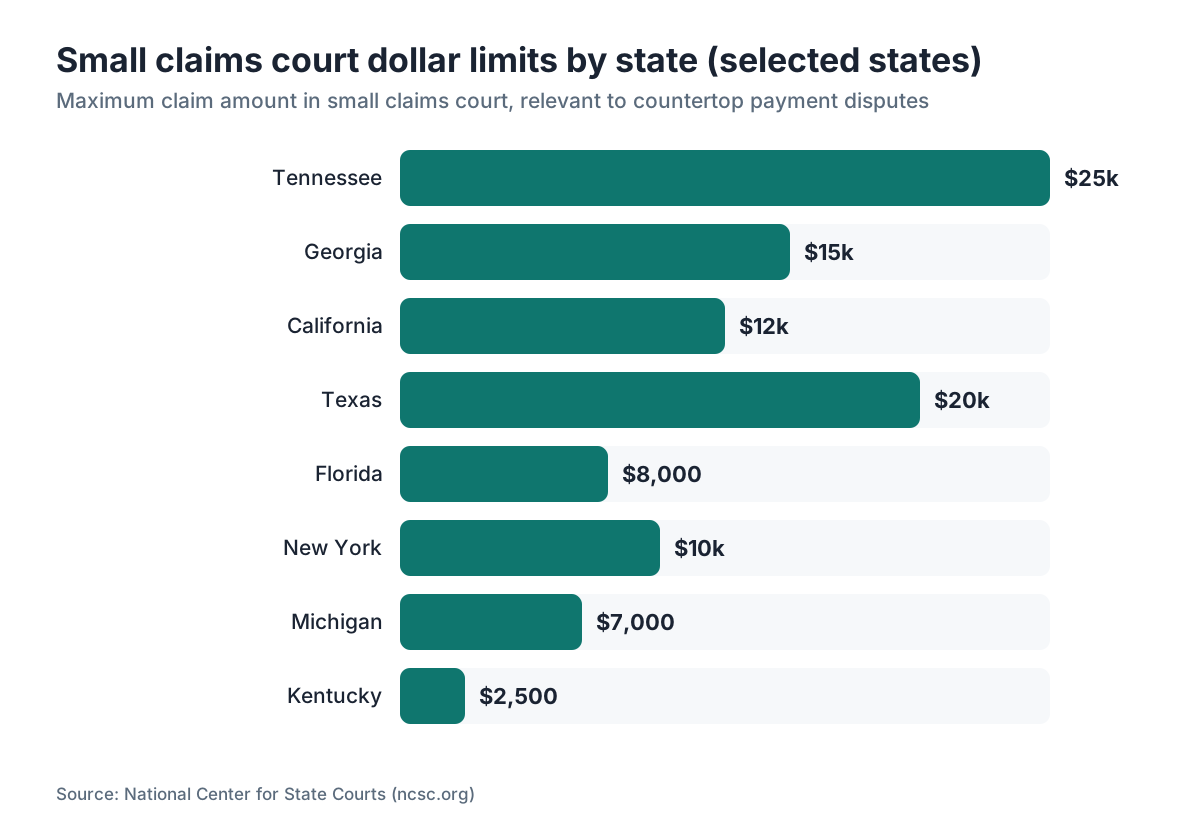
Small claims court handles most residential countertop disputes cleanly. The limit is $10,000 in many states, though it ranges from $2,500 (Kentucky) to $25,000 (Tennessee) [5]. You do not need a lawyer for small claims. Bring your contract, your photos, your invoice, and any texts or emails.
For larger balances, a collections attorney or a lien enforcement action may make sense. Contractors who document their work and collect signed completion forms rarely end up here, because the paper trail makes the customer's position very hard to defend.
How do fabricators handle final payment for commercial or GC jobs?
Commercial work and jobs where you are a subcontractor to a general contractor run on a different rhythm. GCs typically pay net-30 or net-45 after receiving a pay application from you, not on installation day. That is standard practice, but it creates cash flow exposure.
For commercial jobs, your contract with the GC or owner should include a schedule of values that ties each draw to a completion milestone. The final draw usually releases after the owner's punch list is signed off, which can take weeks or months. Retention (often 5-10% of the contract value withheld until substantial completion of the whole project) is common on commercial work.
Prompt payment laws in most states give subcontractors legal protection here. The federal Prompt Payment Act covers federally funded projects [6]. Most states have parallel statutes that require GCs to pass payment through to subs within a set number of days (often 7 to 10 days) after the GC gets paid by the owner. Knowing your state's prompt payment law matters if you do any volume of commercial or new-construction work.
For GC relationships, the preliminary notice (covered in the lien section above) is especially important. Always serve it, even on jobs with GCs you trust, because relationships change and the notice costs nothing.
What software and tools make job-site payment collection easier?
The biggest operational gap in most small shops is the disconnect between the quote, the invoice, and the payment. An installer shows up to a job with a paper invoice or nothing at all, and the homeowner writes a check that may or may not match what the fabricator expects to collect.
Mobile point-of-sale readers from Square or Stripe plug into a phone or tablet and accept chip cards, tap-to-pay, and manual entry. They print or email receipts on the spot. The cost runs roughly 2.6% plus $0.10 per in-person transaction for Square, which you can verify on their published pricing [7].
Fabrication-specific shop management software goes further by linking the approved quote, any change orders, and the final invoice into one document the installer can pull up on a tablet at the door. The customer sees exactly what they owe and why. Shops running software like SlabWise can generate a final invoice from the confirmed quote, with change orders already attached, so the installer is not improvising numbers on the driveway.
For homeowners who want to pay by bank transfer, a QR code on the invoice that links straight to a payment page removes friction. Many fabricators send the final invoice by text or email the day before installation, so the customer is not surprised by the amount and can have payment ready.
Should you offer financing for the final balance?
Some fabricators offer third-party financing through providers like GreenSky, Synchrony, or Hearth, which specialize in home improvement lending. The homeowner applies, gets approved, and the lender pays the fabricator directly, usually within one to two business days. You get paid in full at or before installation; the homeowner pays the lender on a monthly plan.
The tradeoff is a dealer fee. Financing providers typically charge the contractor 3-12% of the financed amount depending on the promotional APR the customer receives [8]. A 0% for 12 months promotion might cost you 8-10% of the transaction. On a $5,000 final balance, that is $400 to $500 out of your margin. Some shops pass part of the fee to the customer; others absorb it as a cost of closing more jobs.
Financing tends to lift average job size more than it costs in fees, because customers who can spread payments often pick better materials. Whether that math works for your shop depends on your margins and your customer base. It is not a fit for every operation.
If you do offer financing, mention it early in the sales conversation, not as a last-ditch rescue when the customer balks at the final number. Introducing financing at the point of installation feels transactional and can chip away at confidence in the job.
What does a good completion sign-off form include?
A completion sign-off form is a one-page document the customer signs at the end of the installation walkthrough. It does three things: confirms the work was done, documents any items outstanding, and gives you evidence that the customer accepted the job if a dispute comes up later.
The form should include the customer's name and address, the job number, the installation date, a short description of the work (material, color, square footage), a checkbox or line for "installation accepted as complete", a space to list any punch items with a scheduled resolution date, the final payment amount, and the customer's signature with date.
Punch items need a follow-up date attached. If you owe the customer a silicone touch-up or a backsplash piece not yet fabricated, write it down and give a specific date. That keeps an open-ended obligation from turning into an excuse to withhold payment forever.
Keep the form in your job file, physical or digital. If the customer later claims the installation was defective from day one, a signed completion form with no noted defects is strong evidence in your favor. Courts and arbitrators take contemporaneous signed documents seriously.
Are there rules about collecting payment in a customer's home?
Federal and state consumer protection rules apply to certain home solicitation sales, but a countertop installation where the customer came to your showroom or contacted you first generally does not fall under the FTC's three-day right-of-rescission rule, which covers unsolicited door-to-door sales [9]. If you solicited the customer at their home and signed them up there, the rescission right may apply to the deposit stage, not the final payment after the work is complete.
A few states have home improvement contractor laws with specific disclosure requirements. California's Home Improvement Contract law (Business and Professions Code Section 7159) requires written contracts for jobs over $500 and specifies what the contract must contain, including a payment schedule [10]. Similar statutes exist in New Jersey, Maryland, and Massachusetts, among others.
Collecting a final payment after completed work does not trigger most of these protections because the customer is paying for something they can see and have already accepted. The rules matter most at the deposit stage. Still, if you operate in a state with a home improvement contractor license requirement, staying inside your license conditions also keeps your payment collection legal and defensible.
Frequently asked questions
What is the typical deposit for countertop installation?
Most fabricators require a 50% deposit at contract signing, with the remaining 50% due on installation day. Some shops use a 40% deposit and 60% balance. A few states cap the maximum deposit by law; California limits it to $1,000 or 10% of the contract price, whichever is less. Deposits cover material costs since the slab is cut specifically for your job and cannot be returned.
Can a countertop fabricator put a lien on my house for non-payment?
Yes. Every U.S. state lets contractors and material suppliers file a mechanic's lien against real property when they are not paid for work that improved the property. A lien attaches to your title and must be resolved before you can refinance or sell. Fabricators who file a valid lien can eventually force a foreclosure sale if the debt stays unpaid, though that step is rare in residential disputes.
What happens if a customer writes a bad check for the final payment?
A bounced check means you left the job site without real payment. Most states have bad check laws that let you demand the face amount plus a penalty fee, typically $25-$35 or up to three times the check amount depending on the state, and to pursue criminal charges for knowingly issuing a bad check. Practically, send a written demand letter, then go to small claims court or file a lien if the customer does not make good within 10-14 days.
Should I charge a credit card fee to customers who pay by card?
You can in most states. The Supreme Court's 2017 ruling in Expressions Hair Design v. Schneiderman opened the door to surcharging, though individual state rules vary. If you surcharge, you must disclose it before the contract is signed, not at the point of payment. A common approach is to offer a small cash discount instead of a card surcharge, which frames the same economics more positively for the customer.
What should I do if the customer refuses to pay because they claim there is a defect?
Document everything before you leave: photos of the completed work, photos of the alleged defect, and a written statement from the customer about exactly what their objection is. If the defect is legitimate, fix it promptly and collect. If it looks pretextual, send a certified demand letter giving 10-14 days to pay, stating that you will file a mechanic's lien if not resolved. Avoid removing installed counters; that can expose you to property damage claims.
How do I collect payment when the homeowner is not home during installation?
Arrange payment before installation day. Options include charging a card on file automatically when the job is marked complete and sending a confirmation text, requiring a bank transfer the morning of installation, or asking the customer to mail or drop off a check before the crew arrives. Many fabricators text the final invoice the evening before installation so the customer has time to set up a transfer. Do not count on collecting from an absent homeowner after the fact.
Is a signed completion form legally binding?
A signed completion form is not a court judgment, but it is strong evidence in any dispute. It shows that at a specific date and time the customer accepted the work as complete, either without defects or with only listed punch items. Courts and arbitrators treat contemporaneous signed documents as highly credible. If a customer later claims the installation was defective from day one, a signed acceptance form with no noted defects makes that claim very hard to support.
How long do I have to file a mechanic's lien if a customer doesn't pay?
The deadline varies by state. Common windows run 60 to 90 days after the last day you furnished labor or materials, though some states give as few as 30 days and others up to 6 months. California gives direct contractors 90 days from project completion. Missing the deadline can wipe out your lien rights entirely, so track the date of your last day on site and calendar the lien deadline right after each installation.
Can I require cash-only payment for countertop installation?
Yes. No federal or state law requires contractors to accept credit cards or checks. You can specify cash, money order, or wire transfer only in your contract. Many customers prefer card or transfer for convenience and security, so a cash-only policy may cost you jobs. A practical middle ground is accepting cards but applying a disclosed surcharge that covers your processing fee, keeping your net revenue the same.
What is a retention clause in a commercial countertop contract?
Retention (or retainage) is a percentage of each payment, typically 5-10%, withheld by the project owner or general contractor until the whole project reaches substantial completion. It is common in commercial construction and new-home builds. As the countertop subcontractor, you may not receive your full retainage for months after your work is done. Prompt payment laws in most states require GCs to release retainage to subs within a set number of days after the owner releases it to them.
How do I handle final payment when the job has change orders?
Each change order should be signed by the customer when approved, with the added cost clearly stated. On installation day, the final invoice should show the original contract price plus each approved change order as a line item, totaling the amount due. Walk the customer through the invoice line by line if needed. Disputes about change order charges are much easier to resolve when the customer signed a paper at the time the change was approved.
What small claims court limit applies to countertop payment disputes?
Small claims limits vary by state. Common thresholds are $5,000 to $10,000, but they range from $2,500 in Kentucky to $25,000 in Tennessee. Most residential countertop final payment disputes fall inside the small claims range. You do not need a lawyer, and the process is faster and cheaper than circuit court. Bring your contract, signed completion form, photos, and all written communications. Courts favor the party with the paper trail.
Should countertop fabricators offer payment plans or financing?
Third-party financing through providers like GreenSky or Hearth pays you in full quickly while the homeowner repays the lender monthly. Dealer fees run 3-12% depending on the promo rate offered. On a $5,000 final balance, that is $150 to $600 out of margin. The upside is that customers on financing plans often choose higher-end materials, raising average job value. It works best introduced early in the sales process, not as a last resort at the invoice stage.
Does the FTC three-day cancellation rule affect collecting final payment at installation?
Generally no. The FTC's three-day right of rescission applies to contracts signed in the customer's home following an unsolicited sales call. A standard countertop job where the customer visited your showroom or contacted you first is typically not covered. Final payment collected after completed, accepted work is even further removed from this rule. If you do any door-to-door sales or home solicitations, consult a local attorney about your specific obligations.
Sources
- California Contractors State License Board, Home Improvement Contracts: California caps the initial deposit on home improvement contracts at $1,000 or 10% of the contract price, whichever is less
- Supreme Court of the United States, Expressions Hair Design v. Schneiderman, 581 U.S. 37 (2017): The Supreme Court's 2017 ruling struck down New York's credit card surcharge ban, opening the door to surcharge policies by merchants in most states
- Cornell Legal Information Institute, Mechanic's Lien: A mechanic's lien is a legal claim against real property by someone who supplied labor or materials that improved the property and was not paid
- California Civil Code, Preliminary Notice Requirements, Sections 8200-8216: In California, a subcontractor or material supplier must serve a preliminary notice within 20 days of first furnishing labor or materials to preserve lien rights
- National Center for State Courts, Small Claims Court Monetary Limits by State: Small claims court monetary limits range from $2,500 in Kentucky to $25,000 in Tennessee, with most states between $5,000 and $10,000
- U.S. Department of the Treasury, Prompt Payment Act (31 U.S.C. 3901-3907): The federal Prompt Payment Act requires timely payment on federally funded construction and service contracts and establishes interest penalties for late payment
- Square, Inc., Processing Fees: Square charges approximately 2.6% plus $0.10 per in-person card transaction as of its published pricing
- Hearth, Home Improvement Financing for Contractors: Home improvement financing providers charge contractors dealer fees of roughly 3-12% of the financed amount depending on the promotional APR offered to the consumer
- Federal Trade Commission, Buyer's Remorse: The FTC's Cooling-Off Rule: The FTC's cooling-off rule gives a three-day right to cancel certain sales made at the buyer's home following an unsolicited sales call
- California Business and Professions Code Section 7159, Home Improvement Contracts: California Business and Professions Code Section 7159 requires written contracts for home improvement jobs over $500 and specifies required contract contents including payment schedules
- American Arbitration Association, Construction Industry Dispute Resolution: Arbitration clauses in construction contracts allow disputes to be resolved outside of court under industry-specific rules, often faster and at lower cost than litigation
- National Association of the Remodeling Industry, Contractor Business Practices: Industry guidance recommends that contractors use signed change orders for every scope addition and include payment schedule language tied to specific project milestones
Last updated 2026-07-11