TL;DR
- Granite countertop edges range from simple eased cuts (often included in the base price) to ornate ogee and waterfall profiles that add $10 to $30 or more per linear foot.
- The profile you pick changes safety, cleaning effort, visual weight, and how much slab gets used.
- Most kitchens do fine with an eased or soft bullnose edge.
What are granite countertop edge profiles and why do they matter?
An edge profile is the shaped cross-section a fabricator cuts along the front and exposed sides of your countertop. Every granite slab comes out of the ground as a rough rectangle. The fabricator trims it to your template dimensions, then runs a CNC router or a handheld profiler along the visible edges to create the finished shape you see and touch every day.
The profile matters for three practical reasons. Sharp 90-degree corners chip. Granite is hard but brittle at thin edges, and a raw square cut will lose corners over time where people bump cabinets or drop pots. The edge also catches the eye more than most homeowners expect. A thick 3 cm slab with a dramatic ogee reads as heavy and formal; the same slab with a straight eased edge reads as light and modern. And some profiles trap crumbs and grease in their grooves. If you cook a lot and hate scrubbing, that matters.
Fabricators price edges by the linear foot of finished edge. Your kitchen has a specific number of linear feet of exposed edge: the front of the island, the perimeter in front of the base cabinets, and any peninsula returns. A realistic residential kitchen has 15 to 25 linear feet of exposed countertop edge [1]. At a $10 per foot upcharge, that adds $150 to $250 to your quote.
What are the most common granite edge profiles?
Here is a plain-English rundown of every profile you will actually meet at a stone shop. Fabricators use slightly different names in different regions, so treat these as the canonical terms with common variants noted.
Eased (straight, flat, square): The simplest cut. The slab face stays vertical and the top corner gets a tiny 1/16-inch break to remove the razor edge. This is the fastest machining operation, which is why it usually comes free in the base slab price. It reads as crisp and modern. The catch: a true square corner on 3 cm granite chips over years of kitchen use, so most fabricators add that small bevel automatically even when a customer asks for "square."
Beveled: A flat angled cut replaces the top corner, typically at 45 degrees. The bevel runs narrow (1/4 inch) or wide (up to 3/4 inch). It deflects impacts better than a square corner and adds a line of visual interest without thickening the profile. Upcharge usually runs $2 to $8 per linear foot depending on bevel width.
Bullnose (full bullnose): The whole edge is routed into a half-circle, so the side view looks like a capital D turned on its side. It is the softest, most rounded option available. Parents with young children often pick it because there is no corner to hit a head on. It is also the most commonly specified profile in American residential kitchens, per fabricator surveys [2]. Upcharge typically runs $5 to $12 per linear foot.
Half bullnose (demi bullnose): Only the top corner rounds; the bottom half of the edge stays vertical. The result looks like a capital P in profile. This is the profile the industry calls a "half bullnose" or "demi bullnose," and it is what most stone suppliers illustrate when they show granite countertop edge profiles in their catalogs. It gives some of the softness of a full bullnose while keeping the visual weight of a flat vertical face. Upcharge is similar to full bullnose, roughly $5 to $10 per linear foot.
Ogee: A classical S-curve profile borrowed from architecture and furniture. The top curves outward (convex), then inward (concave), before ending at a small flat or bullnose at the bottom. The ogee is the most ornate standard profile and looks best in traditional or transitional kitchens. It is also the hardest to keep clean, because the concave section collects crumbs and dried liquid. Upcharge runs $10 to $20 per linear foot or more [3].
Ogee bullnose: Combines the ogee S-curve on the upper portion with a rounded bullnose at the bottom instead of a flat or sharp edge. The result is a touch softer than a standard ogee. This profile shows up often in searches for "ogee ogee bullnose and half bullnose quartz countertop edge profiles" because quartz fabricators adopted it heavily in the 2010s, and granite shops offer it on request. Expect the same upcharge as ogee or slightly higher.
Dupont (DuPont): A stepped profile with a small flat shelf cut horizontally near the top of the edge, then a vertical drop to the bottom. It creates the look of a laminated or thicker top. Popular in traditional kitchens. Upcharge runs roughly $8 to $15 per linear foot.
Waterfall (mitered): Not a routed profile but a full mitered edge, where the slab material continues vertically down the cabinet side to the floor. It uses much more stone and labor. Upcharge can hit $40 to $80 or more per linear foot once you account for the extra material and the precision of the 45-degree miter joint [4].
Laminated edge: Two layers of stone glued together to fake an apparent thickness of 6 cm or more from 3 cm material. Cheaper than a true 6 cm slab and lighter on the structure, but the seam line shows if the stone has strong veining. Often paired with an eased or bullnose profile on top.
How much does each granite edge profile cost?
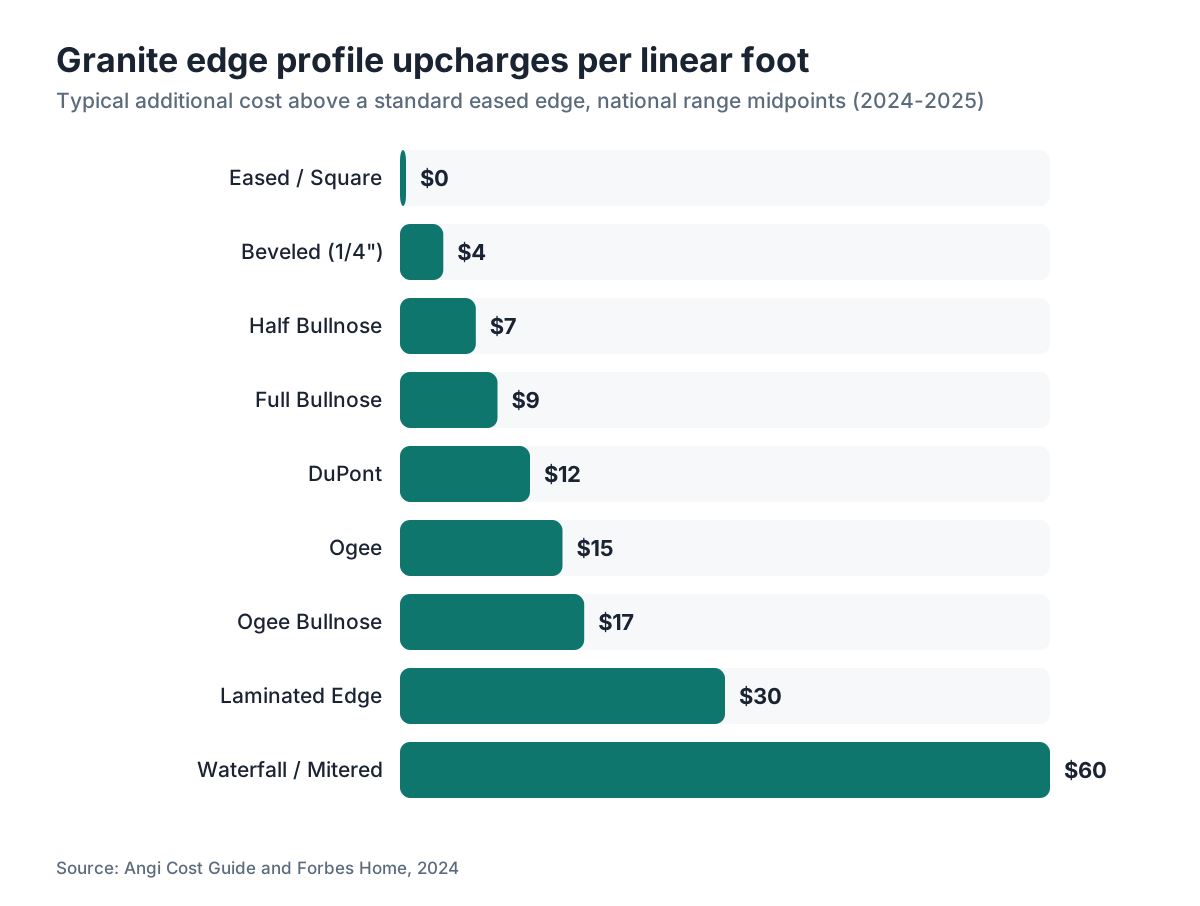
Prices vary by region, shop overhead, and how your fabricator structures the quote. The table below uses national ranges based on industry pricing data from 2024 to 2025 [3][5]. These are upcharges above the included standard edge, not total countertop costs.
| Edge Profile | Typical Upcharge per Linear Foot | Notes |
|---|---|---|
| Eased / Square | $0 | Usually included in base price |
| Beveled (1/4") | $2 - $6 | Wider bevels cost more |
| Half Bullnose | $5 - $10 | Very common in residential quotes |
| Full Bullnose | $5 - $12 | Most specified residential profile |
| Ogee | $10 - $20 | Requires skilled operator or CNC program |
| Ogee Bullnose | $12 - $22 | Combines two tool passes |
| DuPont | $8 - $15 | Stepped profile, moderate complexity |
| Waterfall / Mitered | $40 - $80+ | Includes extra material cost |
| Laminated Edge | $20 - $40 | Material plus labor for bonding |
A few things drive the high end. Natural stone has grain variation, and the harder sections of a granite slab wear router bits faster. A fabricator running an ogee on Absolute Black granite (one of the densest granites available) burns through tooling faster than on a softer stone, and that cost finds its way into pricing [9]. CNC shops often charge less per profile than hand-fabrication shops, because once the program is written, machine time stays consistent. Hand-polishing still takes skill at any price.
Want a realistic total? Multiply the linear footage of your exposed edges by the upcharge. For 20 linear feet of full bullnose at $8 per foot, that is $160. For an ogee on the same kitchen at $15 per foot, that is $300. Neither number breaks a budget, but it is real money and worth knowing before you commit.
Which edge profile is best for a kitchen countertop?
There is no single right answer, but there is a practical hierarchy based on how you use the kitchen.
For most kitchens, a soft bullnose or half bullnose is the best all-around pick. It cleans easily, stays safe for kids, chips less readily than a square corner, and reads well with both traditional and contemporary cabinets. That is why it leads residential granite installations in North America [2].
Got a modern or minimalist kitchen with flat-front cabinets and little ornamentation? The eased edge looks sharper and more intentional there. Thick ogee molding in a sleek kitchen reads as a mismatch. Flip it around: if your cabinets have raised-panel doors and crown molding, a plain eased edge can look unfinished next to all that detail. An ogee or DuPont edge carries visual weight that matches.
Here is my honest take. The ogee is beautiful in catalogs and in large, well-lit traditional kitchens. In an average 10x10 kitchen it gets lost, and the groove is annoying to keep clean. The eased edge ages well. The half bullnose is what I would put in my own house.
For islands with seating overhangs, the profile also changes comfort. A sharp beveled or square edge presses into forearms when people lean in. A bullnose or half bullnose feels noticeably better at a bar-height or counter-height seat.
Does the edge profile affect how granite chips or holds up over time?
Yes, and more than most homeowners expect. Granite ranks 6 to 7 on the Mohs hardness scale, which makes it harder than most metals but not immune to impact fractures [6]. A thin 90-degree corner concentrates stress at a single point. When a heavy cast-iron pan clips that corner, the crystal structure at the apex has nowhere to flex, so a small chip breaks away.
A bullnose or half bullnose spreads impact across the curve. There is more material and no single stress point. Fabricators who have been in the trade for years will tell you square or minimally-eased edges come back for repair more often than rounded ones. The flip side: repairing a chipped bullnose is easier, because the curve shape hides small epoxy fills.
Ogee profiles carry a different weakness. The concave section of the S-curve is a natural stress riser, and a direct hit at that groove can start a crack that runs through the profile. Rare, but not unheard of on heavily used countertops.
Thickness matters too. A 2 cm slab (3/4 inch) is more vulnerable at the edge than a 3 cm slab (1-3/16 inch), regardless of profile. Most residential granite now ships in 3 cm, but if you are working with a 2 cm remnant or a thinner slab, a laminated or built-up edge adds protection along with visual substance [1].
What edge profiles work best on thick granite slabs versus thin?
Standard residential granite comes in two thicknesses: 2 cm and 3 cm. Some fabricators offer 4 cm or even 6 cm slabs for commercial or luxury work, but those are rare.
On 3 cm granite, every profile in the table above works. The stone has enough depth for a full ogee, a DuPont step, or a thick laminate without looking off.
On 2 cm granite, ornate profiles look undersized. An ogee that fills most of the edge height on 3 cm shrinks to a tiny squiggle on 2 cm that most people cannot even identify. The practical choices narrow to eased, beveled, or half bullnose. If you want visual thickness from 2 cm material, a laminated edge beats forcing an elaborate profile into a thin substrate.
For waterfall edges, thickness barely touches the look, because the stone runs floor to ceiling either way. What matters is the precision of the miter cut and whether the stone's veining matches across the joint. Mismatched veining at a waterfall seam is the most common complaint fabricators hear after a job wraps. Ask how the fabricator handles vein matching before you commit to this profile.
Can you change a granite edge profile after installation?
Technically yes, practically rarely. A fabricator can re-profile a countertop edge in place with handheld diamond tooling and a wet polisher. This works best going from a more complex profile to a simpler one, say an ogee back to a bullnose, because you are removing material rather than adding it.
Going the other direction is harder. To upgrade a plain eased edge to an ogee, the fabricator has to cut stone off the front face to carve the S-curve, which trims the visible depth of the countertop slightly. On a 3 cm slab there is room for that. On 2 cm you may not have it.
The bigger issue is logistics. In-place edge work throws a lot of slurry and vibration. The stone is already glued and screwed to the substrate, nearby walls get wet, and there is real risk of cracking the slab if the surface shifts. Most fabricators charge nearly as much for an in-place re-profile as for new fabrication, because the job runs harder and slower. If you are unhappy with an edge and still within the first week of installation, raise it with the fabricator before the job fully cures and settles.
The practical answer: pick your edge once and pick it carefully. Use a physical sample at your countertop height in your actual kitchen light, not a photo on a phone.
How does the edge profile interact with countertop thickness and seam placement?
Seam placement usually follows slab size and layout, but the edge profile adds an aesthetic constraint fabricators weigh when they position seams.
A full ogee or DuPont profile has distinct horizontal features (the S-curve peaks, the step shelf). If a seam lands at the edge, those features have to line up perfectly across the joint. Even a 1/32-inch mismatch shows. So fabricators prefer to end a complex profile at a corner or return rather than running a seam through it mid-run.
A simple eased or bullnose profile forgives a seam more easily, because there are no horizontal features to align. The seam still has to be tight and color-matched, but the geometry does not compound the challenge.
If your layout forces an edge seam in a prominent spot, like the front of a long island, that is a real argument for a simpler profile. Save the ogee for sections with no seams.
This is also the kind of thing quoting software handles automatically when fabricators lay slabs against templates. Tools like SlabWise flag where seams fall relative to edge profiles during the nesting step, which catches these conflicts before the stone gets cut instead of after [7].
What is a half bullnose edge and how is it different from a full bullnose?
The half bullnose (also called demi bullnose) is one of the most searched edge profiles and one of the most confused. Here is the clearest way to see it.
Look at your countertop edge from the side. A full bullnose takes the entire visible edge and rounds it into a half-circle. Top corner curves, middle curves, bottom corner curves. The profile looks like a capital D.
A half bullnose rounds only the top corner. The curve starts at the top surface and sweeps down to a midpoint, then the lower half of the edge stays as a flat vertical face. In profile it looks like a capital P.
The practical differences. The half bullnose cleans a bit easier, because the lower flat section does not wrap under and catch debris. It reads more contemporary than a full bullnose, since the flat face throws a defined shadow line. And it shows off slab thickness better, because you see the full vertical face below the curve.
When fabricators write "half bullnose granite countertop edge profile" on a spec sheet, this is the profile they mean. The term is interchangeable with demi bullnose at most shops.
Cost-wise there is almost no gap between half and full bullnose. Both take a single router pass and polish. If a shop quotes you a lot more for one over the other, ask why.
What is an ogee edge and is it still popular?
The ogee is a classical profile with roots in Greek and Roman architectural molding. The word comes from the Old French "ogive," and the profile is an S-curve: convex on top, concave in the middle, then a flat or rounded end at the bottom.
In countertops, the ogee had a strong run in American kitchens from roughly the mid-1990s through the early 2010s. It was shorthand for granite as a luxury material and showed up in nearly every traditional or Tuscan-style remodel of that era. Design trends shifted toward cleaner lines around 2012 to 2015, and the ogee lost ground to simpler profiles in contemporary kitchens.
It is not gone. It stays the right choice for kitchens with traditional cabinetry and detailed millwork. An ogee or ogee bullnose edge on a dark granite island in a formal kitchen with raised-panel cabinets still looks exactly right. Trying to "modernize" a traditional kitchen with an eased edge on elaborate custom cabinets often reads cheaper, not cleaner.
The ogee bullnose variant (S-curve above, rounded bullnose below) softens the profile a touch and works across more styles. Many quartz fabricators leaned on it hard, which is part of why searches for "ogee ogee bullnose and half bullnose quartz countertop edge profiles" run high. The profile behaves the same way on granite.
Maintenance is the honest tradeoff. The concave groove in any ogee catches crumbs, dried grease, and cleaning residue. You need a small brush or a pointed cloth to get into it. For some homeowners that is a dealbreaker. For others the look earns it. Be honest with yourself about how you cook.
How do I talk to a fabricator about edge profiles and get an accurate quote?
Start by asking for a physical edge sample board, not photos. Every competent stone shop has a sample stick showing every profile it offers, often cut from black granite so the geometry reads easily. Take that stick to your kitchen, hold it at counter height, and look at it in your actual light. Profiles that look dramatic under shop fluorescents often vanish in a bright daylight kitchen, and vice versa.
Ask the fabricator to quote the edge as a per-linear-foot upcharge, separate from the slab and fabrication cost. That makes it easy to compare shops and to see what you are paying for. A bundled number that folds the edge in is harder to judge.
Give them your linear footage estimate. Measure the exposed front edges of all your countertops plus any peninsula or island returns. For a rough check, the Kitchen Cabinet Manufacturers Association publishes standard kitchen layout dimensions that help you estimate [8].
Ask one direct question: is the standard eased edge included in the base price, or does every profile carry an upcharge? Some shops fold eased and bullnose into the base price; others charge for anything above a raw square cut.
Using a digital quoting tool to get a preliminary number before you call shops? Services like the SlabWise instant quote tool let you pick edge profiles as a line item, so you see the cost breakdown before you walk into a showroom. That gives you a reasonable anchor for the conversation.
Finally, ask to see the shop's finished work on the profile you want, either in person or in real project photos, not stock images. An ogee cut in a hurry looks sloppy. Polishing quality on a bullnose varies. A shop confident in its work shows you examples without hesitation. One more thing worth knowing: profiling is dry-cut in some shops, which raises silica dust. OSHA regulates that exposure under 29 CFR 1910.1053, and a shop that wet-cuts and controls dust tends to run a cleaner, more careful operation overall [10].
What edge profile should I use on a bathroom vanity versus a kitchen?
Bathroom vanities carry a few specific constraints that shift the edge decision.
Vanity tops are usually narrower (18 to 22 inches versus 25 or more for kitchen counters) and take less heavy impact. Chips from cast-iron pans are not a concern. So the durability argument for a heavily rounded edge matters less in a bathroom.
Bathroom granite often sits at face height in mirrors and under lighting that plays up the edge profile more than a kitchen counter does. An ornate ogee on a 3 cm vanity top in a traditional bathroom can look very intentional and polished.
Vanity tops often carry a backsplash in the same stone. The edge profile should stay consistent across the top and the backsplash edge. Mismatched profiles on a vanity top and its side returns look like an afterthought.
For contemporary bathrooms, an eased or minimal bevel on a floating vanity reads clean and deliberate. For traditional bathrooms with furniture-style vanity bases, a half bullnose or ogee adds the visual weight that matches the cabinetry.
One practical note. Vessel sink installations often use flat 3/4-inch or 1-inch thick granite deck slabs. On that thickness, avoid complex profiles. An eased edge or a very small bevel is proportionally correct; anything more elaborate looks like it is fighting the thin slab.
Frequently asked questions
What is the most popular granite countertop edge profile in the US?
The bullnose (full or half) is consistently the most specified profile in American residential granite installations. It is safe for families, cleans easily, holds up to chipping better than square corners, and works with both traditional and contemporary kitchens. Most fabricators fold it or a standard eased edge into their base price, so it costs little or nothing beyond the slab.
How much does an ogee edge add to a granite countertop quote?
An ogee profile typically adds $10 to $20 per linear foot above a standard eased edge. On a kitchen with 20 linear feet of exposed edge, that is $200 to $400 in extra fabrication cost. Some high-end shops or very hard granites push the price higher because of tool wear. Always get the upcharge as a separate line item so you can compare quotes accurately.
Can I get a different edge profile on the island versus the perimeter counters?
Yes, and fabricators do this regularly. A common combination puts an ogee or DuPont profile on the island (where it gets the most attention) and a simpler eased or half bullnose on the perimeter. Just make the choice look intentional rather than inconsistent. Two profiles that are close but not the same (say, a full bullnose and a half bullnose) can look like a mistake rather than a design choice.
What is the difference between an eased edge and a bevel edge on granite?
An eased edge removes the sharp 90-degree corner with a tiny flat break, leaving the face of the edge essentially vertical. A bevel replaces the corner with a larger flat angled cut, typically 45 degrees, that is visually distinct. The bevel runs 1/4 inch to 3/4 inch wide. An eased edge is cleaner and more modern; a bevel adds a decorative line and deflects impacts slightly better than a true square corner.
Does the edge profile affect how easy granite is to clean?
Yes. Flat profiles like eased and beveled edges clean easiest, because a cloth wipes straight across them. A bullnose needs a slight wrap of the cloth around the curve. Ogee profiles have a concave groove that collects crumbs and dried liquid; you need a brush or a pointed cloth to clean them properly. If you cook often and hate detail cleaning, stick to eased, beveled, or half bullnose edges.
What does a waterfall edge cost on a granite island?
A waterfall edge, where the granite runs vertically down the cabinet side to the floor, typically adds $40 to $80 or more per linear foot because it needs extra stone, a precision 45-degree miter cut, and careful vein matching across the joint. On a 4-foot island side, that is $160 to $320 per waterfall panel, plus the extra stone material cost. Vein mismatches at the miter are the most common complaint.
Is a half bullnose the same as a demi bullnose?
Yes. Half bullnose and demi bullnose are the same profile: the top corner rounds into a curve, and the lower half of the edge stays a flat vertical face. Some shops use one term, some use the other, and a few use both. If you ask for one and a fabricator looks confused, describe it as a P-shape in cross-section: rounded on top, flat on the bottom half.
Does the edge profile change how thick my granite countertop looks?
Profiles change perceived thickness a lot. A full bullnose wraps the entire edge and makes the stone look thinner, because the curve hides the slab depth. A half bullnose or eased edge shows the full vertical face, so a 3 cm slab looks its actual 1-3/16 inch thickness. A DuPont or laminated edge fakes extra thickness. If you want the counter to look substantial, skip the full bullnose.
Can I get an ogee edge on a 2 cm granite slab?
You can, but it will look proportionally small and may not read as an ogee from a normal viewing distance. An ogee designed for 3 cm stone, roughly 1-3/16 inches, needs that height to show the full S-curve with clear peaks and troughs. On a 2 cm (3/4 inch) slab the geometry gets compressed. Most fabricators will steer you to a half bullnose or eased edge on 2 cm, and a laminated edge if you want more visual substance.
Do edge profiles look the same on granite and quartz?
The geometry is identical, because the same CNC programs cut both materials. What differs is the finished surface. Granite has natural crystal variation and slight surface texture that catches light differently in curved profiles. Quartz has a more uniform surface that shows the geometry cleanly. Some homeowners find the ogee looks more natural on granite; others prefer quartz for the consistency. The upcharge ranges run similar for both.
How do I find granite countertop edge profiles images to show my fabricator?
Most fabricators keep a physical sample board in the shop, which beats any image. For digital reference, stone suppliers like MSI and Cambria publish edge profile diagrams on their websites showing cross-section views of each profile. Houzz and Pinterest hold large libraries of real kitchen photos tagged by edge type. For quartz-specific references, searching 'ogee ogee bullnose and half bullnose quartz countertop edge profiles' pulls up detailed comparison images from major slab brands.
What edge profile is safest for homes with young children?
A full bullnose is the safest option, because there are no corners or sharp edges anywhere on the profile. The curve runs continuous from top to bottom. A half bullnose is nearly as safe, since the one corner (where the flat bottom face meets the underside of the overhang) sits out of reach for small children. Square, beveled, and ogee profiles all have corners or ridges that carry more risk.
Will my choice of granite edge profile affect resale value?
No credible data ties a specific edge profile to measurable resale value. What matters for resale is the stone quality, overall condition, and how the kitchen reads as a whole. A dated ogee in a contemporary remodel might look off to buyers, but a chip or stain on any profile would be a bigger concern. Pick the edge that looks right in your kitchen and maintain it well.
Sources
- National Kitchen and Bath Association, Kitchen Design Guidelines: Typical residential kitchen countertop perimeters and standard slab thickness conventions (2 cm and 3 cm) are referenced in NKBA design guidelines used across the fabrication industry.
- Natural Stone Institute (formerly Marble Institute of America), Fabrication and Installation Guidelines: Bullnose and half bullnose profiles are among the most commonly specified residential edge profiles in North American fabrication surveys cited by the Natural Stone Institute.
- Angi, Granite Countertop Cost Guide 2024: Edge profile upcharges ranging from $0 for eased edges to $20+ per linear foot for ornate ogee profiles are consistent with aggregated contractor pricing data published by Angi.
- Bob Vila, Waterfall Countertop Cost Guide: Waterfall countertop edge installations can cost $40 to $80 or more per linear foot including additional stone material and miter labor.
- Forbes Home, Granite Countertop Cost 2024: National average upcharge ranges for granite edge profiles including bullnose, ogee, and DuPont profiles as reported in Forbes Home contractor surveys.
- United States Geological Survey, Mohs Hardness Scale: Granite ranks 6 to 7 on the Mohs hardness scale, making it harder than most metals but susceptible to impact fractures at thin cross-sections.
- SlabWise, Countertop Fabrication Quoting and Nesting Software: Fabrication quoting software can flag seam-to-edge-profile conflicts during slab nesting before cutting begins.
- Kitchen Cabinet Manufacturers Association, Industry Standards: Standard kitchen cabinet and countertop layout dimensions published by KCMA are used to estimate linear footage of exposed countertop edges.
- Natural Stone Institute, Technical Bulletins on Stone Fabrication: Dense granites such as Absolute Black cause accelerated diamond tooling wear during edge profiling, which affects fabricator pricing.
- Occupational Safety and Health Administration, Crystalline Silica Standard (29 CFR 1910.1053): OSHA regulates silica dust exposure during dry stone fabrication including edge profiling operations, requiring wet cutting or engineering controls.
Last updated 2026-07-09