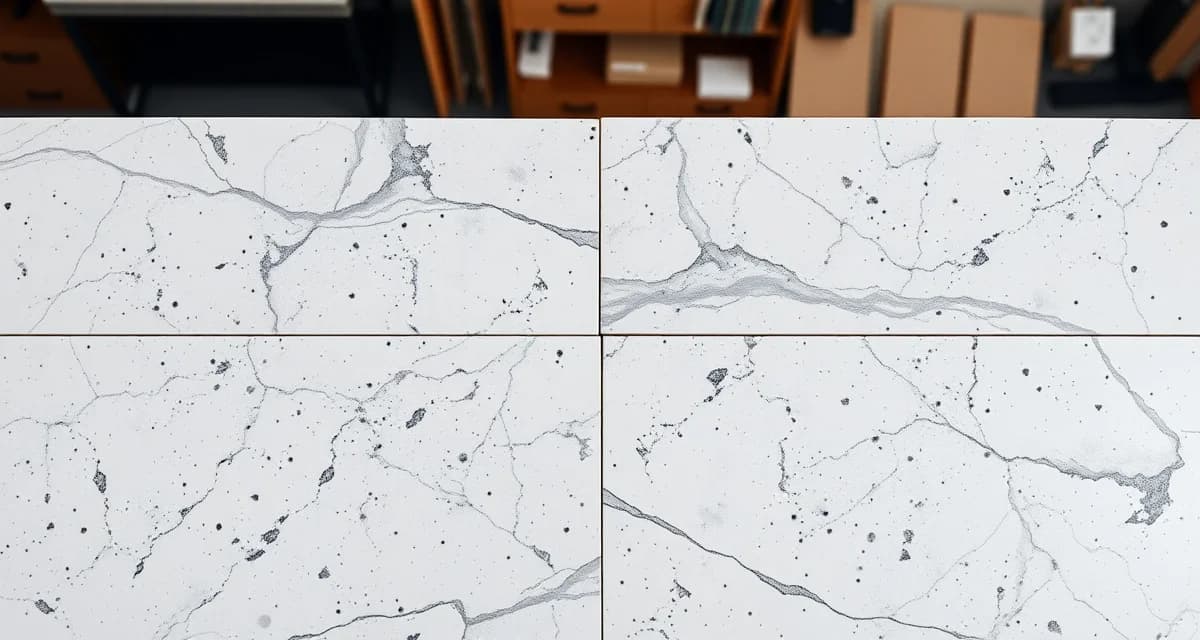
Seam Placement Strategy
Seam placement is the decision of where to join separate countertop pieces. Every countertop longer than roughly 110 inches (the typical maximum transportable piece length) requires at least one seam. Where you place that seam affects the countertop's structural integrity, visual appearance, fabrication efficiency, and installation difficulty. A well-placed seam is nearly invisible. A poorly placed seam is the first thing everyone notices.
TL;DR
- Seams are necessary when countertops exceed maximum piece length (typically 108-120 inches)
- The best seam locations are at natural transition points: behind sinks, at inside corners, and at the junction of different counter sections
- Never place seams over dishwashers, unsupported spans, or within 4 inches of a cutout
- Seam visibility depends on material type - solid colors hide seams well; veined materials require vein matching
- Standard seam gap is 1/16 inch or less, filled with color-matched epoxy
- AI nesting software places seam pieces adjacent on the slab for optimal vein matching
- SlabWise accounts for seam placement during both nesting and template verification
When Seams Are Required
Size Limitations
Countertop pieces are limited in size by:
Calculate your material waste savings
See exactly how much slab material and money you could save with optimized cutting layouts.
Try the free Waste Calculator- Slab dimensions: Most slabs are 120" x 60-65". Pieces can't exceed slab size.
- Transport: Pieces over 108-120 inches long are difficult to transport without breaking.
- Doorway access: Pieces must fit through doorways and hallways. Standard interior door is 32-36 inches wide.
- Weight: Large pieces become dangerously heavy for installation crews.
Common Seam Requirements by Layout
| Kitchen Layout | Typical Seams | Where |
|---|---|---|
| Galley (straight run under 110") | 0 | None needed |
| Galley (straight run over 110") | 1 | At midpoint or behind sink |
| L-shaped | 1 | At the inside corner |
| L-shaped with long runs | 2 | Corner + midpoint of longer run |
| U-shaped | 2-3 | At both inside corners + midpoint if needed |
| Island (under 110") | 0 | None needed |
| Island (over 110") | 1 | At midpoint |
| Island with waterfall | 1-2 | Horizontal/vertical joint + midpoint if needed |
Seam Placement Rules
Rule 1: Place Seams at Natural Transition Points
The best seam locations are where the counter changes direction, function, or visibility:
Behind the sink: The faucet and sink hardware draw the eye, making a nearby seam less noticeable. The seam should be 6-12 inches from the sink cutout edge (not directly at the cutout).
At inside corners: L-shaped and U-shaped counters naturally seam at inside corners. The corner itself disguises the seam, and the two pieces are independently supported by the cabinets on each wall.
At section transitions: Where the counter changes from a work surface to a bar top, or from one material to another.
Rule 2: Never Place Seams in These Locations
Over a dishwasher: The steam and heat from a dishwasher concentrates on the seam, potentially weakening the epoxy over time and causing discoloration.
Over an unsupported span: Seams need solid cabinet support underneath. A seam over a gap (like between two cabinet boxes) will flex and eventually crack the epoxy.
Within 4 inches of a cutout: A seam too close to a sink or cooktop cutout creates a narrow, fragile section of stone that's prone to cracking during installation or use.
At the front edge of a high-traffic area: Seams at the front counter edge in prep zones or eating areas receive daily contact and are the most visible.
In the middle of a visible straight run: A seam in the middle of a long, unbroken countertop run is the most noticeable placement. Push seams toward less visible areas when possible.
Rule 3: Ensure Structural Support
Every seam must have:
- Cabinet support on both sides (at least 4 inches of cabinet under each piece at the seam)
- Minimum piece width of 6 inches at the seam (no narrow slivers)
- Reinforcement for overhangs if the seam is near an unsupported overhang
Rule 4: Consider the Material
Material affects seam visibility:
| Material Type | Seam Visibility | Matching Difficulty |
|---|---|---|
| Solid-color quartz | Very low | Easy (no pattern to match) |
| Granular granite | Low | Easy (random pattern) |
| Subtle-pattern quartz | Low-moderate | Moderate (directional pattern) |
| Veined quartz | Moderate | Moderate (manufactured veins) |
| Marble | Moderate-high | High (natural vein matching required) |
| Quartzite | Moderate-high | High (natural vein matching required) |
| Bookmatched material | High | Very high (mirror pattern at seam) |
For veined materials, seam placement must account for vein matching. Position seam pieces adjacent on the slab so the pattern flows continuously across the joint.
Seam Types
Butt Seam (Standard)
Two straight edges joined together. The most common seam type for countertops.
Characteristics:
- Straight cut on both pieces
- 1/16 inch or less gap filled with color-matched epoxy
- Works for all materials and locations
- Simplest to fabricate and install
Miter Seam
Two pieces cut at 45 degrees and joined to create the appearance of a single thick piece. Used primarily for waterfall edges.
Characteristics:
- Both pieces cut at 45-degree angle
- Creates a continuous appearance at 90-degree turns (waterfall to horizontal)
- More fabrication time and higher skill requirement
- Material cost increases due to the angled cut
Laminated Seam
Two thin pieces bonded together to create the appearance of a thicker slab. Used for thick edge details.
Characteristics:
- Vertical bond between two horizontal pieces
- Creates a doubled-thickness look at the front edge
- Common for 6cm and thicker edge appearances from 3cm material
Seam Execution Best Practices
Fabrication
- Cut seam edges on the CNC for perfectly straight joints
- Polish seam edges to the same level as visible edges (for light-colored materials where the seam line is visible from above)
- Dry-fit seam pieces in the shop before loading for installation
- Label seam pieces with orientation marks (arrows showing which edges join)
Installation
- Dry-fit on-site before applying adhesive
- Apply color-matched epoxy to both seam faces
- Use seam setters (clamps) to pull pieces together tightly
- Scrape excess epoxy before it cures
- Allow full cure time before removing clamps (typically 30-60 minutes)
- Grind and polish the seam surface flush once cured
Quality Standards
| Metric | Acceptable | Good | Excellent |
|---|---|---|---|
| Seam gap | Under 1/16 inch | Under 1/32 inch | Hairline |
| Height difference (lip) | Under 1/32 inch | Under 1/64 inch | None detectable |
| Epoxy color match | Close match | Near-perfect | Invisible |
| Vein continuity (natural stone) | Acceptable transition | Good flow | Near-continuous |
Customer Communication About Seams
Setting Expectations
Discuss seams before fabrication:
- Show the customer the planned seam location on a drawing
- Explain why the seam is necessary (piece size, transport, structural)
- Show examples of completed seams on similar materials
- Be honest: "The seam will be visible up close but barely noticeable at normal viewing distance"
Common Customer Concerns
"Can you make the countertop with no seams?" Only if the counter is under 108-110 inches in total length and fits through all doorways. Explain the size limitations honestly.
"Will I be able to see the seam?" "On solid-color quartz, seams are very difficult to see. On veined materials like marble, we match the veins across the seam to minimize visibility, but some transition will be noticeable up close."
"Can you put the seam somewhere I won't notice?" "We place seams at the least visible location that's also structurally sound. The most common location is at an inside corner or behind the sink area."
Where is the best place for a seam on an L-shaped counter?
At the inside corner. This is the standard location because: the corner is a natural transition point, both pieces are independently supported by the cabinets on each wall, and the corner geometry disguises the seam line.
How visible are seams on quartz countertops?
On solid-color quartz, seams are nearly invisible - the color-matched epoxy blends with the surface. On veined quartz patterns, seams are more visible where the manufactured vein pattern changes at the joint.
Can seams crack or separate over time?
A properly fabricated and installed seam should last the life of the countertop. Seam failures occur when: the seam is over an unsupported area (flexing), the epoxy was mixed incorrectly, or the pieces were not properly joined during installation. All are preventable with proper technique.
How do I match veins at a seam?
Cut seam pieces from adjacent areas of the same slab so the vein pattern flows continuously. AI nesting software positions seam pieces adjacent on the slab and optimizes for vein continuity at the joint line.
Is a miter seam stronger than a butt seam?
A miter seam has a larger bonding surface (the full thickness of the slab at 45 degrees), so it's technically stronger. However, butt seams are adequate for all standard countertop applications. Miter seams are primarily used for appearance (waterfall edges) rather than strength.
Can seams be repaired if they crack?
Yes. The old epoxy is removed, the seam edges are cleaned, and fresh epoxy is applied. If the crack is caused by structural movement (unsupported span), the underlying issue must be fixed first, or the repair will fail again.
How far should a seam be from a sink cutout?
Minimum 4 inches from the edge of any cutout. Closer than 4 inches creates a narrow section that's structurally weak and prone to cracking. Standard practice is 6-12 inches from the nearest cutout edge.
Do seams affect resale value?
No, if properly executed. A well-made seam on a quality countertop doesn't affect home resale value. Visible or poorly made seams on a prominent surface could be a negotiation point during a sale.
How does AI help with seam placement?
AI nesting software ensures seam pieces are cut from adjacent areas of the slab for vein continuity. AI template verification flags seam locations that violate structural rules (too close to cutouts, over unsupported spans). This catches placement issues before fabrication.
Optimize Every Seam
SlabWise places seam pieces adjacent on the slab for optimal vein matching and verifies that seam locations meet structural requirements - automatically during nesting and template verification.
Start Your 14-Day Free Trial - seam optimization included with every plan.
Try These Free Tools
- Nesting Optimizer -- AI-powered slab layout that maximizes yield considering vein direction and defects.
- Defect Mapping -- Upload a slab photo and AI maps every fissure, pit, and color issue.
- Value Engineering -- Find dollar-quantified suggestions to save material without cutting margin.
Sources & Further Reading
-
International Surface Fabricators Association - Digital Fabrication and CAD/CAM Best Practices
-
Natural Stone Institute - Stone Fabrication Technology and Optimization
-
Marble Institute of America - Template and Layout Efficiency Guidelines
-
National Kitchen & Bath Association - Countertop Installation and Fabrication Standards