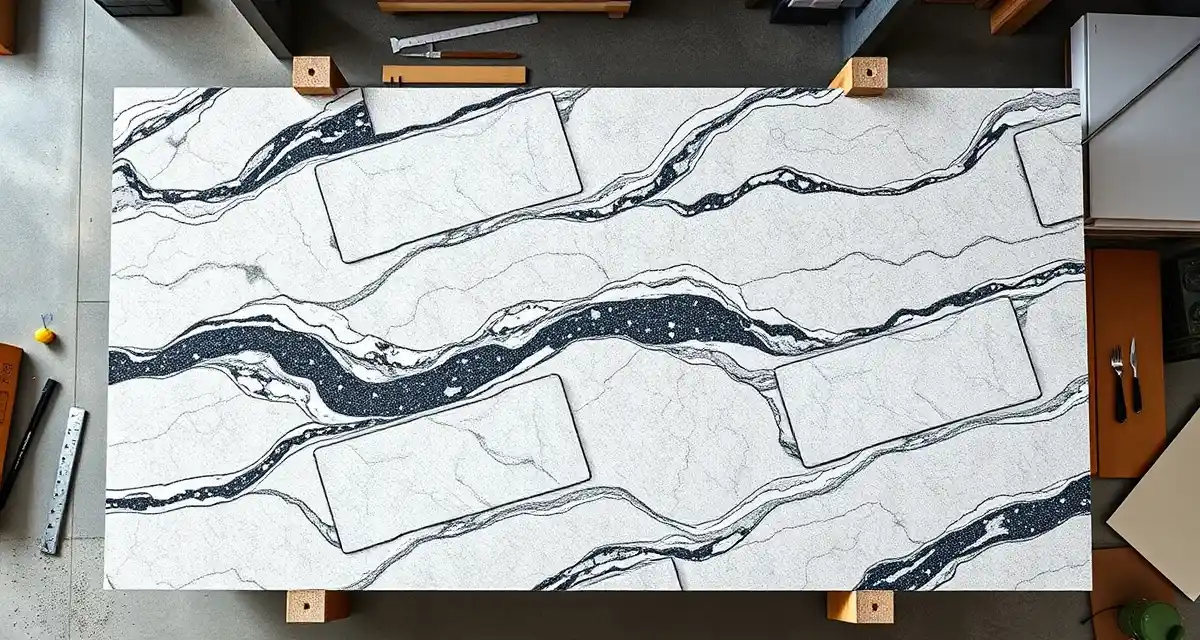
Complete Guide to Slab Nesting Optimization
Slab nesting optimization is the process of arranging countertop pieces on a stone slab to maximize material usage and minimize waste. A well-nested slab produces 85-92% usable material. A poorly nested slab wastes 25-30% - on a $3,000 slab, that's $750-900 thrown in the dumpster.
TL;DR
- Slab nesting determines how much of each slab becomes countertop vs. waste
- Manual nesting typically achieves 70-80% yield; optimized nesting reaches 85-92%
- The key variables are piece arrangement, grain direction, blade kerf, and remnant planning
- Cross-job batching (combining pieces from multiple jobs on one slab) produces the highest yields
- Even small yield improvements compound into significant annual savings
- A 10% yield improvement on 30 slabs/month saves $9,000-18,000 per year
- SlabWise includes AI nesting that optimizes placement automatically
Understanding Slab Yield
What Yield Means
Slab yield is the percentage of a slab that becomes installed countertop material:
Calculate your material waste savings
See exactly how much slab material and money you could save with optimized cutting layouts.
Try the free Waste CalculatorYield = (Total area of usable pieces / Total slab area) x 100
Example: A slab measures 120" x 65" = 7,800 sq inches (54.2 sq ft). You cut 45 sq ft of usable countertop pieces.
Yield = 45 / 54.2 = 83%
The remaining 17% (9.2 sq ft) is a combination of:
- Blade kerf (material removed by the saw)
- Edge clearances (minimum distance from slab edge)
- Between-piece clearances
- Unusable remnants (too small or wrong shape for future use)
- Areas avoided (defects, chips, edge damage)
Industry Yield Benchmarks
| Nesting Method | Typical Yield | Best Case |
|---|---|---|
| No planning (cut as they come) | 60-70% | 75% |
| Manual nesting (experienced operator) | 70-80% | 85% |
| Software nesting (basic algorithm) | 78-85% | 88% |
| AI nesting (advanced optimization) | 85-92% | 95% |
| AI nesting + cross-job batching | 88-95% | 97% |
The Financial Impact of Yield
For a shop using 30 slabs per month at an average cost of $3,000 per slab:
| Yield Improvement | Monthly Material Saved | Annual Savings |
|---|---|---|
| 5% improvement | $4,500 | $54,000 |
| 10% improvement | $9,000 | $108,000 |
| 15% improvement | $13,500 | $162,000 |
These numbers make nesting optimization one of the highest-ROI improvements a fab shop can make.
Factors That Affect Nesting Efficiency
1. Piece Geometry
Simple rectangular pieces nest efficiently. Complex shapes (L-cuts, curves, angular counters) create more waste because they interlock poorly.
Rectangular kitchen run (98" x 25.5"): Easy to nest - stacks and fits predictably.
L-shaped counter with diagonal cut: Harder to nest - the angle creates triangular waste areas that are difficult to fill with other pieces.
Island with curved breakfast bar: Hardest to nest - curves create irregular waste zones around the piece.
2. Grain and Vein Direction
Material type dictates how freely pieces can be rotated:
| Material | Rotation Freedom | Impact on Yield |
|---|---|---|
| Solid-color quartz | Any direction | Maximum yield possible |
| Granular granite | 0/90/180/270 degrees | Minor yield reduction |
| Directional veined marble | 0/180 degrees only | Moderate yield reduction |
| Bookmatched pairs | Fixed position | Significant yield reduction |
A kitchen counter that must run parallel to the slab's natural vein eliminates rotation options that could otherwise improve the layout.
3. Blade Kerf
Every cut removes material. Standard diamond blade kerf is 1/8 to 3/16 inch. This seems trivial, but it adds up:
- A typical kitchen job requires 15-25 linear feet of cuts
- At 3/16 inch kerf, that's 2.8 to 4.7 inches of material removed
- Over 30 slabs per month, kerf waste totals 1-2 full square feet per slab
Good nesting algorithms account for kerf in every cut placement, preventing the "pieces that should fit but don't" problem.
4. Edge Clearances
Most operators leave 1/2 to 1 inch clearance from slab edges because:
- Slab edges are sometimes chipped or irregular
- Clamping the slab on the CNC requires clear edges
- Material near edges may have slightly different thickness
This border subtracts 3-5% from the usable slab area. Minimizing edge clearance (where safely possible) recovers material.
5. Between-Piece Clearances
Pieces need space between them for:
- Blade passage during cutting
- Preventing vibration damage to adjacent pieces
- Allowing the CNC to approach from the correct angle
Standard between-piece clearance is 1/4 to 1/2 inch. Tighter clearances improve yield but require more careful CNC operation.
6. Defect Avoidance
Natural stone slabs often have areas to avoid:
- Fissures that weaken the material
- Color variations that don't match the customer's selection
- Edge chips from shipping or handling
- Mineral deposits or pits
Marking defect zones before nesting prevents cutting pieces that will fail quality check.
Nesting Strategies
Strategy 1: Largest Piece First
The most common manual nesting approach:
- Place the largest piece in the most favorable position
- Fit the next largest piece in remaining space
- Continue until all pieces are placed or the slab is full
- Evaluate remnant size and shape for future use
Pros: Simple, fast, works well for single-job nesting. Cons: Often leaves suboptimal gaps between pieces.
Strategy 2: Edge Packing
Align pieces along the slab edges for the cleanest cuts:
- Place pieces along the long edge of the slab
- Pack pieces against each other with minimum clearance
- Work from one corner toward the opposite
Pros: Minimizes the number of cuts and simplifies CNC programming. Cons: May not achieve optimal yield for irregularly shaped pieces.
Strategy 3: Jigsaw Fitting
Rotate and position pieces to fill gaps created by other pieces:
- Place the primary piece
- Identify the gaps created
- Rotate secondary pieces to fit into those gaps
- Iterate until the best arrangement is found
Pros: Achieves higher yield for complex piece combinations. Cons: Time-consuming when done manually, CNC programming is more complex.
Strategy 4: Cross-Job Batching
Combine pieces from multiple jobs on a single slab:
- Identify all pending jobs using the same material
- Pool all pieces into a single nesting batch
- Optimize the combined set across available slabs
- Track which job each piece belongs to
Pros: Produces the highest possible yield (88-95%). Cons: Requires coordination between jobs, inventory tracking, and reliable scheduling.
Strategy 5: AI-Optimized Nesting
Let an algorithm test millions of arrangements:
- Input all piece dimensions, constraints, and slab data
- Algorithm generates and evaluates millions of arrangements
- Top arrangements presented for human review
- Operator approves and sends to CNC
Pros: Consistently produces optimal results in seconds. Cons: Requires software investment (included with SlabWise).
Nesting for Different Slab Sizes
Standard slab sizes in the U.S. market:
| Slab Size | Approximate Area | Best For |
|---|---|---|
| Jumbo (130" x 65") | 58.6 sq ft | Large kitchens, cross-job batching |
| Standard (120" x 60") | 50 sq ft | Most kitchen jobs |
| Half slab (60" x 60") | 25 sq ft | Bathroom vanities, bar tops |
| Remnant (varies) | 5-20 sq ft | Small pieces, backsplash |
Matching Slab Size to Job Size
Selecting the right slab size for the job is the first nesting decision:
Example job: Kitchen with 38 sq ft of counter + 10 sq ft island = 48 sq ft needed
- Jumbo slab (58.6 sq ft): 48/58.6 = 82% yield. 10.6 sq ft remnant - usable for a bathroom vanity.
- Standard slab (50 sq ft): 48/50 = 96% yield. 2 sq ft waste - minimal but possibly tight.
- Two half slabs (50 sq ft total): 48/50 = 96% yield, but you lose material to additional kerf cuts and can't maintain vein continuity.
In this case, a standard slab is the best choice. If the job were 52 sq ft, you'd need the jumbo, and cross-job batching that extra 6.6 sq ft becomes important.
Advanced Nesting Techniques
Remnant-Aware Nesting
Smart nesting doesn't just minimize waste - it creates usable remnants:
Bad nesting: Leaves a 3" x 24" sliver and a triangular offcut. Neither is usable.
Good nesting: Repositions pieces slightly (accepting 1-2% lower yield on the primary job) to create a clean 15" x 24" remnant that's perfect for a bathroom vanity.
The small yield sacrifice on the current job saves an entire slab on a future job.
Seam-Aware Nesting
For countertops with seams, the seam pieces must be:
- Adjacent on the slab (for vein continuity)
- Cut from a section with matching pattern
- Positioned so the seam edges can be precisely matched
AI nesting places seam pairs together automatically and optimizes the remaining space around them.
Thickness-Aware Nesting
Some jobs combine pieces of different thicknesses:
- Kitchen counter: 3cm
- Backsplash: 2cm
- Edge lamination strips: 3cm
If you're cutting both 3cm and 2cm pieces from the same slab, the nesting must account for the different cutting depths and potentially different tool paths.
Measuring and Improving Your Nesting
How to Track Yield
For every slab you cut, record:
- Total slab area (length x width)
- Total usable piece area (sum of all cut pieces)
- Remnant area (large enough for future use)
- True waste area (too small to use)
- Yield percentage (pieces / slab area)
Target Yield by Material
| Material | Minimum Acceptable | Good | Excellent |
|---|---|---|---|
| Solid-color quartz | 82% | 88% | 93%+ |
| Patterned quartz | 80% | 85% | 90%+ |
| Granite | 78% | 84% | 89%+ |
| Marble/quartzite | 75% | 82% | 87%+ |
| Bookmatched material | 70% | 78% | 83%+ |
Monthly Nesting Report
Create a monthly report tracking:
| Metric | This Month | Last Month | Trend |
|---|---|---|---|
| Average yield per slab | ___% | ___% | Up/Down |
| Number of slabs used | ___ | ___ | ___ |
| Total material cost | $___ | $___ | ___ |
| Usable remnants created | ___ | ___ | ___ |
| True waste (lbs or sq ft) | ___ | ___ | ___ |
| Cost per sq ft fabricated | $___ | $___ | ___ |
Common Nesting Mistakes
Mistake 1: Ignoring Blade Kerf
Forgetting to account for blade kerf means pieces that look like they fit on the layout won't actually fit on the slab. Always add kerf clearance (1/8-3/16 inch) to every cut.
Mistake 2: Nesting One Job at a Time
Single-job nesting is faster but wasteful. Batching even 2-3 jobs of the same material produces significantly better yield.
Mistake 3: Always Using Full Slabs
When a job only needs 30 sq ft, using a full 50 sq ft slab gives you a 40% waste problem. Check your remnant inventory first - you might have a 32 sq ft remnant that's perfect.
Mistake 4: Ignoring Remnant Shape
Not all remnants are equal. A clean 20" x 60" piece is usable for a bathroom vanity. A 20" x 60" L-shaped remnant with a notch may not be usable for anything.
Mistake 5: Over-Optimizing Yield at the Cost of Quality
Packing pieces too tightly risks:
- Chipping during cutting
- Insufficient clearance for CNC operation
- Vein mismatches at seams from forced positioning
A 92% yield that produces a quality issue is worse than an 88% yield that cuts cleanly.
How SlabWise Nesting Works
SlabWise includes AI nesting as a core feature:
- Input: Upload slab data (dimensions, photo, material type) and piece DXFs
- Automatic optimization: AI evaluates millions of arrangements considering grain, kerf, defects, and remnant usability
- Cross-job batching: System identifies other pending jobs using the same material and includes them in the optimization
- Review: Operator reviews the proposed layout and approves or adjusts
- CNC export: Approved layout generates CNC-ready files for your bridge saw
- Tracking: Yield data logged automatically for reporting
What yield should I target?
For solid-color materials, target 88%+. For veined materials, target 82%+. For bookmatched, target 78%+. If you're consistently below these numbers, nesting optimization will produce immediate savings.
How much can AI nesting actually improve my yield?
Most shops see 10-15 percentage points of improvement when moving from manual nesting to AI nesting. The actual improvement depends on your current methods, material mix, and job complexity.
Is nesting software worth it for a small shop?
Yes. Even a shop using 10 slabs per month at $2,500 each saves $2,500-3,750 per month from a 10-15% yield improvement. That covers the cost of SlabWise ($199/month) many times over.
How do I account for slab defects in nesting?
Mark defect zones on the slab photo or drawing before nesting. The algorithm excludes those areas when placing pieces. This prevents cutting pieces through fissures or discolored areas.
Should I always use the smallest slab that fits the job?
Not always. Sometimes a slightly larger slab produces a usable remnant, while the smallest slab creates nothing but waste. Evaluate the remnant potential, not just the immediate yield.
What's the difference between nesting software and AI nesting?
Basic nesting software uses simple rules (largest piece first, edge alignment) and tests a limited number of arrangements. AI nesting uses optimization algorithms that evaluate millions of arrangements and consider complex constraints (vein direction, remnant usability, cross-job batching).
How do I start cross-job batching?
First, maintain accurate slab inventory data so you know what's available. Second, flag pending jobs by material type. Third, batch jobs using the same material within your scheduling window. AI nesting handles the complexity of fitting multiple jobs on shared slabs.
Can nesting optimization work with my existing CNC?
Yes. Nesting optimization produces standard DXF files that work with any CNC bridge saw. The optimization happens before the file reaches your machine - it's about piece placement, not machine programming.
How long should nesting take per slab?
Manual nesting: 15-30 minutes. Software nesting: 2-5 minutes. AI nesting: 10-30 seconds. The time savings per slab may seem small, but over 30 slabs per month, AI nesting saves 7-15 hours.
What if the AI nesting layout doesn't look right?
You always have final approval. Adjust piece positions, change rotation, exclude areas, and re-run the optimization. The AI is a tool that generates proposals - you make the final call.
How does nesting handle seam pieces?
Good nesting algorithms keep seam pieces adjacent on the slab so vein patterns match at the seam line. SlabWise prioritizes seam continuity as a constraint during optimization.
Does nesting affect my CNC programming?
Better nesting can actually simplify CNC programming by grouping pieces logically and creating cleaner cut paths. The nesting output includes a recommended cut sequence optimized for your machine.
Optimize Every Slab
SlabWise AI nesting evaluates millions of arrangements per slab and finds the layout that maximizes your material usage. Most shops save 10-15% on material costs from the first week.
Start Your 14-Day Free Trial - AI nesting included with every plan.
Try These Free Tools
- Nesting Optimizer -- AI-powered slab layout that maximizes yield considering vein direction and defects.
- Defect Mapping -- Upload a slab photo and AI maps every fissure, pit, and color issue.
- Value Engineering -- Find dollar-quantified suggestions to save material without cutting margin.
Sources & Further Reading
-
International Surface Fabricators Association - Digital Fabrication and CAD/CAM Best Practices
-
Natural Stone Institute - Stone Fabrication Technology and Optimization
-
Marble Institute of America - Template and Layout Efficiency Guidelines
-
National Kitchen & Bath Association - Countertop Installation and Fabrication Standards