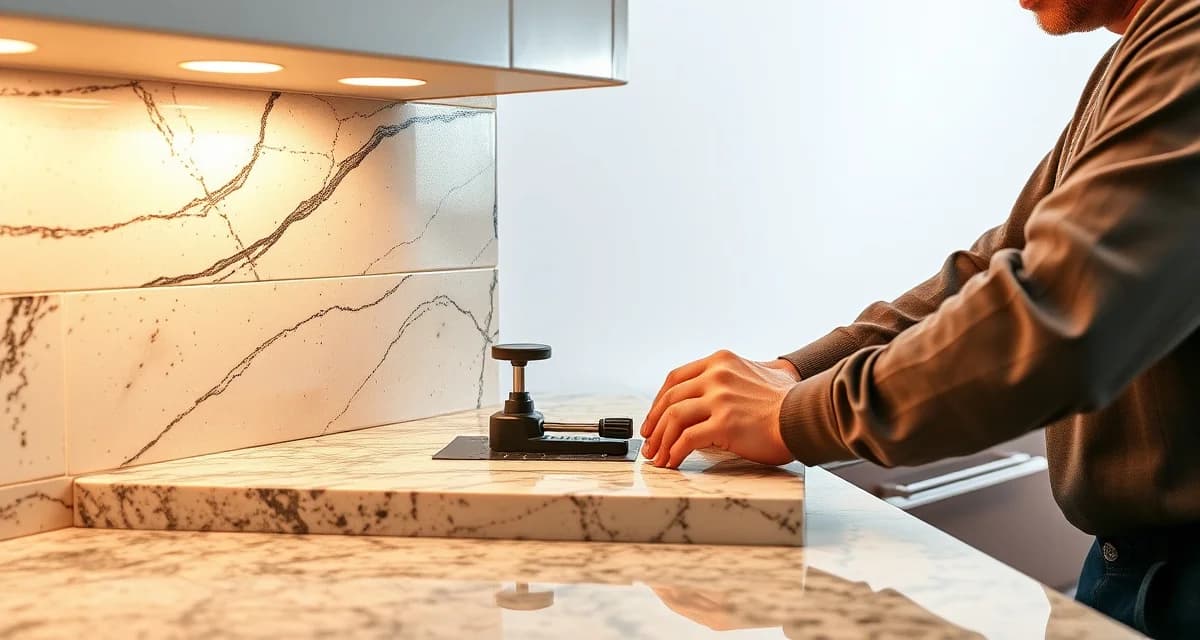
Backsplash Fabrication Guide: Templating, Cutting, and Installation for Stone Shops
Backsplash work adds 15-25% to every countertop job's revenue, but it also introduces the highest callback risk per square foot of any fabrication task. Outlet cutouts, uneven walls, and seam placement all create opportunities for expensive errors.
TL;DR
- Backsplash adds $15-$45/sq ft in revenue and typically represents 15-25% of total job value
- Outlet and switch cutouts are the #1 source of backsplash remakes (42% of callbacks)
- Digital templating reduces backsplash errors by 50% compared to manual field measurements
- Standard backsplash height: 4" for basic, 18-24" for full-height installations
- Seam planning matters - visible seams at eye level are the top customer complaint
- Budget 2-3 hours of shop time per 10 linear feet of full-height backsplash
- Material waste runs 20-30% for backsplash work vs 10-15% for countertop slabs
Backsplash Types and Specifications
Standard (4-Inch) Backsplash
The traditional 4" backsplash is cut from countertop remnants or slab offcuts. It sits directly on the counter surface behind the sink and along walls. Fabrication is straightforward - rip strips at consistent height, polish the top edge, and miter or butt-joint at corners.
Calculate your material waste savings
See exactly how much slab material and money you could save with optimized cutting layouts.
Try the free Waste CalculatorSpecs: 4" height x 3/4" or 1-1/4" thick, polished top edge, factory-finished or site-cut
Production time: 15-20 minutes per linear foot including edge finishing
Full-Height Backsplash
Full-height backsplash runs from the countertop surface to the bottom of wall cabinets - typically 18-24". This is the premium option and where most revenue (and risk) lives. Every outlet, switch, and window needs a precise cutout.
Specs: 18-24" height x 3/4" thick (2cm is standard to reduce weight), finished top edge, multiple cutouts
Production time: 30-45 minutes per linear foot including cutouts and edge work
Waterfall Backsplash
A waterfall backsplash continues the slab pattern vertically from the countertop, creating a continuous stone surface. Pattern matching at the horizontal-to-vertical transition is critical. This is your highest-margin backsplash work - and the most technically demanding.
Specs: Variable height, bookmatched or pattern-matched at transition, mitered or butt-joined at countertop
Production time: 45-60 minutes per linear foot (pattern matching adds significant time)
Templating for Backsplash Work
Backsplash templating is harder than countertop templating. Walls are never perfectly flat or plumb, outlets aren't centered, and the gap between counter and cabinet varies. You're measuring a vertical surface that interfaces with multiple horizontal planes.
What to Measure
Every backsplash template needs:
- Wall contour - Check flatness at 12" intervals with a straightedge. Document any bows greater than 1/8"
- Height at each end and center - Measure from countertop to cabinet bottom at 24" intervals minimum
- Outlet locations - Center point, box dimensions, and depth from wall surface
- Switch locations - Same measurements as outlets
- Window dimensions - If backsplash wraps around windows, measure the opening and sill depth
- Corner angles - Inside corners are rarely 90 degrees; measure the actual angle
- Plumb check - Verify walls are plumb; a 1/4" lean over 18" changes your piece dimensions
Digital vs Field Measurements
| Method | Accuracy | Time per 10 LF | Error Rate |
|---|---|---|---|
| Digital laser template | +/- 1/16" | 20-30 min | 3-5% |
| Manual with tape/level | +/- 1/4" | 35-50 min | 12-18% |
| Cardboard template | +/- 1/8" | 45-60 min | 8-12% |
Digital templating is the clear winner for full-height backsplash. The investment pays for itself in avoided remakes - a single full-height backsplash remake costs $800-$2,000 depending on material.
Outlet and Switch Cutout Measurement
This is where most backsplash jobs go wrong. A 2025 fabricator survey found that 42% of all backsplash-related callbacks involved outlet or switch cutout errors.
Measure each outlet/switch:
- Horizontal center from nearest reference point (corner or edge)
- Vertical center from countertop surface
- Box width and height (standard single gang: 2-3/4" x 4-1/2", but verify)
- Plate clearance - Add 1/8" to each side for cover plate overlap
- GFCI sizing - GFCI outlets use larger cover plates (typically 2-13/16" x 4-1/2")
Pro tip: Photograph every outlet location with a tape measure visible in the frame. This creates a backup reference if your template data seems off during fabrication.
Cutting and Fabrication Process
Material Selection
For backsplash, 2cm (3/4") material is standard. Using 3cm adds unnecessary weight and cost without structural benefit - backsplash pieces don't bear loads.
When cutting backsplash from the same slab as the countertop:
- Plan backsplash pieces during the initial slab layout
- Position them along the slab edges where vein patterns will flow naturally with the countertop
- Account for 20-30% waste on backsplash pieces (higher than countertop waste due to the number of cutouts)
Cutting Sequence
- Rough cut to oversized rectangles on the bridge saw (add 1/2" to each dimension)
- CNC cutouts for outlets and switches (if using CNC)
- Fine trim to final dimensions
- Edge polish on all exposed edges (top edge minimum; side edges if they're visible at returns or ends)
- Dry fit against template before packing
For shops without CNC capability, outlet cutouts can be made with:
- Angle grinder with diamond blade (least precise)
- Plunge router with diamond bit (good precision)
- Small bridge saw with tilting head (best precision for straight cuts)
Seam Planning
Full-height backsplash seams are visible at eye level, making placement critical. Rules for seam placement:
- Never place a seam within 6" of an outlet cutout
- Avoid seams at inside corners - butt the pieces into the corner instead
- Center seams on a wall when unavoidable (visually less noticeable than off-center)
- Match vein patterns across seams when using natural stone
- Use vertical seams only (horizontal seams look like a mistake)
Seam adhesive should color-match the stone. Keep seam width under 1/16" for a professional result.
Pricing Backsplash Work
Cost Structure
| Component | 4" Backsplash (per LF) | Full-Height (per LF) |
|---|---|---|
| Material | $5-$12 | $15-$35 |
| Fabrication labor | $8-$15 | $20-$40 |
| Edge finishing | $3-$5 | $5-$8 |
| Cutouts (outlets/switches) | N/A | $25-$50 each |
| Installation labor | $5-$10 | $12-$25 |
| Total | $21-$42/LF | $52-$108/LF |
Pricing Strategy
Price backsplash as a separate line item, not bundled into the countertop square footage. This approach:
- Shows customers the distinct value and labor involved
- Protects your margins on cutout-heavy installations
- Allows flexible pricing based on complexity (a wall with 6 outlets costs more than one with none)
- Gives customers the option to choose 4" vs full-height based on their budget
Charge per-cutout for outlets and switches. Most shops charge $25-$50 per cutout, which covers the CNC time, hand finishing, and remake risk.
Common Mistakes and How to Avoid Them
Mistake #1: Assuming Walls Are Flat
Walls in most homes bow by 1/8" to 1/2" over a 4-foot span. If you cut a perfectly straight backsplash piece, it will show gaps against the wall.
Fix: Scribe the back of each piece to match the wall contour, or use a flexible backer rod and color-matched caulk to fill minor gaps. For bows greater than 1/4", scribe the piece.
Mistake #2: Cutting Outlet Holes Too Tight
An outlet cutout with zero clearance makes the electrician's job impossible. The cover plate needs room to sit flat, and the outlet itself needs to be adjusted after the stone is set.
Fix: Add 1/4" clearance on all sides of the electrical box. This gives room for adjustment while still being covered by the standard face plate.
Mistake #3: Ignoring Thermal Movement
Stone backsplash pieces expand and contract with kitchen temperature changes. A backsplash glued rigidly to the wall and countertop can crack at the joint.
Fix: Use flexible adhesive (silicone, not rigid epoxy) at the backsplash-to-countertop joint. Leave a 1/16" expansion gap at inside corners, covered with color-matched silicone caulk.
Mistake #4: Poor Seam Placement
A seam right next to a stove or centered on the window is immediately noticeable.
Fix: Plan seams during templating, not during fabrication. Mark proposed seam locations on the template and get customer approval before cutting.
Mistake #5: Not Accounting for Cabinet Scribe
Upper cabinets rarely have perfectly straight bottom edges. The backsplash top must be scribed to match, or you'll have visible gaps.
Fix: Leave the top edge 1/4" long and scribe on site, or template with the cabinet edge as the reference and cut to match. Some shops cut straight and use a matching caulk line at the top.
Installation Best Practices
Adhesive Selection
| Adhesive Type | Best For | Cure Time | Holding Strength |
|---|---|---|---|
| Silicone (100%) | Flexible joints, countertop-to-backsplash | 24 hrs | Moderate |
| Modified thin-set | Full-height on drywall | 24-48 hrs | High |
| Construction adhesive | 4" backsplash on drywall | 24 hrs | High |
| Two-part epoxy | Seam bonding only | 15-45 min | Very high |
For full-height backsplash, most fabricators use a modified thin-set or high-quality construction adhesive. Apply in vertical ribbons (not full coverage) to allow moisture movement behind the stone.
Installation Sequence
- Dry-fit all pieces against the wall
- Mark the wall at piece boundaries
- Apply adhesive to the wall in the first section
- Set bottom pieces first, pressing firmly
- Shim if needed to maintain level
- Set upper pieces (for tall sections)
- Check plumb and alignment before adhesive sets
- Apply silicone caulk at countertop-to-backsplash joint
- Caulk inside corners with color-matched silicone
- Clean excess adhesive and caulk immediately
Maximizing Backsplash Revenue
Backsplash work is often an afterthought in quoting, but it shouldn't be. A typical kitchen with 25 linear feet of countertop also has 15-20 linear feet of potential backsplash area. At full-height pricing, that's $1,000-$2,000 in additional revenue per job.
Upselling Tips
- Show customers photos of the same stone in 4" vs full-height backsplash - the visual difference sells itself
- Quote both options on every kitchen job
- Explain that matching backsplash material is best cut from the same slab for vein continuity
- Mention that adding backsplash during initial installation is 40-50% cheaper than retrofitting later
Using software like SlabWise, you can include backsplash pieces in your slab nesting layout to minimize waste and show customers exactly how the material will be used from their specific slab.
What's the standard backsplash height?
Standard height is 4 inches. Full-height backsplash runs from the countertop to the bottom of upper cabinets, typically 18-24 inches. Some designs extend to ceiling height (36-48 inches or more).
Should backsplash be the same thickness as the countertop?
No. Countertops are typically 3cm (1-1/4") while backsplash is usually 2cm (3/4"). Thinner material reduces weight on the wall and costs less. The thickness difference isn't visible once installed.
How do you handle backsplash behind a cooktop?
Backsplash behind a cooktop must withstand higher temperatures. All natural stone and engineered quartz handle normal cooking heat fine. Leave a 1/4" gap between the cooktop and backsplash surface, filled with high-temp silicone.
Can you fabricate backsplash from countertop remnants?
Yes, and you should when possible. 4" backsplash strips can be ripped from slab edges and remnants. Full-height backsplash often requires dedicated slab area due to height requirements.
What causes backsplash to crack after installation?
The most common cause is rigid adhesive at the countertop-to-backsplash joint. The counter and wall move independently, and a rigid joint concentrates stress in the stone. Always use flexible silicone at this joint.
How do you handle inside corners?
Butt one piece into the corner and run the other piece against it. Don't miter inside corners - the angle is never a true 90 degrees, and miters create a visible line that collects dirt. Caulk the joint with color-matched silicone.
Should backsplash go behind the range hood?
Yes, unless the range hood mounts directly to the wall with no gap. If there's any visible space between the hood and wall, backsplash should extend behind it. This is a common oversight that looks cheap when missed.
How do you waterproof behind the backsplash?
Stone itself is not a moisture barrier. Apply a waterproof membrane (like RedGard or Kerdi) to the wall behind the backsplash in wet areas (behind sinks). For dry areas, the standard drywall surface is sufficient.
What's the waste factor for backsplash?
Budget 20-30% waste for full-height backsplash with multiple cutouts. For 4" strips, waste is typically 10-15% since you're cutting straight pieces from remnants.
How do you match vein patterns from countertop to backsplash?
Cut the backsplash pieces from the same slab, positioned adjacent to the countertop section. Book-matching (flipping the slab face along the cut line) creates a mirror pattern at the transition. Document slab positions during layout for accurate reassembly.
Cut Smarter, Waste Less
Backsplash fabrication is where your slab layout and nesting decisions directly impact profitability. SlabWise's nesting engine plans backsplash pieces alongside countertop sections, reducing waste by 10-15% and ensuring pattern continuity across the entire job.
Start Your 14-Day Free Trial →
Try These Free Tools
- Photo to Template -- Snap a photo of an existing countertop and get an AI-generated DXF template.
- Template Compare -- Upload two templates and see every dimension change highlighted instantly.
- AI Template Verification -- Cross-check your template against manufacturer specs before cutting.
Sources & Further Reading
-
Natural Stone Institute - ADA Compliance Guidelines for Natural Stone Installations
-
National Kitchen & Bath Association - Universal Design and ADA Standards for Kitchen Countertops
-
ASTM International - Standard Practice for Accessible Counter and Work Surface Design