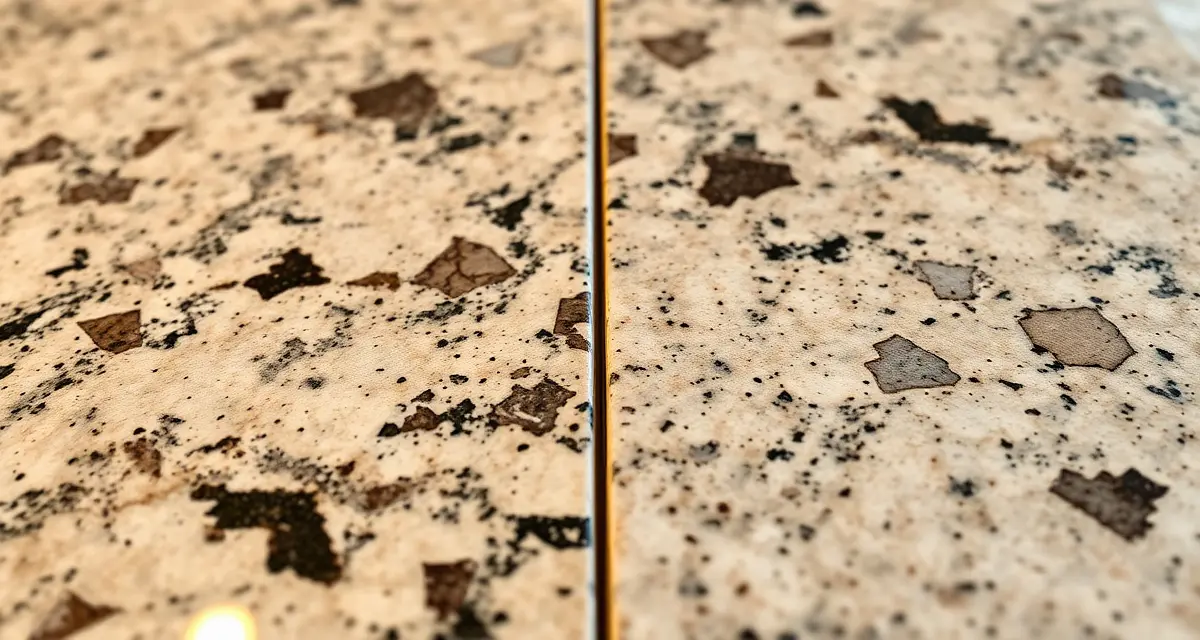
Complete Seams Guide
This complete seams guide walks you through the process step by step.
A countertop seam is the joint where two pieces of countertop material meet. For fabricators, seams are the most scrutinized detail of every installation - a single visible or poorly bonded seam can undo an otherwise perfect job and trigger a $1,500-$4,000 callback. This guide covers seam placement strategy, adhesive selection, techniques for each material type, color matching, and the most common seam failures and how to prevent them.
TL;DR
- Seam placement matters as much as seam quality - poor placement creates visible lines even with perfect adhesive work
- Adhesive choice depends on material: polyester for granite, acrylic cement for solid surface, epoxy for quartzite
- Color matching requires testing on scrap pieces before committing - never match by eye alone
- The ideal seam gap is 1/16" or less for stone, near-zero for solid surface
- Quartz seams are the most visible due to uniform color - technique must be flawless
- Most seam callbacks are caused by poor edge prep, wrong adhesive, or bad placement decisions
- SlabWise AI Template Verification flags problematic seam placements before cutting begins
Seam Placement Strategy
Where you place the seam is half the battle. A perfectly executed seam in the wrong location will still draw complaints.
Calculate your material waste savings
See exactly how much slab material and money you could save with optimized cutting layouts.
Try the free Waste CalculatorPlacement Rules
Do place seams:
- Over a cabinet wall or support (not over open spans)
- In low-visibility areas (behind the sink, near corners)
- Along natural breaks in the layout (where an L-shape meets, at peninsulas)
- Where the countertop changes direction (inside corners)
- At least 3" from sink cutouts, cooktop cutouts, and corners
Don't place seams:
- In the middle of a visible straight run (customers see this every day)
- Across high-traffic prep areas (food prep, rolling dough)
- Through a sink or cooktop cutout (structural failure risk)
- Closer than 6" to an inside corner (stress concentration)
- On a dishwasher or oven opening (heat and moisture stress)
Common Layout Scenarios
L-Shaped Kitchen Standard seam location: at the corner where the two runs meet. The seam runs front-to-back at the inside corner junction. This is the least visible location because the corner itself disguises the line.
U-Shaped Kitchen Two seams minimum: one at each corner junction. Keep both seams at the corner transitions for consistency.
Long Straight Run (Over 120") Slab size limitations force a mid-run seam. Place it behind the sink faucet if possible - the faucet breaks up the visual line. If no sink, place the seam over a cabinet wall in the least-visible zone.
Island Avoid mid-island seams if the slab can cover the full length. For islands over 110", place the seam at a natural visual break - where a waterfall panel meets the top, or where a raised bar transitions to the main surface.
Seam Layout Communication
Always discuss seam locations with the customer during the template visit - not during installation. Show them exactly where each seam will fall and why. A seam the customer agrees to in advance never generates a callback. A seam the customer discovers during installation always does.
SlabWise Customer Portal includes a digital layout approval step where customers can see and approve seam locations before fabrication begins, preventing disputes.
Adhesive Selection by Material
Every countertop material has an optimal adhesive for seaming. Using the wrong adhesive is a guaranteed callback.
Adhesive Comparison
| Material | Primary Adhesive | Cure Time | Gap Tolerance | Strength |
|---|---|---|---|---|
| Granite | Polyester with hardener | 20-30 min | Up to 1/16" | Good |
| Quartz | Manufacturer-specified adhesive | 20-45 min | Minimal (1/32") | Good |
| Marble | Polyester or epoxy (slower cure) | 20-60 min | Up to 1/16" | Good |
| Quartzite | Epoxy (2-part) | 30-60 min | Up to 1/16" | Excellent |
| Solid surface | Acrylic seam adhesive (color-matched) | 30-45 min | Near-zero | Excellent (chemical bond) |
| Porcelain | Flexible epoxy | 30-60 min | Minimal (1/32") | Good |
| Sintered stone | Manufacturer-specified epoxy | 30-60 min | Minimal (1/32") | Good |
Important Notes
Granite and marble: Polyester adhesive (Akemi, Tenax, or similar) is the industry standard. Available in transparent, white, black, and tintable formulations. Add hardener per manufacturer specs - over-catalyzing causes the adhesive to cure too fast and shrink.
Quartz: Most manufacturers require their brand-specific adhesive or an approved equivalent. Using non-approved adhesive may void the warranty. Caesarstone, Cambria, and Silestone each publish approved adhesive lists.
Solid surface: This is the only material where the seam is chemically bonded (not just glued). The acrylic cement melts the mating surfaces together, creating a joint that's as strong as the surrounding material. This is why solid surface seams are virtually invisible.
Quartzite: Quartzite is dense and heavy. Use epoxy rather than polyester - the stronger bond is necessary for a material that puts more stress on every joint.
Color Matching Techniques
A structurally perfect seam that's the wrong color is still a failure. Here's how to match accurately.
For Polyester Adhesive (Granite, Marble)
- Start with a transparent or white base adhesive
- Add pigment pastes (available in 20+ colors from Akemi, Tenax)
- Mix a small test batch and apply it to a scrap piece of the actual material being seamed
- Let it cure - color shifts during curing (polyester typically darkens slightly)
- Compare cured adhesive to the stone under the same lighting conditions the countertop will live under
- Adjust and repeat until the match is right
Rule of thumb: Match to the lightest mineral in the stone's pattern, not the dominant color. The eye reads the seam as a light line, so matching the light minerals makes it disappear.
For Quartz
Quartz is harder to color-match because the material is uniform - there's no pattern to help disguise the seam. Many quartz manufacturers offer pre-mixed color-matched adhesive kits. Use them.
For custom matching:
- Use tintable epoxy or polyester as the base
- Match the background color of the quartz (not the sparkle or chips)
- Test on a scrap piece and examine under kitchen lighting (LED, fluorescent, and natural daylight all look different)
For Solid Surface
Solid surface manufacturers provide brand-specific, color-matched seam adhesive for every color in their line. There's no guessing involved - order the correct adhesive by color number. Using generic adhesive on solid surface defeats the material's biggest advantage.
Seam Fabrication Techniques
Edge Preparation
The quality of the seam edge determines everything. Both mating edges must be:
- Straight: Check with a metal straightedge. Deviations over 1/64" (0.4mm) per foot will show.
- Square: 90 degrees to the top surface. An out-of-square edge creates a visible V-groove on the finished surface.
- Clean: Free of dust, oils, residue. Wipe with denatured alcohol or acetone immediately before gluing.
- Dry: Moisture in the seam prevents adhesive bonding. In humid shops, blow dry the edges with compressed air.
Step-by-Step Seaming Process (Stone)
- Dry fit both pieces on the installation surface. Check alignment, height match, and gap width.
- Apply masking tape 1/4" from each edge on the top surface. This catches adhesive overflow and keeps the surface clean.
- Apply adhesive to one or both edges. For polyester, a thin bead along the full length. For epoxy, a thin coat on both faces.
- Join the pieces by sliding them together (don't drop one onto the other - this traps air).
- Align the surfaces using suction cups or clamps. The top surfaces must be perfectly flush - even 0.5mm of height difference is visible and felt.
- Clamp using seam setters or dedicated seam clamps. Apply pressure evenly along the entire length.
- Clean excess adhesive from the top surface before it cures. Razor blade for polyester, scraper for epoxy.
- Remove tape after the adhesive firms up but before full cure.
- Polish the seam line with appropriate grit progression once fully cured.
Step-by-Step Seaming Process (Solid Surface)
- Cut mating edges straight and square (within 1/32")
- Ensure tight fit - solid surface seams should have near-zero gap
- Apply color-matched acrylic cement to both edges
- Spring-clamp every 4-6 inches along the joint
- Allow 30-45 minutes cure time at 70°F minimum
- Scrape excess with a sharp wood chisel
- Sand flush: 120 grit → 220 grit → 400 grit
- Buff to match the surrounding surface finish
Material-Specific Seam Tips
Granite Seams
Granite's natural variation helps hide seams. Focus on matching the dominant mineral pattern across the joint. On busy patterns (Santa Cecilia, Giallo Ornamental), a well-placed seam practically disappears. On solid-colored granites (Absolute Black), every imperfection shows.
Tip: On dark granites, add a tiny amount of black pigment paste to the adhesive - too much makes the seam line darker than the stone.
Quartz Seams
Quartz seams are the most visible of any material because the surface is uniform with no pattern variation to disguise the joint. Critical success factors:
- Edges must be factory-quality straight (use a CNC or certified straight edge)
- Gap must be under 1/32" (0.8mm) - ideally near-zero
- Color match must be tested on scrap and cured before committing
- Use the manufacturer's recommended adhesive
- Polish the seam to exactly the same finish level as the slab surface
Marble Seams
Marble is soft and chips easily during edge preparation. Cut slowly and support the material fully. On veined marbles (Calacatta, Statuario), orient the pieces so the vein pattern flows across the seam. This turns the seam into a natural line within the stone's pattern.
Quartzite Seams
Quartzite is extremely hard, which makes edge preparation slower. Use diamond-edged grinding tools rather than standard polishing pads for initial straightening. The upside: quartzite's natural veining and variation help conceal seams effectively.
Common Seam Problems and Fixes
Problem: Visible Line
Cause: Gap too wide, adhesive color mismatch, edges not square Prevention: Tighter tolerances on edge prep, color-match testing on scrap, check edges with precision square Repair: For minor visibility, apply a thin layer of color-matched epoxy along the seam and re-polish. For major visibility, the section may need to be recut.
Problem: Height Difference (Lippage)
Cause: Substructure not level, insufficient clamping during cure, pieces cut to different thicknesses Prevention: Check substructure levelness before seaming. Use seam setters that pull both surfaces flush. Verify slab thickness matches at the seam location. Repair: Minor lippage (under 0.5mm) can be ground flush and re-polished. Major lippage requires resetting the pieces.
Problem: Adhesive Failure (Separation)
Cause: Wrong adhesive type, surfaces not clean, insufficient cure time, excessive stress Prevention: Use the correct adhesive for the material. Clean surfaces immediately before gluing. Support the seam during and after cure. Don't rush. Repair: Disassemble, clean both surfaces, re-cut edges if damaged, and re-seam with fresh adhesive.
Problem: Staining at the Seam
Cause: Adhesive shrinkage creating micro-gaps, porous adhesive absorbing liquids, insufficient sealer penetration at the joint Prevention: Use non-shrinking adhesive. Apply sealer specifically along the seam line after polishing. Repair: Clean the stain with a poultice, re-seal the seam area. In severe cases, rout out the old adhesive and re-seam.
Problem: Cracking from Seam
Cause: Seam placed too close to a cutout or corner, thermal expansion stress, structural flex in the substructure Prevention: Maintain 3"+ minimum distance from cutouts. Ensure proper substructure support. For quartz near cooktops, leave a 1/8" expansion gap. Repair: Structural cracks radiating from seams typically require piece replacement - there's no reliable patch for a structural failure.
Seam Quality Standards
The industry-accepted standards for countertop seams come from the Marble Institute of America (now the Natural Stone Institute) and individual material manufacturers:
| Standard | Acceptable | Good | Excellent |
|---|---|---|---|
| Gap width (stone) | Under 1/16" | Under 1/32" | Near-zero |
| Gap width (solid surface) | N/A | Near-zero | Chemically bonded |
| Height difference (lippage) | Under 1mm | Under 0.5mm | Flush |
| Color match | Noticeable from 3'+ | Subtle from 2' | Invisible from 12" |
| Straightness | 1/32" per foot | 1/64" per foot | Dead straight |
Target "Good" at minimum for every seam. "Excellent" is the standard for visible seams on quartz and solid color materials.
Can countertop seams be completely invisible?
Solid surface seams can be virtually invisible because the adhesive chemically bonds with the material. Stone and quartz seams are always slightly detectable up close but should be invisible from normal viewing distance (2-3 feet).
Where should countertop seams be placed?
Over a cabinet wall or support, in low-visibility areas (behind the sink, at corners), and at least 3" from any cutout. Never place seams in the middle of a visible straight run or through a cutout.
How long do countertop seams take to cure?
Polyester adhesive: 20-30 minutes to handling strength. Epoxy: 30-60 minutes. Solid surface acrylic cement: 30-45 minutes. Full strength for all types: 24 hours.
Can a bad seam be fixed without replacing the countertop?
Minor issues (slight color mismatch, small lippage) can often be repaired with re-polishing and adhesive touch-up. Major issues (structural separation, cracking, large gaps) typically require recutting or replacement.
Why are quartz seams more visible than granite seams?
Quartz has a uniform color and pattern with no natural variation to disguise the seam line. Granite's random mineral patterns naturally break up the visual line of the seam.
How thick should seam adhesive be?
As thin as possible. The adhesive is a filler, not a structural element - the tighter the joint, the less visible the seam. Target under 1/32" for stone, near-zero for solid surface.
Do seams affect countertop strength?
A properly bonded seam in stone is not a structural weak point - the adhesive bond is typically stronger than the stone itself. However, seams near cutouts or at stress points can become failure points if not properly supported.
Should customers be able to feel a countertop seam?
No. A properly executed seam should not be detectable by running your fingers across it. If a customer can feel the seam, the surfaces are not flush and the seam needs re-polishing.
How many seams does a typical kitchen have?
Most kitchens have 1-3 seams, depending on the layout and slab sizes available. L-shaped kitchens need at least 1 seam at the corner. U-shaped kitchens need at least 2. Straight runs under 120" can often be fabricated from a single slab with zero seams.
Can old countertop seams be repaired?
Yes. Old seams that have discolored or separated can be routed out, cleaned, and re-filled with fresh color-matched adhesive, then re-polished. This costs $200-$500 per seam and is far cheaper than countertop replacement.
Prevent Seam Problems Before They Start
SlabWise AI Template Verification checks seam placement against structural rules, cutout clearances, and best practice guidelines before a single cut is made. Combined with the Customer Portal's layout approval feature, you can eliminate seam-related callbacks entirely.
Start your 14-day free trial →
Plans start at $199/month. No credit card required for the trial.
Try These Free Tools
- Photo to Template -- Snap a photo of an existing countertop and get an AI-generated DXF template.
- Template Compare -- Upload two templates and see every dimension change highlighted instantly.
- AI Template Verification -- Cross-check your template against manufacturer specs before cutting.