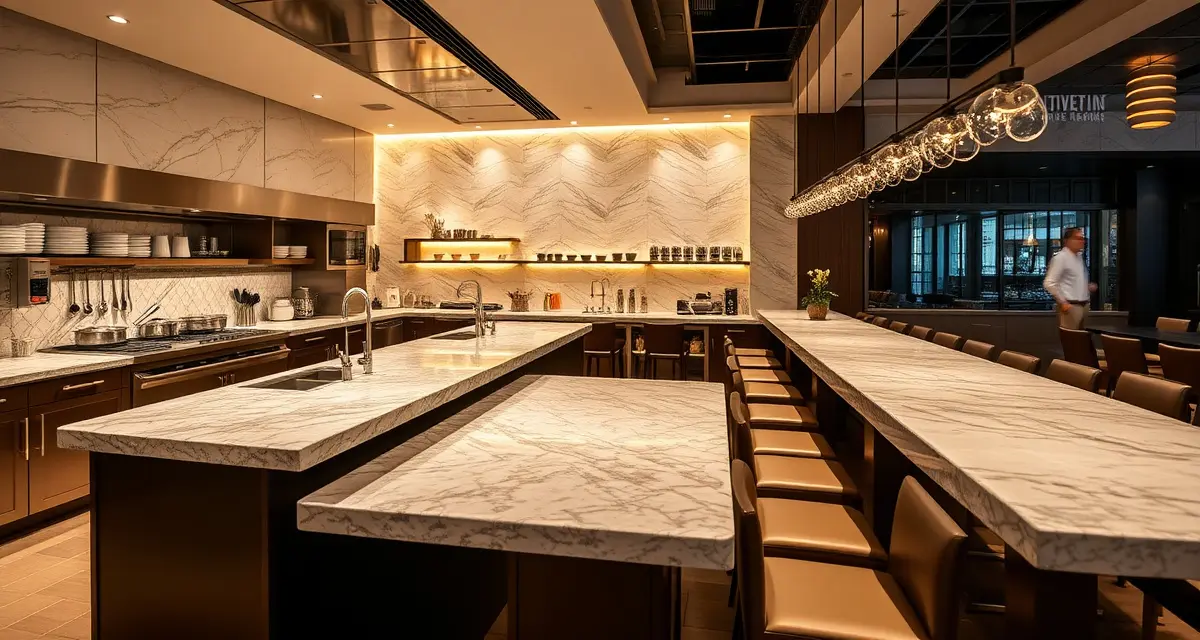
Restaurant Countertop Options
Quick Definition
Restaurant countertop options is an important topic for countertop fabrication professionals.
Restaurant countertops serve two distinct functions: back-of-house surfaces for food preparation (where durability and health code compliance rule), and front-of-house surfaces for dining, bars, and service areas (where aesthetics and toughness must coexist). Material selection varies by restaurant type, budget, and local health regulations, with total surface costs ranging from $8,000 for a small cafe to $50,000+ for an upscale dining establishment.
TL;DR
- Bar tops take the most abuse - expect cigarette burns (outdoor bars), spilled drinks, leaning patrons, and glass impacts
- Granite is the top choice for bar tops at $50-$120/sq ft - heat resistant, visually impressive, extremely durable
- Stainless steel is required for most food prep areas by health code - $50-$150/sq ft depending on gauge
- Quartz works for host stands, server stations, and low-impact dining surfaces at $60-$110/sq ft
- Concrete bar tops are popular for brewpubs and industrial concepts at $70-$150/sq ft - but maintenance is demanding
- Plan for 10-20% higher material costs than residential due to commercial-grade requirements and custom fabrication
- Factor in restaurant downtime costs when planning installation - a delayed opening costs $5,000-$20,000/week
Surface Areas in a Typical Restaurant
Most restaurants need countertop surfaces in 5-8 distinct areas:
Calculate your material waste savings
See exactly how much slab material and money you could save with optimized cutting layouts.
Try the free Waste Calculator| Area | Typical Size | Primary Function | Material Priority |
|---|---|---|---|
| Bar top | 30-80 sq ft | Customer seating, drinks | Durability + aesthetics |
| Back bar | 15-30 sq ft | Drink prep, display | Durability + style |
| Kitchen prep | 40-100 sq ft | Food preparation | Health code compliance |
| Line counter | 20-40 sq ft | Plating, expediting | Heat resistance |
| Host stand | 6-12 sq ft | Reception | Aesthetics |
| Server station | 8-15 sq ft | POS, drink prep | Stain resistance |
| Restroom vanities | 10-20 sq ft | Handwashing | Water resistance |
| Outdoor seating area | 20-60 sq ft | Dining, bar | Weather resistance |
Material Selection by Restaurant Type
Fine Dining
- Bar: Marble or exotic granite - guests expect luxury, and staff handles surfaces carefully
- Kitchen: Stainless steel - non-negotiable for high-end kitchen operations
- Host stand: Marble, onyx, or premium quartz - first impression surface
- Restrooms: Marble or high-end quartz - matches the overall design standard
- Budget: $25,000-$50,000+ for all surfaces
Casual Dining
- Bar: Granite or quartz - tough enough for heavy use, good-looking
- Kitchen: Stainless steel
- Host stand: Quartz - durable and low maintenance
- Restrooms: Quartz or solid surface
- Budget: $12,000-$30,000 for all surfaces
Fast Casual / Counter Service
- Service counter: Quartz or solid surface - clean lines, easy to maintain
- Kitchen: Stainless steel
- Restrooms: Solid surface or laminate
- Budget: $6,000-$15,000 for all surfaces
Brewpub / Industrial Concept
- Bar: Concrete, reclaimed wood, or zinc - matches the industrial aesthetic
- Kitchen: Stainless steel
- Restrooms: Concrete or industrial tile
- Budget: $10,000-$25,000 for all surfaces
Coffee Shop / Cafe
- Service counter: Quartz, butcher block, or solid surface
- Kitchen/prep: Stainless steel or quartz
- Restrooms: Solid surface or laminate
- Budget: $4,000-$10,000 for all surfaces
Bar Top Material Showdown
The bar is the highest-profile surface in most restaurants and takes the most abuse:
| Material | Cost/sq ft | Heat Resistance | Stain Resistance | Maintenance | Durability | Aesthetic |
|---|---|---|---|---|---|---|
| Granite | $50-$120 | Excellent | Good (sealed) | Seal 2x/year | 20+ years | Natural, premium |
| Quartz | $60-$110 | Moderate | Excellent | Minimal | 15-20 years | Consistent, modern |
| Dekton | $80-$130 | Excellent | Excellent | None | 25+ years | Modern, varied |
| Concrete | $70-$150 | Good | Poor-moderate | Monthly wax, seal 2x/year | 10-15 years | Industrial, unique |
| Marble | $80-$200 | Good | Poor (etches) | Seal 4x/year, accept patina | 15+ years (with patina) | Luxury, classic |
| Zinc | $60-$120 | Good | N/A (patinas) | Accept/clean patina | 20+ years | Vintage, Paris bistro |
| Reclaimed wood | $40-$100 | Poor | Poor | Seal regularly, sand periodically | 5-10 years | Rustic, warm |
The Best Bar Top Material (For Most Restaurants)
Granite. Specifically, Level 2-3 granite in 3cm thickness with a polished or leathered finish. Here's why:
- It handles everything bar patrons throw at it - literally. Pint glasses, plates, elbows, purses, keys
- Heat from plates and cups doesn't damage it
- Spilled drinks clean up easily when sealed
- Visual impact is high - guests notice and appreciate real stone
- 20+ year lifespan with basic maintenance (seal twice annually)
- Cost is reasonable for the durability - $50-$80/sq ft for popular colors
For an 8-foot bar (approximately 50 sq ft including overhang), expect $2,500-$4,000 installed for granite.
Design Considerations
Bar Top Dimensions
- Width: 24-30 inches (standard), up to 36 inches for dining bars
- Overhang: 8-12 inches for bar stool seating
- Height: 42 inches (standard bar height) or 36 inches (counter height)
- Thickness: 3cm (1-1/4") standard - thinner looks cheap in commercial settings
- Edge profile: Eased or bullnose for bars (rounded edges reduce chipping and are safer)
Kitchen Surface Requirements
- Height: 36 inches standard, 34 inches for ADA-compliant stations
- Depth: 30 inches minimum for prep surfaces
- Edge treatment: Marine edge (raised lip) to contain liquids
- Backsplash: Integral coved stainless (no seam at the wall-counter junction)
Seam Planning
Large bar tops and kitchen lines often require seams. Seam placement matters:
- Never place a seam at a high-traffic zone (where bartenders work, where servers drop dishes)
- Align seams with structural supports underneath for long-term stability
- Color-match seam adhesive - visible seams look unprofessional in a restaurant setting
Installation Logistics
Timing in Restaurant Build-Outs
Countertop installation typically happens in the final 2-3 weeks of a restaurant build-out. The sequence:
- Cabinets and base structures installed (Week -3)
- Template appointment (Week -2)
- Fabrication (1-2 weeks)
- Countertop installation (Week 0)
- Plumbing connections and fixture installation (same week)
- Health department final inspection (following week)
Critical path issue: If countertops are late, health inspection gets pushed, which pushes the opening date. A 1-week countertop delay can mean $5,000-$20,000 in lost opening revenue plus ongoing rent and labor costs.
Access Challenges
Restaurant installations often involve:
- Narrow doorways and hallways in strip mall locations
- Stairs in multi-level buildings
- After-hours installation (if the space is near operating businesses)
- Coordination with other trades working simultaneously in the space
Maintenance by Material (Commercial Frequency)
| Material | Daily | Weekly | Monthly | Quarterly | Annually |
|---|---|---|---|---|---|
| Stainless | Wipe + sanitize | Polish | Deep clean | - | - |
| Granite | Wipe + sanitize | - | - | Seal | Seal |
| Quartz | Wipe + sanitize | - | - | - | - |
| Dekton | Wipe + sanitize | - | - | - | - |
| Concrete | Wipe + sanitize | - | Wax | - | Seal |
| Marble | Wipe + sanitize | - | - | Seal | Seal |
In commercial settings, "wipe and sanitize" happens dozens of times daily. Materials that degrade with sanitizer exposure (some sealants, natural stone finishes) need more frequent maintenance intervention.
FAQ
What's the best countertop material for a restaurant bar?
Granite is the most practical choice - it handles heat, impacts, spills, and heavy use while looking premium. Budget: $50-$80/sq ft installed for popular colors. For a modern aesthetic, Dekton at $80-$130/sq ft adds heat-proof performance.
How much do restaurant countertops cost total?
$8,000-$50,000+ depending on restaurant size and material choices. A 100-seat casual dining restaurant typically spends $15,000-$30,000 on all countertop surfaces (kitchen + bar + FOH).
Can you use quartz for a restaurant bar?
Yes, but with caveats. Quartz handles spills and impacts well but can be damaged by hot plates or cigarette burns (outdoor bars). For indoor bars without hot-plate service, quartz at $60-$110/sq ft is a solid choice.
What does the health department require for kitchen countertops?
Requirements vary by jurisdiction, but most require non-porous, easily cleanable surfaces for food prep areas. Stainless steel meets every health code. Natural stone may require specific sealing and certification. Always verify with your local health department before specifying materials.
How long does restaurant countertop installation take?
Template: 1 day. Fabrication: 5-10 business days. Installation: 1-3 days depending on scope. Total timeline: 2-3 weeks from template to finished counters.
Should restaurant countertops be 2cm or 3cm thick?
Always 3cm (1-1/4") for commercial applications. Thicker material withstands impacts better, supports undermount sinks, and looks more substantial. 2cm looks flimsy in a commercial setting.
What bar top material handles the most abuse?
Stainless steel is the most durable overall. Among stone options, granite is the most abuse-tolerant - it handles heat, impacts, acidic spills, and heavy use better than quartz, marble, or concrete.
How often do restaurant countertops need replacing?
Stainless steel: rarely (20-30+ years). Granite: 15-25 years. Quartz: 15-20 years. Concrete: 10-15 years before major refinishing. Butcher block: 5-10 years in high-use settings.
Can I use marble for a restaurant bar?
Yes, if you accept the patina. Marble etches from acidic drinks (cocktails, wine, citrus) and stains from colored liquids. Some restaurant owners love the aged patina look. Others find it frustrating. Seal every 3-4 months minimum.
What about outdoor restaurant countertops?
Dekton is the top choice for outdoor restaurant surfaces - UV-resistant, weather-proof, heat-proof. Granite works outdoors with more frequent sealing (4x/year). Quartz is not rated for outdoor use.
Win More Commercial Fabrication Jobs
Restaurant and commercial countertop projects are higher-value than residential work, but they demand faster turnaround and tighter precision. SlabWise helps fabrication shops quote commercial jobs in 3 minutes (not 20), verify templates before cutting, and keep project timelines on track through the Customer Portal. For a shop doing 3-4 commercial projects per month, that efficiency translates to $3,000-$8,000/month in time savings and avoided remakes.
Start your 14-day free trial - build your commercial book with confidence.
Try These Free Tools
- Cost Calculator -- Get instant countertop cost estimates by material, edge profile, and square footage.
- Compare Materials -- Side-by-side material comparison with pricing, durability, and maintenance ratings.
- Edge Profile Selector -- Browse edge profiles with cost impact and visual previews.
Sources & Further Reading
-
Natural Stone Institute - Digital Tools and Technology in Stone Fabrication
-
International Surface Fabricators Association - Quoting Best Practices and Technology
-
National Kitchen & Bath Association - Technology Integration in Kitchen Design
-
Remodeling Magazine - Digital Transformation in Countertop Industry