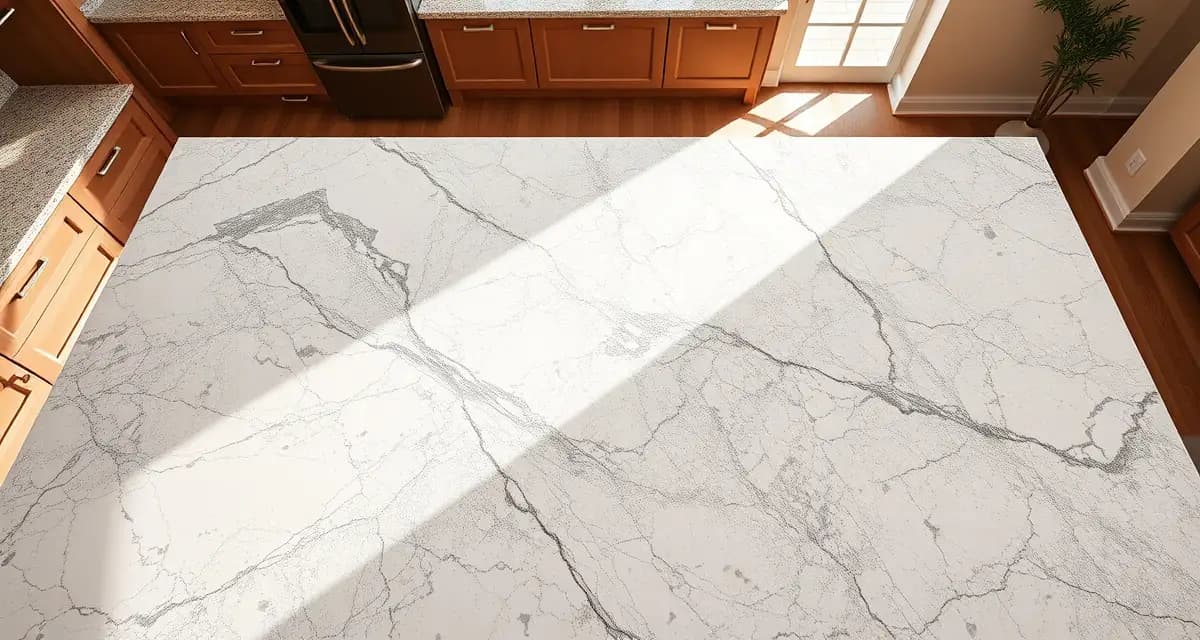
What Is an Island Countertop? Definition & Guide for Countertop Fabricators
An island countertop is a freestanding stone, quartz, or solid-surface top that sits on a centrally located kitchen island cabinet, accessible from all four sides. Island countertops are typically the largest and most expensive single piece in a kitchen project, and they demand careful attention to support, seaming, material selection, and transport logistics throughout the fabrication process.
TL;DR
- Island countertops sit on freestanding cabinets accessible from all sides
- Typical dimensions: 36-72 inches wide by 48-120 inches long
- Often the single most expensive piece in a kitchen countertop project
- Require structural support for any overhang beyond 10-12 inches
- Seam placement (if needed) must account for 360-degree visibility
- Weight ranges from 200-600+ lbs, affecting transport and installation planning
- Waterfall edges, integrated sinks, and multi-level designs increase complexity
Island Countertop Dimensions and Weight
| Dimension | Small Island | Standard Island | Large Island |
|---|---|---|---|
| Width | 36" | 42-48" | 48-72" |
| Length | 48-60" | 72-96" | 96-120" |
| Area | 12-20 sq ft | 21-32 sq ft | 32-60 sq ft |
| Weight (3cm granite) | 200-300 lbs | 300-480 lbs | 480-900 lbs |
| Weight (3cm quartz) | 190-280 lbs | 285-450 lbs | 450-840 lbs |
These weights matter. A 96" x 48" granite island top at 3cm thickness weighs roughly 450 lbs. Moving that from the truck to the kitchen requires 3-4 people, clear pathways, and planning for every doorway and turn along the route.
Calculate your material waste savings
See exactly how much slab material and money you could save with optimized cutting layouts.
Try the free Waste CalculatorWhy Island Countertops Are the Fabrication Centerpiece
They Are Visible from Every Angle
Perimeter countertops hide against walls. An island sits in the middle of the room, visible from the kitchen, dining area, and often the living room. Every flaw - a poorly placed seam, a mismatched vein, an imperfect edge - is on full display. This visibility raises the quality standard for every aspect of fabrication.
They Carry Premium Pricing
Islands represent a disproportionate share of project revenue. A kitchen with 50 sq ft of perimeter counters and a 30 sq ft island allocates about 37% of material to the island - but the island often generates 40-50% of the profit because of the higher complexity, support hardware, and premium edge treatments customers choose.
They Drive Material Selection Decisions
Many homeowners choose their countertop material based on how it looks as an island. A dramatic veined marble or quartzite island becomes the focal point, with simpler (and less expensive) material on the perimeter. Fabricators who can effectively present slab options for island applications close more sales.
Fabrication Considerations
Single Piece vs. Multi-Piece
The ideal island countertop is a single, seamless piece. Whether this is possible depends on:
- Slab size: Standard slabs measure roughly 120" x 65". An island under 120" long and under 65" wide can be cut as one piece.
- Transport access: A single piece must physically fit through every doorway and hallway from the truck to the kitchen.
- Weight: Very large single pieces may exceed what a 3-4 person crew can safely handle.
When a seam is necessary, placement is critical. Common approaches:
| Seam Strategy | Best For | Visual Impact |
|---|---|---|
| Center seam (lengthwise) | Wide islands over 65" | Moderate - visible from ends |
| Offset seam (lengthwise) | Wide islands with sink cutout | Lower - seam hidden by sink area |
| Crosswise seam | Very long islands (10'+) | Higher - visible from sides |
Cutouts and Penetrations
Island countertops commonly include:
- Sink cutout: Undermount sinks require precise cutout dimensions and polished edges
- Cooktop cutout: Some islands house a cooktop; cutout must match exact unit dimensions
- Faucet holes: Placement must align with undermount sink and plumbing below
- Pop-up outlet holes: Electrical access points for island outlets
- Drainage grooves: For integrated drainboards near the sink
Each cutout weakens the stone at that point, which influences seam placement. Never place a seam through or immediately adjacent to a cutout.
Edge Profiles
Because islands are visible from all sides, edge treatment is more extensive than perimeter counters:
- All four edges (or three, if one side is against a wall extension) receive the finished profile
- Common profiles: eased, beveled, half-bullnose, full-bullnose, ogee
- Waterfall edges (stone running vertically down one or both ends) require additional material and precise pattern alignment
Edge profiling for a full island perimeter (20-30 linear feet) adds $200-$900 to the project depending on profile complexity and material.
Support Requirements
Any overhang beyond 10-12 inches (for 3cm granite/quartz) needs brackets, corbels, or other support. Island overhangs for seating bars typically extend 12-18 inches, so support is almost always required.
Support options include:
- Concealed steel brackets ($40-$150 each)
- Decorative corbels ($30-$150 each)
- Knee walls for extended overhangs (18-24")
- Steel sub-frames for very large or heavy islands
Island Countertop Costs
| Component | Small Island | Standard Island | Large Island |
|---|---|---|---|
| Material | $500-$2,400 | $900-$3,800 | $1,300-$7,200 |
| Fabrication | $150-$350 | $250-$500 | $400-$800 |
| Edge profiling | $100-$400 | $200-$600 | $300-$900 |
| Cutouts | $150-$400 | $150-$500 | $200-$600 |
| Support hardware | $100-$400 | $200-$600 | $300-$800 |
| Installation | $200-$400 | $300-$600 | $400-$900 |
| Total | $1,200-$4,350 | $2,000-$6,600 | $2,900-$11,200 |
Slab Nesting for Island Pieces
Island pieces are typically the largest single shapes on the nesting layout. Best practices:
- Nest the island first. Place the island piece on the slab before perimeter pieces, since it has the strictest size and pattern requirements.
- Orient for vein direction. Position the island piece so veining flows from front to back (the most common visual preference).
- Account for waterfall pieces. If the island includes waterfall ends, nest those pieces adjacent to the main top so vein patterns align at the seam.
- Maximize remnant usefulness. After placing the island, fill remaining slab space with perimeter pieces or save useful remnant shapes.
AI nesting software performs this optimization automatically, often finding layouts that save 10-15% material compared to manual arrangement.
FAQ
How big can a kitchen island countertop be without a seam?
Up to approximately 120" x 65" (10 feet by 5.5 feet) for most natural stone and quartz slabs. Jumbo slabs are available from some suppliers at up to 130" x 75".
How much does an island countertop weigh?
A 3cm granite island countertop measuring 4' x 8' weighs approximately 450 lbs. Quartz is slightly lighter at about 420 lbs for the same dimensions.
Do all island countertops need brackets?
Only if the overhang extends beyond the cabinet base by more than 10-12 inches (for 3cm material). If the island has no seating overhang and the stone sits directly on the cabinet frame, brackets may not be necessary.
What is the best material for an island countertop?
Quartz is the most popular choice for islands due to its consistency, durability, and low maintenance. Natural stone like granite and quartzite is popular for homeowners wanting unique patterns. Marble is striking but requires more care.
Can I have a different countertop material on my island than my perimeter?
Yes, and this is a growing trend. Many kitchens pair a statement natural stone island with quartz perimeter counters, combining visual impact with practicality.
How do you transport a large island countertop?
Large island pieces are moved on A-frames in the shop and transported on padded racks in the truck. The install crew uses suction cup lifters and coordinated carrying to move the piece from the truck into the kitchen.
What is a waterfall island countertop?
A waterfall island has the stone continuing vertically down one or both ends of the island to the floor. This creates a dramatic visual effect and requires additional material plus precise vein matching at the horizontal-to-vertical seam.
How do you hide a seam on an island countertop?
Strategic placement helps - locating the seam in line with a sink cutout or at a natural break point. Color-matched epoxy, careful alignment, and vein matching minimize visibility. On solid-color materials, a well-executed seam can be nearly invisible.
Should the island countertop overhang be the same on all sides?
Not necessarily. The seating side typically has a 12-15" overhang, while the working sides may have only a 1-1.5" overhang past the cabinet face.
How long does island countertop installation take?
A standard island installation takes 1-2 hours. Islands with seams, waterfall edges, or complex cutouts can take 2-4 hours.
Plan Island Projects with Precision
Island countertops are the most visible and highest-stakes piece in any kitchen. SlabWise helps you nail the details - from AI nesting that maximizes slab yield to template verification that catches measurement errors before fabrication. Start your 14-day free trial.
Try These Free Tools
- Nesting Optimizer -- AI-powered slab layout that maximizes yield considering vein direction and defects.
- Defect Mapping -- Upload a slab photo and AI maps every fissure, pit, and color issue.
- Value Engineering -- Find dollar-quantified suggestions to save material without cutting margin.