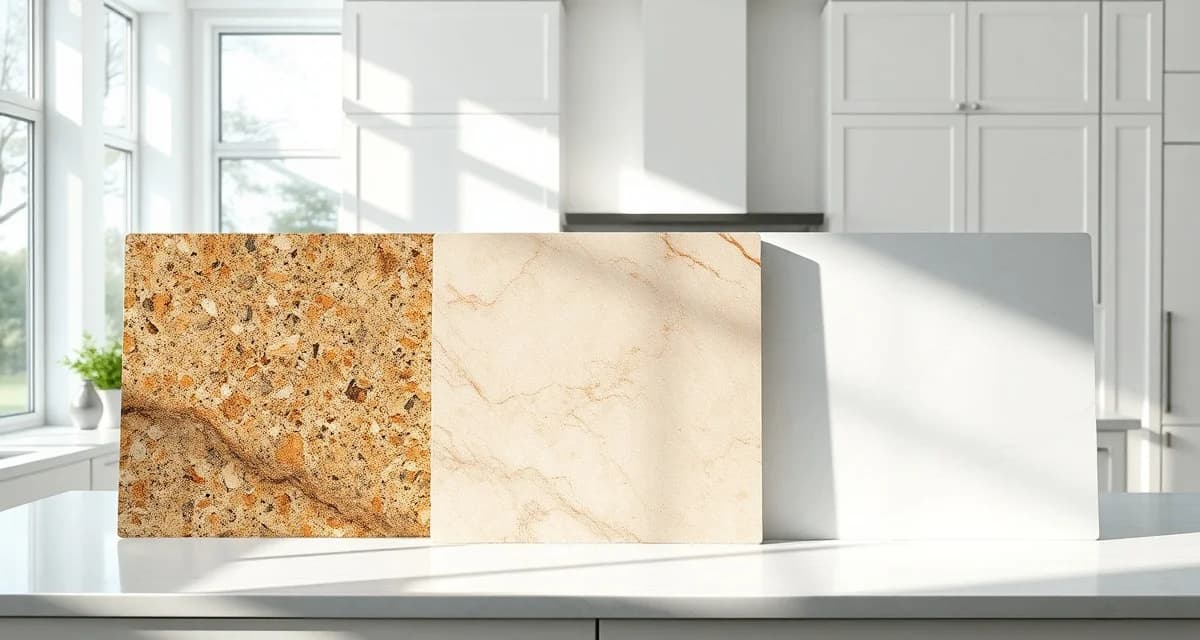
What Does Choosing Countertop Color Involve?
Choosing countertop color means selecting the hue, pattern, and overall visual character of your countertop material to complement your kitchen or bathroom design. It goes beyond picking a shade you like - the right color choice accounts for your cabinetry, flooring, lighting conditions, room size, and long-term resale appeal. Getting this decision wrong is expensive, since countertops aren't something you swap out casually.
TL;DR
- Start with your cabinets and flooring - countertop color should complement what's already fixed
- Test samples in your actual kitchen under both natural and artificial light
- White and neutral countertops dominate resale value, but bold choices work in the right context
- Veining patterns in natural stone vary slab to slab - always select your specific slab
- Consider your lifestyle: light colors show less dust but more stains; dark colors show fingerprints and crumbs
- The "undertone test" matters more than the main color - warm vs. cool undertones make or break coordination
- Bring home at least 3 full-size samples before making a final decision
The Color Selection Process: Where to Start
Most people approach countertop color backwards. They fall in love with a slab at the showroom and then try to make everything else match. The more reliable approach starts with what's already in your space.
Calculate your material waste savings
See exactly how much slab material and money you could save with optimized cutting layouts.
Try the free Waste CalculatorStep 1: Inventory Your Fixed Elements
Before looking at a single countertop sample, document these elements in your kitchen or bathroom:
| Fixed Element | What to Note | Why It Matters |
|---|---|---|
| Cabinets | Color, wood species, finish (matte/gloss) | Countertop sits directly against cabinets |
| Flooring | Color, material, pattern | Creates the visual base of the room |
| Backsplash (if keeping) | Color, pattern, material | Directly adjacent to countertop |
| Appliances | Finish (stainless, black, white, colored) | Creates contrast or coordination |
| Wall paint | Color, undertone (warm/cool) | Sets the ambient color tone |
| Natural light | Direction windows face, amount of light | Dramatically affects how colors read |
Step 2: Identify Your Undertone Direction
Every color has an undertone - a subtle background hue that shifts how it reads in context. This is the single most important factor in color coordination.
Warm undertones: Yellow, gold, orange, red, cream Cool undertones: Blue, green, gray, purple
A white countertop with warm undertones looks completely different from a white countertop with cool undertones. If your cabinets have warm oak tones, pairing them with a cool blue-gray countertop creates visual tension. Match warm with warm, cool with cool - unless you're intentionally creating contrast with professional design guidance.
Quick undertone test: Place a pure white sheet of paper next to the material. The contrast will reveal whether the material leans warm or cool.
Step 3: Decide on Contrast Level
Your countertop can create one of three relationships with your cabinetry:
- High contrast - Dark cabinets with light countertops (or vice versa). Creates visual drama and clearly defines surfaces. Example: espresso cabinets with white quartz.
- Medium contrast - Different colors in similar value ranges. Creates depth without jarring transitions. Example: gray cabinets with white and gray veined quartz.
- Low contrast - Similar tones throughout. Creates a calm, unified look but risks feeling flat. Example: white cabinets with soft white granite.
Color Choices by Material Type
Different countertop materials offer different color ranges and characteristics.
Granite Color Ranges
Granite comes in hundreds of natural color variations. Popular categories include:
| Color Family | Popular Varieties | Best Pairs With |
|---|---|---|
| White/cream | White Ice, Alaska White, Colonial White | Dark or medium cabinets |
| Black | Absolute Black, Black Galaxy, Black Pearl | White or light cabinets |
| Gray | Steel Gray, Silver Cloud, Azul Platino | White, gray, or navy cabinets |
| Brown/gold | Giallo Ornamental, Santa Cecilia, Venetian Gold | White, cream, or medium-tone cabinets |
| Blue | Blue Bahia, Azul Macaubas | White or light gray cabinets |
| Green | Peacock Green, Verde Butterfly | White, cream, or natural wood cabinets |
Key consideration: Granite slabs are unique. Two slabs from the same quarry can look notably different. Always select your specific slab - don't rely on a small sample or a photo on a website.
Quartz Color Ranges
Quartz offers more consistent coloring because it's engineered. What you see in the showroom is what you get.
| Style Category | Examples | Notes |
|---|---|---|
| Marble-look | Calacatta-inspired, Carrara-inspired | Most popular quartz category in 2025-2026 |
| Solid colors | Pure white, black, gray | Clean, modern aesthetic |
| Concrete-look | Textured grays | Industrial and contemporary designs |
| Natural stone-look | Granite and quartzite mimics | Offer stone aesthetics with quartz durability |
| Bold colors | Blue, green, red | Niche but growing in commercial settings |
Marble Color Ranges
Marble is known for its veining, which is the primary visual feature.
- Calacatta - White background with bold, dramatic veining (gold, gray, or brown)
- Carrara - White to blue-gray background with softer, more feathery veining
- Statuario - Bright white background with distinct gray veining
- Emperador - Brown background with lighter veining
- Nero Marquina - Black background with white veining
Solid Surface and Laminate
These materials offer the widest color selection because they're manufactured. You can find virtually any color, including custom-matched options for solid surface.
How Lighting Changes Everything
The same countertop looks different under different lighting - and this catches more homeowners off guard than any other factor.
Natural Light
- North-facing windows cast cool, blue-tinted light. Warm countertop colors help balance this.
- South-facing windows provide warm, yellow light. Cool countertop colors stay balanced; warm colors may read warmer than expected.
- East-facing windows get warm morning light and neutral afternoon shade.
- West-facing windows bring strong, warm afternoon light that can intensify gold and yellow undertones.
Artificial Light
| Bulb Type | Color Temperature | Effect on Countertops |
|---|---|---|
| Warm white LED (2700K) | Warm/yellowish | Enhances warm tones, mutes cool tones |
| Neutral white LED (3500K) | Balanced | Most accurate color rendering |
| Cool white LED (4000K) | Slightly blue | Enhances cool tones, can make warm colors look dull |
| Daylight LED (5000K+) | Blue/cool | Significantly shifts color appearance |
The takeaway: Always view countertop samples in your actual kitchen or bathroom, at different times of day, under your actual lighting. Showroom lighting is designed to make everything look good.
Color Trends vs. Timeless Choices
Trending in 2025-2026
- Warm whites with golden veining
- Greige (gray-beige) tones
- Dramatic bookmatched veining
- Matte and honed finishes (especially in darker colors)
- Warm-toned browns making a comeback
Timeless Options That Don't Date
- Classic white with gray veining (Calacatta or Carrara-style)
- Solid mid-tone gray
- Warm beige and cream
- Black (in certain design contexts)
- Medium-tone granite with subtle movement
Colors That Risk Feeling Dated
- High-contrast black and white combos (depending on execution)
- Bright solid colors (pure blue, red, green)
- Very specific trend colors (certain greens or terracottas)
- Heavily speckled granite patterns
Color and Resale Value
If resale value matters, your color choice should lean conservative. According to multiple real estate and remodeling industry surveys:
| Color Category | Impact on Buyer Appeal | Risk Level |
|---|---|---|
| White/light neutrals | Broad appeal, safe for resale | Low risk |
| Gray tones | Strong appeal, modern and versatile | Low risk |
| Black | Polarizing - loved or rejected | Medium risk |
| Brown/earth tones | Steady appeal, depends on region | Low-medium risk |
| Bold/saturated colors | Very niche appeal | High risk |
The safe bet for resale: white or light gray countertops with subtle veining, paired with white or light-toned cabinetry.
Practical Considerations by Color
Light-Colored Countertops
Pros: Make spaces feel larger, hide dust and crumbs, show well in photos, appeal to most buyers Cons: Show stains and discoloration more readily (especially on marble), require more frequent cleaning for visible messes
Dark-Colored Countertops
Pros: Hide stains and discoloration, create drama, work well as focal points Cons: Show dust, crumbs, fingerprints, and water spots, can make small spaces feel smaller, scratches more visible on polished dark surfaces
Medium-Toned Countertops
Pros: Hide both dirt and stains reasonably well, versatile pairing options Cons: Can lack visual impact, may feel bland without other design elements creating interest
The Sample Process: Getting It Right
How to Compare Samples Effectively
- Get full-size samples - Small chips don't capture veining, pattern repeat, or true visual impact. Request samples at least 4"x4", ideally larger.
- Compare at home, not in the store - Bring samples home and place them against your cabinets, flooring, and backsplash.
- View at different times - Check samples in morning, afternoon, and evening light.
- Photograph for reference - Take photos with your phone to compare digitally, but remember that screens don't reproduce color accurately.
- Narrow to three - Don't agonize over six similar options. Get to three finalists and live with them for a few days.
When to Visit the Slab Yard
For natural stone (granite, marble, quartzite), visit the slab yard to select your specific slab after narrowing your color choice. Bring cabinet door samples or photos. Stand back to see the full slab pattern, and mark any areas you want featured prominently or avoided.
Fabricators using tools like SlabWise can show you digital slab layouts - letting you see exactly where seams will fall and how the pattern will flow across your kitchen before a single cut is made.
FAQ
What countertop color is most popular right now?
White and light gray countertops with marble-style veining dominate current demand. This applies to both natural marble and quartz products that replicate the marble look.
Should countertops be lighter or darker than cabinets?
There's no absolute rule. The most popular approach is pairing dark or medium-tone cabinets with lighter countertops, which creates visual separation and makes the space feel open. But light cabinets with darker countertops also works well in many designs.
How do I choose between warm and cool countertop tones?
Match the undertone of your countertop to the undertone of your cabinets and flooring. If your cabinets have warm wood tones, lean toward countertops with warm undertones. Cool gray cabinets pair better with cool-toned countertops.
Does countertop color affect home resale value?
Yes. Neutral colors (white, gray, light beige) have the broadest buyer appeal. Bold or unusual countertop colors can narrow your buyer pool, though they may attract specific design-savvy buyers willing to pay a premium.
Can I see exactly how a slab will look in my kitchen before installation?
With digital templating and layout tools, fabricators can show you how a specific slab will be cut and positioned on your countertop layout. This helps you approve seam placement and veining direction before fabrication.
Should my countertop match my backsplash?
They shouldn't be identical - that looks flat. Instead, pull a secondary color from your countertop's veining or pattern for the backsplash, or use a complementary neutral.
How do I handle an open floor plan where the kitchen is visible from the living room?
In open layouts, your countertop color becomes part of the overall room palette. Choose a color that bridges the kitchen and living spaces. Neutral tones are safest for open floor plans.
What if I can't decide between two colors?
Live with full-size samples of both in your kitchen for at least 3-5 days. Your preference will usually become clear. If it doesn't, choose the more neutral option for long-term flexibility.
Do polished and honed finishes of the same color look different?
Yes, significantly. Polished finishes reflect light and make colors appear more saturated and vibrant. Honed (matte) finishes soften colors and reduce contrast in veining. Always view the finish you plan to use.
Can I use two different countertop colors in one kitchen?
Yes - this is a growing trend. A common approach is using one color on the perimeter counters and a different (often contrasting) color on the island. Keep materials consistent or intentionally different for the best effect.
How do granite and quartz differ in color consistency?
Granite varies slab to slab because it's natural. Quartz is engineered for consistency - what you see in the showroom is what you'll get at home. If exact color matching matters, quartz is the safer bet.
Should I choose my countertop color before or after my cabinets?
Choose cabinets first if you're doing a full remodel. Cabinet colors are more limited than countertop options, so it's easier to find a countertop to match your cabinets than the reverse.
Estimate Your Countertop Investment
Choosing the right color is one piece of the puzzle. Get a clear picture of total project costs with our countertop calculator - compare materials, factor in your kitchen size, and get a realistic budget range.
Try the Countertop Cost Calculator →
Try These Free Tools
- Kitchen Visualizer -- Upload a kitchen photo and preview different countertop materials in place.
- AR Overlay -- See the actual stone pattern on your customer's cabinets using AR.
- Sink Finder -- Search compatible sink models by countertop dimensions and cutout specs.
Sources & Further Reading
- Natural Stone Institute - Bathroom Design Guidelines
- National Kitchen & Bath Association - Countertop Selection Guide
- Marble Institute of America - Bathroom Stone Applications
- International Surface Fabricators Association - Residential Bathroom Standards