How to Choose Countertop Color
Quick Definition
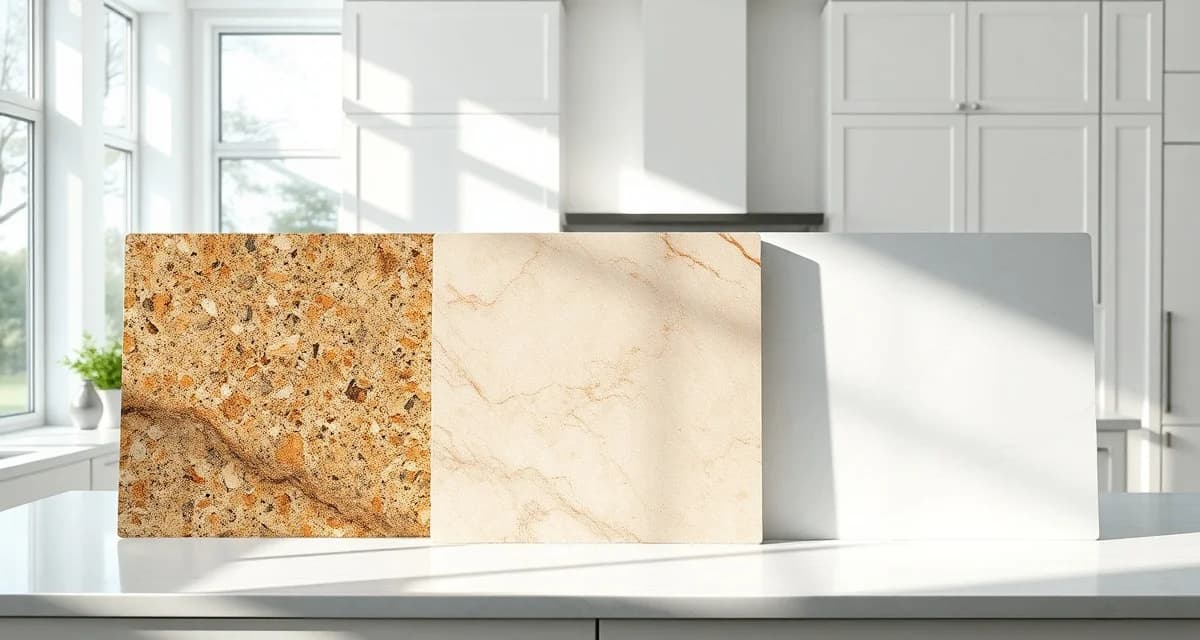
Choosing a countertop color involves balancing your cabinet color, flooring, backsplash, and overall kitchen style. Start with the largest fixed element in the room (usually cabinets), then select a countertop that either complements or contrasts it. Bring physical samples home to test under your kitchen's lighting. Avoid choosing based on online photos alone - screens distort stone colors significantly. The most timeless choices tend to be neutral tones with natural variation.
TL;DR
- Start with your cabinets - they are the largest visual element and the hardest to change
- Complement or contrast - light cabinets with dark counters (or vice versa) creates definition; similar tones create a unified look
- Bring samples home - lighting in showrooms differs dramatically from your kitchen
- Consider the backsplash as the connecting element between cabinets and countertop
- Natural variation (veining, movement, speckles) hides daily wear better than solid colors
- Solid dark colors show everything - fingerprints, crumbs, water spots, and scratches
- White and gray tones remain the most popular countertop colors, but warm neutrals are gaining ground
- The specific slab matters - always select your actual slab at the distributor yard
Step-by-Step Color Selection Process
Step 1: Identify Your Fixed Elements
Before you look at a single countertop sample, inventory the things in your kitchen that you are not changing:
Calculate your material waste savings
See exactly how much slab material and money you could save with optimized cutting layouts.
Try the free Waste Calculator- Cabinet color and finish - The dominant visual element in most kitchens
- Flooring - Especially if it is a strong color or distinctive pattern
- Appliance finish - Stainless steel, black, white, or custom panel
- Window trim and wall color - These create the surrounding context
- Existing backsplash (if you are keeping it)
Your countertop needs to work with all of these simultaneously. The most common mistake is choosing a countertop color you love in isolation, only to find it clashes with your cabinets or floor once installed.
Step 2: Choose Your Strategy - Complement or Contrast
There are two fundamental approaches to countertop color:
Complementary (tone-on-tone):
- Light cabinets with light countertops
- Dark cabinets with dark countertops
- Creates a cohesive, unified look
- Works well in smaller kitchens where visual calm reduces the feeling of clutter
- Risk: Can look flat or monotonous without enough texture or pattern variation
Contrasting:
- White cabinets with dark countertops (the most popular combination)
- Dark cabinets with light countertops
- Creates visual definition and makes each element stand out
- Works well in larger kitchens with enough space to absorb the visual weight
- Risk: High contrast can feel stark or dated if the trend shifts
The middle ground: Choose a countertop with a dominant tone that complements your cabinets, but with veining or movement in a contrasting color that adds visual interest. For example: white cabinets with a gray-veined white quartz that picks up stainless steel tones.
Step 3: Consider Practical Factors
Color choice is not just about aesthetics. Practical considerations include:
| Color Type | Practical Consideration |
|---|---|
| Solid dark (black, dark brown) | Shows fingerprints, crumbs, water spots, and dust constantly |
| Solid white | Shows stains and discoloration more readily |
| Speckled / granular patterns | Hides daily mess and minor scratches well |
| Heavy veining (marble-look) | Pattern distracts from small imperfections |
| Light colors with subtle movement | Good balance of beauty and practicality |
| Medium tones (grays, tans, greiges) | Most forgiving for everyday kitchen use |
If you cook frequently and are not inclined to wipe down counters after every task, medium-toned materials with natural variation will look better day-to-day than solid whites or blacks.
Step 4: Bring Samples Home
This step is non-negotiable. Here is why:
- Showroom lighting uses bright, balanced artificial light. Your kitchen probably has a mix of recessed cans, under-cabinet strips, and natural window light.
- Stone color shifts dramatically with lighting. A granite that looks warm beige under showroom LEDs can look pink or yellow under your kitchen's incandescent bulbs.
- Context matters. A sample viewed against a white showroom wall looks different next to your maple cabinets and travertine floor.
How to test properly:
- Get physical samples from the fabricator or distributor (most provide these free)
- Place samples on your actual cabinets
- View them at different times of day (morning light vs. evening light)
- Look at them under all your kitchen light sources (overhead, under-cabinet, natural)
- Place the sample next to your flooring and backsplash material
- Live with the samples for at least 2-3 days before deciding
Step 5: Visit the Slab Yard
For natural stone (granite, quartzite, marble), every slab is unique. The small sample you took home represents a general range, but the actual slab you purchase may have different veining intensity, color variation, or pattern.
Slab yard tips:
- Ask to see the slab standing upright and wet (water reveals the polished appearance)
- Look at the entire slab, not just one corner
- Photograph the slab with your phone next to your cabinet sample or a paint chip
- If your project requires two slabs, inspect both and confirm they match
- Mark the sections of the slab you want used for the most visible areas
For engineered quartz, slab variation is minimal within the same lot. But it is still worth seeing a full slab to confirm the pattern scale works at countertop size.
Popular Color Combinations That Work
White Cabinets (Most Common Starting Point)
| Countertop Color | Style | Durability Notes |
|---|---|---|
| White with gray veining (quartz) | Classic, clean | Good - pattern hides minor wear |
| Dark gray granite | High contrast, modern | Very good - hides everything |
| Black granite (Absolute Black) | Bold, dramatic | Shows fingerprints and dust |
| Warm white quartzite | Tone-on-tone, elegant | Requires sealing |
| Calacatta marble-look quartz | Luxury, traditional | Good stain resistance (quartz) |
| Concrete gray quartz | Industrial, modern | Good all-around |
Gray Cabinets
| Countertop Color | Style | Durability Notes |
|---|---|---|
| White quartz or quartzite | Bright, airy contrast | Good to excellent |
| Dark charcoal granite | Moody, dramatic | Very good |
| Warm beige quartzite | Softens the gray | Requires sealing |
| Calacatta marble-look | Classic contrast | Depends on material |
Wood-Tone or Natural Cabinets
| Countertop Color | Style | Durability Notes |
|---|---|---|
| White or cream quartz | Clean contrast | Good |
| Black granite | Bold, defined | Shows fingerprints |
| Green or blue-gray soapstone | Earthy, warm | Needs oiling |
| Warm gray granite | Complements wood tones | Very good |
Dark Cabinets (Navy, Black, Espresso)
| Countertop Color | Style | Durability Notes |
|---|---|---|
| White marble or quartzite | High contrast, luxury | Marble needs maintenance |
| Light gray quartz | Clean, modern | Good |
| Gold/cream granite | Warm contrast | Very good |
| Butcher block (on island) | Warm, mixed-material | High maintenance |
Color Trends vs. Timeless Choices
Countertop trends shift every 5-10 years. Choosing a trendy color means your kitchen may look dated sooner. Here is how recent trends have evolved:
| Era | Popular Countertop Colors |
|---|---|
| 2000-2010 | Dark granites (Ubatuba, Tan Brown), gold granites |
| 2010-2018 | White marble looks, gray quartz, solid whites |
| 2018-2023 | Bold veining (Calacatta), waterfall edges, concrete tones |
| 2023-Present | Warm whites, greige tones, subtle veining, matte finishes |
Timeless choices that resist dating:
- Neutral tones (whites, grays, warm beiges) with moderate pattern
- Natural stone with movement (speckled granite, veined quartzite)
- Medium-contrast combinations (not too matchy, not too stark)
Choices that tend to date faster:
- Very bold solid colors (bright blue, red, lime green)
- Heavy Calacatta-look veining (extremely popular now, which means it may feel overdone in 5 years)
- Exact color-matching between countertop and backsplash (lacks visual depth)
How Color Affects the Fabrication Process
From the fabricator's perspective, countertop color impacts several production decisions:
Seam visibility. Solid-color materials (especially dark solids) show seams more than patterned materials. Fabricators need to be extra precise with seam placement and color-matching epoxy on solid colors.
Vein matching at seams. Materials with strong veining patterns require the fabricator to align the veins across the seam. This takes additional slab planning and may reduce yield (more waste from positioning pieces to match).
Slab nesting considerations. When optimizing how pieces are cut from a slab, the fabricator must account for pattern direction and color consistency. A good nesting tool positions pieces so visible areas have consistent color and pattern. SlabWise's slab nesting algorithm accounts for these visual factors while still optimizing material yield - balancing aesthetics with the 10-15% waste reduction that affects the bottom line.
What is the most popular countertop color?
White and light gray countertops dominate current preferences, particularly quartz with subtle gray or gold veining. This has been the most popular category since the early 2010s, though warm neutrals (greige, soft cream) are gaining popularity.
Should countertops be lighter or darker than cabinets?
Either works. The most popular combination is dark countertops with light cabinets (contrast approach). But light-on-light and dark-on-dark both work well when the textures and patterns provide enough visual distinction.
Do I need to match countertop and backsplash?
No. A slight contrast between countertop and backsplash adds depth and visual interest. Matching them too exactly can make the kitchen feel flat. Pick a backsplash that shares one color element with the countertop without duplicating it entirely.
What countertop color shows the least dirt?
Medium-toned materials with speckled or veined patterns hide daily mess the best. Think mid-gray granite with multi-colored speckles or beige quartz with subtle movement. Solid darks and solid whites both show everything.
Will white countertops stain?
White quartz is non-porous and resists staining extremely well. White granite and white marble are porous and can stain if not sealed properly. If you want white and worry about stains, quartz is the safer choice.
How do I match countertops to existing flooring?
Your countertop does not need to match your floor - it needs to not clash with it. Warm-toned floors (honey oak, warm tile) pair well with warm-toned or neutral countertops. Cool-toned floors (gray tile, dark walnut) pair well with cool-toned or neutral countertops. Avoid mixing warm and cool extremes.
Should I pick countertops or backsplash first?
Pick countertops first. There are far more backsplash options than countertop options, so it is easier to find a backsplash that complements your countertop than the reverse.
Does countertop color affect resale value?
Neutral colors (white, gray, beige) appeal to the widest range of buyers and generally support stronger resale. Bold or unusual colors can limit your buyer pool but may appeal strongly to the right person.
Can I see the exact slab before ordering?
For natural stone, yes - and you should. Visit the slab yard and select your specific slab(s). For quartz, you can typically see a slab, though variation within a lot is minimal. Always confirm with your fabricator that the slab you selected is the one that gets cut.
Is it better to choose a simple or complex pattern?
Simple patterns (solid, subtle speckle) create a calm, modern look but show imperfections more. Complex patterns (heavy veining, movement) create visual drama and hide imperfections, but can be overwhelming in smaller spaces. Match the pattern scale to your kitchen size.
What color countertop goes with everything?
A medium gray quartz or granite with subtle pattern variation works with virtually any cabinet color, flooring, and backsplash. It is the safest choice if you are unsure or want maximum flexibility for future changes.
How many samples should I bring home?
Bring home 3-5 samples. More than that creates decision paralysis. Narrow your choices at the showroom, then bring finalists home for the real-world lighting test.
Color Precision Starts with Slab Planning
For fabricators, getting the color right means planning how pieces are cut from the slab - especially when veining needs to match across seams. SlabWise's slab nesting tools help position pieces for both material efficiency and visual consistency, reducing waste by 10-15% without sacrificing the aesthetic your customers expect. Start your 14-day free trial.
Try These Free Tools
- Kitchen Visualizer -- Upload a kitchen photo and preview different countertop materials in place.
- AR Overlay -- See the actual stone pattern on your customer's cabinets using AR.
- Sink Finder -- Search compatible sink models by countertop dimensions and cutout specs.
Sources & Further Reading
- Natural Stone Institute - Natural Stone Color Selection Guide
- National Kitchen & Bath Association - Countertop Design Trends and Color Choices
- Marble Institute of America - Stone Color and Pattern Selection
- International Surface Fabricators Association - Countertop Material and Color Guide