What Is Speed Label? Definition & Guide
Quick Definition
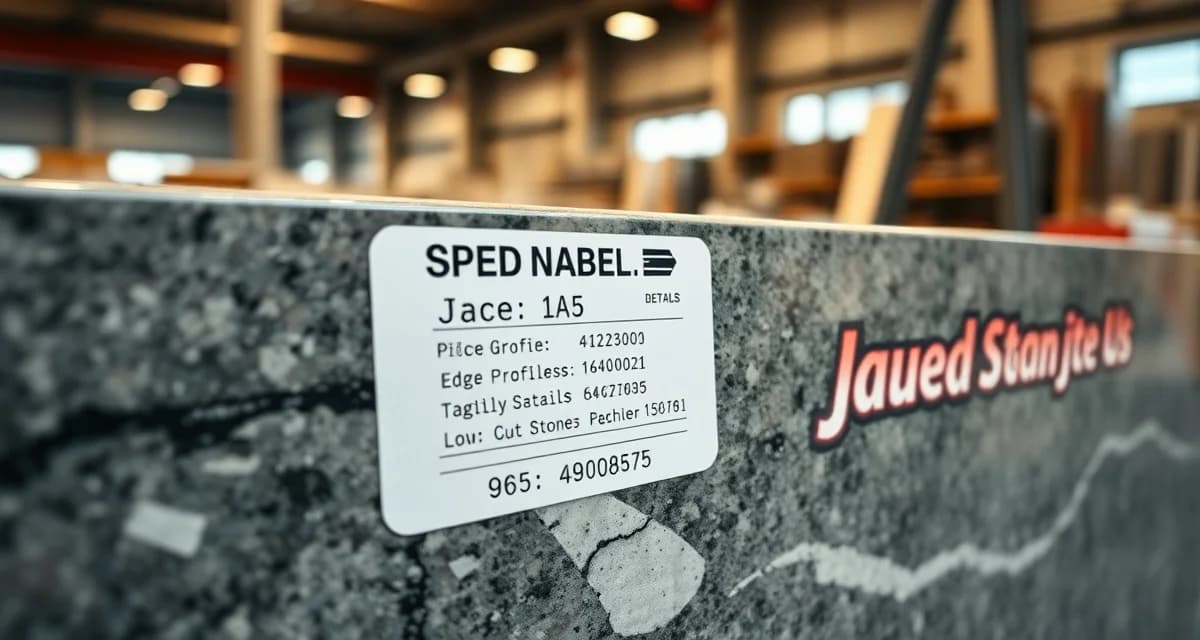
A speed label is a printed adhesive label applied to each individual countertop piece during fabrication that identifies the piece - including the job name, piece number, edge profile, material, and installation location. Speed labels help fabrication crews, quality control, and installation teams quickly identify which piece goes where, reducing errors during production and installation. The term also refers to labeling systems/printers used in fabrication shops to generate these identification labels.
TL;DR
- Speed labels are identification stickers applied to individual countertop pieces during fabrication
- They include job name, piece number, edge details, material, and placement instructions
- Prevent installation errors - wrong piece in wrong location costs $1,500-$4,000 in remakes
- Generated from CNC programming or job management software
- Label printers cost $300-$1,500; label stock costs are minimal ($0.05-$0.15/label)
- Most efficient when connected to your digital workflow (template to label, automated)
- Some shops use barcode or QR code labels for scanning-based tracking
Speed Labels: Piece Identification in Countertop Fabrication
Why Labeling Every Piece Matters
A typical kitchen countertop job produces 3-8 individual pieces: perimeter sections, island top, backsplash strips, and support pieces. Each piece has specific characteristics:
Calculate your material waste savings
See exactly how much slab material and money you could save with optimized cutting layouts.
Try the free Waste Calculator- Unique shape - Fits a specific section of the kitchen
- Edge profiles - Different edges may have different profiles (eased on back edges, ogee on exposed edges)
- Orientation - Left side vs. right side matters for seam alignment and vein direction
- Finish - Some pieces might have different finishes (polished top, honed backsplash)
Without labels, the installation crew arrives at the customer's home with 5-8 pieces of stone and has to figure out which piece goes where. On straightforward jobs, experienced installers manage. On complex jobs - especially those with multiple seams, matching veining, or mixed edge profiles - guessing leads to mistakes.
The cost of a wrong placement:
- Installer realizes the mistake during dry-fit: 30-60 minutes wasted rearranging
- Installer doesn't notice until after adhesive is applied: potential $1,500-$4,000 remake
- Customer notices post-installation that veining doesn't match the approved layout: callback, potential remake
Speed labels prevent all of these scenarios for pennies per piece.
What Goes on a Speed Label
A well-designed speed label includes:
| Field | Example | Purpose |
|---|---|---|
| Job name/number | "Johnson Kitchen - JOB-2847" | Identifies the project |
| Piece number | "Piece 3 of 6" | Tracks individual pieces |
| Piece description | "Island - Left Section" | Plain-language placement |
| Edge profiles | "Front: Ogee, Back: Eased" | Tells installer which finish goes where |
| Material | "Calacatta Gold Marble" | Confirms correct material |
| Dimensions | "72" x 26" x 3cm" | Verification reference |
| Orientation arrow | "↑ FRONT" | Prevents upside-down installation |
| Barcode/QR code | Scannable code | Digital tracking capability |
| Date fabricated | "02/11/2026" | Production tracking |
| Special notes | "Match vein to Piece 2 at seam" | Critical instructions |
Label Generation Methods
Manual Labels
Some shops handwrite labels with markers on painter's tape. It works, but it's:
- Slow (1-2 minutes per piece)
- Error-prone (bad handwriting, inconsistent information)
- Unprofessional (customers see these labels)
- Not trackable (no barcode scanning)
Software-Generated Labels
Modern fabrication software generates labels automatically from the job data:
- CNC software (Alphacam) - Can output piece labels as part of the programming workflow
- Job management software - Moraware, ActionFlow, and similar tools can generate labels from job records
- Dedicated labeling systems - Some shops use dedicated label design and printing systems
Automated label generation saves 5-15 minutes per job compared to handwriting and ensures consistency. For a shop doing 25 jobs per week, that's 2-6 hours saved weekly.
Barcode and QR Code Labels
Advanced shops use labels with barcodes or QR codes that connect to their digital job management system. Scanning a QR code on a piece pulls up the complete job record: customer details, layout diagram, special instructions, and installation notes.
Benefits of scannable labels:
- Installation crew scans each piece to confirm correct placement
- Shop floor scans track production progress in real time
- Quality control scanning creates a verification record
- Delivery scanning confirms all pieces are loaded
Speed Label Hardware
| Equipment | Cost | Output |
|---|---|---|
| Brother/Dymo industrial label printer | $300-$800 | Standard adhesive labels |
| Thermal transfer printer (Zebra, etc.) | $500-$1,500 | Durable, water-resistant labels |
| Inkjet label printer | $200-$500 | Color labels with images |
| Label applicator gun | $50-$150 | Pre-printed label application |
Label stock considerations for stone shops:
- Labels must adhere to dusty, sometimes damp stone surfaces
- They need to survive transport (wind, vibration, rain during loading)
- They should remove cleanly after installation without residue
- Waterproof or water-resistant stock is preferred for wet shop environments
Integrating Labels into Your Workflow
The most efficient labeling happens when labels are generated automatically as part of your digital workflow:
- Template completed → Digital file captured
- Template verified → Errors caught before programming
- CNC programmed → Pieces defined in software
- Labels generated → Automatically from piece data
- Pieces fabricated → Labels applied immediately after cutting
- Quality checked → Labels verified against job requirements
- Loaded for delivery → Labels confirm all pieces accounted for
- Installed → Labels guide placement
SlabWise connects the entire upstream workflow - template verification, slab assignment, and production scheduling - creating the data foundation that makes accurate, automated labeling possible. When every piece in your shop has a verified template, an assigned slab, and a clear production schedule, the labels practically write themselves.
What is a speed label in stone fabrication?
A speed label is an identification sticker applied to each countertop piece that includes job information, piece number, edge profiles, and installation placement instructions.
Why are speed labels important?
Speed labels prevent installation errors by clearly identifying which piece goes where, with what edge profile and orientation. A single placement error can cost $1,500-$4,000 in remake costs.
How much do speed labels cost?
The labels themselves cost $0.05-$0.15 each. Label printers range from $300-$1,500 depending on type and durability requirements.
Can I just use painter's tape and a marker?
You can, but handwritten labels are slower, less consistent, and lack barcode/QR tracking capability. Automated labels save 5-15 minutes per job.
What printer should I use for speed labels?
Thermal transfer printers (like Zebra) are the most popular for fabrication shops because they produce durable, water-resistant labels that survive the shop environment.
Should speed labels include barcodes?
Barcodes or QR codes add tracking capability - scanning pieces through production, confirming delivery completeness, and guiding installation. They're worth adding if your workflow supports digital tracking.
When should labels be applied to pieces?
Apply labels immediately after cutting, before pieces leave the CNC machine area. This prevents confusion when multiple jobs are in production simultaneously.
Do labels leave residue on the stone?
Use labels designed for temporary application on stone surfaces. Most fabrication-grade labels remove cleanly. Test on a scrap piece first with any new label stock.
Can speed labels help with inventory tracking?
Yes. When labels include scannable codes linked to your job management system, they create a trackable chain from production through installation.
How do installation crews use speed labels?
Installers reference labels to identify each piece, confirm placement location, verify edge profile orientation, and ensure all pieces for the job are present before starting work.
Automate Your Labels with SlabWise
When your templates are verified, your slabs are assigned, and your production is scheduled in SlabWise, every piece in your shop has the data it needs for accurate labeling - no manual data entry, no handwriting, no mistakes.
Start your 14-day free trial at SlabWise.com
Try These Free Tools
- Photo to Template -- Snap a photo of an existing countertop and get an AI-generated DXF template.
- Template Compare -- Upload two templates and see every dimension change highlighted instantly.
- AI Template Verification -- Cross-check your template against manufacturer specs before cutting.
Sources & Further Reading
- National Kitchen & Bath Association - Kitchen Sink Selection Guide
- International Surface Fabricators Association - Sink Cutout and Installation Standards
- Natural Stone Institute - Countertop Sink Integration Best Practices
- Remodeling Magazine - Apron Front Sinks: Design and Installation Considerations